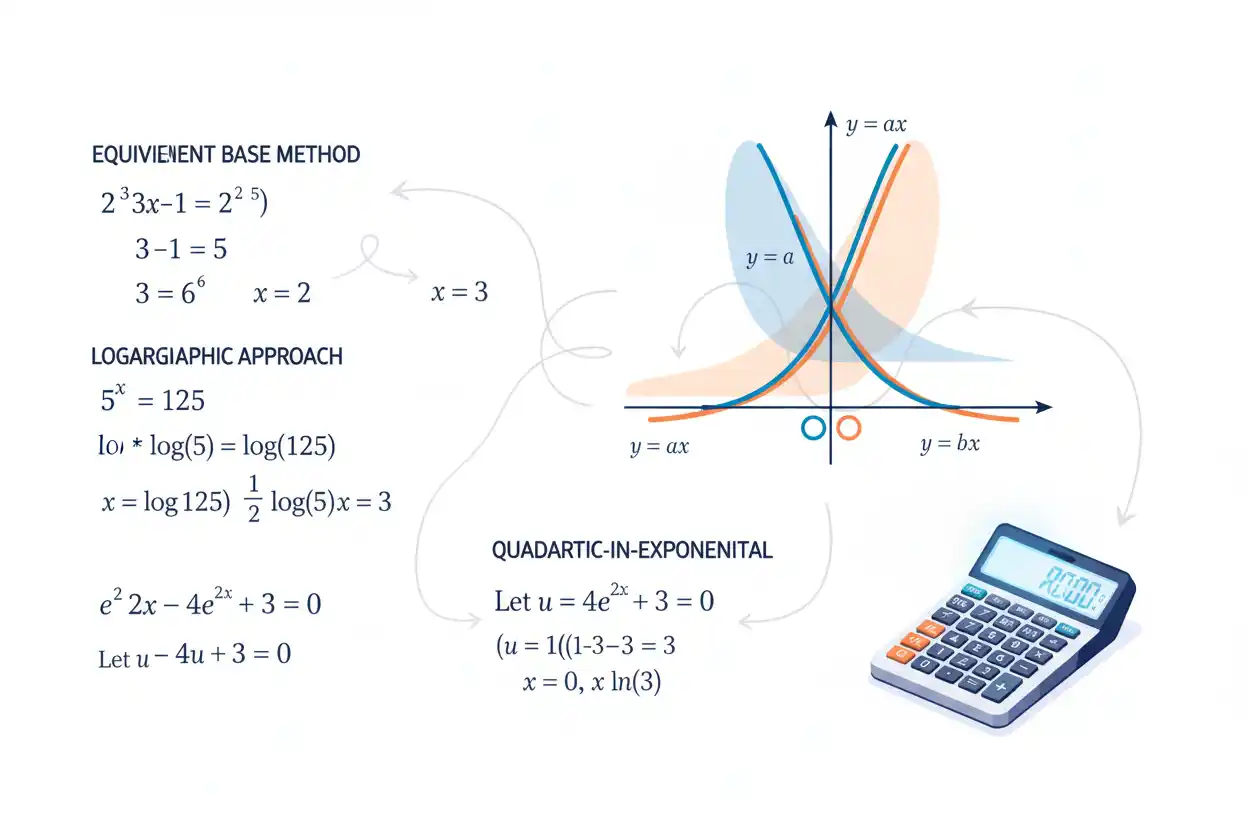

An exponential equation is an equation in which the unknown variable appears in an exponent.
Examples include:
2ˣ = 16
3ˣ⁺¹ = 27
5²ˣ = 125
2ˣ = 10
The solving method depends on whether both sides can be written with the same base.
If they can, equate the exponents.
If they cannot, logarithms usually provide the most direct solution.
For example:
2ˣ = 16
Since:
16 = 2⁴
we have:
2ˣ = 2⁴
Therefore:
x = 4
For:
2ˣ = 10
10 cannot be rewritten conveniently as an integer power of 2, so use logarithms:
x = ln(10) / ln(2)
x ≈ 3.3219
These two techniques solve a large proportion of introductory exponential equations.
What Is an Exponential Equation?
An exponential equation contains a variable in an exponent.
For example:
4ˣ = 64
is exponential because x appears as the exponent.
By contrast:
x⁴ = 64
is a polynomial equation because the variable is the base and the exponent is fixed.
The distinction matters because the solving methods are different.
Exponential equations belong to the broader system of symbolic relationships explained in algebra.
Basic Exponential Equation Formula
For a positive base:
aˣ = b
where:
a > 0
a ≠ 1
b > 0
the logarithmic solution is:
x = log(b) / log(a)
or equivalently:
x = ln(b) / ln(a)
Either logarithm base works as long as the same logarithm is used in the numerator and denominator.
For example:
7ˣ = 20
Then:
x = ln(20) / ln(7)
x ≈ 1.5395
Rule 1: Rewrite Both Sides With the Same Base
When possible, the easiest method is:
If aᶠ⁽ˣ⁾ = aᵍ⁽ˣ⁾, then f(x) = g(x)
provided:
a > 0 and a ≠ 1
Example:
2ˣ⁺² = 32
Rewrite:
32 = 2⁵
Therefore:
2ˣ⁺² = 2⁵
Set the exponents equal:
x + 2 = 5
So:
x = 3
Example: 3²ˣ⁻¹ = 27
Rewrite:
27 = 3³
Then:
3²ˣ⁻¹ = 3³
Therefore:
2x – 1 = 3
2x = 4
x = 2
Check:
3²⁽²⁾⁻¹ = 3³ = 27
The solution is correct.
Example: 9ˣ = 27
The bases initially look different.
Rewrite both as powers of 3:
9 = 3²
27 = 3³
Therefore:
(3²)ˣ = 3³
Use the power rule:
3²ˣ = 3³
Set exponents equal:
2x = 3
Therefore:
x = 3/2
Example: 8ˣ⁺¹ = 4²ˣ
Rewrite both bases using 2:
8 = 2³
4 = 2²
Then:
(2³)ˣ⁺¹ = (2²)²ˣ
Simplify:
2³ˣ⁺³ = 2⁴ˣ
Therefore:
3x + 3 = 4x
So:
x = 3
Rewriting to a common base can eliminate the need for logarithms entirely.
Rule 2: Use Logarithms When the Bases Do Not Match
Consider:
5ˣ = 17
Take the natural logarithm of both sides:
ln(5ˣ) = ln(17)
Use the logarithm power rule:
x ln(5) = ln(17)
Therefore:
x = ln(17) / ln(5)
x ≈ 1.7604
The same method works with common logarithms:
x = log(17) / log(5)
The choice of logarithm base does not change the result.
General Exponential Equation With a Linear Exponent
For:
a^(mx + n) = b
take logarithms:
(mx + n) ln(a) = ln(b)
Therefore:
mx + n = ln(b) / ln(a)
and:
x = [ln(b) / ln(a) – n] / m
provided:
m ≠ 0
This is a useful general formula when the exponent is linear.
Example: 7^(2x – 1) = 50
Take natural logarithms:
(2x – 1)ln(7) = ln(50)
Divide by:
ln(7)
giving:
2x – 1 = ln(50) / ln(7)
Then:
2x = 1 + ln(50) / ln(7)
Therefore:
x = [1 + ln(50) / ln(7)] / 2
This exact form can be evaluated numerically when needed.
Exponential Equation With Base e
For:
eˣ = A
the natural logarithm is especially convenient because:
ln(eˣ) = x
Therefore:
x = ln(A)
Example:
eˣ = 12
gives:
x = ln(12)
For:
e²ˣ = 10
take natural logs:
2x = ln(10)
Therefore:
x = ln(10) / 2
Why Logarithms Solve Exponential Equations
Exponentials and logarithms are inverse operations.
In general:
aˣ = b
is equivalent to:
logₐ(b) = x
So:
2ˣ = 8
can be rewritten:
log₂(8) = x
Since:
log₂(8) = 3
we get:
x = 3
The relationship between these inverse operations is developed further in logarithmic equations.
Exponential Equations and Inverse Functions
An exponential function:
f(x) = aˣ
has a logarithmic inverse:
f⁻¹(x) = logₐ(x)
for:
a > 0
a ≠ 1
This is why applying a logarithm can isolate an exponent.
The broader inverse function framework explains why one operation reverses the other.
Exponential Functions Are Always Positive
For a real exponent and positive base:
aˣ > 0
when:
a > 0
This immediately tells us that equations such as:
2ˣ = -5
have:
No real solution
Likewise:
3ˣ = 0
has no real solution because a positive-base exponential can approach zero but never equal zero.
This behavior is also important when determining domain and range.
Domain and Range of an Exponential Function
For:
f(x) = aˣ
with:
a > 0
a ≠ 1
the domain is:
(-∞, ∞)
and the range is:
(0, ∞)
Therefore every real x is allowed, but the output is always positive.
These restrictions help identify impossible exponential equations before performing unnecessary calculations.
Exponential Equation With Terms on Both Sides
Consider:
2ˣ = 3 × 2ˣ⁻¹
Using:
2ˣ = 2 × 2ˣ⁻¹
the equation becomes:
2 × 2ˣ⁻¹ = 3 × 2ˣ⁻¹
Since:
2ˣ⁻¹ > 0
divide both sides by it:
2 = 3
This is impossible.
Therefore:
No solution
Not every exponential equation necessarily has a real answer.
Factoring an Exponential Expression
Consider:
2ˣ + 2ˣ⁺¹ = 24
Use:
2ˣ⁺¹ = 2 × 2ˣ
Then:
2ˣ + 2(2ˣ) = 24
Factor:
3 × 2ˣ = 24
Therefore:
2ˣ = 8
So:
x = 3
Factoring common exponential terms can be much faster than applying logarithms immediately.
Example: 3ˣ⁺² – 3ˣ = 72
Rewrite:
3ˣ⁺² = 9 × 3ˣ
Then:
9 × 3ˣ – 3ˣ = 72
Factor:
8 × 3ˣ = 72
Therefore:
3ˣ = 9
So:
x = 2
The key is recognizing a common exponential factor.
Substitution in Exponential Equations
Some exponential equations become quadratic after substitution.
Consider:
4ˣ – 5(2ˣ) + 4 = 0
Since:
4ˣ = (2ˣ)²
let:
u = 2ˣ
Then:
u² – 5u + 4 = 0
This is now an ordinary quadratic equation.
Factor:
(u – 1)(u – 4) = 0
Therefore:
u = 1 or u = 4
Return to:
u = 2ˣ
So:
2ˣ = 1 → x = 0
and:
2ˣ = 4 → x = 2
Solutions:
x = 0 or x = 2
The transformed polynomial can often be handled through factoring quadratics.
Discriminant in a Transformed Exponential Equation
Suppose substitution produces:
u² – 6u + 2 = 0
Its discriminant is:
D = (-6)² – 4(1)(2)
D = 36 – 8
D = 28
Because:
D > 0
the transformed quadratic has two distinct real roots.
However, if:
u = aˣ
then:
u > 0
Any negative quadratic root must be rejected before converting back to x.
The discriminant classifies the transformed quadratic; it does not automatically establish validity for the original exponential equation.
Example With an Invalid Substitution Root
Solve:
4ˣ + 2ˣ – 2 = 0
Let:
u = 2ˣ
Then:
u² + u – 2 = 0
Factor:
(u + 2)(u – 1) = 0
Therefore:
u = -2 or u = 1
But:
u = 2ˣ > 0
so:
u = -2
is impossible.
Use:
2ˣ = 1
Therefore:
x = 0
The only real solution is:
x = 0
Using the Quadratic Formula After Substitution
Not every transformed quadratic factors conveniently.
Suppose:
9ˣ – 4(3ˣ) – 1 = 0
Let:
u = 3ˣ
Then:
u² – 4u – 1 = 0
Use the quadratic formula:
u = [4 ± √(16 + 4)] / 2
u = [4 ± √20] / 2
u = 2 ± √5
Since:
u = 3ˣ > 0
reject:
2 – √5
because it is negative.
Thus:
3ˣ = 2 + √5
and:
x = ln(2 + √5) / ln(3)
Exponential Equation With Reciprocal Bases
Consider:
2ˣ = 1/8
Rewrite:
1/8 = 2⁻³
Therefore:
2ˣ = 2⁻³
So:
x = -3
Negative exponents naturally represent reciprocals.
Example With Fractional Base
Solve:
(1/3)ˣ = 27
Rewrite:
1/3 = 3⁻¹
and:
27 = 3³
Therefore:
3⁻ˣ = 3³
So:
-x = 3
and:
x = -3
Exponential Equations With Fractional Exponents
Consider:
4^(x/2) = 8
Rewrite using base 2:
4 = 2²
8 = 2³
Then:
(2²)^(x/2) = 2³
Simplify the exponent:
2ˣ = 2³
Therefore:
x = 3
Careful exponent simplification often reveals a simple same-base equation.
Exponential Equation With a Polynomial Exponent
Consider:
2^(x² – 1) = 8
Rewrite:
8 = 2³
Therefore:
x² – 1 = 3
So:
x² = 4
Therefore:
x = 2 or x = -2
The exponential step disappears after matching bases, leaving a quadratic equation.
Example With a Cubic Exponent
Consider:
3^(x³) = 27
Rewrite:
27 = 3³
Then:
x³ = 3
Therefore:
x = ∛3
The method is still the same: equal positive bases allow the exponents to be equated.
Function Notation and Exponential Equations
Using function notation, an exponential function can be written:
f(x) = 2ˣ
Solving:
f(x) = 16
means solving:
2ˣ = 16
so:
x = 4
This interpretation emphasizes that an equation asks which input produces a specified function output.
Composite Functions and Exponential Equations
Suppose:
f(x) = 2ˣ
and:
g(x) = 3x – 1
Then the composite function:
f(g(x)) = 2^(3x – 1)
If:
f(g(x)) = 32
then:
2^(3x – 1) = 2⁵
Therefore:
3x – 1 = 5
3x = 6
x = 2
Composition determines the exponent structure; exponential-equation rules solve it.
Exponential Equations vs. Direct Variation
A direct variation has the form:
y = kx
An exponential relationship has a variable in the exponent:
y = abˣ
They behave differently.
In direct variation, scaling x scales y proportionally.
In exponential growth, equal additive increases in x multiply the output by a constant factor.
For example:
y = 2ˣ
produces:
1, 2, 4, 8, 16, …
for successive integer inputs.
The ratio between consecutive outputs is constant, not the ratio y/x.
Exponential Patterns and Geometric Series
A geometric series is closely related to exponential behavior because its terms change by a constant ratio.
For example:
2, 6, 18, 54, …
has terms based on powers of 3.
If an unknown term number appears in an exponent, finding that position can produce an exponential equation.
The geometric series concerns the sum of such terms, while the exponential equation concerns solving for an unknown exponent.
Solving for a Geometric Sequence Position
Suppose a geometric sequence starts:
5, 10, 20, 40, …
Its nth term can be written:
aₙ = 5 × 2^(n – 1)
Find when:
aₙ = 640
Then:
5 × 2^(n – 1) = 640
Divide by 5:
2^(n – 1) = 128
Since:
128 = 2⁷
we get:
n – 1 = 7
Therefore:
n = 8
The sequence structure creates an exponential equation in the term number.
Solving Exponential Equations Numerically
Some equations contain several incompatible exponential terms and cannot be solved with elementary algebra alone.
For example:
2ˣ + 3ˣ = 10
There is no simple common-base transformation.
A graphing or numerical method may be more practical.
Notice:
x = 2
gives:
4 + 9 = 13
while:
x = 1
gives:
2 + 3 = 5
so a real solution lies between 1 and 2.
Numerical methods can refine it.
Not every exponential equation has a neat symbolic closed form.
Checking an Exponential Solution
Suppose:
x = 3
is obtained for:
2ˣ⁺¹ = 16
Check:
2³⁺¹ = 2⁴
= 16
The answer is valid.
Checking is particularly useful after logarithms, substitution, or multi-step algebra.
Common Exponential Equation Mistakes
A common mistake is treating:
aˣ + aʸ
as:
aˣ⁺ʸ
That exponent rule applies to multiplication:
aˣ × aʸ = aˣ⁺ʸ
not addition.
Another error is using:
(a + b)ˣ = aˣ + bˣ
which is not a general exponent rule.
Students can also forget that positive-base exponentials are always positive.
When substitution creates:
u = aˣ
a negative candidate for u must be rejected over the real numbers.
Another common mistake is applying logarithms to only one side of an equation.
Finally, converting to a common base should be checked before using logarithms because it often produces a much simpler exact solution.
Exponential Equation Formulas
These formulas are:
Same Base Rule: If a^f(x) = a^g(x), then f(x) = g(x), for a > 0 and a ≠ 1
Basic Exponential Equation: a^x = b
Log Solution: x = ln(b) / ln(a)
Linear Exponent: a^(mx + n) = b
x = [ln(b) / ln(a) – n] / m
Exponential Range: a^x > 0, for a > 0
Substitution Example: If u = a^x, then a^(2x) = u²
These versions require no LaTeX, MathJax, or special mathematics plugin.
Frequently Asked Questions
What is an exponential equation?
An exponential equation is an equation in which an unknown variable appears in an exponent.
What is an example of an exponential equation?
2ˣ = 16
Since:
16 = 2⁴
the solution is:
x = 4
What is the basic exponential equation formula?
For:
aˣ = b
use:
x = ln(b) / ln(a)
when a same-base simplification is not available.
When can you set exponents equal?
When both sides have the same valid positive base:
aᶠ⁽ˣ⁾ = aᵍ⁽ˣ⁾
then:
f(x) = g(x)
for:
a > 0 and a ≠ 1
How do you solve 3ˣ = 20?
x = ln(20) / ln(3)
Can an exponential equation have no real solution?
Yes.
For example:
2ˣ = -4
has no real solution because:
2ˣ > 0
for every real x.
Can an exponential equation have more than one solution?
Yes. Equations that transform into polynomial equations can produce multiple valid exponent values.
Why are logarithms used?
Logarithms are inverse functions of exponentials and allow an exponent to be isolated.
Can you use log instead of ln?
Yes. Any consistent logarithm base can be used in:
x = log(b) / log(a)
How do you solve an exponential equation with the same base?
Rewrite both sides with one base and equate the exponents.
How do you solve an exponential equation that becomes quadratic?
Use a substitution such as:
u = aˣ
solve the resulting quadratic, reject invalid nonpositive values of u, and then solve for x.
What is the domain of an exponential function?
For a standard positive base:
Domain = (-∞, ∞)
What is its range?
Range = (0, ∞)
Is 2ˣ = 0 possible for a real x?
No. The expression can approach zero but never equal zero.
Is an exponential equation the same as a polynomial equation?
No. In an exponential equation the variable appears in an exponent. In a polynomial, variable exponents are fixed nonnegative integers.
How is a geometric series related to exponential equations?
Geometric terms contain repeated multiplication by a constant ratio, so formulas for unknown term positions can lead to exponential equations.
Why is checking a solution useful?
It confirms that exponent manipulation, logarithms, substitutions, and domain restrictions were applied correctly.
Why are exponential equations important?
They are used whenever unknown quantities appear in exponents, including mathematical growth and decay models, geometric patterns, logarithmic relationships, repeated multiplication, and many higher-level algebra problems.