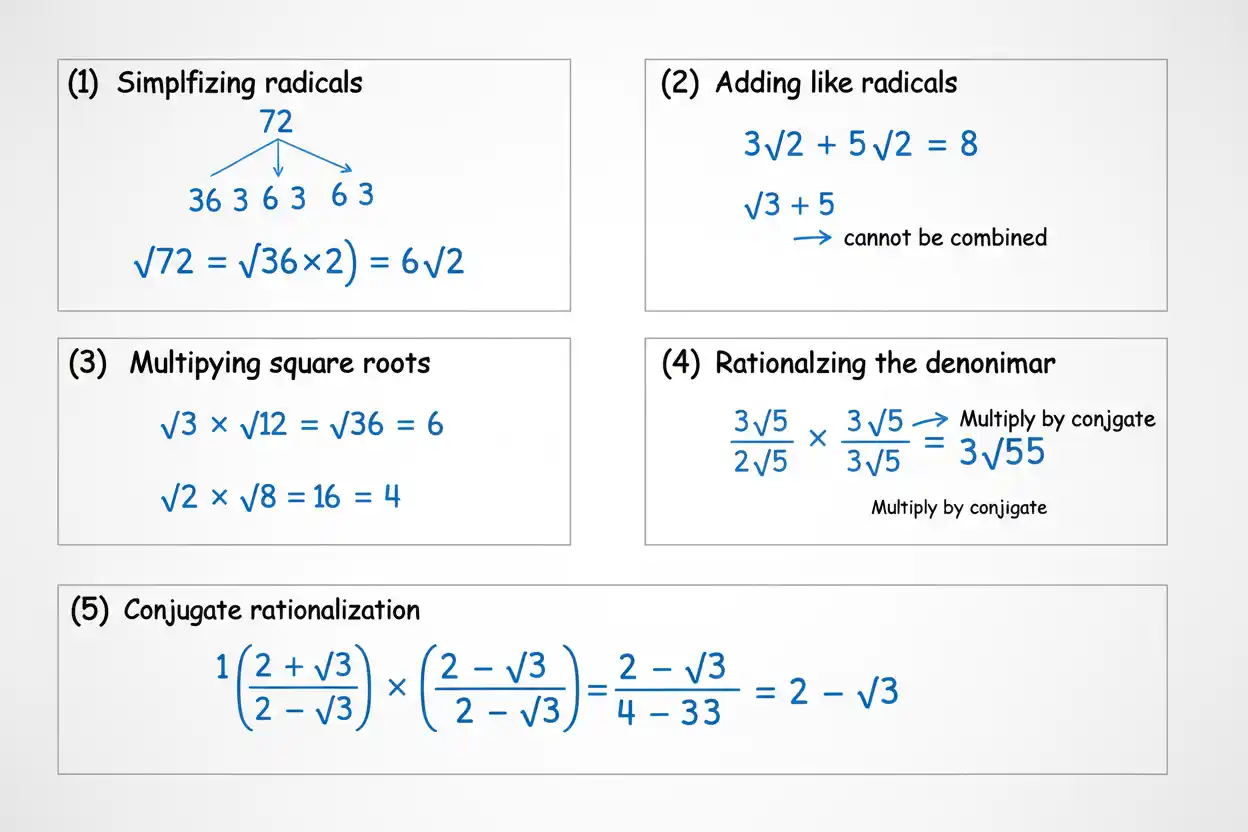

Radical expressions contain roots such as square roots, cube roots, or higher roots. They can often be simplified by factoring perfect powers out of the radicand and applying valid root rules.
For example:
√72
can be simplified by factoring 72 as:
72 = 36 × 2
Therefore:
√72 = √(36 × 2)
√72 = 6√2
Radical expressions can also be added, multiplied, divided, and rationalized, but each operation has specific rules. In particular, radicals can be added directly only when their simplified radical parts are alike.
What Is a Radical Expression?
A radical expression contains a radical symbol or an equivalent fractional exponent.
Examples include:
√5
3√2
√(x + 4)
∛27
2 + √7
Square roots can also be written using fractional exponents:
√x = x^(1/2)
Cube roots can be written:
∛x = x^(1/3)
These forms are closely related through exponent rules.
Radical expressions are part of algebra and frequently appear inside equations, functions, geometry formulas, and exact solutions.
Parts of a Radical Expression
Consider:
3√20
The number outside the radical, 3, is a coefficient.
The number or expression inside the radical, 20, is the radicand.
The radical symbol indicates which root is being taken.
For a square root, the index 2 is normally omitted:
√x
means the second root of x.
For a cube root:
∛x
the index is 3.
Understanding these parts makes simplification rules easier to apply.
Principal Square Root
The symbol:
√a
represents the principal square root, which is nonnegative when a ≥ 0.
For example:
√25 = 5
not ±5.
The statement:
x² = 25
has two solutions:
x = ±5
but the expression:
√25
has the single value:
5
This distinction becomes particularly important when radical expressions are used inside a radical equation.
Basic Radical Rules
For nonnegative real values where the expressions are defined:
√(ab) = √a × √b
and, when b > 0:
√(a/b) = √a / √b
For example:
√(9 × 5) = √9 × √5
√45 = 3√5
Likewise:
√(16/25) = √16 / √25
√(16/25) = 4/5
These rules help simplify products and quotients involving square roots.
Important Rule: √(a²) = |a|
A common mistake is to write:
√(a²) = a
for every real a.
The correct real-number identity is:
√(a²) = |a|
For example, if:
a = -4
then:
√((-4)²) = √16 = 4
but:
a = -4
Therefore the absolute value is necessary.
If a is already known to satisfy a ≥ 0, then:
√(a²) = a
is valid under that condition.
How to Simplify Radical Expressions
A square-root expression is usually simplified by identifying the largest perfect-square factor of the radicand.
For:
√48
factor:
48 = 16 × 3
Then:
√48 = √16 × √3
√48 = 4√3
The remaining radicand 3 has no perfect-square factor greater than 1, so the expression is simplified.
Example 1: Simplify √72
Factor:
72 = 36 × 2
Then:
√72 = √36 × √2
√72 = 6√2
Therefore:
√72 = 6√2
Example 2: Simplify √200
Use the perfect-square factor 100:
200 = 100 × 2
Therefore:
√200 = √100 × √2
√200 = 10√2
Choosing the largest convenient perfect-square factor can reduce the number of simplification steps.
Perfect Squares
Recognizing common perfect squares makes radical simplification faster:
1² = 1
2² = 4
3² = 9
4² = 16
5² = 25
6² = 36
7² = 49
8² = 64
9² = 81
10² = 100
For example, √300 contains the perfect-square factor 100:
√300 = √(100 × 3)
√300 = 10√3
Simplifying Cube Roots
For cube roots, look for perfect cubes.
Common perfect cubes include:
1³ = 1
2³ = 8
3³ = 27
4³ = 64
5³ = 125
For example:
∛54
factor:
54 = 27 × 2
Then:
∛54 = ∛27 × ∛2
∛54 = 3∛2
Unlike square roots, real cube roots can contain negative radicands.
For example:
∛(-64) = -4
Simplifying Variables Under a Radical
Suppose variables are known to be nonnegative.
Then:
√(x²) = x
and:
√(x⁴) = x²
Without a nonnegative assumption, remember:
√(x²) = |x|
For:
√(x⁶)
write:
x⁶ = (x³)²
so:
√(x⁶) = |x³|
Variable assumptions matter when simplifying even roots.
Example With Numbers and Variables
Assume x ≥ 0.
Simplify:
√(48x²)
Factor:
48x² = 16 × 3 × x²
Then:
√(48x²) = √16 × √3 × √(x²)
= 4x√3
If no sign information about x were given, the safer form would be:
4|x|√3
Adding Radical Expressions
Radical expressions can be combined by addition or subtraction only when their radical parts are alike after simplification.
For example:
3√5 + 2√5
has matching radical parts, so add the coefficients:
3√5 + 2√5 = 5√5
This works in the same way as combining like algebraic terms.
By contrast:
√2 + √3
cannot be simplified into one radical term through ordinary addition.
Simplify Before Combining Radicals
Expressions that do not initially look alike may become alike after simplification.
Consider:
√50 + 3√8
Simplify each radical:
√50 = √(25 × 2) = 5√2
and:
√8 = √(4 × 2) = 2√2
Therefore:
3√8 = 6√2
Now combine:
5√2 + 6√2 = 11√2
So:
√50 + 3√8 = 11√2
Example 3: Subtract Like Radicals
Simplify:
5√12 – 2√27
First:
√12 = 2√3
so:
5√12 = 10√3
Next:
√27 = 3√3
so:
2√27 = 6√3
Subtract:
10√3 – 6√3 = 4√3
Therefore:
5√12 – 2√27 = 4√3
Why √a + √b Is Not Usually √(a + b)
In general:
√a + √b ≠ √(a + b)
For example:
√9 + √16 = 3 + 4 = 7
but:
√(9 + 16) = √25 = 5
Since:
7 ≠ 5
the addition rule is invalid.
Product and quotient rules for radicals do not create a corresponding rule for addition.
Multiplying Radical Expressions
For suitable nonnegative real values:
√a × √b = √(ab)
For example:
√3 × √12 = √36
= 6
Coefficients multiply normally.
Consider:
3√2 × 4√5
Multiply coefficients:
3 × 4 = 12
Multiply radicals:
√2 × √5 = √10
Therefore:
3√2 × 4√5 = 12√10
Example 4: Multiply and Simplify
Calculate:
(3√5)(2√10)
Multiply coefficients:
3 × 2 = 6
Multiply radicals:
√5 × √10 = √50
So:
6√50
Simplify:
√50 = 5√2
Therefore:
6√50 = 30√2
The final answer is:
30√2
Multiplying Binomials With Radicals
Radical terms follow the same distributive rules as other algebraic terms.
For example:
(√3 + 2)(√3 – 1)
Distribute:
√3 × √3 – √3 + 2√3 – 2
Since:
√3 × √3 = 3
combine like terms:
3 + √3 – 2
= 1 + √3
Therefore:
(√3 + 2)(√3 – 1) = 1 + √3
Squaring a Radical Binomial
Consider:
(√2 + 3)²
Use:
(a + b)² = a² + 2ab + b²
Then:
(√2 + 3)² = (√2)² + 2(√2)(3) + 3²
= 2 + 6√2 + 9
= 11 + 6√2
The radical does not disappear from the middle term.
Dividing Radical Expressions
For appropriate values:
√a / √b = √(a/b)
when b > 0.
For example:
√48 / √3
combine:
√(48/3)
= √16
= 4
You may also simplify numerator and denominator separately before dividing.
Example 5: Divide Radicals
Simplify:
6√18 / 3√2
Divide coefficients:
6/3 = 2
Divide radicals:
√18 / √2 = √9
= 3
Therefore:
6√18 / 3√2 = 2 × 3
= 6
Rationalizing a Radical Denominator
A simplified exact expression is often written without a square root in the denominator.
Consider:
3/√5
Multiply numerator and denominator by √5:
(3/√5) × (√5/√5)
The numerator becomes:
3√5
The denominator becomes:
5
Therefore:
3/√5 = 3√5/5
This process is called rationalizing the denominator.
Why Rationalization Works
Multiplying by:
√5/√5
does not change the value because:
√5/√5 = 1
It changes only the form.
The denominator simplifies because:
√5 × √5 = 5
so the radical disappears from the denominator.
Rationalizing a Binomial Denominator
If a denominator has two terms involving a radical, multiply by its conjugate.
For example:
1/(2 + √3)
The conjugate of:
2 + √3
is:
2 – √3
Multiply:
[1/(2 + √3)] × [(2 – √3)/(2 – √3)]
The denominator becomes:
(2 + √3)(2 – √3)
Using the difference of squares:
4 – 3 = 1
Therefore:
1/(2 + √3) = 2 – √3
The conjugate removes the radical because the middle terms cancel.
Conjugates
Expressions of the form:
a + b
and:
a – b
are conjugates.
With radicals:
a + √b
and:
a – √b
are commonly paired.
Their product is:
(a + √b)(a – √b) = a² – b
This identity is useful when rationalizing denominators containing two terms.
Radical Expressions and Rational Expressions
A rational expression is a quotient of polynomial expressions. A radical expression contains a root or fractional exponent.
For example:
(x + 1)/(x – 2)
is rational.
√(x + 1)
is radical.
An expression may contain both structures, such as:
√x/(x – 2)
In that case, both radical-domain rules and denominator restrictions must be respected.
Domain Restrictions With Square Roots
For a real square root:
√A
the radicand must satisfy:
A ≥ 0
For example:
√(x – 7)
requires:
x – 7 ≥ 0
so:
x ≥ 7
This is a restriction on the expression’s real-number domain.
For:
1/√(x – 7)
the denominator cannot equal zero, so the restriction becomes stricter:
x – 7 > 0
x > 7
Even Roots and Odd Roots
An even root such as:
√x
requires a nonnegative real radicand.
An odd root such as:
∛x
can accept any real radicand.
For example:
√(-8)
is not a real number.
But:
∛(-8) = -2
This difference should be considered before simplifying expressions containing variable radicands.
Radical Expressions and the Quadratic Formula
The quadratic formula commonly produces radical expressions:
x = (-b ± √(b² – 4ac)) / 2a
If the discriminant is a positive number that is not a perfect square, the exact solutions remain radical expressions.
For example, if the formula produces:
x = (3 ± √12) / 2
simplify:
√12 = 2√3
so:
x = (3 ± 2√3) / 2
Simplifying the radical preserves an exact answer without replacing it prematurely with a decimal.
Radical Expressions and Quadratic Equations
A quadratic equation may have irrational real roots.
For example:
x² – 2 = 0
gives:
x² = 2
so:
x = ±√2
The equation-solving step identifies the roots, while radical-expression rules determine whether their exact forms can be simplified further.
Radical Expressions in Rational Equations
A rational equation can contain radical coefficients or radical expressions within its fractions.
The denominator restrictions still apply, and any radicals must also satisfy their own domains.
For instance, an expression containing:
1/√x
requires:
x > 0
because the square root must be defined and the denominator must not be zero.
This combines two different kinds of algebraic restrictions.
Radical Expression vs Radical Equation
A radical expression contains no equality requirement.
For example:
3√8 + √18
is a radical expression.
It can be simplified:
3(2√2) + 3√2
= 6√2 + 3√2
= 9√2
A radical equation includes an equals sign and asks for unknown values:
√(x + 1) = 4
The first task is expression simplification. The second is equation solving.
Keeping those intents separate is important because equation solving introduces candidate solutions and possible extraneous roots.
Simplifying Before Substitution
Suppose:
f(x) = √(12x²)
and x is known to be nonnegative.
Simplify first:
√(12x²) = √(4 × 3 × x²)
= 2x√3
If x = 5:
f(5) = 10√3
You could substitute first and still obtain the same value, but symbolic simplification often exposes the expression’s structure more clearly.
Common Radical Expression Mistakes
Adding Unlike Radicals
You cannot generally combine:
√2 + √3
into one radical term.
Only like radical terms can be combined through their coefficients.
Failing to Simplify Before Combining
√8 + √18
may look unlike initially, but:
√8 = 2√2
and:
√18 = 3√2
so:
√8 + √18 = 5√2
Incorrectly Splitting Addition Under a Root
In general:
√(a + b) ≠ √a + √b
Forgetting Absolute Value
For real x:
√(x²) = |x|
not always x.
Multiplying Only the Radicands
When coefficients are present, multiply both the coefficients and radical parts.
Leaving a Simplifiable Perfect-Square Factor
An answer such as:
√20
is not fully simplified because:
√20 = 2√5
Rationalizing With the Wrong Expression
For a denominator such as:
2 + √3
use the conjugate:
2 – √3
rather than multiplying only by √3.
Worked Radical Expression Example
Simplify:
2√50 – √8 + 3√18
Simplify each radical.
First:
√50 = √(25 × 2)
= 5√2
Therefore:
2√50 = 10√2
Next:
√8 = √(4 × 2)
= 2√2
Finally:
√18 = √(9 × 2)
= 3√2
Therefore:
3√18 = 9√2
Now combine like terms:
10√2 – 2√2 + 9√2
Add the coefficients:
(10 – 2 + 9)√2
17√2
Therefore:
2√50 – √8 + 3√18 = 17√2
Worked Rationalization Example
Simplify:
4/√8
First simplify the denominator:
√8 = 2√2
So:
4/√8 = 4/(2√2)
= 2/√2
Multiply by:
√2/√2
Then:
2√2 / 2
= √2
Therefore:
4/√8 = √2
You can verify numerically that both forms represent the same positive value.
Frequently Asked Questions
What is a radical expression?
A radical expression is an algebraic expression containing a root, such as √x, ∛x, or a higher root.
How do you simplify a square root?
Factor the radicand into a perfect-square factor and a remaining factor, then take the square root of the perfect square.
For example:
√72 = √(36 × 2) = 6√2
Can you add two radicals?
Yes, when their simplified radical parts are identical.
For example:
3√2 + 5√2 = 8√2
Can you add √2 and √3?
No. They are unlike radical terms and cannot be combined through ordinary addition.
Is √(a + b) equal to √a + √b?
No, not in general.
For example:
√(9 + 16) = 5
while:
√9 + √16 = 7
What is √(x²)?
For real x:
√(x²) = |x|
If x is known to be nonnegative, this simplifies to x.
How do you multiply square roots?
For suitable nonnegative real values:
√a × √b = √(ab)
Then simplify the resulting radical if possible.
How do you divide square roots?
When the denominator is positive:
√a / √b = √(a/b)
The result can then be simplified.
What does rationalizing the denominator mean?
It means rewriting an equivalent expression so that a radical no longer appears in the denominator.
For example:
3/√5 = 3√5/5
What is a conjugate?
For an expression:
a + √b
the conjugate is:
a – √b
Multiplying conjugates produces:
a² – b
which is useful for rationalizing binomial denominators.
What is the difference between a radical expression and a radical equation?
A radical expression is an algebraic quantity such as 3√8 + √2. A radical equation contains an equality and asks for variable values, such as √(x + 1) = 4.
Can a cube root contain a negative number?
Yes. Odd roots are defined for negative real radicands. For example:
∛(-27) = -3