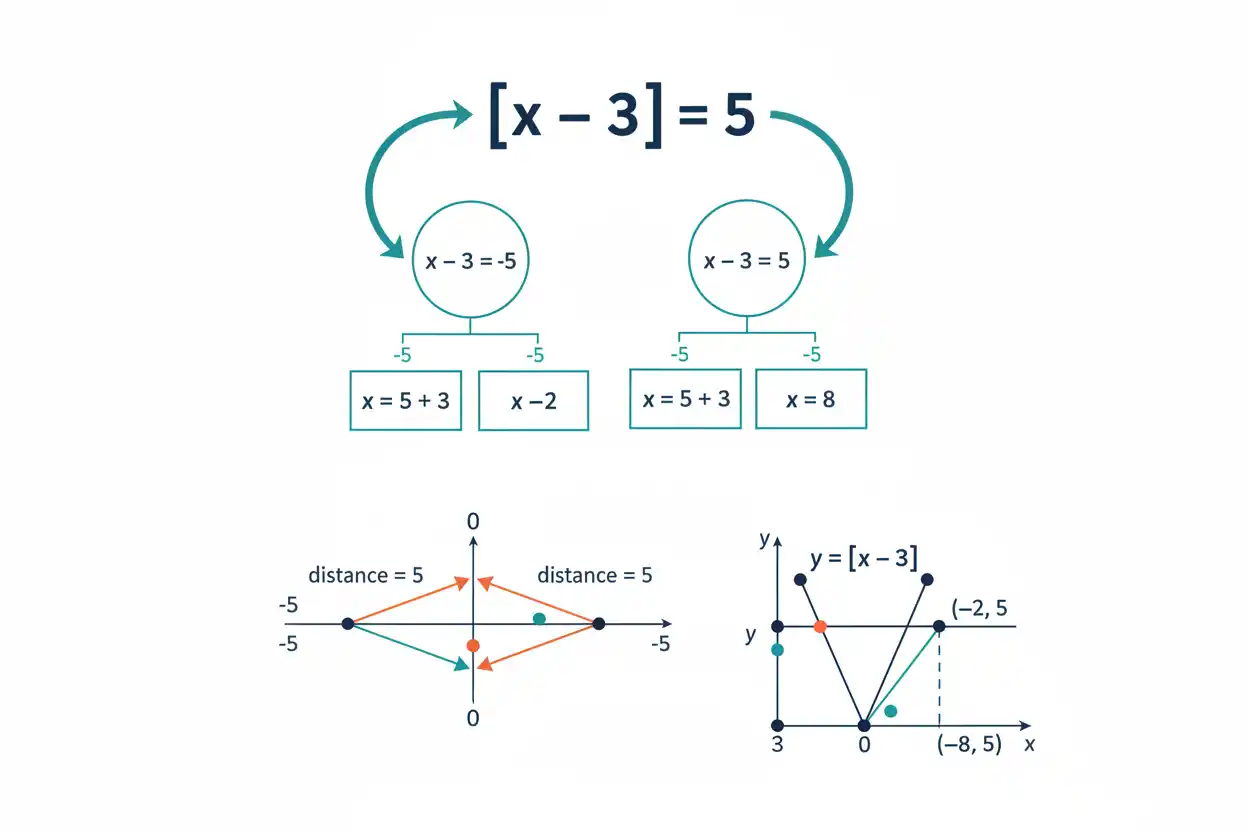

An absolute value equation is an equation containing an absolute value expression, such as:
|x| = 5
Absolute value represents distance from zero, so both (5) and (-5) are five units from zero. Therefore:
x = 5 or x = −5
The fundamental rule is:
If |A| = c and c ≥ 0, then A = c or A = −c
If the isolated absolute value equals a negative number, there is no real solution:
|A| = −c, where c > 0 → No real solution
These two ideas handle a large proportion of basic absolute value equations. More complicated problems require isolating the absolute value first, respecting domain restrictions, and checking candidate solutions in the original equation.
What Is an Absolute Value Equation?
An absolute value equation contains an unknown inside an absolute value expression.
Examples include:
|x − 3| = 7
2|x + 4| = 10
|3x − 1| + 5 = 14
|x − 2| = x + 4
The absolute value bars change how the equation is solved because an expression and its negative have the same absolute value.
For example:
|8| = 8
and:
|−8| = 8
That is why many absolute value equations produce two solutions.
Absolute value is fundamentally a distance concept, not simply a rule that “removes a negative sign.”
Basic Absolute Value Equation Formula
For:
|x| = a
three cases are possible.
When:
a > 0
there are two real solutions:
x = a or x = −a
When:
a = 0
there is exactly one solution:
x = 0
When:
a < 0
there is no real solution:
|x| cannot be negative
More generally:
|f(x)| = a
with (a>0) becomes:
f(x) = a
or:
f(x) = −a
This converts one absolute value equation into two ordinary equations.
Why Absolute Value Produces Two Cases
Consider:
|x − 4| = 3
The expression (x-4) must be three units from zero.
Therefore:
x − 4 = 3
or:
x − 4 = −3
Solving the first:
x = 7
Solving the second:
x = 1
Geometrically, both 1 and 7 are three units away from 4 on the number line.
This distance interpretation makes the two-branch rule easier to understand.
Absolute Value Equation Example
Solve:
|x + 2| = 6
Create two equations:
x + 2 = 6
or:
x + 2 = −6
First branch:
x = 4
Second branch:
x = −8
Solutions:
x = 4 or x = −8
Check:
|4 + 2| = |6| = 6
|−8 + 2| = |−6| = 6
Both values satisfy the original equation.
How to Solve an Absolute Value Equation
A reliable process is to first isolate the absolute value expression.
Once the equation has the form:
|A| = c
inspect (c).
If (c<0), there is no real solution.
If (c=0), solve:
A = 0
If (c>0), solve the two branches:
A = c
and:
A = −c
Then verify candidate answers in the original equation.
These ordinary branch equations can often be handled using the same principles covered in solving equations.
Example With a Coefficient Outside the Absolute Value
Solve:
3|x − 2| = 18
Divide both sides by 3:
|x − 2| = 6
Now split into two cases:
x − 2 = 6
or:
x − 2 = −6
Solutions:
x = 8
or:
x = −4
Check:
3|8 − 2| = 3(6) = 18
3|−4 − 2| = 3(6) = 18
Both are valid.
Example With Addition Outside the Absolute Value
Solve:
2|x + 1| + 4 = 16
Subtract 4:
2|x + 1| = 12
Divide by 2:
|x + 1| = 6
Split:
x + 1 = 6
or:
x + 1 = −6
Therefore:
x = 5
or:
x = −7
The important step is to isolate the absolute value before creating the positive and negative branches.
A Common Mistake: Splitting Too Early
Consider:
2|x − 3| + 5 = 15
It is incorrect to immediately write:
2(x − 3) + 5 = 15
and:
2(x − 3) + 5 = −15
The absolute value itself must first be isolated.
Correctly:
2|x − 3| = 10
|x − 3| = 5
Then:
x − 3 = 5
or:
x − 3 = −5
giving:
x = 8 or x = −2
Absolute Value Equation With No Solution
Solve:
|2x + 1| = −7
The left side is always nonnegative:
|2x + 1| ≥ 0
It can never equal (-7).
Therefore:
No real solution
This conclusion can be reached immediately without additional algebra.
Another No-Solution Example
Solve:
4|x − 2| + 3 = −5
Subtract 3:
4|x − 2| = −8
Divide by 4:
|x − 2| = −2
Absolute value cannot equal a negative real number.
Therefore:
No real solution
Absolute Value Equal to Zero
Solve:
|3x − 12| = 0
An absolute value equals zero only when the expression inside it equals zero:
3x − 12 = 0
3x = 12
x = 4
There is only one solution.
Writing separate (+0) and (-0) branches produces the same equation because:
−0 = 0
Example With Fractions
Solve:
|x/2 − 3| = 4
Split:
x/2 − 3 = 4
or:
x/2 − 3 = −4
First branch:
x/2 = 7
x = 14
Second:
x/2 = −1
x = −2
Solutions:
x = 14 or x = −2
Absolute Value on Both Sides
Consider:
|2x + 1| = |x − 4|
Two real numbers have equal absolute value when they are equal or opposites.
Therefore:
2x + 1 = x − 4
or:
2x + 1 = −(x − 4)
First branch:
x = −5
Second branch:
2x + 1 = −x + 4
3x = 3
x = 1
Check:
For (x=-5):
|−9| = |−9|
For (x=1):
|3| = |−3|
Both work.
Why Squaring Both Sides Can Work
For an equation:
|A| = |B|
squaring produces:
A² = B²
Then:
A² − B² = 0
Using the difference of squares:
(A − B)(A + B) = 0
Therefore:
A = B
or:
A = −B
This explains algebraically why equal absolute values produce two possible relationships.
Absolute Value Equation With a Variable on the Right
Equations become more subtle when the right side also contains a variable.
Consider:
|x − 2| = x + 4
Because an absolute value cannot be negative, any solution must satisfy:
x + 4 ≥ 0
so:
x ≥ −4
Now solve two branches.
First:
x − 2 = x + 4
Subtract (x):
−2 = 4
Impossible.
Second:
x − 2 = −(x + 4)
x − 2 = −x − 4
2x = −2
x = −1
Check:
|−1 − 2| = 3
and:
−1 + 4 = 3
Therefore:
x = −1
Why the Right Side Must Be Nonnegative
For:
|f(x)| = g(x)
the left side satisfies:
|f(x)| ≥ 0
Therefore every genuine solution must also satisfy:
g(x) ≥ 0
Ignoring this condition can introduce invalid candidate answers.
This is especially important when the right side contains (x).
Example Where Checking Removes a Candidate
Consider:
|x| = x − 2
The right side must satisfy:
x − 2 ≥ 0
therefore:
x ≥ 2
Split formally:
x = x − 2
which is impossible,
or:
x = −(x − 2)
x = −x + 2
2x = 2
x = 1
But (x=1) violates:
x ≥ 2
Check:
|1| = 1
while:
1 − 2 = −1
So (x=1) is not valid.
The equation has:
No real solution
Absolute Value as a Piecewise Function
Absolute value can be written as:
|x| = x, when x ≥ 0
|x| = −x, when x < 0
More generally:
|f(x)| = f(x), when f(x) ≥ 0
|f(x)| = −f(x), when f(x) < 0
This connects absolute value equations with the broader idea of a piecewise function.
The familiar two-case solution method is therefore a compact way of applying the piecewise definition.
Example Using the Piecewise Definition
Solve:
|2x − 6| = 8
When:
2x − 6 ≥ 0
the absolute value is:
2x − 6
so:
2x − 6 = 8
x = 7
This solution satisfies (x≥3).
When:
2x − 6 < 0
the absolute value becomes:
−(2x − 6)
so:
−2x + 6 = 8
−2x = 2
x = −1
This solution satisfies (x<3).
Therefore:
x = 7 or x = −1
Absolute Value and Distance
An equation:
|x − a| = d
can be interpreted as:
The distance between x and a is d
When (d>0):
x = a + d
or:
x = a − d
For example:
|x − 10| = 4
means (x) is four units from 10.
Thus:
x = 14
or:
x = 6
This geometric interpretation often makes absolute value equations easier than memorizing rules.
Solving |x − a| = d Directly
The distance form gives:
|x − a| = d
therefore:
x = a ± d
For:
|x − 7| = 12
x = 7 ± 12
So:
x = 19
or:
x = −5
This shortcut is useful when the coefficient of (x) inside the absolute value is 1.
Graphical Meaning of an Absolute Value Equation
Consider:
|x| = 3
Graph:
y = |x|
and:
y = 3
The horizontal line intersects the V-shaped absolute value graph at:
x = −3
and:
x = 3
An absolute value equation can therefore be understood as an intersection problem between functions.
The function notation framework is useful when representing these expressions as functions rather than isolated equations.
Graphical Example With One Solution
Consider:
|x| = 0
The graph:
y = |x|
touches:
y = 0
only at:
x = 0
This explains why an isolated absolute value equal to zero produces one solution rather than two distinct solutions.
Graphical Example With No Solution
For:
|x| = −2
the graph (y=|x|) never reaches a negative (y)-value.
Therefore the graph does not intersect:
y = −2
and the equation has no real solution.
Equations With Two Absolute Value Terms
Consider:
|x − 1| + |x + 2| = 5
The expressions change sign at:
x = 1
and:
x = −2
These points divide the number line into intervals:
x < −2
−2 ≤ x < 1
x ≥ 1
Within each interval, remove the absolute values according to the signs of the inside expressions.
This is often the cleanest method when more than one absolute value term appears.
Example With Two Absolute Values
Solve:
|x − 1| + |x + 2| = 5
For:
x ≥ 1
both expressions are nonnegative:
(x − 1) + (x + 2) = 5
2x + 1 = 5
x = 2
Valid.
For:
−2 ≤ x < 1
(x-1) is negative while (x+2) is nonnegative:
−(x − 1) + (x + 2) = 5
−x + 1 + x + 2 = 5
3 = 5
No solutions in this interval.
For:
x < −2
both expressions are negative:
−(x − 1) − (x + 2) = 5
−x + 1 − x − 2 = 5
−2x − 1 = 5
−2x = 6
x = −3
Valid.
Solutions:
x = −3 or x = 2
Absolute Value Equations and Inequalities
An absolute value equation asks for exact distances.
For example:
|x − 4| = 3
means the distance from 4 is exactly 3.
The corresponding inequality:
|x − 4| < 3
means the distance from 4 is less than 3, giving an interval rather than two isolated points.
The related inequalities topic handles interval notation and solution-set representation in more detail.
Absolute Value With Radicals
Suppose an equation contains:
|√x − 2| = 3
Before solving, the radical imposes a domain restriction:
x ≥ 0
Then:
√x − 2 = 3
or:
√x − 2 = −3
First:
√x = 5
x = 25
Second:
√x = −1
This branch is impossible over the real numbers.
Therefore:
x = 25
Problems of this type combine absolute-value logic with the restrictions studied in radical equations.
Absolute Value With Rational Expressions
Consider:
|(x + 1)/(x − 2)| = 3
The denominator imposes:
x ≠ 2
Then solve:
(x + 1)/(x − 2) = 3
or:
(x + 1)/(x − 2) = −3
Both candidate solutions must be checked against the original denominator restriction.
This is the same type of domain discipline required in a rational equation.
Absolute Value and Quadratic Expressions
An absolute value can contain a quadratic:
|x² − 5x + 6| = 2
This becomes:
x² − 5x + 6 = 2
or:
x² − 5x + 6 = −2
The first branch gives:
x² − 5x + 4 = 0
The second gives:
x² − 5x + 8 = 0
Each branch is then treated as a quadratic equation.
The absolute value changes the branching step, not the underlying methods for solving the resulting quadratics.
Solving the Quadratic Absolute Value Example
First branch:
x² − 5x + 4 = 0
Factor:
(x − 1)(x − 4) = 0
So:
x = 1 or x = 4
Second branch:
x² − 5x + 8 = 0
Its discriminant is:
D = (−5)² − 4(1)(8)
D = 25 − 32 = −7
Therefore it has no real solutions.
The real solutions to the original absolute value equation are:
x = 1 or x = 4
The discriminant provides a fast way to identify the nature of the second branch’s quadratic roots.
Absolute Value and Complex Numbers
The notation (|z|) is also used for the magnitude or modulus of a complex number, although that concept extends beyond ordinary real-number absolute value.
For:
z = a + bi
the complex magnitude is:
|z| = √(a² + b²)
That interpretation belongs to complex numbers and should not be confused with simply applying the real-number two-branch rule to (a+bi).
For basic absolute value equations in one real variable, the distance-on-the-real-number-line interpretation is sufficient.
Absolute Value Inside a Composite Function
If:
f(x) = |x|
and:
g(x) = 2x − 3
then:
f(g(x)) = |2x − 3|
An equation such as:
f(g(x)) = 5
is therefore:
|2x − 3| = 5
This connects absolute value equations naturally with a composite function.
Number of Solutions
An isolated equation:
|ax + b| = c
with (a \neq 0) has:
Two real solutions when (c>0).
One real solution when (c=0).
No real solutions when (c<0).
More complicated equations can have different numbers of solutions because the inside or outside expressions can be nonlinear.
For example:
|x² − 1| = 3
can generate up to four real candidates from two quadratic branches.
Example With Four Potential Branch Solutions
Solve:
|x² − 5| = 4
Branch one:
x² − 5 = 4
x² = 9
x = ±3
Branch two:
x² − 5 = −4
x² = 1
x = ±1
Therefore:
x = −3, −1, 1, 3
All four satisfy the original equation.
Absolute value equations are therefore not limited to two solutions when the inside expression is nonlinear.
Checking Solutions
Checking is a valuable final step.
Suppose you obtain:
x = 5
for:
|2x − 3| = 7
Substitute:
|2(5) − 3|
|7| = 7
Valid.
Candidate solutions can fail because of domain restrictions, a variable expression on the right side, or transformations used elsewhere in the problem.
Verification protects against those errors.
Common Absolute Value Equation Mistakes
One common mistake is forgetting the negative branch:
|A| = c
does not mean only:
A = c
when (c>0).
Another is creating two branches before isolating the absolute value.
Students also sometimes try to solve:
|A| = −5
rather than recognizing immediately that no real solution exists.
When a variable appears on the right side, forgetting that it must be nonnegative can create invalid answers.
For expressions involving fractions, radicals, or logarithms, domain restrictions must also be preserved.
Finally, candidate answers should be substituted into the original equation rather than only into a transformed version.
Frequently Asked Questions
What is an absolute value equation?
An absolute value equation is an equation containing one or more absolute value expressions, such as:
|x − 2| = 6
What is the main rule for solving an absolute value equation?
For:
|A| = c
with (c>0):
A = c or A = −c
Why do absolute value equations often have two answers?
Because a positive number and its negative have the same distance from zero.
|5| = |−5| = 5
How do you solve |x| = 7?
x = 7 or x = −7
How do you solve |x − 3| = 5?
x − 3 = 5
or:
x − 3 = −5
Therefore:
x = 8 or x = −2
Can absolute value equal a negative number?
No, not for real-number absolute value.
|x| ≥ 0
for every real (x).
What happens when absolute value equals zero?
The expression inside the absolute value must equal zero.
|A| = 0 → A = 0
Can an absolute value equation have one solution?
Yes. A simple example is:
|x − 4| = 0
which has only:
x = 4
Can an absolute value equation have more than two solutions?
Yes. If the expression inside the absolute value is nonlinear, each branch can itself have several solutions.
Why must the absolute value be isolated first?
The positive-and-negative branching rule applies to the absolute value expression itself. Other terms or coefficients outside the bars must first be removed using ordinary equation operations.
What if the right side contains x?
Any genuine solution must make the right side nonnegative. Solve the branches and verify every candidate in the original equation.
How is an absolute value equation related to distance?
|x − a| = d
means (x) is exactly (d) units away from (a).
How is an absolute value equation different from an absolute value inequality?
An equation usually identifies exact points satisfying a specified distance. An inequality describes a range of distances and commonly produces intervals or unions of intervals.
Why should solutions be checked?
Checking catches invalid candidates caused by domain restrictions, variable right-hand sides, or other algebraic transformations.
What is the most important absolute value equation formula?
|A| = c → A = c or A = −c, provided c > 0
That branching principle is the foundation for solving most elementary absolute value equations.