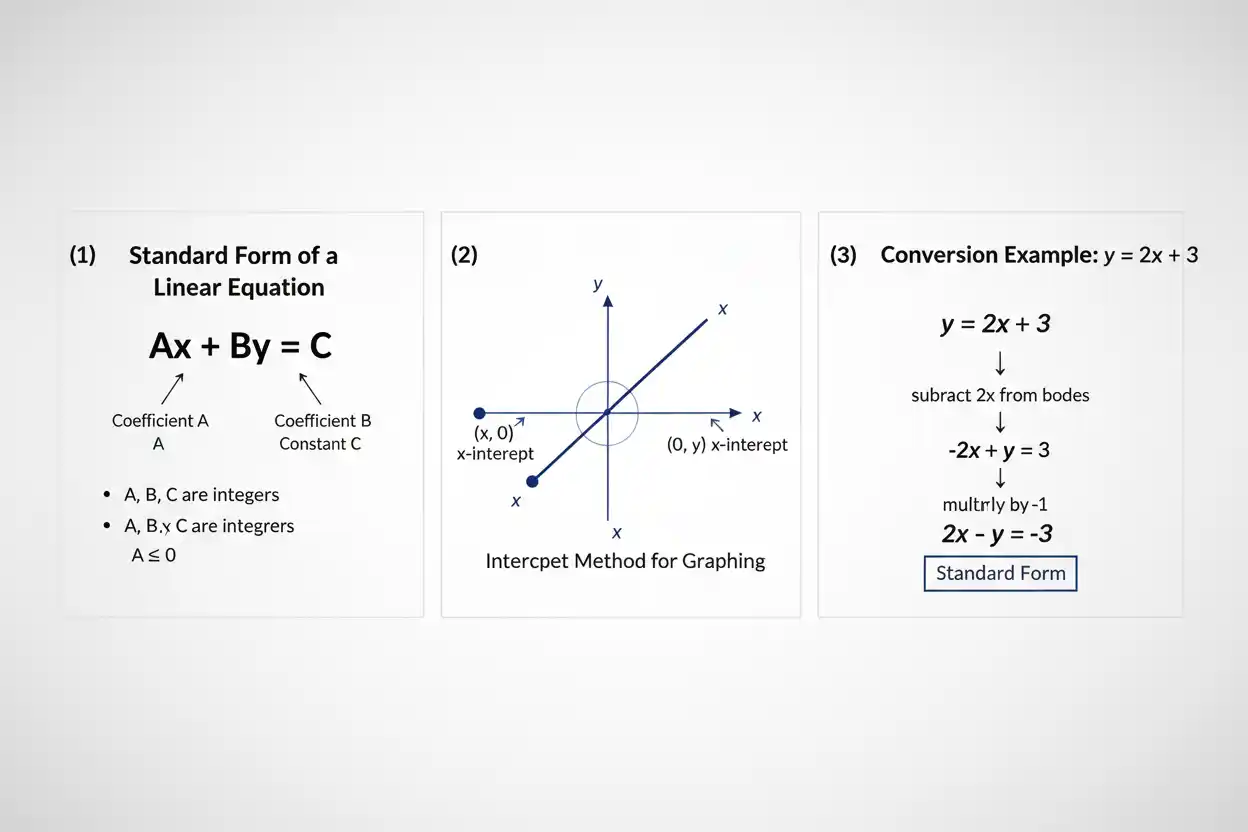

The standard form of a line is commonly written as:
Ax + By = C
where A, B, and C are constants and A and B are not both zero.
For example:
3x + 2y = 12
is a linear equation in standard form.
From this equation, you can find the intercepts quickly. Set y = 0 to find the x-intercept:
3x = 12
x = 4
So the x-intercept is:
(4, 0)
Set x = 0 to find the y-intercept:
2y = 12
y = 6
So the y-intercept is:
(0, 6)
Standard form is especially useful when intercepts, integer coefficients, or systems of linear equations matter.
What Is the Standard Form of a Line?
A straight line can be written in standard form as:
Ax + By = C
where:
- A is the coefficient of x.
- B is the coefficient of y.
- C is a constant.
- A and B cannot both equal zero.
For example:
5x – 3y = 15
has:
A = 5
B = -3
C = 15
Because x and y appear only to the first power and are not multiplied together, the equation represents a straight line.
Standard Form Formula
The basic formula is:
Ax + By = C
A common convention is to use integer values for A, B, and C with no common factor other than 1. Many textbooks also prefer A to be positive.
For example:
6x + 9y = 12
is mathematically valid standard form, but dividing every term by 3 gives the simpler equivalent equation:
2x + 3y = 4
Both equations represent exactly the same line.
The normalization convention is useful for consistency, but equivalent scalar multiples still describe the same geometric line.
What Values Can A, B, and C Have?
A, B, and C may be positive, negative, or zero, subject to one essential restriction:
A and B cannot both be zero
If:
A = 0
the equation becomes:
By = C
which represents a horizontal line when B ≠ 0.
If:
B = 0
the equation becomes:
Ax = C
which represents a vertical line when A ≠ 0.
If both were zero, the equation would no longer specify an ordinary line.
Example 1: Identify A, B, and C
Consider:
4x – 7y = 21
Compare it with:
Ax + By = C
Therefore:
A = 4
B = -7
C = 21
The negative sign belongs to B.
This detail matters when converting the equation or finding its slope.
Standard Form vs Slope-Intercept Form
Another common representation of a straight line is slope-intercept form:
y = mx + b
where m is the slope and b is the y-intercept.
Standard form:
Ax + By = C
emphasizes the coefficients and makes intercept calculations convenient.
Slope-intercept form:
y = mx + b
makes the slope and y-intercept visible immediately.
The same line can usually be converted between the two forms.
Converting Standard Form to Slope-Intercept Form
Start with:
Ax + By = C
Solve for y.
Subtract Ax:
By = -Ax + C
Divide by B:
y = (-A/B)x + C/B
provided:
B ≠ 0
Therefore the slope is:
m = -A/B
and the y-intercept is:
b = C/B
This gives two useful formulas directly from standard form.
Slope From Standard Form
For:
Ax + By = C
when B ≠ 0:
m = -A/B
Consider:
3x + 2y = 12
Then:
A = 3
B = 2
So:
m = -3/2
Converting verifies the result:
2y = -3x + 12
y = -(3/2)x + 6
The slope is indeed:
-3/2
Y-Intercept From Standard Form
For:
Ax + By = C
set:
x = 0
Then:
By = C
so:
y = C/B
provided B ≠ 0.
Therefore the y-intercept is:
(0, C/B)
For:
3x + 2y = 12
the y-intercept is:
y = 12/2 = 6
So:
(0, 6)
X-Intercept From Standard Form
Set:
y = 0
Then:
Ax = C
so:
x = C/A
provided A ≠ 0.
Therefore the x-intercept is:
(C/A, 0)
For:
3x + 2y = 12
we get:
x = 12/3 = 4
so:
(4, 0)
These intercept formulas are one reason standard form is convenient for graphing.
Example 2: Find Both Intercepts
Find the intercepts of:
4x + 5y = 20
X-intercept
Set y = 0:
4x = 20
x = 5
So:
(5, 0)
Y-intercept
Set x = 0:
5y = 20
y = 4
So:
(0, 4)
A straight line through these two points represents the equation.
Graphing Standard Form Using Intercepts
Suppose:
2x + 3y = 6
Set y = 0:
2x = 6
x = 3
The x-intercept is:
(3, 0)
Set x = 0:
3y = 6
y = 2
The y-intercept is:
(0, 2)
Plot those two points and draw the straight line through them.
This intercept method can be faster than converting to slope-intercept form when both intercepts are easy to calculate.
Converting Slope-Intercept Form to Standard Form
Suppose:
y = 3x – 5
Move the x-term to the left:
-3x + y = -5
If a positive x coefficient is preferred, multiply the entire equation by -1:
3x – y = 5
This is standard form.
The conversion uses the same balancing principles involved in solving equations.
Example 3: Convert y = -2x + 7
Start with:
y = -2x + 7
Add 2x to both sides:
2x + y = 7
Therefore the standard form is:
2x + y = 7
Here:
A = 2
B = 1
C = 7
Converting Fractional Slope to Standard Form
Suppose:
y = (3/4)x – 2
First remove the denominator by multiplying the entire equation by 4:
4y = 3x – 8
Move 3x to the left:
-3x + 4y = -8
If A is preferred positive, multiply by -1:
3x – 4y = 8
Therefore:
3x – 4y = 8
is an integer-coefficient standard form of the line.
Example 4: Convert y = -(5/3)x + 4
Start with:
y = -(5/3)x + 4
Multiply every term by 3:
3y = -5x + 12
Add 5x:
5x + 3y = 12
So the standard form is:
5x + 3y = 12
Check by solving for y again:
3y = -5x + 12
y = -(5/3)x + 4
The conversion is correct.
Standard Form With a Horizontal Line
A horizontal line such as:
y = 6
can be written in standard form as:
0x + y = 6
or simply:
y = 6
Here:
A = 0
B = 1
C = 6
Its slope is:
0
Every point on the line has y-coordinate 6.
Standard Form With a Vertical Line
A vertical line such as:
x = -3
can be represented as:
x + 0y = -3
Here:
A = 1
B = 0
C = -3
A vertical line cannot be written in ordinary slope-intercept form because its slope is undefined.
Standard form handles vertical lines naturally.
Finding Slope Without Fully Converting
From:
Ax + By = C
the slope is:
m = -A/B
when B ≠ 0.
For:
7x – 2y = 10
we have:
A = 7
B = -2
Therefore:
m = -7/(-2)
m = 7/2
You can confirm by solving for y:
-2y = -7x + 10
y = (7/2)x – 5
Finding the Y-Intercept Without Fully Converting
For:
7x – 2y = 10
set x = 0:
-2y = 10
y = -5
Therefore:
(0, -5)
This agrees with:
y = (7/2)x – 5
Finding the X-Intercept
Using the same line:
7x – 2y = 10
set y = 0:
7x = 10
x = 10/7
Therefore the x-intercept is:
(10/7, 0)
An intercept does not need to be an integer.
Writing Standard Form From Two Intercepts
Suppose a line crosses the axes at:
(6, 0)
and:
(0, 4)
The slope is:
m = (4 – 0)/(0 – 6)
m = 4/(-6)
m = -2/3
Use slope-intercept form:
y = -(2/3)x + 4
Multiply by 3:
3y = -2x + 12
Rearrange:
2x + 3y = 12
Therefore the line’s standard form is:
2x + 3y = 12
Writing Standard Form From a Point and Slope
Suppose a line has slope:
m = 2
and passes through:
(3, 7)
Use the line relation:
y – 7 = 2(x – 3)
Expand:
y – 7 = 2x – 6
Add 7:
y = 2x + 1
Convert to standard form:
2x – y = -1
Check the point:
2(3) – 7 = -1
6 – 7 = -1
Correct.
Equivalent Standard-Form Equations
The equations:
2x + 3y = 12
and:
4x + 6y = 24
represent the same line because the second equation is obtained by multiplying every term in the first by 2.
Likewise:
-2x – 3y = -12
represents the same line.
A nonzero scalar multiple does not change the solution set.
For a standardized final form, divide out any common factor when possible.
Example: Reduce Common Factors
Simplify:
12x – 18y = 30
The greatest common factor of 12, 18, and 30 is 6.
Divide every term by 6:
2x – 3y = 5
This is a simpler equivalent standard form.
Standard Form in Systems of Equations
Standard form is particularly convenient when two linear equations need to be compared or combined.
For example:
2x + 3y = 13
4x – 3y = 5
The y-coefficients are opposites, so adding the equations immediately eliminates y:
6x = 18
x = 3
This elimination structure is one reason equations in a system of linear equations are often arranged in standard form.
The present topic, however, concerns representing and interpreting one line rather than solving an entire system.
Parallel Lines in Standard Form
Suppose two lines are written with identical normalized A and B coefficients:
2x + 3y = 6
2x + 3y = 12
Both have slope:
m = -2/3
but different intercepts.
Therefore the lines are parallel.
More generally, proportional x- and y-coefficients produce equal slopes, provided the equations do not represent the same line.
Same Line in Standard Form
Consider:
2x + 3y = 6
and:
4x + 6y = 12
Every coefficient and constant in the second equation is twice the corresponding value in the first.
Therefore they represent the same line, not two distinct parallel lines.
This is important when comparing linear equations algebraically.
Standard Form and Rational Expressions
When converting:
Ax + By = C
to slope-intercept form, you may obtain fractions such as:
y = -(A/B)x + C/B
These are constant coefficients when A, B, and C are constants.
That does not turn the equation into one of the variable-denominator rational expressions studied separately.
For example:
y = -(2/3)x + 4
is still a linear equation.
Standard Form vs Higher-Degree Algebra
Standard form of a line deals with first-degree equations in x and y.
Factoring identities such as sum and difference of cubes apply to cubic polynomial expressions instead, while synthetic division is used to divide suitable polynomials by linear factors.
Those techniques belong to higher-degree polynomial algebra rather than conversion between equivalent line equations.
This distinction prevents the phrase “standard form” from being treated as one universal algebraic form for every type of expression.
Common Standard Form Mistakes
Forgetting That Both Variables Are First Degree
A line in standard form uses:
Ax + By = C
An equation such as:
x² + y = 5
is not a line because x is squared.
Losing a Sign When Rearranging
From:
y = 3x – 4
subtract 3x:
-3x + y = -4
If you multiply by -1, every term must change sign:
3x – y = 4
Clearing Only One Fraction
For:
y = (2/3)x + 5/6
multiply the entire equation by 6:
6y = 4x + 5
not just the fractional x-term.
Confusing the X- and Y-Intercepts
For the x-intercept, set:
y = 0
For the y-intercept, set:
x = 0
Forgetting a Vertical Line
A vertical line can be written in standard form even though it cannot be written as y = mx + b.
Treating Equivalent Multiples as Different Lines
Equations obtained by multiplying every term by the same nonzero constant represent the same line.
Worked Standard Form Example
Convert:
y = -(3/4)x + 5/2
to standard form and find both intercepts.
First clear the fractions by multiplying every term by 4:
4y = -3x + 10
Move -3x to the left:
3x + 4y = 10
So the standard form is:
3x + 4y = 10
Now find the x-intercept.
Set y = 0:
3x = 10
x = 10/3
Therefore:
(10/3, 0)
Find the y-intercept.
Set x = 0:
4y = 10
y = 5/2
Therefore:
(0, 5/2)
Check the slope:
m = -A/B
m = -3/4
which matches the original equation.
Frequently Asked Questions
What is the standard form of a line?
The standard form of a line is:
Ax + By = C
where A and B are not both zero.
What do A, B, and C represent?
A is the coefficient of x, B is the coefficient of y, and C is the constant on the other side of the equation.
What is the slope of Ax + By = C?
When B ≠ 0:
m = -A/B
What is the y-intercept in standard form?
When B ≠ 0:
y-intercept = (0, C/B)
What is the x-intercept in standard form?
When A ≠ 0:
x-intercept = (C/A, 0)
How do you convert standard form to slope-intercept form?
Solve:
Ax + By = C
for y:
y = (-A/B)x + C/B
provided B ≠ 0.
How do you convert y = mx + b to standard form?
Move the x-term and y-term to opposite sides as needed, then clear fractions and simplify coefficients.
For example:
y = 2x + 3
becomes:
2x – y = -3
Can standard form represent a vertical line?
Yes. A vertical line such as x = 4 is equivalent to:
x + 0y = 4
Can standard form represent a horizontal line?
Yes. A horizontal line such as y = 5 is equivalent to:
0x + y = 5
Do A, B, and C have to be integers?
Not for the equation to be mathematically valid, although standard-form conventions often clear fractions so that A, B, and C are integers.
Are 2x + 3y = 6 and 4x + 6y = 12 the same line?
Yes. The second equation is exactly twice the first, so both have the same solution set and represent the same line.
Why is standard form useful?
It makes x- and y-intercepts easy to find, handles vertical lines naturally, and arranges coefficients conveniently for techniques such as elimination in systems of linear equations.