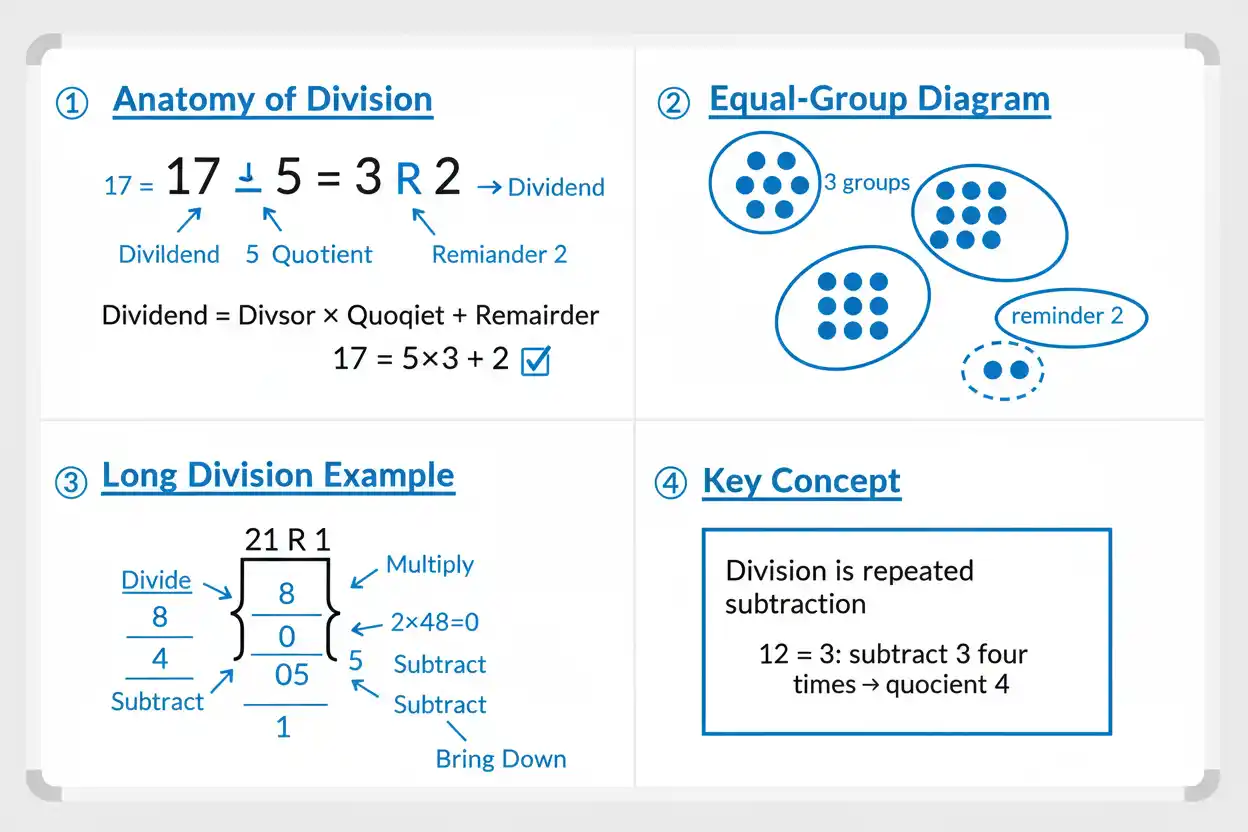

Division is the arithmetic operation used to split a quantity into equal groups or determine how many times one number fits into another. The result of division is called the quotient, and when an integer cannot be divided evenly, the amount left over is called the remainder.
For example:
20 ÷ 4 = 5
Here:
20 = dividend
4 = divisor
5 = quotient
There is no remainder because 4 divides 20 exactly.
For:
23 ÷ 5 = 4 remainder 3
the quotient is 4 and the remainder is 3 because:
23 = 5 × 4 + 3
This dividend-divisor-quotient-remainder relationship is one of the fundamental structures in arithmetic and number theory.
What Is Division?
Division reverses multiplication.
If:
a × b = c
then, provided a ≠ 0 and b ≠ 0 where appropriate:
c ÷ a = b
and:
c ÷ b = a
For example:
6 × 7 = 42
so:
42 ÷ 6 = 7
and:
42 ÷ 7 = 6
Division can therefore answer either of two closely related questions:
How many equal groups can be formed?
or:
How large is each group?
Parts of a Division Problem
For:
35 ÷ 5 = 7
the parts are:
Dividend: the quantity being divided.
Dividend = 35
Divisor: the number by which the dividend is divided.
Divisor = 5
Quotient: the result.
Quotient = 7
The basic relationship is:
Dividend = Divisor × Quotient
when the remainder is zero.
Division With a Remainder
Not every integer division produces an integer quotient.
Consider:
29 ÷ 6
The largest whole-number multiple of 6 that does not exceed 29 is:
6 × 4 = 24
The amount left is:
29 – 24 = 5
Therefore:
29 ÷ 6 = 4 remainder 5
The complete relationship is:
Dividend = Divisor × Quotient + Remainder
So:
29 = 6 × 4 + 5
The dedicated remainders topic focuses more closely on remainder calculations and their properties.
Division Algorithm Formula
For integers, division with remainder can be expressed as:
a = bq + r
where:
a = dividend
b = nonzero divisor
q = integer quotient
r = remainder
For a positive divisor:
0 ≤ r < b
For example:
47 ÷ 8
gives:
q = 5
because:
8 × 5 = 40
and:
r = 47 – 40 = 7
Therefore:
47 = 8 × 5 + 7
Why the Remainder Must Be Smaller Than the Divisor
Suppose someone writes:
29 ÷ 6 = 3 remainder 11
Although:
6 × 3 + 11 = 29
the representation is not the standard quotient-remainder result because the remainder 11 is larger than the divisor 6.
Another complete group of 6 can still be removed:
11 = 6 + 5
So:
29 = 6 × 4 + 5
The correct result is:
29 ÷ 6 = 4 remainder 5
For a positive divisor, the remainder must satisfy:
0 ≤ remainder < divisor
Exact Division
Division is exact when the remainder is zero.
For example:
72 ÷ 9 = 8
because:
9 × 8 = 72
Equivalently:
72 = 9 × 8 + 0
When one integer divides another exactly, the divisor is a factor of the dividend.
That relationship is the basis of divisibility rules, which provide shortcuts for identifying whether certain divisors produce a zero remainder.
Example: 156 ÷ 12
Calculate:
156 ÷ 12
Since:
12 × 13 = 156
the quotient is:
13
and the remainder is:
0
Therefore:
156 ÷ 12 = 13
Check:
12 × 13 = 156
Example: 157 ÷ 12
Now divide:
157 ÷ 12
We know:
12 × 13 = 156
Subtract:
157 – 156 = 1
Therefore:
157 ÷ 12 = 13 remainder 1
Check:
12 × 13 + 1 = 157
Division as Equal Sharing
Suppose 24 apples are shared equally among 6 people.
The calculation is:
24 ÷ 6 = 4
Each person receives:
4 apples
This is sometimes called the partitive interpretation of division: the number of groups is known, and the size of each group must be found.
Division as Equal Grouping
Suppose 24 apples are packed into groups of 4.
The calculation is still:
24 ÷ 4 = 6
but now the question asks how many groups can be formed.
There are:
6 groups
The arithmetic operation is the same even though the practical interpretation differs.
Division and Multiplication
Division and multiplication are inverse operations.
If:
56 ÷ 8 = 7
then:
7 × 8 = 56
This gives a simple way to check division.
For example, suppose:
144 ÷ 12 = 12
Check:
12 × 12 = 144
Since multiplication recovers the dividend, the quotient is correct.
Division by 1
Every number divided by 1 equals itself:
a ÷ 1 = a
For example:
83 ÷ 1 = 83
This follows because:
1 × 83 = 83
Dividing a Number by Itself
Every nonzero number divided by itself equals 1:
a ÷ a = 1
provided:
a ≠ 0
For example:
25 ÷ 25 = 1
because:
25 × 1 = 25
Zero Divided by a Nonzero Number
Zero divided by any nonzero number is zero:
0 ÷ a = 0
for:
a ≠ 0
For example:
0 ÷ 7 = 0
because:
7 × 0 = 0
Why Division by Zero Is Undefined
An expression such as:
12 ÷ 0
is undefined.
If a quotient q existed, it would need to satisfy:
0 × q = 12
But multiplication by zero always produces:
0 × q = 0
No finite number can make the equation true.
Therefore:
division by zero is undefined
Similarly:
0 ÷ 0
does not have one unique quotient. Every number multiplied by zero gives zero, so the expression is indeterminate rather than having an ordinary division value.
Integer Division and Decimal Division
Suppose:
7 ÷ 2
If the result is requested as integer quotient and remainder:
7 ÷ 2 = 3 remainder 1
If ordinary real-number division is used:
7 ÷ 2 = 3.5
These answers represent the same underlying relationship in different forms.
Since:
7 = 2 × 3 + 1
the remainder contributes:
1 / 2 = 0.5
so:
3 + 0.5 = 3.5
Calculations directly involving decimal notation are developed more fully under decimal operations.
Division and Fractions
A fraction is another way to represent division.
For example:
3 / 4 = 3 ÷ 4
and:
3 ÷ 4 = 0.75
Therefore:
3/4 = 0.75
Similarly:
7 ÷ 5 = 7/5 = 1.4
This relationship explains why converting a decimal to fraction form often amounts to expressing a division result as an integer ratio.
Dividing Fractions
Division involving fractions can be rewritten using multiplication by a reciprocal.
For example:
3/4 ÷ 2/5
becomes:
3/4 × 5/2
Then:
15/8
The complete procedures for such calculations belong to fraction operations, while the underlying interpretation remains division by a nonzero quantity.
Dividing Decimals
Consider:
7.2 ÷ 0.6
Multiply both dividend and divisor by 10:
72 ÷ 6
Then:
72 ÷ 6 = 12
Therefore:
7.2 ÷ 0.6 = 12
Scaling both quantities by the same nonzero factor leaves the quotient unchanged.
Long Division
When a division problem cannot be completed immediately from known multiplication facts, long division provides a systematic written procedure.
For example:
864 ÷ 12 = 72
The long-division method breaks the problem into repeated stages of estimation, multiplication, subtraction, and bringing down digits.
The current page owns the broader meaning of division, quotient, and remainder rather than reproducing the full long-division procedure.
Division and Factors
If:
a ÷ b
produces an integer with no remainder, then b is a factor of a.
For example:
48 ÷ 6 = 8
so 6 is a factor of 48.
Likewise:
48 ÷ 8 = 6
so 8 is also a factor.
When two integers are divisible by the same values, those shared divisors are their common factors.
Division and the Greatest Common Factor
Division plays an important role in finding the greatest common factor of integers.
For example, 36 and 48 are both divisible by 12:
36 ÷ 12 = 3
48 ÷ 12 = 4
No larger positive integer divides both exactly, so 12 is their greatest common factor.
The GCF problem is a specialized application of integer divisibility rather than a definition of division itself.
Division and the Euclidean Algorithm
The Euclidean algorithm repeatedly uses quotients and remainders to find a greatest common divisor.
For example, to compare 252 and 105:
252 = 105 × 2 + 42
Then:
105 = 42 × 2 + 21
Then:
42 = 21 × 2 + 0
The last nonzero remainder is:
21
So:
GCD(252, 105) = 21
This is a powerful example of how the simple division relationship:
a = bq + r
supports a more advanced number-theory algorithm.
Division and Divisibility Tests
A divisibility rule answers whether a specific division will leave remainder zero without performing the entire calculation.
For example, to test:
5,472 ÷ 3
add the digits:
5 + 4 + 7 + 2 = 18
Since 18 is divisible by 3, 5,472 is divisible by 3.
Therefore, the quotient will be an integer.
The divisibility shortcut does not replace division when the actual quotient is required.
Quotient and Remainder Example
Divide:
123 ÷ 10
Ten fits into 123 twelve times:
10 × 12 = 120
Subtract:
123 – 120 = 3
Therefore:
Quotient = 12
Remainder = 3
and:
123 = 10 × 12 + 3
In decimal form:
123 ÷ 10 = 12.3
The quotient-and-remainder form and decimal form describe the same division in different ways.
Negative Division
Division can involve negative numbers.
The sign rules are:
positive ÷ positive = positive
negative ÷ negative = positive
positive ÷ negative = negative
negative ÷ positive = negative
For example:
-24 ÷ 6 = -4
-24 ÷ -6 = 4
24 ÷ -6 = -4
These rules follow from the corresponding multiplication sign rules.
Quotient and Remainder With Negative Integers
Remainder conventions for negative integers require care because different computational systems may define the quotient differently.
For elementary arithmetic with positive dividends and divisors, the standard condition is straightforward:
a = bq + r
with:
0 ≤ r < b
That positive-integer case is usually the intended interpretation in introductory remainder problems.
Checking Division With Multiplication
Suppose:
95 ÷ 7 = 13 remainder 4
Check:
7 × 13 + 4
First:
7 × 13 = 91
Then:
91 + 4 = 95
The original dividend is recovered.
The universal integer check is:
Divisor × Quotient + Remainder = Dividend
Estimating a Quotient
Estimation can catch arithmetic errors before they are accepted.
Consider:
598 ÷ 19
Round:
598 ≈ 600
19 ≈ 20
Then:
600 ÷ 20 = 30
So the exact quotient should be near 30.
Since:
19 × 31 = 589
we get:
598 ÷ 19 = 31 remainder 9
A result such as 310 would clearly be unreasonable.
Practical Example: Packing Items
Suppose 137 items are packed into boxes holding 12 items each.
Calculate:
137 ÷ 12
Since:
12 × 11 = 132
the remainder is:
137 – 132 = 5
Therefore:
137 ÷ 12 = 11 remainder 5
This means:
11 full boxes
with:
5 items left
If every item must be shipped, a twelfth box would be needed, even though it would not be full.
This shows why practical interpretation matters after calculating the quotient and remainder.
Practical Example: Equal Teams
Suppose 96 participants are divided equally among 8 teams.
96 ÷ 8 = 12
Each team receives:
12 participants
Because the remainder is zero, the groups can be exactly equal.
Practical Example With a Remainder
Suppose 50 students must be placed into groups of 6.
50 ÷ 6 = 8 remainder 2
So eight full groups of six can be formed:
8 × 6 = 48
with:
2 students remaining
The mathematics provides the quotient and remainder; the real situation determines what to do with the remaining students.
Division in Ratios and Rates
Many rates are fundamentally division.
If a car travels:
240 km
in:
4 hours
then its average rate is:
240 ÷ 4 = 60 km/h
Similarly, a unit price is found by dividing total cost by quantity.
Division therefore appears throughout measurement, finance, science, and statistics even when the division symbol is not written explicitly.
Division in Probability
Probability calculations frequently divide the number or weight of favorable outcomes by the total.
For equally likely outcomes:
Probability = favorable outcomes / total outcomes
For example, if 3 of 12 equally likely outcomes are favorable:
Probability = 3 / 12 = 1 / 4
The fraction is itself a division relationship.
Division and Determinants
Division can appear in formulas built from more advanced mathematical structures.
For example, the inverse of a 2 × 2 matrix involves division by its determinant.
If the determinant equals zero, the required division would involve a zero denominator, so the ordinary inverse cannot exist.
The matrix problem is specialized, but the restriction comes directly from the basic rule that division by zero is undefined.
Division and Information-Theory Entropy
In entropy calculations, probabilities are often ratios created by division.
If a symbol occurs 25 times among 100 observations:
p = 25 / 100 = 0.25
That probability may then be used inside an information-theory formula.
Division supplies the ratio, while entropy answers a different question about uncertainty or information.
Common Division Mistakes
One common mistake is reversing the dividend and divisor.
For:
20 ÷ 5
the answer is:
4
but:
5 ÷ 20 = 0.25
Division is not commutative.
Another mistake is reporting a remainder equal to or larger than the positive divisor.
For:
17 ÷ 5
the correct result is:
3 remainder 2
not:
2 remainder 7
Another error is assuming division by zero produces zero. It does not.
0 ÷ 5 = 0
but:
5 ÷ 0
is undefined.
Finally, an integer quotient should not be confused with the full decimal quotient. For:
11 ÷ 4
the integer quotient and remainder are:
2 remainder 3
while the decimal quotient is:
2.75
Frequently Asked Questions
What is division?
Division is an arithmetic operation that determines equal group size, number of equal groups, or the ratio between two quantities.
What is a dividend?
The dividend is the quantity being divided.
In:
48 ÷ 6 = 8
the dividend is 48.
What is a divisor?
The divisor is the quantity by which the dividend is divided.
In:
48 ÷ 6 = 8
the divisor is 6.
What is a quotient?
The quotient is the result of division.
For:
48 ÷ 6 = 8
the quotient is 8.
What is a remainder?
A remainder is the amount left after forming as many complete divisor-sized groups as possible.
For:
26 ÷ 7 = 3 remainder 5
the remainder is 5.
What is the quotient and remainder formula?
For integer division:
Dividend = Divisor × Quotient + Remainder
or:
a = bq + r
Can the remainder be bigger than the divisor?
Not in the standard quotient-remainder representation with a positive divisor. It must satisfy:
0 ≤ remainder < divisor
What does a remainder of zero mean?
It means the division is exact and the divisor is a factor of the dividend.
Is division by zero allowed?
No. Division by zero is undefined.
Is zero divided by another number allowed?
Yes, provided the divisor is nonzero:
0 ÷ a = 0
How can I check a division answer?
Multiply the divisor by the quotient and add any remainder:
Divisor × Quotient + Remainder
The result should equal the dividend.
Final Example
Divide:
347 ÷ 15
Find the largest multiple of 15 that does not exceed 347:
15 × 23 = 345
Subtract:
347 – 345 = 2
Therefore:
Quotient = 23
Remainder = 2
So:
347 ÷ 15 = 23 remainder 2
Check:
15 × 23 + 2
= 345 + 2
= 347
The central relationship behind division is therefore:
Dividend = Divisor × Quotient + Remainder
When the remainder is zero, the division is exact. When it is nonzero, the quotient tells how many complete groups fit and the remainder tells how much is left.