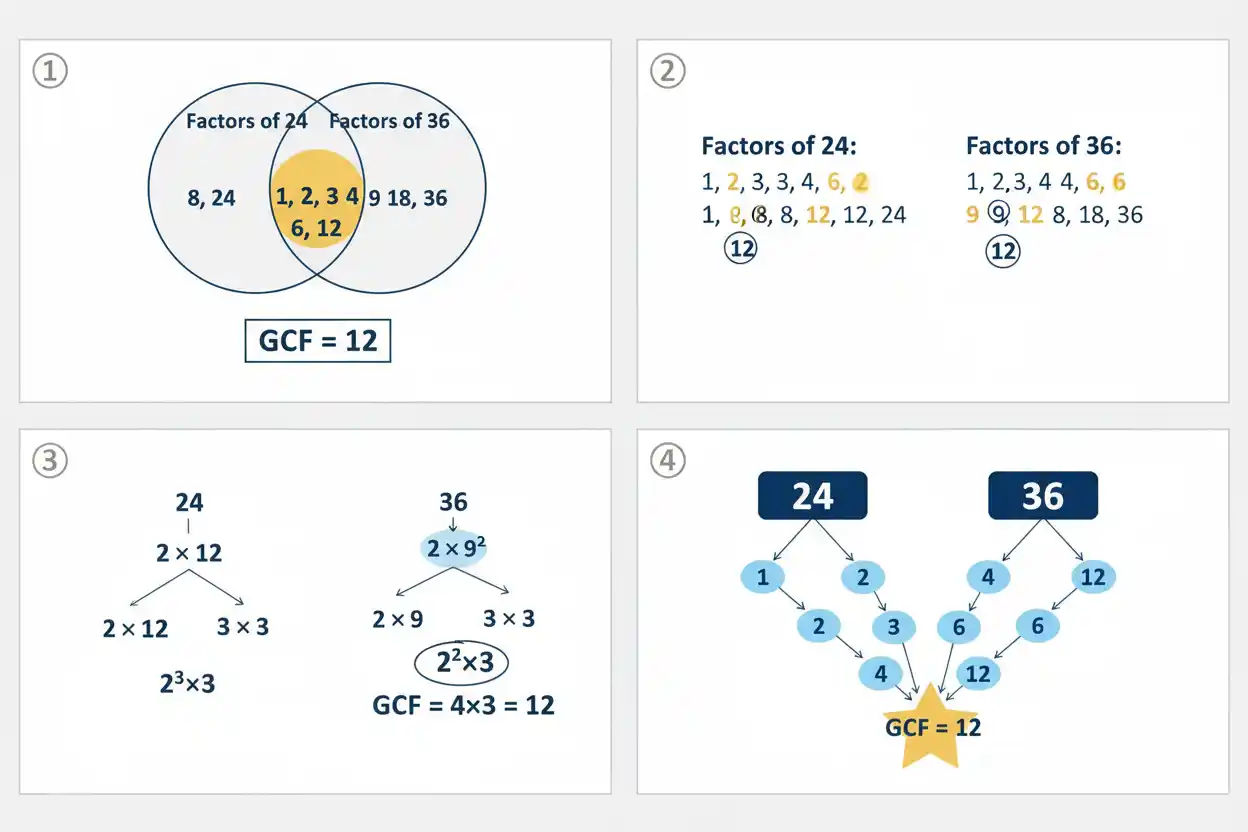

GCF stands for greatest common factor. It is the largest positive integer that divides two or more integers exactly, leaving no remainder.
For example, consider 24 and 36.
Factors of 24:
1, 2, 3, 4, 6, 8, 12, 24
Factors of 36:
1, 2, 3, 4, 6, 9, 12, 18, 36
Their common factors are:
1, 2, 3, 4, 6, 12
The largest is 12.
Therefore:
GCF(24, 36) = 12
GCF is a fundamental idea in arithmetic and number theory. It is especially useful for simplifying fractions, factoring expressions, comparing integer divisibility, and identifying the largest equal grouping possible.
What Does GCF Mean?
The abbreviation:
GCF
means:
Greatest Common Factor
Each word describes part of the definition.
Factor means a number divides another integer exactly.
Common means the factor belongs to all the numbers being compared.
Greatest means the largest such positive factor is selected.
For example, 6 is a factor of both 18 and 30:
18 ÷ 6 = 3
30 ÷ 6 = 5
But 6 is not merely a common factor—it is their largest common factor.
Therefore:
GCF(18, 30) = 6
GCF Formula Concept
For integers a and b, the GCF can be described as:
GCF(a, b) = largest positive integer d such that d divides both a and b
In divisibility notation:
a mod d = 0
and:
b mod d = 0
For:
a = 20
b = 32
the largest d satisfying both conditions is:
4
Therefore:
GCF(20, 32) = 4
GCF and Common Factors
The common factors of two numbers form a list. The GCF is simply the largest value in that list.
For 12 and 30:
Factors of 12:
1, 2, 3, 4, 6, 12
Factors of 30:
1, 2, 3, 5, 6, 10, 15, 30
Common factors:
1, 2, 3, 6
Therefore:
GCF = 6
This distinction matters:
Common factors = all shared positive divisors
GCF = largest shared positive divisor
GCF of Two Numbers
Consider:
16 and 24
The factor lists are:
16: 1, 2, 4, 8, 16
24: 1, 2, 3, 4, 6, 8, 12, 24
Shared factors:
1, 2, 4, 8
The greatest is:
8
Therefore:
GCF(16, 24) = 8
GCF of Three Numbers
The concept extends beyond two integers.
Find the GCF of:
18, 30, 42
Common factors of all three include:
1, 2, 3, 6
The greatest is:
6
Therefore:
GCF(18, 30, 42) = 6
A number counts as common only if it divides every integer in the set.
GCF When One Number Divides the Other
Suppose:
12 and 48
Since:
48 ÷ 12 = 4
12 divides 48 exactly.
Every factor of 12 is therefore also present among the factors of 48, and the largest possible common factor is 12 itself.
So:
GCF(12, 48) = 12
In general, if positive integer a divides b:
GCF(a, b) = a
when a ≤ b.
GCF of Consecutive Numbers
Consecutive positive integers always have GCF 1.
For example:
14 and 15
The only positive factor they share is:
1
Therefore:
GCF(14, 15) = 1
Likewise:
GCF(100, 101) = 1
Numbers whose GCF is 1 are called coprime or relatively prime.
GCF Does Not Require Both Numbers to Be Prime
Consider:
8 and 15
Both are composite:
8 = 2³
15 = 3 × 5
but they share no positive factor greater than 1.
Therefore:
GCF(8, 15) = 1
So coprime numbers do not need to be individually prime.
Method 1: Use Factor Lists
For small integers, listing factors is intuitive.
Find:
GCF(20, 28)
Factors of 20:
1, 2, 4, 5, 10, 20
Factors of 28:
1, 2, 4, 7, 14, 28
Common:
1, 2, 4
The largest is:
4
Therefore:
GCF(20, 28) = 4
This method works well when the factor lists are short.
Method 2: Use Prime Factorization
Another approach uses prime factorization.
For:
72 and 120
write:
72 = 2³ × 3²
120 = 2³ × 3 × 5
Take only the prime factors common to both, using the smaller exponent:
For 2:
2³
For 3:
3¹
Therefore:
GCF = 2³ × 3
= 8 × 3
= 24
So:
GCF(72, 120) = 24
The separate greatest common factor page covers detailed calculation methods and larger worked examples.
Method 3: Use the Euclidean Algorithm
For larger integers, the Euclidean algorithm avoids complete factorization.
Find:
GCF(252, 105)
Use repeated division:
252 = 105 × 2 + 42
105 = 42 × 2 + 21
42 = 21 × 2 + 0
The final nonzero remainder is:
21
Therefore:
GCF(252, 105) = 21
The method works because replacing the original pair with the divisor and remainder does not change their greatest common divisor.
GCF and Fraction Simplification
One of the most common uses of GCF is fraction simplification.
Consider:
42 / 56
Find:
GCF(42, 56) = 14
Divide both parts by 14:
42 ÷ 14 = 3
56 ÷ 14 = 4
Therefore:
42 / 56 = 3 / 4
Using the GCF reduces a fraction to lowest terms in one step.
Example: Simplify 54/72 Using GCF
Find:
GCF(54, 72) = 18
Then:
54 ÷ 18 = 3
72 ÷ 18 = 4
So:
54/72 = 3/4
Because:
GCF(3,4) = 1
no further reduction is possible.
GCF in Fraction Operations
During fraction operations, a result may need to be reduced.
Suppose multiplication produces:
30 / 45
Find:
GCF(30,45) = 15
Then:
30/45 = 2/3
The arithmetic operation determines the original result; GCF identifies the largest shared divisor for reducing it.
GCF Before Converting Fractions to Percent
A fraction does not need to be simplified before converting fractions to percent, but doing so can make the relationship easier to see.
Consider:
45/60
Find:
GCF(45,60) = 15
Simplify:
45/60 = 3/4
Then:
3/4 = 75%
Therefore:
45/60 = 75%
The percentage is unchanged because simplification preserves the fraction’s value.
GCF and LCM
The GCF is closely related to the least common multiple.
For positive integers a and b:
GCF(a,b) × LCM(a,b) = a × b
Therefore:
LCM(a,b) = (a × b) / GCF(a,b)
For example, let:
a = 18
b = 24
Their GCF is:
6
Then:
LCM = (18 × 24) / 6
= 432 / 6
= 72
So:
LCM(18,24) = 72
The dedicated LCM topic focuses on the least common multiple itself.
GCF vs. LCM
GCF asks:
What is the largest number that divides all the given integers?
LCM asks:
What is the smallest positive number that all the given integers divide?
For 8 and 12:
GCF = 4
while:
LCM = 24
These values answer opposite kinds of divisibility questions.
GCF and Equal Grouping
Suppose 36 red objects and 48 blue objects must be divided into the greatest possible number of identical groups, with no objects left over.
The number of groups must divide both:
36 and 48
Find:
GCF(36,48) = 12
Therefore:
12 equal groups
can be formed.
Each group contains:
36 ÷ 12 = 3 red objects
and:
48 ÷ 12 = 4 blue objects
This is a classic practical interpretation of the GCF.
GCF and Cutting Lengths
Suppose two ropes measure:
84 cm
and:
126 cm
They must be cut into equal pieces of the greatest possible integer length without waste.
The length must divide both 84 and 126.
Find:
GCF(84,126) = 42
Therefore:
Maximum equal piece length = 42 cm
The 84 cm rope produces:
84 ÷ 42 = 2 pieces
The 126 cm rope produces:
126 ÷ 42 = 3 pieces
GCF and Rectangular Grouping
Suppose 60 tiles of one type and 84 tiles of another must be distributed equally among the maximum number of identical sets.
Find:
GCF(60,84)
The answer is:
12
Therefore:
12 identical sets
can be made.
Each contains:
60 ÷ 12 = 5
tiles of the first type and:
84 ÷ 12 = 7
of the second.
GCF With Prime Numbers
If p and q are two different prime numbers:
GCF(p,q) = 1
For example:
GCF(11,17) = 1
because the positive factors are:
11: 1, 11
17: 1, 17
Only 1 appears in both lists.
If the same prime is compared with itself:
GCF(11,11) = 11
GCF With Zero
For a positive integer a:
GCF(a,0) = a
For example:
GCF(35,0) = 35
Every positive divisor of 35 also divides zero, so the largest common positive divisor is 35.
The value:
GCF(0,0)
is generally left undefined in elementary treatments because there is no greatest positive integer dividing both in the ordinary sense.
GCF With Negative Integers
GCF is conventionally reported as a positive number.
For example:
GCF(-18,30) = 6
and:
GCF(-18,-30) = 6
The signs do not change the positive common-factor structure.
A practical calculation can use:
GCF(|a|,|b|)
GCF and Geometric Sequences
A geometric sequence is defined by a constant multiplicative ratio, so it answers a different mathematical question from GCF.
However, if individual terms happen to be integers, those terms can still have a GCF.
For example, the geometric sequence:
6, 12, 24, 48
has common factor:
6
and:
GCF(6,12,24,48) = 6
The geometric rule generates the terms; GCF analyzes their shared divisibility afterward.
GCF Is Not the Same as a Common Factor
For:
24 and 40
both:
2
and:
4
are common factors.
But:
8
also divides both:
24 ÷ 8 = 3
40 ÷ 8 = 5
Therefore:
GCF(24,40) = 8
Calling 2 or 4 a common factor is correct. Calling either one the GCF would be incorrect because a larger shared factor exists.
Common GCF Mistakes
A frequent error is selecting the first common factor found rather than the largest.
Another is confusing GCF with LCM.
For 6 and 8:
GCF = 2
LCM = 24
Another mistake is finding the largest factor of only one number instead of checking whether it divides all numbers in the problem.
For:
12 and 18
12 is a factor of 12 but not of 18.
Therefore it cannot be their GCF.
A final common mistake is reducing a fraction by a common factor and assuming that factor was necessarily the GCF. Reduction by smaller common factors is valid, but the GCF is specifically the largest shared one.
How to Check a GCF
Suppose the proposed result is:
GCF(48,72) = 24
First verify that 24 divides both:
48 ÷ 24 = 2
72 ÷ 24 = 3
Then check that no larger positive shared factor exists.
Since:
48 = 24 × 2
and:
72 = 24 × 3
and 2 and 3 are coprime, the common factor 24 cannot be enlarged.
Therefore:
GCF(48,72) = 24
Frequently Asked Questions
What does GCF stand for?
GCF stands for:
Greatest Common Factor
What is a GCF?
It is the largest positive integer that divides every given integer exactly.
What is the GCF of 12 and 18?
Common factors are:
1, 2, 3, 6
Therefore:
GCF(12,18) = 6
What is the GCF of 24 and 36?
GCF(24,36) = 12
What is the GCF of 8 and 15?
Their only positive common factor is 1:
GCF(8,15) = 1
Can a GCF equal one of the original numbers?
Yes. If the smaller positive integer divides the larger exactly, the smaller value is the GCF.
For example:
GCF(9,45) = 9
Can the GCF be 1?
Yes. Two numbers with GCF 1 are called coprime or relatively prime.
Is GCF the same as GCD?
In ordinary elementary mathematics, greatest common factor and greatest common divisor refer to the same positive value.
How is GCF used to simplify fractions?
Find the GCF of the numerator and denominator, then divide both by it.
What is the difference between GCF and LCM?
GCF is the greatest shared divisor. LCM is the smallest shared positive multiple.
Final Example
Find:
GCF(84,126)
Using prime factorization:
84 = 2² × 3 × 7
126 = 2 × 3² × 7
Use the common prime factors with the smaller exponents:
2 × 3 × 7
Calculate:
2 × 3 × 7 = 42
Therefore:
GCF(84,126) = 42
Check:
84 ÷ 42 = 2
126 ÷ 42 = 3
Both divisions are exact.
The core meaning of GCF is simple: identify the positive factors shared by the numbers, then select the greatest one.