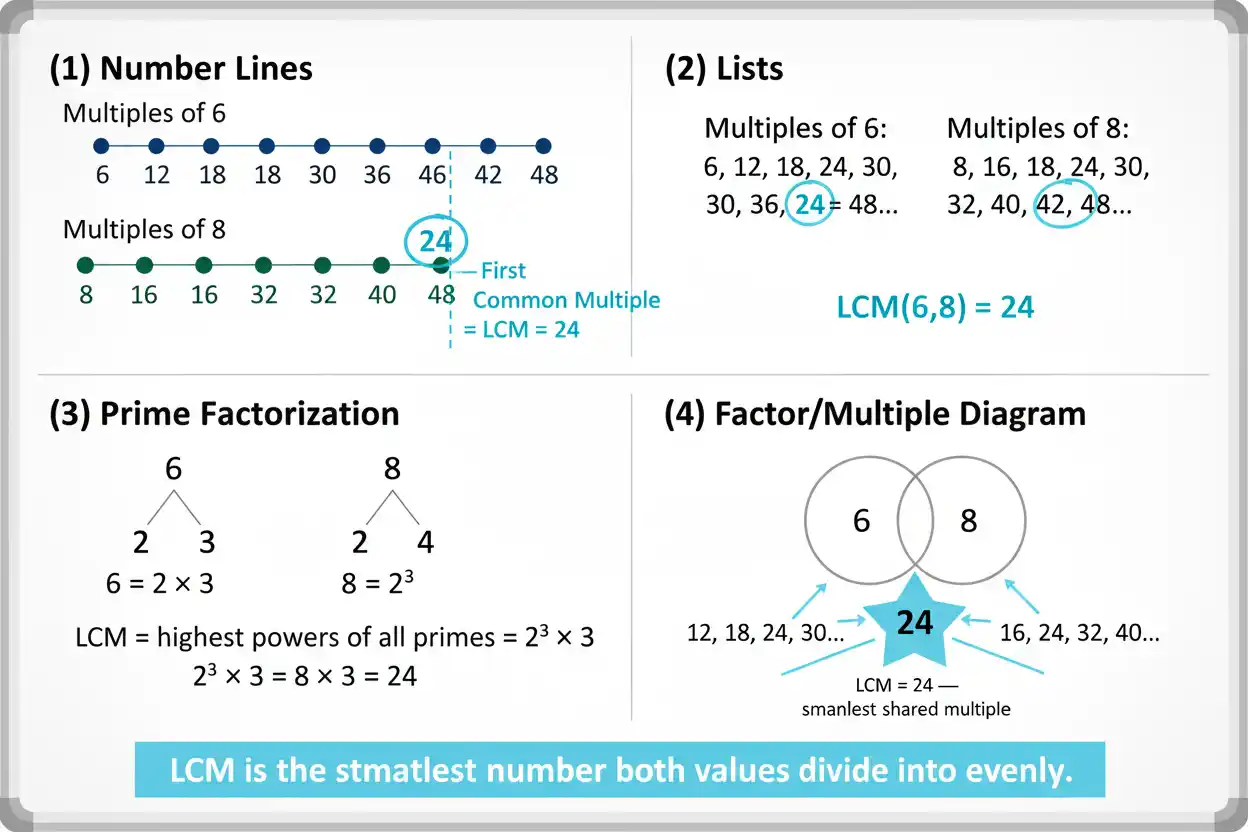

LCM stands for least common multiple. It is the smallest positive integer that is a multiple of two or more given integers.
For example, consider:
6 and 8
Multiples of 6 begin:
6, 12, 18, 24, 30, 36, …
Multiples of 8 begin:
8, 16, 24, 32, 40, …
The first positive value appearing in both lists is:
24
Therefore:
LCM(6,8) = 24
LCM is useful whenever repeating integer intervals need to align, fractions need common denominators, or multiple divisibility conditions must be satisfied simultaneously.
What Does LCM Mean?
The abbreviation:
LCM
means:
Least Common Multiple
Each word has a specific role.
Multiple means a number can be written as the original integer multiplied by another integer.
Common means the value is a multiple of every integer being considered.
Least means the smallest positive shared multiple is selected.
For example:
12, 24, 36, 48, …
are multiples of 12.
And:
18, 36, 54, 72, …
are multiples of 18.
Their first positive shared value is:
36
Therefore:
LCM(12,18) = 36
The detailed formula-based methods belong to the separate least common multiple page. Here the emphasis is on what LCM means, how to recognize it, and when it is useful.
What Is a Multiple?
For an integer a, a multiple has the form:
a × k
where k is an integer.
Positive multiples of 5 include:
5, 10, 15, 20, 25, 30, …
because:
5 × 1 = 5
5 × 2 = 10
5 × 3 = 15
and so on.
A positive integer has infinitely many positive multiples.
Common Multiples
A common multiple belongs to the multiple lists of two or more numbers.
For 4 and 6:
Multiples of 4:
4, 8, 12, 16, 20, 24, 28, 32, 36, …
Multiples of 6:
6, 12, 18, 24, 30, 36, …
Common multiples include:
12, 24, 36, …
The least is:
12
Therefore:
LCM(4,6) = 12
LCM Is Always Positive
For positive input integers, the LCM is conventionally reported as a positive integer.
For example:
LCM(9,12) = 36
Although negative multiples also exist:
-36
is not reported as the least common multiple under the standard definition.
The word “least” refers to the smallest positive common multiple.
LCM of Two Identical Numbers
If both inputs are the same positive integer:
LCM(a,a) = a
For example:
LCM(14,14) = 14
The number 14 is already a positive multiple of both inputs and no smaller positive common multiple exists.
LCM When One Number Divides the Other
Suppose:
5 and 20
Since:
20 = 5 × 4
20 is already a multiple of 5 as well as itself.
Therefore:
LCM(5,20) = 20
In general, if positive integer a divides b:
LCM(a,b) = b
when b is the larger value.
LCM of Coprime Numbers
When two positive integers have no common factor greater than 1, their LCM equals their product.
For example:
8 and 15
have:
GCF(8,15) = 1
Therefore:
LCM(8,15) = 8 × 15
= 120
So:
LCM(8,15) = 120
This relationship follows from the fact that the two integers have no shared prime factors that need to be counted only once.
LCM and GCF Relationship
For positive integers a and b:
GCF(a,b) × LCM(a,b) = a × b
Therefore:
LCM(a,b) = (a × b) / GCF(a,b)
For example:
a = 18
b = 24
Their GCF is:
6
So:
LCM = (18 × 24)/6
= 432/6
= 72
Therefore:
LCM(18,24) = 72
This connects the smallest common multiple with the largest common divisor.
Example: LCM of 12 and 30
Find:
GCF(12,30)
The answer is:
6
Then:
LCM(12,30) = (12 × 30)/6
= 360/6
= 60
Therefore:
LCM(12,30) = 60
Check:
60 ÷ 12 = 5
60 ÷ 30 = 2
So 60 is a common multiple.
Method 1: List Multiples
For small values, listing multiples is straightforward.
Find:
LCM(5,7)
Multiples of 5:
5, 10, 15, 20, 25, 30, 35, …
Multiples of 7:
7, 14, 21, 28, 35, …
The first shared value is:
35
Therefore:
LCM(5,7) = 35
Since 5 and 7 are distinct prime numbers, their product gives the same result.
Example: LCM of 6 and 9
Multiples of 6:
6, 12, 18, 24, 30, 36, …
Multiples of 9:
9, 18, 27, 36, …
The first common multiple is:
18
Therefore:
LCM(6,9) = 18
Method 2: Prime Factorization
LCM can also be found from prime factors.
Suppose:
12 = 2² × 3
and:
18 = 2 × 3²
For an LCM, use every prime appearing in either number and take the largest exponent.
For 2:
max(2,1) = 2
For 3:
max(1,2) = 2
Therefore:
LCM = 2² × 3²
= 4 × 9
= 36
So:
LCM(12,18) = 36
The detailed calculation procedures are covered more extensively under least common multiple.
LCM vs. GCF
LCM and GCF solve opposite divisibility problems.
For:
8 and 12
the shared positive factors are:
1, 2, 4
so:
GCF = 4
Their positive common multiples begin:
24, 48, 72, …
so:
LCM = 24
Thus:
GCF asks for the largest shared divisor.
LCM asks for the smallest shared multiple.
Why LCM Matters for Fractions
Suppose you want to add:
1/6 + 1/8
The denominators differ.
A common denominator must be a multiple of both:
6 and 8
Their LCM is:
24
So:
1/6 = 4/24
1/8 = 3/24
Then:
1/6 + 1/8 = 7/24
LCM supplies the smallest convenient common denominator.
LCM and Fraction Operations
During fraction operations, addition and subtraction often require a common denominator.
For:
5/12 + 7/18
find:
LCM(12,18) = 36
Convert:
5/12 = 15/36
7/18 = 14/36
Add:
15/36 + 14/36 = 29/36
Therefore:
5/12 + 7/18 = 29/36
Using the LCM keeps the denominator smaller than simply multiplying:
12 × 18 = 216
LCM and Prime Factorization
prime factorization makes the LCM structure particularly clear.
Suppose:
24 = 2³ × 3
90 = 2 × 3² × 5
Use the largest exponent for each prime appearing:
2³
3²
5¹
Then:
LCM = 2³ × 3² × 5
= 8 × 9 × 5
= 360
Therefore:
LCM(24,90) = 360
Why LCM Uses the Largest Prime Exponents
A common multiple must contain enough copies of every prime factor to be divisible by each original integer.
If:
a = 2³ × 3
and:
b = 2 × 3²
then a common multiple must contain at least:
2³
to be divisible by a
and at least:
3²
to be divisible by b.
Therefore the smallest possible combination is:
2³ × 3²
Using any smaller exponent would fail one divisibility requirement.
LCM of Three Numbers
LCM applies to more than two integers.
Find:
LCM(4,6,10)
Prime factorizations:
4 = 2²
6 = 2 × 3
10 = 2 × 5
Use the largest prime powers:
2²
3
5
Therefore:
LCM = 4 × 3 × 5
= 60
So:
LCM(4,6,10) = 60
Check:
60 ÷ 4 = 15
60 ÷ 6 = 10
60 ÷ 10 = 6
LCM of Four Numbers
Consider:
6, 8, 9, 12
Prime forms:
6 = 2 × 3
8 = 2³
9 = 3²
12 = 2² × 3
The maximum prime powers needed are:
2³
and:
3²
Therefore:
LCM = 8 × 9
= 72
So:
LCM(6,8,9,12) = 72
LCM and Repeating Events
One practical interpretation of LCM is the first time repeating cycles align.
Suppose one event occurs every:
4 days
and another every:
6 days
If they occur together today, they next coincide after:
LCM(4,6)
= 12
days.
Therefore:
the events align every 12 days
under the assumption of fixed integer-day intervals.
Example: Bus Arrivals
Suppose one bus arrives every:
15 minutes
and another every:
20 minutes
If both arrive at the same time now, their next simultaneous arrival occurs after:
LCM(15,20)
Prime factors:
15 = 3 × 5
20 = 2² × 5
Therefore:
LCM = 2² × 3 × 5
= 60
So:
they coincide again after 60 minutes
Example: Machine Cycles
Machine A completes a cycle every:
8 seconds
Machine B completes a cycle every:
12 seconds
Their cycles realign after:
LCM(8,12)
= 24
seconds.
Therefore:
both complete a cycle simultaneously every 24 seconds
if they begin together.
LCM and Lattice Grid Patterns
Lattice points are integer-coordinate points, and LCM can appear when independent grid patterns have different periods.
Suppose one vertical marking pattern repeats every:
6 grid units
while another repeats every:
8 grid units
Their positions coincide again after:
LCM(6,8)
= 24
grid units.
This periodic-alignment use is distinct from counting lattice points on a line segment, which normally relies on a GCD rather than an LCM.
LCM and Integer Operations
LCM is defined through integer multiples, so integer operations underpin the calculation.
For example:
Multiples of 7 = 7 × 1, 7 × 2, 7 × 3, …
giving:
7, 14, 21, …
The multiples themselves remain integers because the factors being multiplied are integers.
LCM and Irrational Numbers
Ordinary elementary LCM is an integer divisibility concept.
An irrational number such as:
√2
or:
π
is not an integer, so the usual positive-integer multiple lists used in LCM calculations do not apply in the same way.
For example, asking:
LCM(6,8)
has the standard answer:
24
But the ordinary elementary definition should not simply be extended to:
LCM(√2,π)
This keeps the concept inside its intended number-theory domain.
LCM and Logarithms
logarithms solve problems involving exponents and multiplicative scales, while LCM solves integer common-multiple problems.
For example:
LCM(12,18) = 36
requires divisibility or factor reasoning, not logarithms.
However, if very large numbers are represented through prime powers, logarithmic estimates may help reason about their magnitude without directly writing every digit.
The two topics remain distinct: LCM is exact integer structure, while logarithms invert exponentiation.
LCM and Exponents
Suppose:
a = 2⁴ × 3²
and:
b = 2² × 3⁵ × 7
The LCM uses the maximum exponent for each prime:
LCM(a,b) = 2⁴ × 3⁵ × 7
This is a direct application of the rules of exponents within prime-factor representation.
The GCF would instead use the minimum common exponents.
LCM and Factors
A number is a multiple of a precisely when a is one of its factors.
For example:
24
is a multiple of 6 because:
6 is a factor of 24
and:
24 ÷ 6 = 4
Therefore finding a common multiple means finding a number whose factor structure contains all required divisors.
LCM and Divisibility Rules
divisibility rules can help verify an LCM candidate.
Suppose someone claims:
LCM(9,12) = 36
Check divisibility:
For 9:
3 + 6 = 9
so 36 is divisible by 9.
For 12, check divisibility by 3 and 4:
3 + 6 = 9
and:
36 ÷ 4 = 9
so 36 is divisible by 12.
Further reasoning confirms no smaller positive common multiple exists.
LCM of Zero and a Positive Integer
A common convention is:
LCM(a,0) = 0
for nonzero integer a.
This is because 0 is a multiple of every integer:
0 = a × 0
and no positive common multiple involving zero exists under the usual positive-multiple requirement.
Some elementary treatments avoid LCM problems containing zero entirely, so the convention should be interpreted according to context.
Negative Inputs
LCM is normally reported as nonnegative and depends on magnitudes rather than signs.
For example:
LCM(-6,8) = 24
The same common-multiple structure comes from:
|−6| = 6
and:
|8| = 8
A practical convention is:
LCM(a,b) = LCM(|a|,|b|)
for nonzero inputs.
LCM Is Not the Product in Every Case
A common mistake is writing:
LCM(a,b) = ab
for all positive integers.
This only works automatically when the numbers are coprime.
For:
6 and 8
the product is:
48
but:
LCM(6,8) = 24
because the numbers share a factor of 2.
Their shared factor does not need to be counted twice in the least common multiple.
LCM and the GCF Product Formula
The product relationship explains the previous example:
GCF(6,8) = 2
Then:
LCM(6,8) = (6 × 8)/2
= 48/2
= 24
So dividing the raw product by the GCF removes the duplicated common factor structure.
LCM vs. Greatest Common Factor
For:
20 and 30
their greatest common factor is:
10
Their LCM is:
60
Check the product identity:
10 × 60 = 600
and:
20 × 30 = 600
The relationship is consistent.
Common LCM Mistake: Choosing Any Common Multiple
For 4 and 6:
24
is a common multiple.
So is:
36
and:
48
But the LCM is:
12
because it is the smallest positive common multiple.
Finding a shared multiple is not enough; you must determine that no smaller positive shared value exists.
Common Mistake: Confusing Factors and Multiples
For 6 and 8:
Common factor:
2
Common multiple:
24
Factors divide the original numbers.
Multiples are divisible by the original numbers.
The direction of the divisibility relationship is reversed.
Common Mistake: Using Minimum Prime Exponents
For an LCM, use the largest exponent of every required prime.
Suppose:
12 = 2² × 3
18 = 2 × 3²
Using minimum exponents gives:
2 × 3 = 6
which is the GCF.
The LCM uses maximum exponents:
2² × 3² = 36
How to Check an LCM
Suppose:
LCM(8,12) = 24
First verify that 24 is a multiple of both:
24 ÷ 8 = 3
24 ÷ 12 = 2
Then determine whether a smaller positive common multiple exists.
Multiples below 24:
For 8:
8,16
For 12:
12
None coincide.
Therefore:
24 is the least common multiple
LCM Through the Product-GCF Check
Suppose:
LCM(18,30) = 90
and:
GCF(18,30) = 6
Check:
GCF × LCM = 6 × 90
= 540
and:
18 × 30 = 540
The product identity confirms consistency.
Frequently Asked Questions
What does LCM stand for?
LCM stands for:
Least Common Multiple
What is an LCM?
It is the smallest positive integer that is divisible by every integer in a given set.
What is the LCM of 4 and 6?
LCM(4,6) = 12
What is the LCM of 6 and 8?
LCM(6,8) = 24
What is the LCM of 12 and 18?
LCM(12,18) = 36
What is the LCM of 5 and 7?
Since 5 and 7 are coprime:
LCM(5,7) = 35
Is LCM the same as GCF?
No. LCM is the smallest shared positive multiple. GCF is the largest shared positive divisor.
What is the LCM formula using GCF?
For positive integers:
LCM(a,b) = (a × b)/GCF(a,b)
Why is LCM useful for fractions?
It can provide the least common denominator needed to add or subtract fractions efficiently.
How do you find an LCM with prime factorization?
Prime-factorize all numbers, then use every prime that appears with the largest exponent required by any input.
Can the LCM equal the larger input number?
Yes. If the larger number is already divisible by the smaller one.
For example:
LCM(6,24) = 24
Is the product always the LCM?
No. The product is automatically the LCM only when the positive integers are coprime.
Final Example
Find:
LCM(18,24,30)
Prime-factorize each number:
18 = 2 × 3²
24 = 2³ × 3
30 = 2 × 3 × 5
Use the largest exponent of every prime appearing.
For 2:
2³
For 3:
3²
For 5:
5¹
Therefore:
LCM = 2³ × 3² × 5
= 8 × 9 × 5
= 360
Check:
360 ÷ 18 = 20
360 ÷ 24 = 15
360 ÷ 30 = 12
All quotients are integers.
Therefore:
LCM(18,24,30) = 360
The key meaning of LCM is straightforward: among all positive numbers divisible by every given integer, select the smallest one.