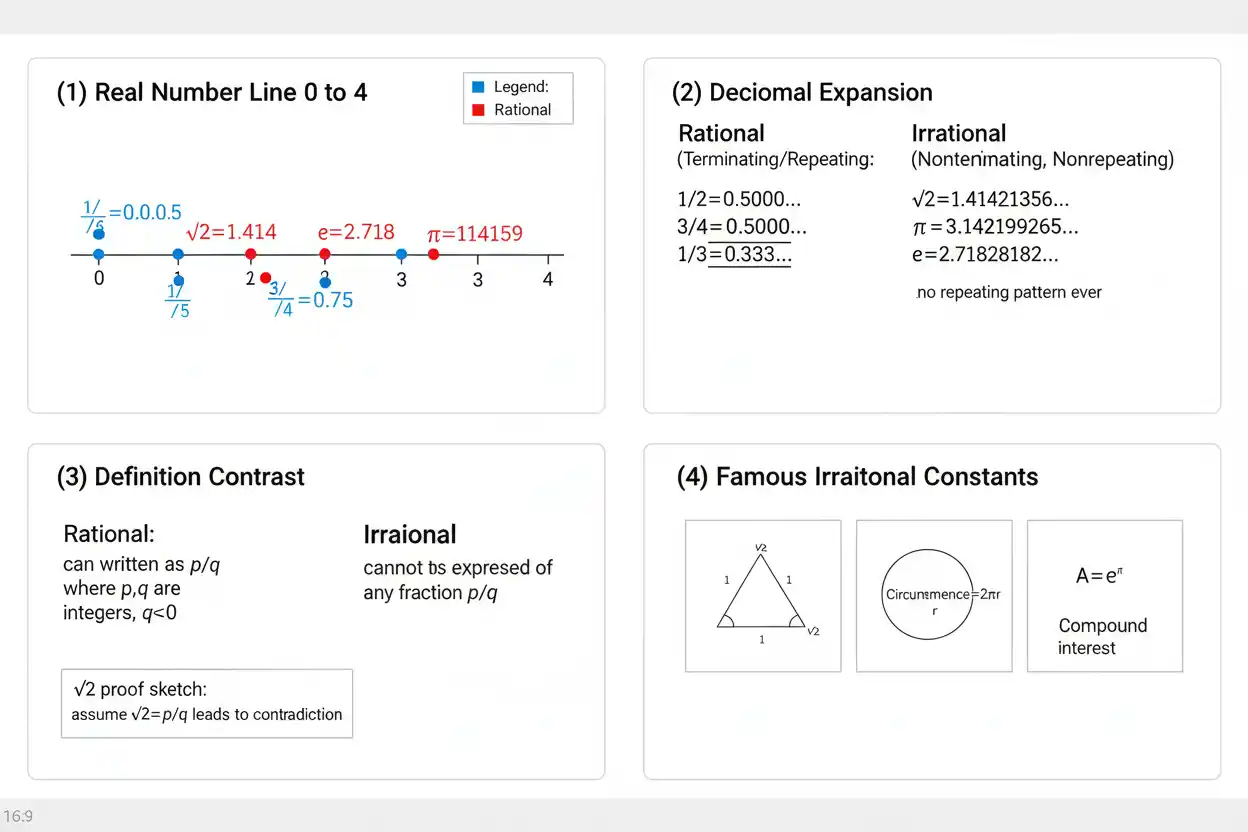

Irrational numbers are real numbers that cannot be written as a ratio of two integers.
A rational number can be expressed as:
a / b
where a and b are integers and:
b ≠ 0
An irrational number cannot be represented exactly in that form.
Common examples include:
√2
√3
π
e
Their decimal expansions do not terminate and do not settle into a repeating block.
For example:
√2 ≈ 1.41421356237…
The displayed decimal is an approximation. The exact number is:
√2
Irrational numbers are part of the real numbers and fill the number line alongside rational values.
What Is an Irrational Number?
A real number x is irrational if there do not exist integers a and b, with b ≠ 0, such that:
x = a/b
In set language, irrational numbers are real numbers that are not rational.
Conceptually:
Irrational numbers = Real numbers – Rational numbers
Examples:
√2
√5
π
e
Non-examples include:
3
-7
1/4
0.125
0.333…
Each non-example is rational because it can be expressed as an integer ratio.
Rational vs. Irrational Numbers
A rational number can be written as:
a/b
for integers a and b ≠ 0.
An irrational number cannot.
For example:
0.75 = 3/4
so 0.75 is rational.
Likewise:
0.333… = 1/3
so the repeating decimal is rational.
But:
√2
cannot be written as an exact fraction of two integers.
Therefore:
√2 is irrational.
Decimal Rule for Irrational Numbers
The decimal expansion of a rational number either:
- terminates, or
- repeats eventually.
An irrational number has a decimal expansion that:
- does not terminate, and
- does not become periodic.
For example:
1/8 = 0.125
terminates, so it is rational.
And:
2/11 = 0.181818…
repeats, so it is rational.
By contrast:
π = 3.141592653589793…
continues without an eventually repeating digit block.
Therefore π is irrational.
Nonterminating Does Not Automatically Mean Irrational
A crucial distinction is that a nonterminating decimal can still be rational if it repeats.
For example:
0.777777…
does not terminate.
But it repeats the digit 7.
It can be written:
7/9
Therefore:
0.777… is rational
To establish irrationality from decimal behavior, the expansion must be both nonterminating and nonrepeating.
Terminating Decimals Are Rational
Any terminating decimal can be written over a power of 10.
For example:
0.625 = 625/1000
Simplify:
625/1000 = 5/8
Therefore:
0.625 is rational
This is one reason ordinary terminating decimal values are never irrational.
Repeating Decimals Are Rational
Consider:
x = 0.272727…
Multiply by 100:
100x = 27.272727…
Subtract:
100x – x = 27
99x = 27
Therefore:
x = 27/99
Simplify:
x = 3/11
So:
0.272727… is rational
Repeating decimals may look infinite, but their repeating structure allows exact fractional representation.
Square Roots and Irrational Numbers
Many irrational numbers arise from roots.
For positive integers, the square root of a perfect square is an integer and therefore rational.
Examples:
√4 = 2
√9 = 3
√25 = 5
But the square root of a positive integer that is not a perfect square is irrational.
Examples:
√2
√3
√5
√7
√10
These cannot be expressed exactly as ratios of integers.
Perfect Squares vs. Irrational Square Roots
Consider:
√36 = 6
Since 36 is one of the perfect squares:
√36
is rational.
Now consider:
√40
Since 40 is not a perfect square, its square root is irrational.
It can be simplified:
√40 = √(4 × 10)
= 2√10
The factor 2 is rational, but:
√10
is irrational.
Therefore:
√40 is irrational
Simplifying Does Not Always Remove Irrationality
Consider:
√72
Factor:
72 = 36 × 2
Then:
√72 = √36 × √2
= 6√2
The radical is simplified, but the result remains irrational because:
√2
is irrational and 6 is a nonzero rational number.
Cube Roots and Irrational Numbers
The same general idea applies to cube roots of integers.
If an integer is a perfect cube, its cube root is an integer.
For example:
∛27 = 3
so the result is rational.
But:
∛2
is irrational.
Likewise:
∛10
is irrational.
The dedicated cube roots topic handles cube-root calculations themselves; irrationality describes the type of resulting number.
Nth Roots and Irrationality
For an integer a, an exact integer nth root is rational.
For example:
⁴√16 = 2
But roots that cannot be reduced to a rational value are often irrational.
For example:
√2
∛5
⁴√3
are irrational.
The nth roots framework determines the root, while the rational-versus-irrational classification describes the nature of that result.
Is π Irrational?
Yes.
The number:
π ≈ 3.141592653589793…
is irrational.
No fraction of integers equals π exactly.
Fractions such as:
22/7
are approximations.
For example:
22/7 ≈ 3.142857…
which is close to π but not equal to it.
The distinction between exact equality and approximation is essential.
Is e Irrational?
Yes.
The mathematical constant:
e ≈ 2.718281828459045…
is irrational.
Like π, it cannot be represented exactly as a ratio of two integers.
Finite decimal forms such as:
2.71828
are rational approximations to e, not the exact constant.
Integers Are Rational, Not Irrational
Every integer can be written with denominator 1.
For example:
7 = 7/1
-12 = -12/1
0 = 0/1
Therefore every integer is rational.
The integer operations page concerns arithmetic within the integer set; irrational numbers belong to the larger real-number system.
Improper Fractions Are Rational
Every valid improper fraction is a ratio of integers.
For example:
17/5
is rational.
Its decimal value is:
3.4
Likewise:
10/3 = 3.333…
is rational despite having a nonterminating decimal expansion because its digits repeat.
Therefore:
No ordinary fraction of integers with a nonzero denominator is irrational.
Irrational Numbers on the Number Line
Irrational numbers occupy exact positions on the real number line.
For example:
1 < √2 < 2
because:
1² < 2 < 2²
More precisely:
√2 ≈ 1.4142
Similarly:
3 < π < 4
These numbers are not vague or indeterminate simply because their decimal expansions are infinite.
Each represents one exact real-number value.
Approximating Irrational Numbers
Since their decimal expansions do not terminate or repeat, irrational numbers are often approximated for practical calculations.
For example:
√2 ≈ 1.414
π ≈ 3.142
The number of decimal places retained depends on the required precision.
An approximation should not be confused with the exact value.
For example:
π ≠ 3.14
but:
π ≈ 3.14
Rounding Irrational Numbers
Suppose:
√7 ≈ 2.64575131…
Rounded to two decimal places:
√7 ≈ 2.65
Rounded to three:
√7 ≈ 2.646
The rounding rules determine how the approximation is reported.
Rounding never converts the exact irrational number itself into a rational number. It creates a rational approximation.
Can an Irrational Number Be Written as a Decimal?
Yes.
Every real number has a decimal expansion.
The key difference is the pattern.
Rational decimals terminate or eventually repeat.
Irrational decimals continue indefinitely without becoming periodic.
For example:
√2 = 1.414213562373095…
The infinite decimal is an exact representation in principle, while any finite truncation of it is only an approximation.
Rational Plus Irrational
If:
r
is rational and:
x
is irrational, then:
r + x
is irrational.
For example:
3 + √2
is irrational.
Why?
If 3 + √2 were rational, subtracting the rational number 3 would imply:
√2
is rational.
That is a contradiction.
Therefore:
rational + irrational = irrational
Rational Minus Irrational
Similarly:
rational – irrational = irrational
For example:
5 – π
is irrational.
If it were rational, subtracting it from rational 5 would make π rational, which is impossible.
Irrational Plus Irrational
The sum of two irrational numbers may be rational or irrational.
For example:
√2 + (-√2) = 0
which is rational.
But:
√2 + √3
is irrational.
Therefore there is no general rule saying:
irrational + irrational = irrational
in every case.
Irrational Minus Irrational
Again, the result may be rational or irrational.
For example:
√5 – √5 = 0
is rational.
But:
√5 – √2
is irrational.
The classification depends on the particular values.
Nonzero Rational Times Irrational
If r is a nonzero rational number and x is irrational:
rx
is irrational.
For example:
4√3
is irrational.
If 4√3 were rational, dividing by rational nonzero 4 would imply:
√3
is rational.
That is impossible.
Zero Times an Irrational Number
The nonzero condition matters.
For any real number x:
0 × x = 0
Therefore:
0 × π = 0
and 0 is rational.
So it would be wrong to say that rational times irrational is always irrational without excluding the rational value zero.
Irrational Times Irrational
The product may be rational or irrational.
For example:
√2 × √2 = 2
which is rational.
But:
√2 × √3 = √6
which is irrational.
Therefore:
irrational × irrational
does not have one universal classification.
Irrational Divided by a Nonzero Rational
If x is irrational and r is a nonzero rational number:
x/r
is irrational.
For example:
π/2
is irrational.
If it were rational, multiplying by 2 would imply that π is rational.
Irrational Divided by Irrational
The quotient may be rational or irrational.
For example:
√2 / √2 = 1
which is rational.
But:
√2 / √3
is irrational.
Again, knowing only that both operands are irrational is insufficient to classify the result.
Powers of Irrational Numbers
An irrational base can produce a rational or irrational power result.
For example:
(√2)² = 2
which is rational.
But:
(√2)³ = 2√2
which is irrational.
Therefore irrationality is not automatically preserved under exponentiation.
The exponents involved must be evaluated before classifying the final number.
Can a Rational Number Have an Irrational Power?
Yes.
For example:
2^(1/2) = √2
The base 2 is rational.
The exponent:
1/2
is rational.
Yet the result is irrational.
This is another reason number classification should be applied to the evaluated value rather than guessed from the types of its individual components.
Irrational Numbers and Lattice Points
A lattice point has integer coordinates.
For example:
(3, -2)
is a lattice point.
But:
(√2, 4)
is not a lattice point because:
√2
is not an integer.
Similarly:
(π, 1)
is not a lattice point.
The coordinate plane contains many points with irrational coordinates, but those points lie outside the integer-coordinate lattice.
Irrational Numbers and the LCM
The LCM is an integer divisibility concept.
It applies to integers such as:
6 and 8
where:
LCM(6,8) = 24
An irrational number such as:
√2
does not have integer multiples in the ordinary least-common-multiple sense used for whole-number arithmetic.
Therefore LCM problems should not be extended indiscriminately to irrational values.
Irrational Numbers and Least Common Multiple
Likewise, the detailed least common multiple calculation is based on integer factors and multiples.
For:
12 and 18
the least common multiple is:
36
But asking for the ordinary elementary LCM of:
√2 and π
does not fit that integer-number-theory definition.
This distinction keeps integer divisibility tools within their intended domain.
Irrational Numbers in Hexadecimal
hexadecimal changes the base used to represent a number; it does not change whether the number is rational or irrational.
For example:
1/2
is rational in decimal, binary, or hexadecimal representation.
An irrational number such as:
√2
remains irrational in base 16.
Its hexadecimal expansion, like its decimal expansion, cannot terminate or eventually repeat if it represents the exact irrational value.
A finite hexadecimal representation can only approximate it.
Irrational Numbers and Number Bases
A rational number may terminate in one base and repeat in another.
For example:
1/3
repeats in decimal.
Its appearance changes under other bases, but the number remains rational because it is still exactly:
1/3
Irrationality is therefore not defined by how inconvenient a particular base representation looks. It is defined by whether the number can be expressed as an integer ratio.
Irrational Numbers and Prime Factorization
Prime factorization can help determine whether certain integer square roots simplify to rational values.
Consider:
√72
Factor:
72 = 2³ × 3²
Separate square pairs:
√72 = √(2² × 3² × 2)
= 2 × 3 × √2
= 6√2
Because an unpaired factor of 2 remains under the square root:
√72
is irrational.
Example: Determine Whether √144 Is Irrational
Prime factorization:
144 = 2⁴ × 3²
All prime exponents are even.
Therefore:
√144 = 2² × 3
= 12
Since 12 is an integer:
√144 is rational
It is not irrational.
Example: Determine Whether √180 Is Irrational
Factor:
180 = 36 × 5
Then:
√180 = √36 × √5
= 6√5
Since:
√5
is irrational:
√180 is irrational
Simplifying the radical does not change its irrational classification.
Irrational Numbers and Decimal to Fraction Conversion
A terminating or repeating decimal can be converted exactly with the decimal to fraction process.
For example:
0.125 = 1/8
and:
0.272727… = 3/11
An irrational decimal has no such exact fraction of integers.
You may approximate:
π ≈ 314159/100000
but that fraction equals the approximation 3.14159, not π itself.
Irrational Numbers and Improper Fractions
An ordinary improper fraction always has the form:
a/b
for integers a and b ≠ 0.
Therefore it is rational by definition.
For example:
29/6
is rational even though:
29/6 = 4.83333…
The repeating decimal confirms, rather than contradicts, its rationality.
Irrational Numbers and Integer Operations
Integer operations remain inside the integer set for addition, subtraction, and multiplication.
For example:
5 + (-8) = -3
Introducing an irrational value changes the classification:
5 + √2
is irrational.
The integer itself remains rational; the result becomes irrational because a rational number has been combined additively with an irrational one.
Comparing Irrational Numbers
Irrational values can be compared exactly or approximately.
For example:
√2 < √3
because:
2 < 3
and both roots are positive.
Similarly:
π > 3
because:
π ≈ 3.14159
Approximation is useful, but exact algebraic relationships should be preferred when available.
Irrational Numbers Between Integers
Every irrational real number lies somewhere on the number line.
For example:
2 < √5 < 3
because:
2² = 4
and:
3² = 9
with:
4 < 5 < 9
Therefore:
√5
lies between 2 and 3.
This comparison can be made without calculating a long decimal expansion.
There Are Irrational Numbers Between Rational Numbers
Consider the rational numbers:
1 and 2
The irrational number:
√2
lies between them.
But there are not merely a few irrational numbers in that interval. There are infinitely many.
The real-number line is densely populated with both rational and irrational numbers.
Between any two distinct real numbers, other real numbers exist.
Are Irrational Numbers Rare?
No.
Although familiar examples such as π and √2 receive special attention, irrational numbers are not exceptional gaps between rational values.
Mathematically, there are vastly more irrational real numbers than rational numbers in the sense of set cardinality.
Both types are dense on the real number line, meaning any interval contains rational and irrational values.
Algebraic and Transcendental Irrational Numbers
Some irrational numbers are solutions to polynomial equations with integer coefficients.
For example:
√2
satisfies:
x² – 2 = 0
Such numbers are called algebraic.
Other irrational numbers, including:
π
and:
e
are transcendental: they are not roots of any nonzero polynomial with integer coefficients.
Both categories contain irrational numbers, but transcendence is a stronger property than irrationality.
Common Irrational Number Mistake: Infinite Means Irrational
It is incorrect to say:
“Every infinite decimal is irrational.”
For example:
0.12121212…
continues forever but repeats.
Therefore it is rational.
The correct rule is:
nonterminating + nonrepeating decimal = irrational
Common Mistake: Every Radical Is Irrational
A radical does not automatically represent an irrational number.
For example:
√49 = 7
which is rational.
Similarly:
∛125 = 5
which is rational.
You must evaluate or simplify the root before classifying it.
Common Mistake: Every Sum of Irrationals Is Irrational
Consider:
√2 + (-√2) = 0
Both terms are irrational, but their sum is rational.
Therefore the result of combining two irrational numbers must be evaluated individually.
Common Mistake: Decimal Approximation Equals the Exact Number
It is incorrect to write:
π = 3.14
The correct relationship is:
π ≈ 3.14
Likewise:
√2 ≈ 1.414
A finite decimal approximation is rational, whereas the exact irrational number is not.
How to Identify an Irrational Number
A number is irrational if you can establish that it cannot be expressed as an integer ratio.
Useful clues include:
- a known irrational constant such as π or e,
- a square root of a positive integer that is not a perfect square,
- an nth root that cannot simplify to a rational result,
- a known nonterminating, nonrepeating decimal.
However, an arbitrary displayed decimal with only finitely many shown digits is rational as written.
For example:
1.414213
is a terminating decimal and therefore rational, even though it may be intended as an approximation to irrational √2.
How to Check a Radical
Consider:
√98
Factor:
98 = 49 × 2
Then:
√98 = 7√2
Because:
√2
is irrational and 7 is nonzero rational:
√98 is irrational
Now consider:
√196
Since:
196 = 14²
we get:
√196 = 14
Therefore:
√196 is rational
Frequently Asked Questions
What are irrational numbers?
Irrational numbers are real numbers that cannot be written exactly as a ratio of two integers.
What is the definition of an irrational number?
A real number x is irrational when there are no integers a and b, with b ≠ 0, such that:
x = a/b
What are examples of irrational numbers?
Common examples include:
√2, √3, √5, π, e
Is π irrational?
Yes.
Is √2 irrational?
Yes.
Is √4 irrational?
No.
√4 = 2
and 2 is rational.
Are repeating decimals irrational?
No. Repeating decimals are rational.
For example:
0.333… = 1/3
Are terminating decimals irrational?
No. Every terminating decimal can be written as a fraction with a power of 10 in the denominator.
Can an irrational number be negative?
Yes.
For example:
-√2
and:
-π
are irrational.
Is the sum of two irrational numbers always irrational?
No.
For example:
√2 + (-√2) = 0
Is a rational number plus an irrational number irrational?
Yes.
Is the product of two irrational numbers always irrational?
No.
For example:
√2 × √2 = 2
Is an improper fraction irrational?
No. A valid improper fraction is a ratio of integers, so it is rational.
Can irrational numbers be approximated by fractions?
Yes. They can be approximated as closely as desired by rational numbers, but no fraction of integers equals an irrational number exactly.
Final Example
Classify each number as rational or irrational:
√81
√18
0.454545…
π
17/6
√81
Since:
√81 = 9
and 9 is an integer:
Rational
√18
Simplify:
√18 = √(9 × 2)
= 3√2
Since √2 is irrational:
Irrational
0.454545…
The block 45 repeats.
Therefore the decimal is rational.
In fact:
0.454545… = 5/11
So:
Rational
π
π cannot be expressed exactly as a ratio of integers.
Therefore:
Irrational
17/6
This is already a ratio of integers with nonzero denominator.
Therefore:
Rational
The central distinction is exact: rational numbers can be expressed as integer fractions, while irrational numbers cannot. In decimal form, that difference appears as terminating or eventually repeating expansions for rational numbers and nonterminating, nonrepeating expansions for irrational numbers.