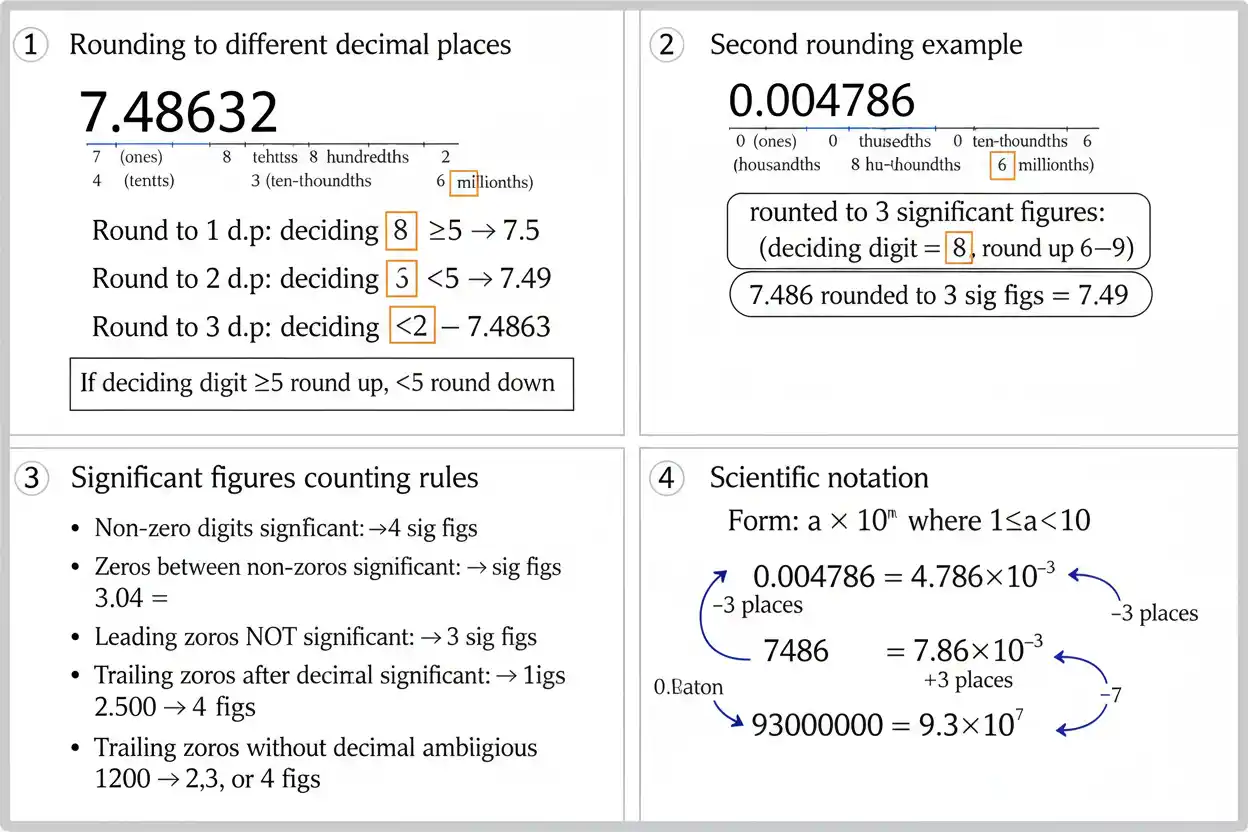

Rounding rules replace a number with a nearby value at a chosen level of precision while keeping the result as close as the specified method permits.
For ordinary decimal-place rounding:
- Identify the digit you want to keep.
- Look at the digit immediately to its right.
- If that next digit is 0–4, keep the retained digit unchanged.
- If it is 5–9, increase the retained digit by 1.
- Remove the remaining digits.
For example, round:
7.486
to two decimal places.
The hundredths digit is:
8
The next digit is:
6
Since 6 is at least 5, increase 8 to 9:
7.486 ≈ 7.49
The symbol:
≈
is useful because the rounded value is an approximation rather than an exact equality.
What Is Rounding?
Rounding reduces numerical precision in a controlled way.
For example:
12.78364
might be represented as:
12.78
to two decimal places.
The exact value and rounded value are not identical:
12.78364 ≠ 12.78
but:
12.78364 ≈ 12.78
Rounding is used when exact digits are unnecessary, unavailable, or impractical for the intended calculation.
Basic Rounding Rule
Suppose you are rounding to a selected place.
Look one digit to the right.
If that digit is:
0, 1, 2, 3, or 4
leave the retained digit unchanged.
If it is:
5, 6, 7, 8, or 9
increase the retained digit by 1.
Then discard all digits farther to the right.
This is the familiar elementary round-half-up convention for positive decimal values.
Some statistical, financial, programming, and scientific systems use different tie-breaking conventions for an exact trailing 5, so the required convention should be followed when one is specified.
Decimal Place Values
To round decimals correctly, identify place value.
For:
43.72658
the digits are:
4 tens
3 ones
7 tenths
2 hundredths
6 thousandths
5 ten-thousandths
8 hundred-thousandths
The desired place determines which digit is retained and which digit determines the rounding direction.
Round to the Nearest Whole Number
Round:
18.6
to the nearest whole number.
Retain:
18
Look at the tenths digit:
6
Since:
6 ≥ 5
round up:
18.6 ≈ 19
Now consider:
18.3
The tenths digit is 3, so:
18.3 ≈ 18
Round to One Decimal Place
Round:
5.47
to one decimal place.
The tenths digit is:
4
Look at the hundredths digit:
7
Round the tenths digit up:
5.47 ≈ 5.5
Round to Two Decimal Places
Round:
13.624
to two decimal places.
Keep:
13.62
Look at the third decimal digit:
4
Since it is below 5:
13.624 ≈ 13.62
Round to Three Decimal Places
Round:
2.71886
to three decimal places.
Keep:
2.718
Look at the next digit:
8
Increase the thousandths digit:
8 → 9
Therefore:
2.71886 ≈ 2.719
Carrying During Rounding
Rounding can produce a carry.
Consider:
4.9996
rounded to three decimal places.
Keep:
4.999
Next digit:
6
Increase the final retained 9.
That causes carrying:
4.999 → 5.000
Therefore:
4.9996 ≈ 5.000
Writing the trailing zeros may be important because they communicate the requested precision.
Rounding Whole Numbers
The same rounding rules apply to positions left of the decimal point.
Round:
4,783
to the nearest hundred.
The hundreds digit is:
7
Look at the tens digit:
8
Round 7 up:
8
Replace lower places with zeros:
4,783 ≈ 4,800
Round to the Nearest Ten
Round:
6,274
to the nearest ten.
Retain the tens digit:
7
Look at the ones digit:
4
Keep the tens digit unchanged.
Therefore:
6,274 ≈ 6,270
Round to the Nearest Thousand
Round:
184,650
to the nearest thousand using the ordinary half-up rule.
The thousands digit is:
4
The hundreds digit is:
6
Round up:
184,650 ≈ 185,000
Negative Number Rounding
The easiest approach is usually to round the magnitude using the specified convention, then restore the sign.
For example:
-7.46
to one decimal place.
Magnitude:
7.46
The hundredths digit is:
6
so:
7.46 ≈ 7.5
Therefore:
-7.46 ≈ -7.5
Notice that -7.5 is numerically smaller than -7.4; language such as “round up” can therefore be ambiguous for negative numbers. It is clearer to describe changing the retained digit based on the next digit.
Exact Halfway Cases
Consider:
2.5
rounded to a whole number.
Under ordinary round-half-up:
2.5 → 3
But not every system uses that rule.
A common alternative is round half to even, where an exact midpoint is rounded toward the result whose retained final digit is even.
Under half-to-even:
2.5 → 2
3.5 → 4
This convention can reduce cumulative directional bias in repeated rounding.
Use the rule required by the problem or application.
Rounding vs. Truncation
Rounding considers the first discarded digit.
Truncation simply removes unwanted digits.
For:
8.769
to two decimal places:
Rounded:
8.77
Truncated:
8.76
These operations are different.
Rounding vs. Floor
The floor function always moves to the greatest integer not exceeding the number.
For:
4.9
nearest-integer rounding gives:
5
but:
floor(4.9) = 4
For:
-4.1
nearest-integer rounding gives:
-4
while:
floor(-4.1) = -5
The floor and ceiling functions therefore should not be treated as ordinary rounding rules.
Rounding and Decimal Arithmetic
Accurate decimal arithmetic is important before a result is rounded.
Suppose:
7.84 ÷ 3.2 = 2.45
If the final answer requires one decimal place:
2.45 ≈ 2.5
Rounding operands before performing the arithmetic can produce a different result, so full available precision should normally be retained until the end.
Do Not Round Too Early
Suppose:
x = 1.246
and a later calculation uses:
10x
Exact intermediate calculation:
10 × 1.246 = 12.46
Rounded to one decimal place:
12.5
If x had first been rounded to:
1.2
then:
10 × 1.2 = 12
The early rounding creates a much larger discrepancy.
Therefore:
round final results rather than intermediate values whenever practical
unless the method explicitly requires intermediate rounding.
Guard Digits
When a final answer needs a specified precision, retaining extra intermediate digits can reduce accumulated error.
Suppose a final result must have:
3 decimal places.
An intermediate calculator value might be kept as:
1.7320508
rather than immediately shortened to:
1.732
Only the final reported result is rounded to the required place.
These extra retained digits are often called guard digits.
Significant Figures
Significant figures describe precision based on meaningful digits rather than fixed decimal places.
For example:
12.34
contains:
4 significant figures
The value:
0.001234
also contains:
4 significant figures
because leading zeros only locate the decimal point and are not significant.
The dedicated significant figures topic covers counting and calculation conventions in greater depth.
Basic Significant-Figure Rules
For ordinary decimal notation:
All nonzero digits are significant.
Zeros between nonzero digits are significant.
Leading zeros are not significant.
Trailing zeros after a decimal point are significant when they indicate measured precision.
For example:
0.004050
has significant digits:
4, 0, 5, 0
Therefore it has:
4 significant figures
Nonzero Digits
Every nonzero digit counts as significant.
For example:
4728
has:
4 significant figures
and:
3.14159
has:
6 significant figures
Leading Zeros
Leading zeros are not significant.
For:
0.00052
the significant digits are:
5 and 2
Therefore:
0.00052 has 2 significant figures
The zeros only establish place value.
Zeros Between Nonzero Digits
Zeros between nonzero digits are significant.
For example:
1.007
has:
4 significant figures
The two internal zeros are part of the measured precision.
Trailing Decimal Zeros
Trailing zeros to the right of a decimal point can be significant.
For example:
2.500
communicates:
4 significant figures
whereas:
2.5
has:
2 significant figures
Although the numerical values are equal, their stated precision differs.
Ambiguous Trailing Zeros in Whole Numbers
The notation:
1,500
can be ambiguous.
It may represent two, three, or four significant figures depending on context.
Scientific notation removes the ambiguity:
1.5 × 10³ → 2 significant figures
1.50 × 10³ → 3 significant figures
1.500 × 10³ → 4 significant figures
Rounding to Significant Figures
To round to n significant figures:
- Find the first nonzero digit.
- Count
nsignificant digits from there. - Inspect the next digit.
- Apply the specified rounding convention.
- Replace or remove later digits as necessary.
Example: 7.486 to 3 Significant Figures
Significant digits begin immediately at 7.
Keep:
7, 4, 8
The next digit is:
6
Round 8 upward:
9
Therefore:
7.486 ≈ 7.49
to three significant figures.
Example: 0.004786 to 3 Significant Figures
Ignore leading zeros.
The first three significant digits are:
4, 7, 8
Next digit:
6
Round 8 up:
9
Therefore:
0.004786 ≈ 0.00479
to three significant figures.
Example: 58,472 to 3 Significant Figures
Keep:
5, 8, 4
Next digit:
7
Round 4 upward:
5
Replace later place values with zeros:
58,472 ≈ 58,500
To make precision explicit:
5.85 × 10⁴
clearly shows three significant figures.
Decimal Places vs. Significant Figures
Decimal places count digits after the decimal point.
Significant figures count meaningful digits beginning with the first significant digit.
Consider:
0.004586
To three decimal places:
The third decimal position is the thousandths place.
0.004586 ≈ 0.005
To three significant figures:
Keep:
4, 5, 8
Next digit:
6
Therefore:
0.004586 ≈ 0.00459
These results are very different because the precision definitions are different.
Rounding Scientific Notation
Suppose:
6.37824 × 10⁷
must be rounded to four significant figures.
Round the coefficient:
6.37824 → 6.378
because the next digit is 2.
Therefore:
6.378 × 10⁷
The power of 10 remains unchanged.
Carrying in Scientific Notation
Round:
9.999 × 10⁴
to three significant figures.
The coefficient:
9.999
rounds to:
10.0
But normalized scientific notation requires:
1 ≤ |a| < 10
Therefore:
10.0 × 10⁴ = 1.00 × 10⁵
So:
9.999 × 10⁴ ≈ 1.00 × 10⁵
to three significant figures.
Scientific Functions and Rounding
Outputs from scientific functions such as trigonometric functions, logarithms, and roots often contain many decimal digits.
For example:
√7 ≈ 2.64575131…
If the requested result is three decimal places:
√7 ≈ 2.646
The calculator may display many digits, but the reporting precision should follow the problem’s requirements.
Roots and Rounding
The mapped roots topic frequently produces irrational values.
For example:
∛10 ≈ 2.15443469…
To two decimal places:
2.15
To four significant figures:
2.154
A radical can often be retained exactly when no decimal approximation is required.
Rounding Real Numbers
Any finite real value can be approximated to a chosen decimal resolution.
For example, the real number:
π ≈ 3.14159265…
can be rounded:
to two decimal places:
3.14
to four decimal places:
3.1416
to three significant figures:
3.14
The rounded decimal is an approximation to the exact real value π.
Rounding and Remainders
remainders describe exact leftovers in integer division, not approximate values.
For:
17 ÷ 5
quotient-and-remainder form is:
3 R2
Exact decimal form:
3.4
Rounded to a whole number:
3
These are three different representations or operations.
The remainder 2 should not be confused with the decimal digit used for rounding.
Rounding Fractions
Suppose:
2/7
As a decimal:
0.285714…
Rounded to three decimal places:
0.286
The fraction:
2/7
is exact.
The decimal:
0.286
is approximate.
When possible, retaining the fraction can preserve exactness until a decimal result is actually required.
Rounding Percentages
Suppose a calculation gives:
17/23 × 100%
≈ 73.913043…%
Rounded to one decimal place:
73.9%
Rounded to the nearest whole percent:
74%
The denominator and numerator should generally be used at full precision before the final percentage is rounded.
Rounding Errors
If an exact value is replaced with a rounded value, the difference is a rounding error.
Suppose:
x = 4.376
rounded to:
4.38
Absolute rounding error:
|4.38 – 4.376|
= 0.004
The approximation is close but not exact.
Repeated rounding can allow such errors to accumulate.
Maximum Error From Decimal-Place Rounding
When using nearest-value rounding, a value rounded to a particular unit differs from the exact value by at most half that unit, aside from boundary-convention details.
Rounded to nearest whole number:
maximum magnitude of rounding error ≈ 0.5
Rounded to nearest tenth:
≈ 0.05
Rounded to nearest hundredth:
≈ 0.005
For example, a value reported as:
7.3
to the nearest tenth conventionally represents values roughly from:
7.25
up to but not including:
7.35
under half-up boundary handling.
Rounding Intervals
If a positive measurement is rounded to:
12.4
to the nearest tenth, the half-unit is:
0.05
So the underlying value lies around:
12.35 ≤ x < 12.45
under a standard half-up interval convention.
Such bounds are useful when reconstructing possible original values from rounded data.
Significant Figures in Multiplication and Division
In many measurement contexts, a multiplication or division result is reported with the same number of significant figures as the input with the fewest significant figures.
Suppose:
4.2 × 3.15
Exact calculator product:
13.23
The inputs contain:
2 significant figures
and:
3 significant figures
Using the common measurement convention, report:
13
to two significant figures.
This is a reporting rule tied to measured precision, not an algebraic requirement for exact mathematical numbers.
Significant Figures in Addition and Subtraction
For measured quantities, addition and subtraction are commonly rounded according to decimal place rather than number of significant figures.
Suppose:
12.34 + 1.2
Exact arithmetic:
13.54
The least precise input reaches only the tenths place.
So a typical measurement-reporting result is:
13.5
Again, the rule applies to stated measurement precision, not to exact abstract arithmetic.
Exact Numbers and Significant Figures
Counts and mathematically exact definitions do not necessarily limit significant figures.
For example:
12 objects
may be an exact count rather than a measurement rounded to two significant figures.
Likewise:
1 meter = 100 centimeters
is an exact defined conversion.
The precision limitations of measured values should not automatically be imposed on exact constants.
Rounding to Tens, Hundreds, and Thousands
The same next-digit rule applies to whole-number positions.
Round:
36,782
to nearest ten:
36,780
to nearest hundred:
36,800
to nearest thousand:
37,000
Each result uses a different retained place.
Rounding Very Small Numbers
Consider:
0.000067384
To two significant figures:
First significant digit:
6
Second:
7
Next digit:
3
So:
0.000067
To three significant figures:
Keep:
6,7,3
Next digit:
8
Round:
0.0000674
Scientific notation can make this easier to see:
6.7384 × 10^-5
Rounding Very Large Numbers
Consider:
987,654,321
to four significant figures.
Keep:
9,8,7,6
Next digit:
5
Under half-up, increase the retained 6:
7
Therefore:
987,654,321 ≈ 987,700,000
Scientific notation makes the stated precision clearer:
9.877 × 10⁸
Approximation Symbol
Use:
≈
when two values are approximately equal.
For example:
√2 ≈ 1.414
Using:
=
would claim exact equality, which is false.
For exact transformations:
1/4 = 0.25
is appropriate because the values are exactly equal.
Common Mistake: Looking at Too Many Discarded Digits
To round:
3.14249
to three decimal places, retain:
3.142
Only the next digit:
4
determines the decision.
Therefore:
3.14249 ≈ 3.142
You do not look ahead to the later 9 and use it to make the 4 act like a 5.
Common Mistake: Dropping Digits Instead of Rounding
Round:
6.378
to two decimal places.
Dropping the last digit gives:
6.37
But the discarded digit is:
8
so the correct rounded value is:
6.38
Simply cutting off digits is truncation.
Common Mistake: Counting Leading Zeros as Significant
For:
0.00340
the zeros before 3 are not significant.
The digits:
3,4,0
are significant.
Therefore:
0.00340 has 3 significant figures
Common Mistake: Confusing Decimal Places With Significant Figures
For:
0.012345
three decimal places gives:
0.012
Three significant figures gives:
0.0123
The two instructions use different starting points for counting precision.
Common Mistake: Removing Significant Trailing Zeros
If a measured result is correctly reported as:
2.50
to three significant figures, rewriting it as:
2.5
changes the communicated precision.
The numerical value is the same, but the significant-figure information is not.
Common Mistake: Repeated Intermediate Rounding
Suppose multiple stages of a calculation each use an already rounded result.
Small errors may accumulate and affect the final digit.
Retain extra digits during intermediate work and apply the required rounding rules once at the reporting stage whenever practical.
How to Check a Rounded Value
Suppose:
48.376
is rounded to two decimal places as:
48.38
The hundredths digit is:
7
The next digit is:
6
Since:
6 ≥ 5
the 7 becomes 8.
Therefore:
48.38 is correct
Frequently Asked Questions
What are the basic rounding rules?
Keep the desired digit and inspect the next digit. Under ordinary half-up rounding, 0–4 leaves the retained digit unchanged, while 5–9 increases it by 1.
What does rounding to two decimal places mean?
Keep exactly two digits after the decimal point, using the third decimal digit to decide whether the second changes.
Round 4.376 to two decimal places.
The third decimal digit is 6, so:
4.38
Round 8.234 to two decimal places.
The third decimal digit is 4, so:
8.23
What are significant figures?
Significant figures are digits that communicate a number’s meaningful precision.
Are leading zeros significant?
No.
Are zeros between nonzero digits significant?
Yes.
Are trailing decimal zeros significant?
Yes, when they are written to indicate precision.
What is the difference between decimal places and significant figures?
Decimal places count positions after the decimal point. Significant figures begin with the first significant digit regardless of decimal-point location.
Is rounding the same as truncation?
No. Rounding uses the next digit to decide whether the retained value changes; truncation simply discards digits.
Should intermediate results be rounded?
Usually it is better to retain additional precision and round the final result unless the method requires otherwise.
What symbol indicates approximate equality?
≈
Does every system round an exact 5 upward?
No. Some systems use alternatives such as round-half-to-even. Follow the stated convention.
Final Example
Round:
0.0079864
to:
three significant figures
Ignore the leading zeros.
The first three significant digits are:
7, 9, 8
The next digit is:
6
Since:
6 ≥ 5
increase the third retained digit:
8 → 9
Therefore:
0.0079864 ≈ 0.00799
Now express the same number in scientific notation:
7.9864 × 10^-3
Round the coefficient to three significant figures:
7.99 × 10^-3
which gives the same result:
0.00799
The central rounding rules are:
Choose the required precision.
Inspect the first discarded digit.
Apply the specified tie and rounding convention.
Preserve extra intermediate precision when later calculations depend on the result.
Decimal places control positional precision, while significant figures describe meaningful digits. Keeping those two ideas separate prevents many of the most common rounding errors.