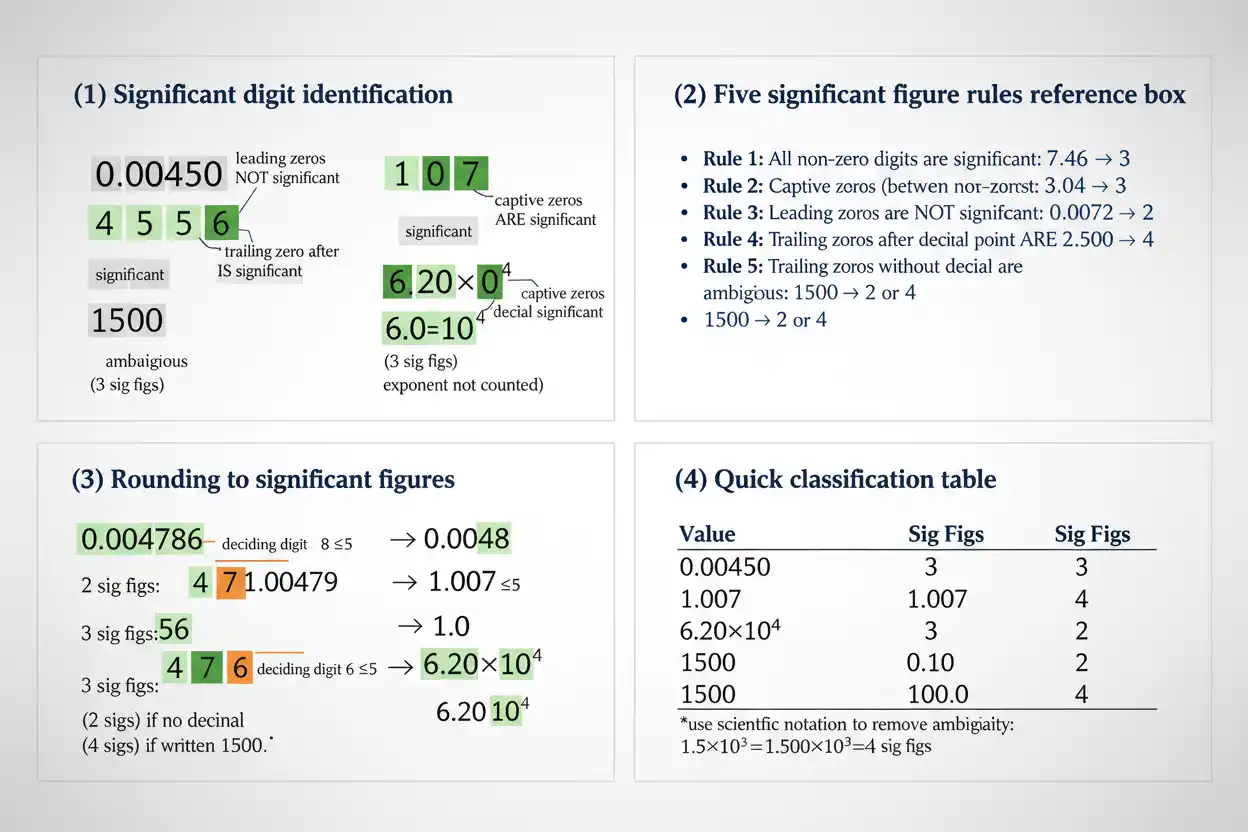

Significant figures are the digits in a number that communicate its meaningful precision. They include all certain digits plus, in a measured value, the final estimated digit.
For example:
7.42
has:
3 significant figures
The number:
0.00450
also has:
3 significant figures
because the leading zeros only locate the decimal point, while the final zero after the decimal indicates precision.
Significant figures are especially important when reporting measurements and calculated results. They differ from decimal places: decimal places count digits after the decimal point, while significant figures begin with the first significant digit regardless of where the decimal point appears.
What Are Significant Figures?
Significant figures, often shortened to sig figs, identify the meaningful digits in a numerical value.
For example:
25.68
contains four nonzero digits, so it has:
4 significant figures
In:
0.002568
the zeros before 2 are placeholders.
The significant digits are:
2, 5, 6, 8
Therefore:
0.002568 also has 4 significant figures
The magnitude changed dramatically, but the stated precision in significant digits did not.
The Main Significant-Figure Rules
For ordinary decimal notation:
All nonzero digits are significant.
347 → 3 significant figures
Zeros between significant nonzero digits are significant.
4.007 → 4 significant figures
Leading zeros are not significant.
0.0036 → 2 significant figures
Trailing zeros to the right of a decimal point are significant when written as part of the value.
2.500 → 4 significant figures
Trailing zeros in a whole number without an explicit precision marker may be ambiguous.
1500
could represent different levels of precision depending on context.
Using scientific notation removes this ambiguity.
All Nonzero Digits Count
Any digit from:
1 through 9
is significant.
Examples:
57 → 2 significant figures
837 → 3 significant figures
4.926 → 4 significant figures
63,817 → 5 significant figures
This is the simplest counting rule.
Leading Zeros Do Not Count
Leading zeros appear before the first nonzero digit and only establish decimal position.
For:
0.00072
the significant digits are:
7 and 2
Therefore:
0.00072 has 2 significant figures
Similarly:
0.004090
does not count the zeros before 4.
Its significant digits are:
4, 0, 9, 0
so it has:
4 significant figures
Zeros Between Nonzero Digits Count
Zeros trapped between nonzero significant digits are significant.
Examples:
101 → 3 significant figures
1.005 → 4 significant figures
20.03 → 4 significant figures
7008 → 4 significant figures
These zeros are part of the stated numerical precision rather than mere decimal placeholders.
Trailing Decimal Zeros Count
Consider:
3.50
The final zero is significant.
Therefore:
3.50 has 3 significant figures
Compare:
3.5
which has:
2 significant figures
Numerically:
3.50 = 3.5
but their written precision is different.
Likewise:
7.000
contains:
4 significant figures
Whole-Number Trailing Zeros Can Be Ambiguous
Consider:
2500
Without further information, it may be unclear whether the trailing zeros indicate measured precision or simply place value.
Scientific notation states the intended precision explicitly:
2.5 × 10³ → 2 significant figures
2.50 × 10³ → 3 significant figures
2.500 × 10³ → 4 significant figures
For this reason, scientific notation is often preferable when significant figures matter.
How Many Significant Figures Does 0.00620 Have?
Ignore the leading zeros:
0.00
Begin counting at:
6
The significant digits are:
6, 2, 0
The final zero is after the decimal and follows significant digits.
Therefore:
0.00620 has 3 significant figures
How Many Significant Figures Does 1.0205 Have?
All digits from the first nonzero digit through the final digit count.
The digits are:
1, 0, 2, 0, 5
The zeros occur between nonzero digits.
Therefore:
1.0205 has 5 significant figures
Significant Figures vs. Decimal Places
These terms are not interchangeable.
Consider:
0.004786
To:
3 significant figures
keep:
4, 7, 8
and inspect the next digit:
6
So:
0.004786 ≈ 0.00479
But to:
3 decimal places
the result is:
0.005
because decimal-place counting begins immediately after the decimal point.
The broader mechanics of positional rounding are covered under rounding rules.
How to Round to Significant Figures
To round to n significant figures:
- Find the first significant digit.
- Count
nsignificant digits. - Inspect the next digit.
- Apply the required rounding convention.
- Remove or replace later digits while preserving place value.
For ordinary elementary rounding, a next digit of 0–4 leaves the retained digit unchanged, while 5–9 increases it by 1.
Example: Round 47.286 to 3 Significant Figures
The first three significant digits are:
4, 7, 2
The next digit is:
8
Increase 2:
2 → 3
Therefore:
47.286 ≈ 47.3
to three significant figures.
Example: Round 0.003674 to 2 Significant Figures
Ignore leading zeros.
Keep:
3, 6
The next digit is:
7
Round 6 upward:
7
Therefore:
0.003674 ≈ 0.0037
to two significant figures.
Example: Round 83,749 to 3 Significant Figures
Keep:
8, 3, 7
The next digit is:
4
So the retained 7 remains unchanged.
Replace lower place values with zeros:
83,749 ≈ 83,700
To state the three-significant-figure precision unambiguously:
8.37 × 10⁴
Rounding Can Change the Exponent
Consider:
9.997 × 10⁵
to three significant figures.
Keep:
9, 9, 9
Next digit:
7
Rounding creates:
10.0 × 10⁵
Normalize:
1.00 × 10⁶
The exponent changes because carrying moves the decimal point.
Significant Figures in Scientific Notation
In:
a × 10ⁿ
all significant-figure information is contained in:
a
For example:
6.02 × 10²³
has:
3 significant figures
The exponent:
23
does not count toward the significant-figure total.
Similarly:
1.5000 × 10^-4
has:
5 significant figures
Significant Figures in Multiplication
For measured quantities, a common reporting rule is:
Multiplication result → same number of significant figures as the factor with the fewest significant figures
Example:
4.56 × 1.4
Exact arithmetic:
6.384
The factors contain:
4.56 → 3 significant figures
1.4 → 2 significant figures
Report the product to:
2 significant figures
Therefore:
4.56 × 1.4 ≈ 6.4
Significant Figures in Division
The same rule commonly applies to division.
Calculate:
18.4 / 3.2
Exact arithmetic:
5.75
Significant figures:
18.4 → 3
3.2 → 2
Therefore report:
5.8
to two significant figures.
Addition Uses Decimal-Place Precision
For addition and subtraction of measured values, the usual reporting rule is based on the least precise decimal place, not simply the fewest significant figures.
Consider:
12.11 + 0.3 + 4.56
Exact sum:
16.97
The least precise input:
0.3
is stated only to the tenths place.
Therefore round the result to tenths:
17.0
The trailing zero communicates that the result has been reported to the nearest tenth.
Subtraction Example
Calculate:
10.25 – 3.1
Exact difference:
7.15
The second input is stated to the tenths place.
Therefore:
10.25 – 3.1 ≈ 7.2
under the usual measured-value reporting convention.
Why Addition and Multiplication Use Different Precision Rules
Multiplication and division depend on relative precision, which is represented conveniently by significant figures.
Addition and subtraction depend on absolute place-value precision.
For example, an uncertainty in the tenths place of one added quantity prevents the sum from meaningfully claiming hundredths or thousandths.
This is why applying the multiplication sig-fig rule mechanically to every operation gives incorrect reporting precision.
Multi-Step Calculations
For a multi-step calculation, avoid rounding every intermediate result to its final significant-figure count.
Instead:
retain additional digits during intermediate work
and:
round the final result appropriately.
This reduces accumulated error.
For example, if:
√7 ≈ 2.64575131…
is used inside another calculation, replacing it immediately with:
2.6
may noticeably alter the final result.
The square roots calculation should generally retain enough precision until the final reporting stage.
Significant Figures and Exact Numbers
Not every number in a calculation limits precision.
Exact counts are not rounded measurements.
For example:
12 students
may mean exactly 12 students.
Likewise, defined conversion relationships can be exact.
An exact value is treated as having effectively unlimited precision for significant-figure calculations.
Therefore an exact count of:
4 objects
does not force a measured result to one significant figure merely because the written digit 4 has one digit.
Measured Numbers vs. Exact Numbers
Compare:
3 meters
measured to a particular precision
with:
3 identical boxes
counted exactly.
The notation may look similar, but the uncertainty is different.
Significant figures primarily communicate measurement or reporting precision, not the number of characters appearing in every exact mathematical quantity.
Zeros and Exact Quantities
Suppose a definition states:
1 km = 1000 m
The 1000 in this exact metric relationship should not automatically be interpreted as having only one significant figure.
It is a defined scale relationship.
Using significant figures requires understanding whether a number is:
measured,
rounded,
counted,
or:
exactly defined.
Significant Figures in Speed Calculations
The mapped speed distance time relationship is:
Speed = Distance / Time
Suppose measured distance is:
125 km
with three significant figures
and measured time is:
2.4 h
with two significant figures.
Calculate:
125 / 2.4
≈ 52.0833 km/h
For multiplication/division reporting, use the lower significant-figure count:
2
Therefore:
Speed ≈ 52 km/h
The arithmetic can retain extra digits internally even though the reported measurement has two significant figures.
Significant Figures in Sequence Sums
A sequence sum may involve exact mathematical terms or measured terms.
For an exact sequence:
1 + 2 + 3 + 4 = 10
significant-figure restrictions are unnecessary.
But if the terms are measurements:
1.2 + 2.35 + 4.016
the final reporting precision should reflect the least precise decimal place.
The mathematical structure of the sum and the precision of its inputs are separate considerations.
Significant Figures and Series Convergence
In series convergence, partial sums may approach a limit with increasing numerical accuracy.
For example:
1.9
1.99
1.999
1.9999
may suggest approach toward:
2
Numerically reporting a partial sum to a fixed number of significant figures can make successive approximations appear identical.
For instance:
1.9999
to three significant figures becomes:
2.00
But matching rounded displays does not by itself prove convergence. Convergence is determined mathematically from the limiting behavior of the partial sums.
Significant Figures and Rational Values
An exact fraction such as:
1/3
is an exact rational number.
Its decimal:
0.333333…
continues indefinitely.
Writing:
0.333
gives a three-significant-figure approximation.
Thus the exact rational value and its rounded decimal representation should be distinguished.
Significant Figures in Percentages
Suppose a measured calculation gives:
17/23 × 100%
≈ 73.913043…%
If the relevant inputs justify three significant figures, report:
73.9%
The percent sign does not change the underlying precision logic.
Significant Figures and Unit Conversion
Suppose a measured length is:
2.50 m
The value contains:
3 significant figures.
Using the exact relationship:
1 m = 100 cm
we get:
250 cm
The converted result should preserve the original measurement precision.
Writing:
2.50 × 10² cm
makes the three significant figures explicit.
Precision vs. Accuracy
Significant figures communicate precision, but more significant digits do not automatically guarantee greater accuracy.
A measurement may be reported as:
12.3456
with many digits but still be inaccurate if the measuring instrument is biased.
Conversely, a shorter reported value may be close to the true value.
Precision concerns resolution and repeatability; accuracy concerns closeness to the accepted or true value.
Significant Figures and Error
Suppose an accepted value is:
50.0
and a measured value is:
49.8
The difference is:
-0.2
The measurement’s significant figures describe its stated precision.
A separate error calculation describes how far it is from the reference value.
These two concepts should not be treated as interchangeable.
Significant Figures in Calculators
A calculator may display many digits, but that does not mean every displayed digit should be reported.
For example:
25.4 / 3.7
may display:
6.864864864…
The original measured quantities have:
3 significant figures
and:
2 significant figures.
So a typical reported answer is:
6.9
not the entire calculator display.
Significant Figures and Scientific Functions
Values produced by scientific functions often contain many displayed digits.
For example:
ln(5) ≈ 1.609437912…
If the surrounding measured inputs support four significant figures, report:
1.609
The function value itself is not inherently limited to those digits; the reporting context determines the chosen precision.
Significant Figures in Square Roots
Suppose:
√45.0
The radicand:
45.0
contains:
3 significant figures.
Calculator value:
√45.0 ≈ 6.70820393
A measurement-style result may therefore be reported as:
6.71
with three significant figures.
This is a precision convention applied to the result, not a change in the exact mathematical root.
Ambiguous Precision Example
Consider:
3000
How many significant figures does it have?
Without context:
the answer may be ambiguous
Possible intended representations include:
3 × 10³ → 1 sig fig
3.0 × 10³ → 2 sig figs
3.00 × 10³ → 3 sig figs
3.000 × 10³ → 4 sig figs
Scientific notation is the clearest solution.
Counting Significant Figures Step by Step
For:
0.010080
First ignore leading zeros:
0.0
Begin at:
1
Now count:
1
0
0
8
0
The internal zeros and final decimal zero count.
Therefore:
0.010080 has 5 significant figures
Example: 500.0
The decimal point and trailing decimal zero make the stated precision clear.
Digits:
5, 0, 0, 0
Therefore:
500.0 has 4 significant figures
In scientific notation:
5.000 × 10²
which also clearly shows four significant digits.
Example: 0.000500
Leading zeros do not count.
The significant digits are:
5, 0, 0
Therefore:
0.000500 has 3 significant figures
Equivalent scientific notation:
5.00 × 10^-4
Common Mistake: Counting Leading Zeros
For:
0.000304
the significant digits are:
3, 0, 4
Therefore:
3 significant figures
The zeros before 3 only locate the decimal point.
Common Mistake: Ignoring Internal Zeros
For:
7005
all four digits count.
Therefore:
7005 has 4 significant figures
The two zeros lie between significant nonzero digits.
Common Mistake: Removing a Significant Trailing Zero
The measured values:
4.0
and:
4
have the same numerical magnitude but communicate different precision.
4.0 has:
2 significant figures
while 4 has:
1
when both are interpreted as measured values.
Do not remove meaningful trailing zeros merely because they do not change arithmetic value.
Common Mistake: Applying the Multiplication Rule to Addition
Suppose:
100.2 + 0.35
Exact sum:
100.55
Addition should be reported according to decimal-place precision.
100.2 reaches the tenths place.
Therefore:
100.55 ≈ 100.6
Using the fewest total significant figures instead would apply the wrong rule.
Common Mistake: Rounding Every Intermediate Step
If several calculations are chained together, repeated rounding can compound error.
Carry additional digits internally and apply the appropriate significant-figure rule at the end.
This is especially important for:
roots,
trigonometric functions,
logarithms,
and:
multi-step formulas.
Common Mistake: Treating Exact Counts as Measurements
If:
8 identical objects
each have a measured mass of:
2.34 g
the count 8 is exact.
Total:
8 × 2.34
= 18.72 g
The exact count does not restrict the answer to one significant figure.
The measured value:
2.34 g
provides the relevant precision.
How to Check Significant Figures
For any value:
First identify the first nonzero digit.
Then determine which zeros are:
leading placeholders,
internal zeros,
or:
trailing precision indicators.
Finally consider whether the value is:
measured,
exact,
or:
ambiguous in ordinary whole-number notation.
When ambiguity exists, rewrite the number in scientific notation.
Frequently Asked Questions
What are significant figures?
Significant figures are the meaningful digits used to communicate the precision of a numerical value.
Are all nonzero digits significant?
Yes.
Do leading zeros count?
No.
Do zeros between nonzero digits count?
Yes.
Do trailing zeros after a decimal count?
Yes, when they are written to indicate precision.
How many significant figures are in 0.00450?
3
How many significant figures are in 1.0020?
5
How many significant figures are in 5000?
It may be ambiguous without additional notation or context.
How can I show significant figures clearly in a large whole number?
Use scientific notation.
For example:
5.00 × 10³
clearly has three significant figures.
What is the multiplication and division rule?
For measured quantities, report the result with the same number of significant figures as the input with the fewest significant figures.
What is the addition and subtraction rule?
Report according to the least precise decimal place among the measured inputs.
Do exact numbers limit significant figures?
No. Exact counts and defined constants do not ordinarily restrict the reported precision.
Are significant figures the same as decimal places?
No. Significant figures count meaningful digits; decimal places count positions after the decimal point.
Final Example
Calculate:
18.35 × 2.4
First perform the multiplication without premature rounding:
18.35 × 2.4
= 44.04
Now count the significant figures in the inputs:
18.35 → 4 significant figures
2.4 → 2 significant figures
The result should therefore be reported with:
2 significant figures
Round:
44.04 → 44
Therefore:
18.35 × 2.4 ≈ 44
to two significant figures.
The core rules are:
Nonzero digits count.
Leading zeros do not count.
Internal zeros count.
Trailing decimal zeros can communicate precision.
Multiplication/division usually follows the fewest significant figures.
Addition/subtraction usually follows the least precise decimal place.
Significant figures are primarily a language of numerical precision. Counting them correctly is only the first step; applying them appropriately requires distinguishing measured quantities from exact numbers and delaying rounding until the calculation is ready to be reported.