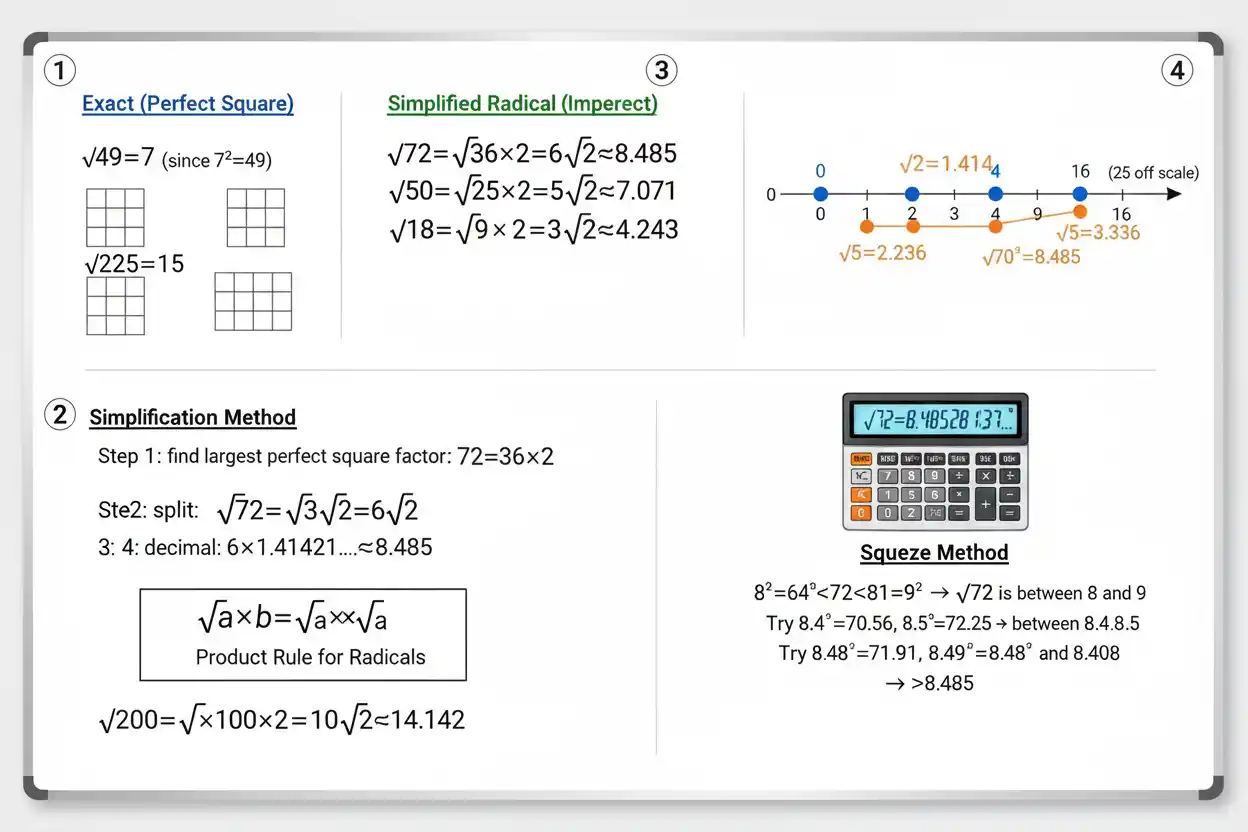

Square roots reverse the operation of squaring. For a nonnegative number a, the principal square root is the nonnegative number whose square equals a.
The basic relationship is:
√a = b ⇔ b² = a, where b ≥ 0
For example:
√49 = 7
because:
7² = 49
Some square roots are exact integers:
√81 = 9
Others simplify to exact radical forms:
√72 = 6√2
And many can also be represented approximately as decimals:
√72 ≈ 8.485281…
The important distinction is that:
6√2
is exact, while:
8.485
is a rounded decimal approximation.
What Is a Square Root?
A square root answers:
What nonnegative number multiplied by itself gives this number?
For example:
√25 = 5
because:
5 × 5 = 25
Likewise:
√144 = 12
because:
12² = 144
The square-root operation is a special case of the broader roots concept.
Principal Square Root
The radical symbol:
√a
means the principal square root.
For real a ≥ 0, that principal value is always:
nonnegative.
Therefore:
√36 = 6
not:
±6
However, if you solve the equation:
x² = 36
there are two real solutions:
x = 6 or x = -6
which can be written:
x = ±6
This distinction prevents a common error.
Square Root Formula
The core inverse relationship is:
√a = b ⇔ b² = a and b ≥ 0
For example:
√169 = 13
because:
13² = 169
A useful identity for real x is:
√(x²) = |x|
For example:
√((-8)²)
= √64
= 8
not:
-8
because the principal square root is nonnegative.
Perfect Square Roots
A perfect square is an integer obtained by squaring an integer.
Examples include:
0, 1, 4, 9, 16, 25, 36, 49, 64, 81, 100, …
Therefore:
√0 = 0
√1 = 1
√4 = 2
√9 = 3
√16 = 4
√25 = 5
and so on.
Square roots of nonnegative perfect squares are exact integers.
Common Perfect Squares
| n | n² | √(n²) |
|---|---|---|
| 0 | 0 | 0 |
| 1 | 1 | 1 |
| 2 | 4 | 2 |
| 3 | 9 | 3 |
| 4 | 16 | 4 |
| 5 | 25 | 5 |
| 6 | 36 | 6 |
| 7 | 49 | 7 |
| 8 | 64 | 8 |
| 9 | 81 | 9 |
| 10 | 100 | 10 |
| 11 | 121 | 11 |
| 12 | 144 | 12 |
| 13 | 169 | 13 |
| 14 | 196 | 14 |
| 15 | 225 | 15 |
Recognizing these values can make many square-root problems nearly immediate.
Exact Square Roots
An exact square root preserves the mathematical value without approximation.
Examples:
√64 = 8
and:
√18 = 3√2
Both answers are exact.
The first is an integer.
The second is an exact radical.
A decimal such as:
√18 ≈ 4.24264
is useful for numerical interpretation but is not exact.
Decimal Square Roots
When a radicand is not a perfect square, its principal square root may be represented approximately as a decimal.
For example:
√2 ≈ 1.41421356…
√3 ≈ 1.73205081…
√5 ≈ 2.23606798…
These are irrational values, so their decimal expansions do not terminate or become permanently repeating.
If a problem asks for a decimal answer, appropriate rounding rules determine how many digits should be reported.
Exact vs. Decimal Example
Consider:
√20
Factor:
20 = 4 × 5
Then:
√20 = √4 × √5
= 2√5
So:
Exact form = 2√5
Using a decimal approximation:
√5 ≈ 2.2360679
Therefore:
2√5 ≈ 4.4721359
So, to three decimal places:
√20 ≈ 4.472
Both forms represent the same number, but only:
2√5
is exact.
Simplifying Square Roots
To simplify a square root, look for a perfect-square factor.
For:
√72
factor:
72 = 36 × 2
Then:
√72 = √36 × √2
= 6√2
Therefore:
√72 = 6√2
This form is exact.
Another Simplification Example
Simplify:
√108
Factor:
108 = 36 × 3
Then:
√108 = √36 × √3
= 6√3
Therefore:
√108 = 6√3
Prime Factorization Method
Prime factorization provides a systematic way to simplify roots.
Factor:
180
into primes:
180 = 2² × 3² × 5
Then:
√180 = √(2² × 3² × 5)
Complete pairs leave the root:
= 2 × 3 × √5
Therefore:
√180 = 6√5
Each pair of identical prime factors contributes one factor outside a square root.
Why Pairs Matter
A square root reverses squaring.
Therefore:
√(p²) = p
for positive prime p.
If the factorization contains:
p⁴
then:
√(p⁴) = p²
In general, pairs of equal prime factors can move outside the radical.
For example:
√(2⁶ × 3² × 5)
becomes:
2³ × 3 × √5
= 24√5
Square Root Product Rule
For nonnegative real numbers a and b:
√(ab) = √a × √b
For example:
√(9 × 7)
= √9 × √7
= 3√7
This property explains the standard radical-simplification process.
Square Root Quotient Rule
For:
a ≥ 0
and:
b > 0
we have:
√(a/b) = √a/√b
For example:
√(49/16)
= √49/√16
= 7/4
Therefore:
√(49/16) = 7/4
Square Roots Do Not Distribute Across Addition
In general:
√(a+b) ≠ √a + √b
For example:
√(9+16)
= √25
= 5
But:
√9 + √16
= 3 + 4
= 7
Therefore the two expressions are not equal.
The same warning applies to subtraction.
Square Roots and Exponents
The square root can be written as a fractional exponent:
√a = a^(1/2)
For example:
81^(1/2) = 9
More generally:
√(a³) = a^(3/2)
when the expression is defined appropriately.
This connection follows the standard exponents rules.
Example With Fractional Exponents
Evaluate:
16^(3/2)
Take the square root first:
√16 = 4
Then cube:
4³ = 64
Therefore:
16^(3/2) = 64
Equivalently:
(16³)^(1/2)
produces the same real value.
Square Roots of Fractions
Consider:
√(9/25)
Take the square root of numerator and denominator:
√9/√25
= 3/5
Therefore:
√(9/25) = 3/5
If the numerator or denominator is not a perfect square, the result may retain a radical.
Square Root of a Decimal
Suppose:
√0.49
Since:
0.7² = 0.49
we have:
√0.49 = 0.7
Likewise:
√0.0004 = 0.02
because:
0.02² = 0.0004
Decimal place value matters because squaring doubles the exponent of powers of ten.
Estimating a Square Root
Suppose you need:
√30
Find nearby perfect squares:
5² = 25
6² = 36
Therefore:
5 < √30 < 6
Because 30 is closer to 25 than 36, the root is somewhat closer to 5.
A calculator gives:
√30 ≈ 5.4772256
Estimate √70
Nearby perfect squares:
8² = 64
9² = 81
Therefore:
8 < √70 < 9
Numerically:
√70 ≈ 8.3666
This quick bounding check is useful for detecting calculator-entry errors.
Newton-Style Approximation
Square roots can also be approximated iteratively.
For positive N, choose an initial estimate x and repeat:
x_new = (x + N/x)/2
For:
N = 10
start with:
x = 3
Then:
x_new = (3 + 10/3)/2
≈ 3.16667
Repeat:
(3.16667 + 10/3.16667)/2
≈ 3.16228
The values quickly approach:
√10 ≈ 3.16227766
This illustrates how decimal square roots can be generated numerically.
Square Roots and Irrational Numbers
Many non-perfect-square integers have irrational square roots.
For example:
√2
√3
√5
√6
√7
are irrational numbers.
A useful rule is:
If positive integer n is not a perfect square, √n is irrational.
Thus:
√49
is rational because 49 is a perfect square.
But:
√50
is irrational, even though it simplifies:
√50 = 5√2
Square Roots and Real Numbers
Within the real numbers, a square root requires:
radicand ≥ 0
Therefore:
√9
is real.
√0
is real.
But:
√(-9)
is not a real number.
The restriction applies because every real square is nonnegative.
Square Root of Zero
Since:
0² = 0
we have:
√0 = 0
Zero is the only number that is both nonnegative and equal to its own principal square root besides 1:
√1 = 1
Solving x² = a
If:
a > 0
then:
x² = a
has two real solutions:
x = ±√a
For example:
x² = 20
gives:
x = ±√20
Simplify:
x = ±2√5
Approximate:
x ≈ ±4.472
Solving x² = 0
If:
x² = 0
then:
x = 0
There is only one distinct solution.
Solving x² = a for Negative a
Consider:
x² = -16
There is no real x satisfying the equation because:
x² ≥ 0
for every real x.
Therefore:
x² = -16 has no real solution
This differs from odd-power equations, where negative values can have real roots.
Principal Root vs. Equation Solutions
Remember:
√25 = 5
but:
x² = 25
gives:
x = ±5
The radical symbol identifies one principal value.
The equation asks for every value whose square equals the radicand.
These are related but not identical tasks.
Square Roots in Geometry
If a square has area:
A
then its side length is:
s = √A
For example, if:
A = 144 cm²
then:
s = √144
= 12 cm
Therefore:
Side length = 12 cm
This gives a direct geometric meaning to square roots.
Square Roots in the Distance Formula
The distance formula uses a square root:
d = √[(x₂-x₁)² + (y₂-y₁)²]
Suppose coordinate differences are:
3 and 4
Then:
d = √(3²+4²)
= √25
= 5
Therefore:
Distance = 5
Square Roots in Speed-Distance-Time Problems
The mapped speed distance time page primarily uses division and multiplication, but square roots may arise when the travel distance itself must first be found geometrically.
For example, if the direct path has perpendicular components:
6 km and 8 km
then:
d = √(6²+8²)
= √100
= 10 km
If that distance is traveled in:
0.5 h
then:
speed = 10/0.5
= 20 km/h
Square roots determine the geometric distance; the motion formula then uses that distance.
Square Roots in Step-by-Step Problem Solving
A structured step-by-step math solving process is particularly useful for roots:
First identify whether an exact or decimal answer is required.
Then check whether the radicand is a perfect square.
If not, look for perfect-square factors.
Simplify the radical before approximating.
Finally, round only if a decimal answer is requested.
This sequence prevents replacing an exact expression with an unnecessary approximation.
Exact Form Before Decimal Form
Consider:
√75
First simplify:
75 = 25 × 3
Therefore:
√75 = 5√3
Only then approximate:
√3 ≈ 1.7320508
so:
5√3 ≈ 8.660254
The exact form:
5√3
reveals mathematical structure that the decimal:
8.660254
does not.
Significant Figures for Square Roots
When a square root comes from measured data, significant figures may determine the reported decimal precision.
Suppose a measured quantity is:
45.0
with three significant figures.
Calculate:
√45.0 ≈ 6.7082039
A three-significant-figure result is:
6.71
The calculator may display more digits, but the input precision limits what should normally be reported in a measurement context.
Square Roots and Summation Notation
Summation notation can contain square-root terms.
For example:
Σ √k, from k=1 to 4
means:
√1 + √2 + √3 + √4
Therefore:
= 1 + √2 + √3 + 2
Exact form:
3 + √2 + √3
A decimal approximation can be calculated afterward if needed.
The sigma notation controls which terms are added; it does not change how each square root is evaluated.
Square Roots in Series
The mapped series convergence topic may involve terms containing square roots.
For example:
Σ 1/n^(3/2)
can be written:
Σ 1/(n√n)
This is a p-series with:
p = 3/2
Since:
3/2 > 1
the series converges.
The square root helps define the term, while convergence is determined by the structure of the infinite series.
Rationalizing a Simple Denominator
An expression such as:
1/√2
can be rewritten by multiplying numerator and denominator by:
√2
Then:
1/√2 × √2/√2
= √2/2
Therefore:
1/√2 = √2/2
This gives an equivalent exact expression without a radical in the denominator.
Rationalizing a Multiple Radical
Consider:
3/(2√5)
Multiply numerator and denominator by:
√5
Then:
3√5/(2×5)
= 3√5/10
Therefore:
3/(2√5) = 3√5/10
This preserves exactness.
Surds and Square Roots
A simplified irrational radical such as:
√2
3√5
or:
7√3
is commonly described as a surd in mathematical contexts that use that terminology.
The key point is that the radical remains exact and cannot be simplified to a rational number.
For example:
√12 = 2√3
so:
√12
was not fully simplified, while:
2√3
is.
Comparing Square Roots
To compare positive square roots, compare their radicands.
If:
a < b
with:
a,b ≥ 0
then:
√a < √b
For example:
17 < 20
so:
√17 < √20
No decimal approximation is required.
Comparing a Root With an Integer
Compare:
√50
with:
7
Square 7:
7² = 49
Since:
50 > 49
we know:
√50 > 7
Similarly:
8² = 64
so:
√50 < 8
Therefore:
7 < √50 < 8
Common Mistake: Writing √49 = ±7
Correct:
√49 = 7
For the equation:
x² = 49
correct:
x = ±7
Do not attach ± automatically to the radical symbol.
Common Mistake: Simplifying √(a+b)
In general:
√(a+b)
cannot be separated.
For example:
√13
is not:
√9 + √4
Even though:
13 = 9 + 4
because:
√13 ≠ 5
Common Mistake: Ignoring Perfect-Square Factors
For:
√48
a decimal approximation is possible, but the exact radical should first simplify.
Since:
48 = 16 × 3
we get:
√48 = 4√3
This is the standard exact simplified form.
Common Mistake: Assuming Every Non-Integer Root Is Irrational Without Simplifying
Consider:
√(9/16)
This is:
3/4
which is rational.
Similarly:
√2.25 = 1.5
A radicand need not be an integer perfect square for its root to be rational.
Common Mistake: Using Too Few Decimal Digits
If:
√2
is used in several later calculations, rounding immediately to:
1.4
can introduce noticeable error.
Keep:
√2
exactly or retain several calculator digits until the final step.
How to Check a Square Root
Square the proposed result.
If:
√121 = 11
check:
11² = 121
For an approximate result:
√30 ≈ 5.477
square it:
5.477² ≈ 29.9975
which is close to:
30
The small difference comes from rounding.
Frequently Asked Questions
What is a square root?
A square root of a is a number whose square equals a. The notation √a denotes the principal nonnegative square root.
What is the square-root formula?
√a = b ⇔ b² = a and b ≥ 0
What is √64?
8
What is √100?
10
Is √2 exact?
Yes. √2 is an exact irrational value.
What is √2 as a decimal?
√2 ≈ 1.41421356…
What is the difference between exact and decimal square roots?
An exact result preserves the full mathematical value, such as 3√2. A decimal such as 4.243 is an approximation.
What is √72 in simplest form?
6√2
Is √25 equal to ±5?
No.
√25 = 5
The equation x² = 25 has solutions ±5.
Can you take the square root of a negative number?
Not within the real-number system.
Is √0 defined?
Yes.
√0 = 0
Why is √(x²) equal to |x|?
Because the principal square root is always nonnegative.
How do I estimate a non-perfect square root?
Locate it between neighboring perfect squares, then use a calculator or numerical method for additional precision.
Final Example
Find the exact and decimal value of:
√288
First factor:
288 = 144 × 2
Since:
144 = 12²
we have:
√288 = √144 × √2
= 12√2
Therefore the exact answer is:
√288 = 12√2
Now approximate:
√2 ≈ 1.414213562
Multiply:
12 × 1.414213562
≈ 16.97056274
To three decimal places:
√288 ≈ 16.971
Check:
16.97056274² ≈ 288
The central square-root relationship is:
√a = b ⇔ b² = a and b ≥ 0
Use exact integers for perfect squares, simplify non-perfect-square radicals whenever possible, and convert to decimals only when approximation is useful or specifically required.