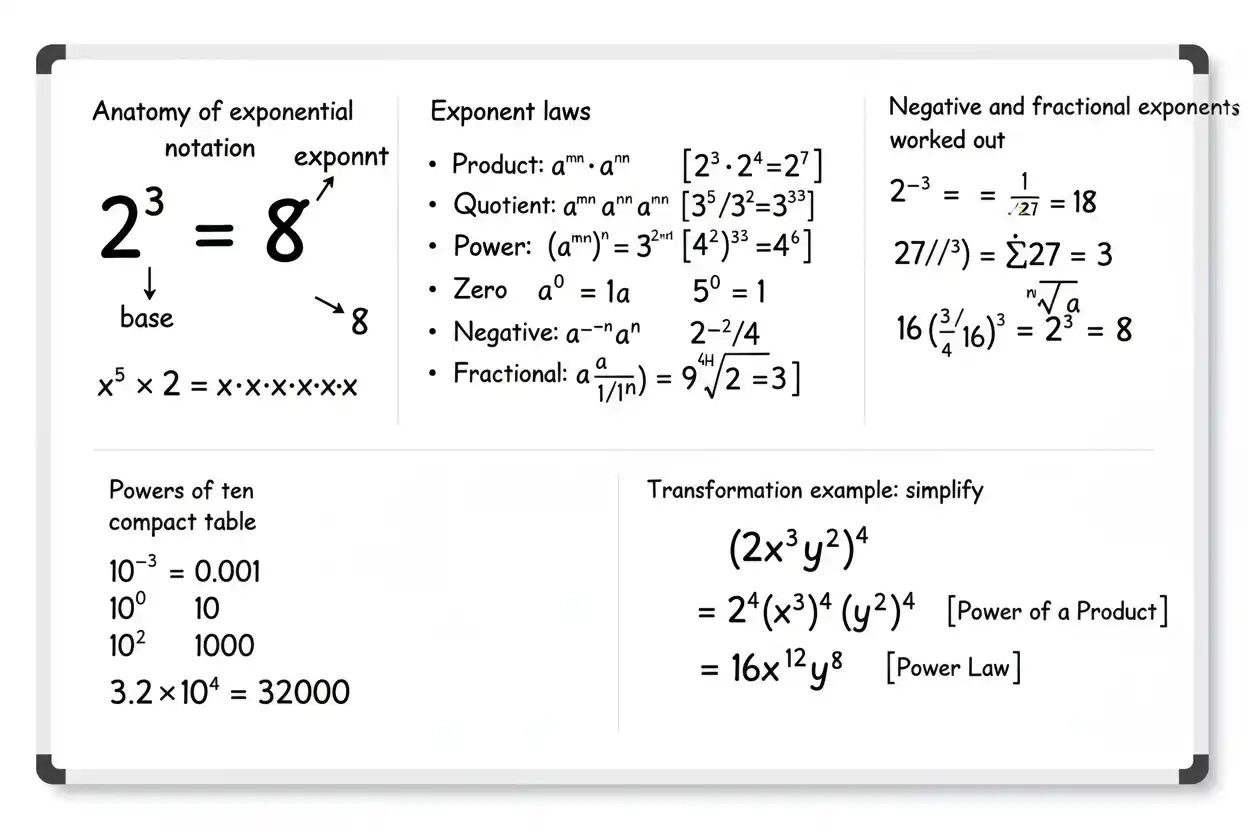

Exponents provide a compact way to represent repeated multiplication and powers. In an expression such as:
5³
the number 5 is the base, while 3 is the exponent.
The expression means:
5³ = 5 × 5 × 5
so:
5³ = 125
Exponents also extend beyond positive whole numbers. Zero exponents, negative exponents, fractional exponents, and variable exponents follow consistent mathematical rules that connect powers with reciprocals, roots, logarithms, and scientific notation.
Exponents are a fundamental topic within arithmetic and number theory.
What Is an Exponent?
For a positive integer exponent n:
a^n = a × a × … × a
where a appears n times.
Here:
a = base
n = exponent
a^n = power
For example:
3⁴ = 3 × 3 × 3 × 3
3⁴ = 81
The exponent tells how many factors of the base appear in the multiplication.
Base, Exponent, and Power
Consider:
7² = 49
The base is:
7
The exponent is:
2
The resulting power is:
49
Similarly:
2⁵ = 32
because:
2 × 2 × 2 × 2 × 2 = 32
The terms exponent and power are sometimes used informally in overlapping ways, but the exponent is specifically the raised number indicating the power.
First Exponent Rule: Product of Powers
When multiplying powers with the same base, add the exponents:
a^m × a^n = a^(m+n)
For example:
2³ × 2⁴
Expand:
(2 × 2 × 2)(2 × 2 × 2 × 2)
There are seven factors of 2:
2⁷
Therefore:
2³ × 2⁴ = 2⁷
and:
2⁷ = 128
Why Exponents Add When Multiplying
Consider:
x² × x³
Expand:
(x × x)(x × x × x)
Combine:
x × x × x × x × x
There are five factors of x.
Therefore:
x² × x³ = x⁵
This explains:
a^m × a^n = a^(m+n)
The rule applies because the bases are identical.
Quotient of Powers Rule
When dividing powers with the same nonzero base, subtract the exponents:
a^m / a^n = a^(m-n)
for:
a ≠ 0
For example:
5⁶ / 5² = 5^(6-2)
= 5⁴
= 625
You can see this through cancellation:
(5 × 5 × 5 × 5 × 5 × 5) / (5 × 5)
leaves:
5 × 5 × 5 × 5
which is:
5⁴
The underlying operation is division, but exponent notation makes repeated factors much easier to manage.
Power of a Power Rule
When a power is raised to another power, multiply the exponents:
(a^m)^n = a^(mn)
For example:
(2³)⁴ = 2^(3×4)
= 2¹²
= 4096
Why?
(2³)⁴ = 2³ × 2³ × 2³ × 2³
Using the product rule:
2^(3+3+3+3) = 2¹²
Therefore the exponents multiply.
Power of a Product Rule
If a product is raised to a power:
(ab)^n = a^n b^n
For example:
(2 × 3)³ = 2³ × 3³
Calculate:
6³ = 216
and:
2³ × 3³ = 8 × 27 = 216
Both forms give the same result.
Power of a Quotient Rule
For:
b ≠ 0
the rule is:
(a / b)^n = a^n / b^n
For example:
(2 / 3)³ = 2³ / 3³
= 8 / 27
The exponent applies to both numerator and denominator.
Exponent of 1
Any number raised to the first power equals itself:
a¹ = a
For example:
19¹ = 19
(-4)¹ = -4
x¹ = x
The exponent 1 is usually omitted in ordinary notation.
Zero Exponent Rule
For any nonzero base:
a⁰ = 1
For example:
7⁰ = 1
100⁰ = 1
(-3)⁰ = 1
The condition:
a ≠ 0
matters.
The expression 0⁰ is treated specially depending on mathematical context and should not simply be handled by the ordinary zero-exponent rule.
Why a⁰ = 1
Start with the quotient rule:
a³ / a³ = a^(3-3)
So:
a³ / a³ = a⁰
But any nonzero quantity divided by itself equals 1:
a³ / a³ = 1
Therefore:
a⁰ = 1
for nonzero a.
This keeps the exponent laws internally consistent.
Negative Exponents
A negative exponent represents a reciprocal:
a^-n = 1 / a^n
for:
a ≠ 0
For example:
2^-3 = 1 / 2³
= 1 / 8
Similarly:
10^-2 = 1 / 10²
= 1 / 100
= 0.01
A negative exponent does not make the value automatically negative.
Why Negative Exponents Give Reciprocals
Use the quotient rule:
a² / a⁵ = a^(2-5)
= a^-3
But direct cancellation gives:
a² / a⁵ = 1 / a³
Therefore:
a^-3 = 1 / a³
The reciprocal interpretation follows directly from the ordinary laws of exponents.
Negative Base vs. Negative Exponent
These ideas are different.
Consider:
(-2)³ = -8
Here the base is negative.
Now consider:
2^-3 = 1/8
Here the exponent is negative.
And:
(-2)^-3 = 1 / (-2)³
= -1/8
Signs and exponent direction must therefore be handled separately.
Parentheses Matter
Compare:
(-3)²
with:
-3²
The first means:
(-3) × (-3) = 9
So:
(-3)² = 9
Under the usual order of operations, the second means:
-(3²)
Therefore:
-3² = -9
The parentheses determine whether the negative sign is part of the base.
Even and Odd Exponents With Negative Bases
For a negative base:
(-a)^even = positive
and:
(-a)^odd = negative
For example:
(-2)⁴ = 16
because four negative factors produce a positive result.
But:
(-2)⁵ = -32
because an odd number of negative factors produces a negative result.
Fractional Exponents
Fractional exponents represent roots.
For positive real a:
a^(1/n) = ⁿ√a
For example:
25^(1/2) = √25 = 5
and:
27^(1/3) = ∛27 = 3
This connects exponent notation with nth roots.
General Fractional Exponent Rule
A rational exponent:
a^(m/n)
can be interpreted as:
ⁿ√(a^m)
or equivalently, when defined:
(ⁿ√a)^m
For example:
8^(2/3)
First take the cube root:
∛8 = 2
Then square:
2² = 4
Therefore:
8^(2/3) = 4
Example: 16^(3/4)
Calculate:
16^(3/4)
Take the fourth root first:
⁴√16 = 2
Then cube:
2³ = 8
Therefore:
16^(3/4) = 8
Alternatively:
16³ = 4096
and:
⁴√4096 = 8
Both interpretations agree.
Square Roots as Exponents
A square root can be expressed using exponent 1/2:
√x = x^(1/2)
For example:
√49 = 49^(1/2)
= 7
The square-root page focuses on evaluating and interpreting square roots, while exponent rules explain why the fractional notation behaves consistently.
Cube Roots as Exponents
Similarly:
∛x = x^(1/3)
For example:
∛125 = 125^(1/3)
= 5
because:
5³ = 125
The dedicated cube roots topic covers cube-root calculations in greater detail.
Exponents and Perfect Squares
A perfect square is an integer expressible as:
n²
Examples include:
1 = 1²
4 = 2²
9 = 3²
16 = 4²
25 = 5²
The exponent 2 is why the terms “square” and “squared” are used.
Exponents and Perfect Cubes
A perfect cube has the form:
n³
Examples include:
8 = 2³
27 = 3³
64 = 4³
125 = 5³
216 = 6³
The exponent describes how many equal factors are multiplied.
Exponents With Variables
Exponent rules work with variables as long as the required domain restrictions are respected.
For example:
x⁴ × x³ = x⁷
and:
y⁹ / y⁴ = y⁵
for:
y ≠ 0
Also:
(a²)⁵ = a¹⁰
The same laws apply whether the base is numerical or algebraic.
Simplifying an Exponential Expression
Simplify:
x³ × x⁵ / x²
First combine the numerator:
x³ × x⁵ = x⁸
Then divide:
x⁸ / x² = x⁶
Therefore:
x³ × x⁵ / x² = x⁶
assuming:
x ≠ 0
where division requires a nonzero denominator.
Example With Several Bases
Simplify:
a³b² × a⁴b⁵
Group identical bases:
a³ × a⁴ × b² × b⁵
Add exponents:
a⁷b⁷
Therefore:
a³b² × a⁴b⁵ = a⁷b⁷
Do not combine exponents belonging to different bases.
You Cannot Add Exponents Across Addition
A very common mistake is writing:
a² + a³ = a⁵
This is false.
Exponent addition applies when multiplying powers with the same base:
a² × a³ = a⁵
But:
a² + a³
can instead be factored:
a²(1 + a)
The operation between the terms determines which rule applies.
Exponents With Coefficients
Consider:
3x² × 4x⁵
Multiply the numerical coefficients:
3 × 4 = 12
Then apply the exponent rule:
x² × x⁵ = x⁷
Therefore:
3x² × 4x⁵ = 12x⁷
The exponent applies to x, not automatically to the coefficient 3 or 4.
Power Applied to a Coefficient and Variable
Compare:
3x²
with:
(3x)²
They are not the same.
The first is:
3 × x²
The second is:
3² × x²
= 9x²
Parentheses indicate which entire quantity is being raised to the power.
Example: Power of a Monomial
Simplify:
(2x³)⁴
Apply the exponent to both factors:
2⁴ × (x³)⁴
Then:
2⁴ = 16
and:
(x³)⁴ = x¹²
Therefore:
(2x³)⁴ = 16x¹²
Negative Exponents in Fractions
Consider:
x^-4
Rewrite:
x^-4 = 1 / x⁴
Now consider:
1 / x^-4
Since:
x^-4 = 1/x⁴
the reciprocal gives:
1 / x^-4 = x⁴
for:
x ≠ 0
A useful practical principle is that moving a factor across a fraction bar changes the sign of its exponent.
Example: Simplify x^-2 / x^-5
Use the quotient rule:
x^-2 / x^-5 = x^(-2 – (-5))
= x³
Therefore:
x^-2 / x^-5 = x³
for nonzero x.
The subtraction of a negative exponent is an easy place to make a sign error.
Powers of 10
Powers of 10 are particularly useful in decimal notation.
10¹ = 10
10² = 100
10³ = 1000
10⁰ = 1
10^-1 = 0.1
10^-2 = 0.01
10^-3 = 0.001
This pattern underlies scientific notation.
Scientific Notation Example
Consider:
4,500,000
This can be written as:
4.5 × 10⁶
The exponent indicates how the coefficient relates to the original magnitude.
Similarly:
0.00032 = 3.2 × 10^-4
Positive powers of 10 scale upward, while negative powers scale downward.
Multiplying Numbers in Scientific Notation
Suppose:
(3 × 10⁴)(2 × 10³)
Multiply coefficients:
3 × 2 = 6
Multiply powers of 10:
10⁴ × 10³ = 10⁷
Therefore:
(3 × 10⁴)(2 × 10³) = 6 × 10⁷
This is a direct application of the product-of-powers rule.
Dividing Numbers in Scientific Notation
Consider:
(8 × 10⁷) / (2 × 10³)
Divide coefficients:
8 / 2 = 4
Subtract the exponents:
10⁷ / 10³ = 10⁴
Therefore:
(8 × 10⁷) / (2 × 10³) = 4 × 10⁴
Exponential Equations
An exponential equation has a variable in an exponent.
For example:
2^x = 16
Recognize:
16 = 2⁴
Therefore:
2^x = 2⁴
so:
x = 4
When both sides can be written with the same base, solving may be straightforward.
Example: Same-Base Exponential Equation
Solve:
3^(x+1) = 81
Recognize:
81 = 3⁴
Therefore:
3^(x+1) = 3⁴
Set the exponents equal:
x + 1 = 4
x = 3
Check:
3^(3+1) = 3⁴ = 81
Exponents and Logarithms
When an exponential equation cannot conveniently be rewritten with matching bases, logarithms can reverse exponentiation.
For example:
2^x = 10
Take a logarithm:
x = log₂(10)
or using natural logarithms:
x = ln(10) / ln(2)
This is approximately:
x ≈ 3.3219
The logarithm page owns the detailed methods for such equations; the important relationship here is that exponentiation and logarithms are inverse operations.
Exponential Growth
Repeated multiplication by the same factor produces exponential behavior.
Suppose a quantity doubles each period.
Starting with 100:
Period 0: 100
Period 1: 200
Period 2: 400
Period 3: 800
The value after n periods can be written:
A = 100 × 2^n
The exponent records the number of repeated growth factors.
Exponential Decay
Repeated multiplication by a factor between 0 and 1 produces exponential decay.
Suppose a quantity retains half its value each period:
A = A₀(1/2)^n
If:
A₀ = 160
then after 3 periods:
A = 160(1/2)³
= 160 × 1/8
= 20
The structure is exponential because the changing variable appears in the exponent.
Exponents in Compound Multiplication
Suppose a value grows by 5% per period.
The multiplier per period is:
1 + 0.05 = 1.05
After n periods:
A = A₀(1.05)^n
The exponent counts how many times the growth multiplier is applied.
This is different from adding 5% only once.
Exponents and Prime Factorization
Exponent notation makes repeated prime factors compact.
For example:
360 = 2 × 2 × 2 × 3 × 3 × 5
can be written:
360 = 2³ × 3² × 5
This form makes the multiplicities of prime factors immediately visible.
It is particularly useful for factor and divisibility calculations.
Exponents and Factorial Notation
A factorial represents repeated multiplication of decreasing positive integers:
5! = 5 × 4 × 3 × 2 × 1
An exponent represents repeated multiplication of the same factor:
5⁴ = 5 × 5 × 5 × 5
The two notations should not be confused.
For example:
5! = 120
while:
5⁴ = 625
Factorial vs. Factorials
The workbook also distinguishes the broader discussion of factorials from the singular factorial calculation page.
Exponent notation may appear when analyzing prime powers inside a factorial, but factorials and exponents represent different multiplication patterns.
For example:
6! = 720
while:
6⁶ = 46,656
Exponents and the Euclidean Algorithm
The Euclidean algorithm finds greatest common divisors through repeated division and remainders.
Exponent notation may describe the same integers through prime powers, but the Euclidean algorithm does not require those powers to be known.
For instance:
72 = 2³ × 3²
is an exponent-based factorization, while the Euclidean method can find:
GCD(72, 120)
directly through division.
These are related number-theory tools with different primary purposes.
Exponents and Entropy
The maximum entropy of n equally likely outcomes in bits is:
Hmax = log₂(n)
The inverse relationship gives:
n = 2^Hmax
For example, an entropy of 4 bits corresponds to:
n = 2⁴ = 16
equally likely possibilities.
This illustrates how exponential and logarithmic relationships appear outside elementary power calculations.
Common Exponent Mistake: Adding Bases
It is incorrect to write:
2³ × 3³ = 5³
Instead, use the power-of-a-product rule:
2³ × 3³ = (2 × 3)³
= 6³
= 216
Although the exponents are the same, the bases are multiplied rather than added.
Common Exponent Mistake: Power of a Sum
In general:
(a + b)² ≠ a² + b²
For example:
(2 + 3)² = 25
but:
2² + 3² = 4 + 9 = 13
Expanding:
(a + b)² = a² + 2ab + b²
Exponent rules for products cannot simply be applied across addition.
Common Exponent Mistake: Multiplying Exponents During Ordinary Multiplication
For:
x² × x³
the answer is:
x⁵
not:
x⁶
Exponents multiply only in a power-of-a-power expression:
(x²)³ = x⁶
The operation between the powers determines the correct rule.
Common Exponent Mistake: Negative Exponent Means Negative Value
It is incorrect to assume:
4^-2 = -16
Instead:
4^-2 = 1 / 4²
= 1 / 16
The negative sign in the exponent indicates a reciprocal.
Common Exponent Mistake: Zero Exponent
For nonzero a:
a⁰ = 1
not:
0
For example:
1000⁰ = 1
The base does not disappear because its value became zero; rather, the exponent law produces the multiplicative identity 1.
Order of Operations With Exponents
Exponents are evaluated before ordinary multiplication, addition, and subtraction unless grouping changes the order.
For example:
2 + 3² × 4
Evaluate the exponent:
3² = 9
Then multiply:
9 × 4 = 36
Then add:
2 + 36 = 38
Therefore:
2 + 3² × 4 = 38
Parentheses can change the result.
Example With Parentheses
Compare:
(2 + 3)²
with:
2 + 3²
First:
(2 + 3)² = 5² = 25
Second:
2 + 3² = 2 + 9 = 11
The expressions contain the same numbers but represent different operations.
Checking an Exponent Calculation
For small positive integer exponents, expand the multiplication.
Suppose:
4³ = 64
Check:
4 × 4 × 4
= 16 × 4
= 64
For exponent laws, you can often check both the simplified and expanded forms.
For example:
2² × 2³ = 2⁵
Left side:
4 × 8 = 32
Right side:
2⁵ = 32
The equality is confirmed.
Frequently Asked Questions
What is an exponent?
An exponent indicates a power. For a positive integer exponent, it tells how many times the base appears as a factor.
For example:
3⁴ = 3 × 3 × 3 × 3
What is the product rule for exponents?
For the same base:
a^m × a^n = a^(m+n)
What is the quotient rule for exponents?
For nonzero a:
a^m / a^n = a^(m-n)
What is the power-of-a-power rule?
(a^m)^n = a^(mn)
What is any nonzero number to the zero power?
a⁰ = 1
for:
a ≠ 0
What does a negative exponent mean?
A negative exponent creates a reciprocal:
a^-n = 1/a^n
What does a fractional exponent mean?
A denominator in a fractional exponent represents a root:
a^(1/n) = ⁿ√a
What is 2^-3?
2^-3 = 1/2³ = 1/8
What is 16^(1/2)?
16^(1/2) = √16 = 4
What is 27^(2/3)?
Take the cube root:
∛27 = 3
Then square:
3² = 9
Therefore:
27^(2/3) = 9
Is (-2)² the same as -2²?
No.
(-2)² = 4
while:
-2² = -(2²) = -4
under the standard order of operations.
Why do exponent rules matter?
They make repeated multiplication, division, powers, roots, scientific notation, exponential equations, and many algebraic expressions much easier to represent and simplify.
Final Example
Simplify:
(2x³y^-2)² × x⁴y
First apply the outer power:
(2x³y^-2)² = 2²x⁶y^-4
So:
= 4x⁶y^-4
Now multiply:
4x⁶y^-4 × x⁴y
Combine identical bases:
x⁶ × x⁴ = x¹⁰
and:
y^-4 × y¹ = y^-3
Therefore:
4x¹⁰y^-3
Rewrite with positive exponents:
4x¹⁰ / y³
for:
y ≠ 0
The exponent rules work together consistently: multiplying equal bases adds exponents, raising a power to another power multiplies exponents, and negative exponents represent reciprocals.