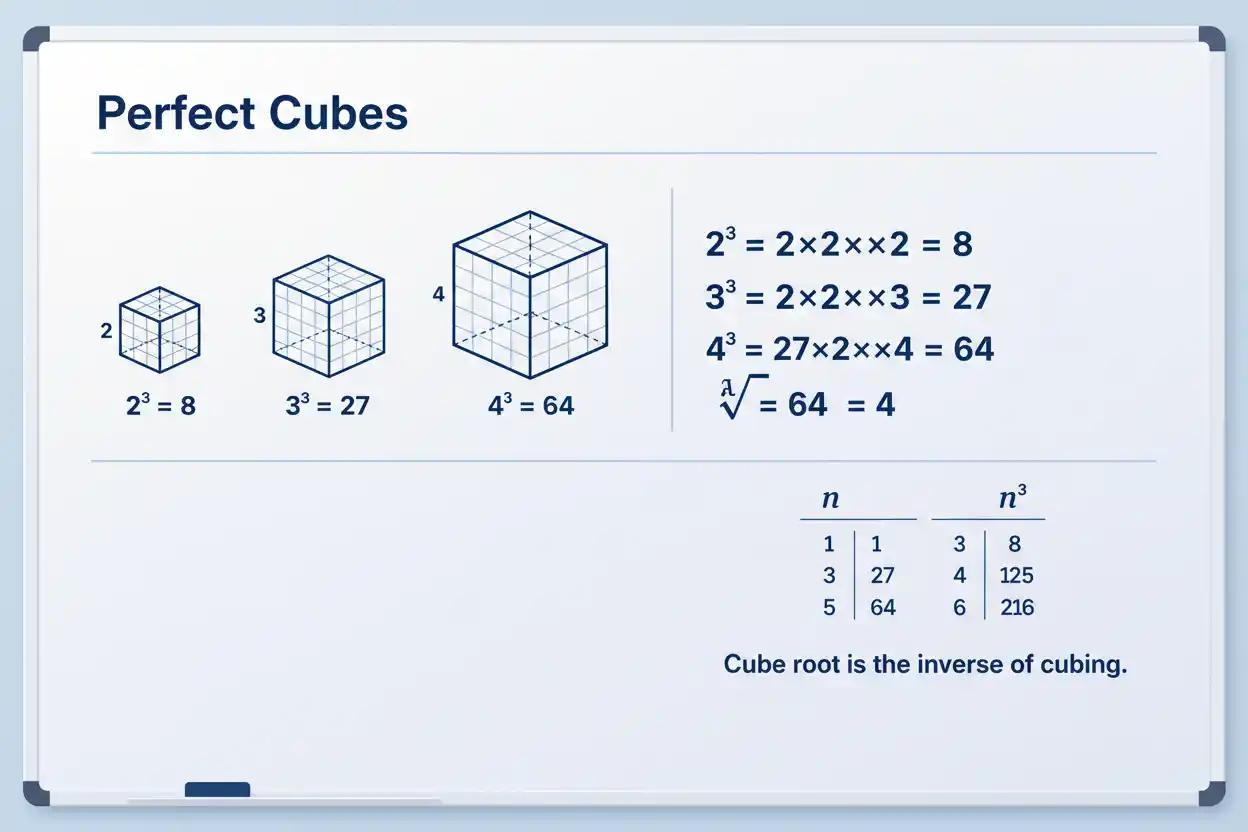

Cube roots reverse the process of cubing a number. If a number y multiplied by itself three times equals x, then y is the cube root of x.
For example:
4³ = 4 × 4 × 4 = 64
Therefore:
∛64 = 4
Unlike square roots of positive numbers, real cube roots do not require a positive-and-negative pair. Every real number—including every negative real number—has exactly one real cube root.
Cube roots are part of the broader study of arithmetic and number theory and connect naturally with powers, radicals, equations, geometry, and numerical approximation.
What Is a Cube Root?
The cube root of x is the number that produces x when raised to the third power.
The defining relationship is:
∛x = y if y³ = x
For example:
∛125 = 5
because:
5³ = 5 × 5 × 5 = 125
Similarly:
∛1000 = 10
because:
10³ = 1000
The cube-root operation reverses cubing.
Cube Root Formula
A cube root can also be expressed using an exponent:
∛x = x^(1/3)
So:
∛27 = 27^(1/3) = 3
because:
3³ = 27
This fractional-exponent form connects cube roots directly with the rules covered under exponents.
Perfect Cubes
Cube roots are easiest to evaluate exactly when the number is a perfect cube.
A perfect cube is a number that can be written as:
n³
for an integer n.
Some common perfect cubes are:
| n | n³ |
|---|---|
| 1 | 1 |
| 2 | 8 |
| 3 | 27 |
| 4 | 64 |
| 5 | 125 |
| 6 | 216 |
| 7 | 343 |
| 8 | 512 |
| 9 | 729 |
| 10 | 1000 |
Therefore:
∛8 = 2
∛216 = 6
∛729 = 9
∛1000 = 10
Recognizing common perfect cubes can make many calculations almost immediate.
How to Find a Cube Root
For a perfect cube, ask:
What number multiplied by itself three times gives the original number?
For example, find:
∛343
Because:
7 × 7 × 7 = 343
the result is:
∛343 = 7
For larger numbers, prime factorization can be useful because groups of three identical factors can be extracted from the cube root.
Example: Cube Root of 1728
Find:
∛1728
One way is to recognize that:
12² = 144
and:
144 × 12 = 1728
Therefore:
12³ = 1728
So:
∛1728 = 12
Check:
12 × 12 × 12 = 1728
The result is exact.
Example: Cube Root of 2744
Consider:
∛2744
Test 14:
14² = 196
and:
196 × 14 = 2744
Therefore:
14³ = 2744
So:
∛2744 = 14
Cube Roots of Negative Numbers
Negative numbers have real cube roots.
For example:
(-5)³ = (-5) × (-5) × (-5)
The first two negative factors produce a positive result:
(-5) × (-5) = 25
Then:
25 × (-5) = -125
Therefore:
∛(-125) = -5
More generally:
∛(-x) = -∛x
for positive real x.
This works because cubing preserves the sign of a real number.
Why Negative Cube Roots Are Real
An odd number of negative factors produces a negative product.
For example:
(-2)³ = -8
(-3)³ = -27
(-10)³ = -1000
Therefore:
∛(-8) = -2
∛(-27) = -3
∛(-1000) = -10
This is an important distinction between cube roots and square roots. Negative real numbers do not have real square roots, but they do have real cube roots.
Cube Root of Zero
The cube root of zero is:
∛0 = 0
because:
0³ = 0
Zero therefore creates no special difficulty for the cube-root operation.
Cube Roots of Fractions
A cube root can be applied separately to the numerator and denominator when both roots are defined:
∛(a / b) = ∛a / ∛b
provided b ≠ 0.
For example:
∛(64 / 125)
Since:
∛64 = 4
and:
∛125 = 5
we get:
∛(64 / 125) = 4 / 5
Check:
(4 / 5)³ = 64 / 125
Cube Roots of Decimals
Decimals may also have exact cube roots.
Consider:
∛1.728
Since:
1.2³ = 1.2 × 1.2 × 1.2
First:
1.2 × 1.2 = 1.44
Then:
1.44 × 1.2 = 1.728
Therefore:
∛1.728 = 1.2
The general rules for calculating with decimal values belong to decimal arithmetic, while the current calculation specifically asks for a number whose cube equals the given decimal.
Another Decimal Example
Find:
∛0.008
Since:
0.2³ = 0.2 × 0.2 × 0.2
= 0.04 × 0.2
= 0.008
therefore:
∛0.008 = 0.2
Careful decimal placement is especially important when checking these calculations.
Cube Roots That Are Not Integers
Not every cube root produces an integer.
For example:
∛2 ≈ 1.2599
because 2 is not a perfect cube.
Likewise:
∛10 ≈ 2.1544
These are approximate decimal values.
The exact expression can remain:
∛2
or:
∛10
when an approximation is not required.
Numbers such as ∛2 are examples of irrational numbers because their decimal expansions do not terminate or repeat.
Exact vs. Approximate Cube Roots
An exact answer preserves the precise value.
For example:
∛54 = 3∛2
An approximate answer replaces that exact expression with a decimal:
∛54 ≈ 3.7798
Which form is appropriate depends on the problem.
If exact mathematical manipulation is still required, keeping the radical is often preferable. If the result represents a physical measurement, a numerical approximation may be more useful.
Simplifying Cube Roots
A cube root can sometimes be simplified by separating a perfect-cube factor.
Consider:
∛54
Factor 54:
54 = 27 × 2
Therefore:
∛54 = ∛(27 × 2)
Use:
∛(ab) = ∛a × ∛b
Then:
∛54 = ∛27 × ∛2
Since:
∛27 = 3
we get:
∛54 = 3∛2
The exact simplified result is:
3∛2
This type of radical simplification should be distinguished from the broader treatment of roots.
Product Rule for Cube Roots
For real numbers a and b:
∛(ab) = ∛a × ∛b
For example:
∛216 = ∛(27 × 8)
Therefore:
∛216 = ∛27 × ∛8
= 3 × 2
= 6
This property can make perfect-cube factors easier to identify.
Quotient Rule for Cube Roots
For real a and nonzero b:
∛(a / b) = ∛a / ∛b
For example:
∛(216 / 8)
= ∛216 / ∛8
= 6 / 2
= 3
Check:
3³ = 27
and:
216 / 8 = 27
so the result is correct.
Cube Roots and Fractional Exponents
Because:
∛x = x^(1/3)
more complicated expressions can sometimes be interpreted using exponent rules.
For example:
∛(x⁶) = (x⁶)^(1/3)
Multiply the exponents:
x^(6/3) = x²
For real x:
∛(x⁶) = x²
Since x² is already nonnegative, no absolute-value adjustment is needed here.
Cube Root of a Cubed Number
For every real number x:
∛(x³) = x
For example:
∛((-7)³) = -7
because:
(-7)³ = -343
and:
∛(-343) = -7
Cube roots and cubes therefore undo each other across the real numbers.
Cube Roots vs. nth Roots
A cube root is a specific type of nth root.
The general relationship is:
ⁿ√x = x^(1/n)
For a cube root:
n = 3
so:
∛x = x^(1/3)
Cube roots have particularly simple real-number behavior because 3 is odd: every real input has one real cube root.
Solving Cubic Equations With a Cube Root
Cube roots can solve simple equations where a cubed expression is isolated.
Consider:
x³ = 216
Take the cube root of both sides:
x = ∛216
Therefore:
x = 6
Check:
6³ = 216
Unlike the equation:
x² = 36
which has two real solutions, the equation:
x³ = 216
has only one real solution:
x = 6
Example With a Coefficient
Solve:
2x³ = 250
Divide both sides by 2:
x³ = 125
Take the cube root:
x = ∛125
Therefore:
x = 5
Check:
2(5³) = 2(125) = 250
Example With a Shifted Cube
Solve:
(x – 2)³ = 64
Take the cube root:
x – 2 = 4
Then:
x = 6
Check:
(6 – 2)³ = 4³ = 64
This approach works when the entire cubed expression can first be isolated.
There Is No ± Rule for Real Cube Roots
A common mistake is copying the square-root pattern and writing:
∛64 = ±4
That is incorrect.
The cube root function returns:
∛64 = 4
because:
4³ = 64
but:
(-4)³ = -64
not 64.
So the real cube root of 64 is uniquely:
4
The ± behavior associated with solving certain quadratic equations should not be transferred automatically to cube roots.
Estimating a Cube Root
If a number lies between two perfect cubes, its cube root lies between the corresponding integers.
For example, estimate:
∛50
We know:
3³ = 27
and:
4³ = 64
Since:
27 < 50 < 64
it follows that:
3 < ∛50 < 4
A more precise calculation gives approximately:
∛50 ≈ 3.684
The perfect cubes provide an immediate reasonableness check.
Estimating ∛100
Since:
4³ = 64
and:
5³ = 125
we know:
4 < ∛100 < 5
Numerically:
∛100 ≈ 4.642
Any result below 4 or above 5 would therefore be clearly incorrect.
Rounding Cube Roots
Approximate cube roots may need to be rounded.
Suppose:
∛7 ≈ 1.912931…
Rounded to three decimal places:
∛7 ≈ 1.913
The precision should be chosen according to the problem rather than arbitrarily. General decimal precision decisions are covered more broadly by rounding rules.
Cube Roots and Real Numbers
Every real number has exactly one real cube root.
That means the function:
y = ∛x
is defined for all values on the real numbers line.
Examples include:
∛(-1) = -1
∛0 = 0
∛1 = 1
∛8 = 2
There is no gap in the real domain for negative inputs.
Cube Roots and Surds
A cube root that cannot be simplified to a rational number may remain in radical form.
For example:
∛5
is exact even though its decimal representation is nonterminating and nonrepeating.
Expressions involving non-rational roots are related to surds, although not every convention uses the term identically for every type of radical.
For a cube-root calculation, the main objective is to determine whether the value is exact, simplifiable, or best expressed approximately.
Cube Roots and Composite Numbers
A number being composite does not necessarily mean it has an integer cube root.
For example:
12
is composite, but 12 is not a perfect cube.
Therefore:
∛12
is not an integer.
By contrast:
216
is composite and also a perfect cube:
216 = 6³
So:
∛216 = 6
The relevant question for an integer cube root is whether the number is a perfect cube, not merely whether it is composite.
Cube Roots and Common Factors
Factorization can help simplify cube-root expressions because perfect-cube factors can be separated.
For example:
108 = 27 × 4
and 27 is a perfect cube.
Recognizing common factors can assist when manipulating related expressions, but common-factor problems themselves focus on divisors shared by integers rather than evaluating roots.
Cube Roots in Decimal Operations
When a cube root is approximate, later calculations may involve addition, subtraction, multiplication, or division of its decimal value.
For instance:
∛10 ≈ 2.1544
If a later calculation doubles this value:
2 × 2.1544 ≈ 4.3088
The dedicated decimal operations topic covers those arithmetic procedures in detail.
Cube Roots and Algebraic Transformations
Cube-root extraction should be used only when a cubed quantity has the appropriate structure.
It differs from techniques such as completing the square, which transforms quadratic expressions rather than reversing a third power.
Recognizing whether a problem contains a square, cube, or another power is essential before selecting a method.
Geometric Meaning of a Cube Root
Cube roots have a direct geometric interpretation.
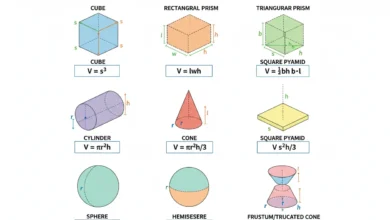
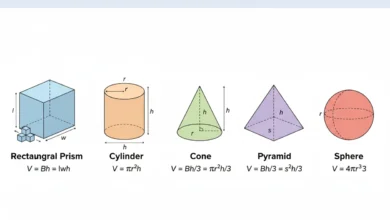
For a cube with side length s:
Volume = s³
If the volume V is known, the side length is:
s = ∛V
Suppose a cube has volume:
V = 512 cm³
Then:
s = ∛512
Because:
8³ = 512
the side length is:
s = 8 cm
The units also change correctly from cubic units back to ordinary length units.
Practical Example: Storage Cube
A cubic container has a volume of:
3375 cm³
Find its side length.
Use:
s = ∛3375
Since:
15³ = 15 × 15 × 15 = 3375
we get:
s = 15 cm
So each edge of the cube measures 15 centimeters.
Common Cube Root Mistakes
One common error is confusing a cube root with division by 3.
For example:
∛27 ≠ 27 / 3
because:
27 / 3 = 9
while:
∛27 = 3
Another mistake is writing both positive and negative answers for a simple cube root:
∛125 = 5
not:
±5
A third mistake is forgetting that negative numbers can have real cube roots:
∛(-8) = -2
It is also important to distinguish between:
∛(a + b)
and:
∛a + ∛b
These are generally not equal.
For example:
∛(1 + 7) = ∛8 = 2
but:
∛1 + ∛7 = 1 + ∛7
which is not 2.
How to Check a Cube Root
The simplest verification method is to cube the answer.
Suppose:
∛729 = 9
Check:
9³ = 9 × 9 × 9
= 81 × 9
= 729
The original number is recovered, so the answer is correct.
For an approximate result, cubing the approximation should produce a number close to the original value.
Frequently Asked Questions
What is the cube root formula?
The defining relationship is:
∛x = y if y³ = x
It may also be written:
∛x = x^(1/3)
What is the cube root of 8?
∛8 = 2
because:
2³ = 8
What is the cube root of 27?
∛27 = 3
because:
3³ = 27
What is the cube root of 64?
∛64 = 4
because:
4³ = 64
Can a negative number have a cube root?
Yes. Every negative real number has a negative real cube root.
For example:
∛(-216) = -6
Does a cube root have positive and negative answers?
A cube-root expression represents one real value. For example:
∛125 = 5
There is no ±5 because (-5)³ = -125.
What is the difference between a cube and a cube root?
Cubing raises a number to the third power:
x → x³
Taking the cube root reverses that operation:
x³ → x
How can I tell if a cube root is an integer?
Determine whether the input is a perfect cube. If:
n = k³
for an integer k, then:
∛n = k
Can cube roots be irrational?
Yes. For example:
∛2
is irrational because 2 is not a perfect cube of a rational number.
How do I estimate a cube root?
Locate the number between nearby perfect cubes. If:
a³ < n < b³
then:
a < ∛n < b
This provides an immediate interval for the answer.
Final Example
Find:
∛(-4096)
Because:
16³ = 4096
we know:
(-16)³ = -4096
Therefore:
∛(-4096) = -16
Check:
(-16) × (-16) × (-16)
= 256 × (-16)
= -4096
The defining rule remains consistent for positive, zero, and negative inputs: the cube root is the real number whose third power equals the original number.