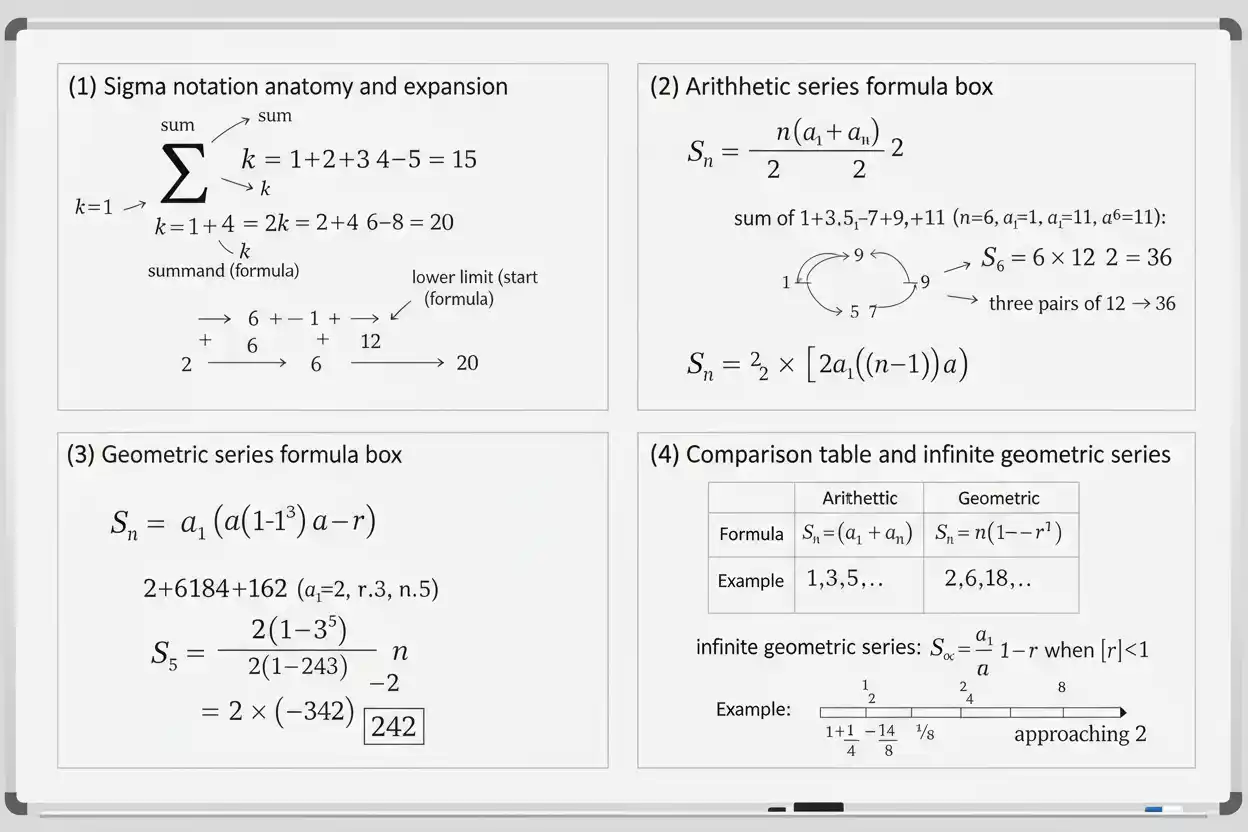

Sequence sums combine the terms of a sequence by addition. Instead of asking for one term such as aₙ, a sequence-sum problem asks for the total of several terms.
For a finite sequence:
a₁, a₂, a₃, …, aₙ
the sum of the first n terms is:
Sₙ = a₁ + a₂ + a₃ + … + aₙ
Using sigma notation:
Sₙ = Σ aₖ, from k = 1 to n
For example, the sequence:
2, 4, 6, 8, 10
has sum:
2 + 4 + 6 + 8 + 10 = 30
Therefore:
S₅ = 30
Different sequence types have formulas that avoid adding every term individually. Arithmetic and geometric sequences are especially important because their sums have compact closed forms.
What Is a Sequence Sum?
A number sequence is an ordered list of values.
A sequence sum adds selected terms from that list.
For:
3, 6, 9, 12, 15, …
the first four terms are:
3, 6, 9, 12
Their sum is:
3 + 6 + 9 + 12
= 30
So:
S₄ = 30
The notation Sₙ usually means the sum of the first n terms.
Sigma Notation
The Greek capital letter sigma:
Σ
represents summation.
For example:
Σ k, from k = 1 to 5
means:
1 + 2 + 3 + 4 + 5
which equals:
15
Likewise:
Σ k², from k = 1 to 4
means:
1² + 2² + 3² + 4²
= 1 + 4 + 9 + 16
= 30
The index tells which values are substituted into the expression.
General Finite Sum Formula
For terms:
a₁, a₂, …, aₙ
the finite sum is:
Sₙ = Σ aₖ
or explicitly:
Sₙ = a₁ + a₂ + … + aₙ
There may or may not be a shorter formula. The answer depends on the structure of the sequence.
Sum of Consecutive Positive Integers
A fundamental sequence sum is:
1 + 2 + 3 + … + n
The formula is:
Sₙ = n(n+1)/2
For example:
1 + 2 + … + 100
becomes:
100 × 101 / 2
= 5,050
Therefore:
1 + 2 + … + 100 = 5,050
Why the Integer-Sum Formula Works
Write:
S = 1 + 2 + 3 + … + (n-1) + n
Reverse it:
S = n + (n-1) + (n-2) + … + 2 + 1
Add corresponding terms.
Each pair equals:
n + 1
and there are:
n
such pairs across the two copies.
Therefore:
2S = n(n+1)
so:
S = n(n+1)/2
Arithmetic Sequence Sums
An arithmetic sequence has a constant difference d.
Its nth term is:
aₙ = a₁ + (n-1)d
The sum of its first n terms is:
Sₙ = n(a₁ + aₙ)/2
An equivalent form is:
Sₙ = n[2a₁ + (n-1)d]/2
These formulas are useful when many terms must be added.
Arithmetic Sum Example
Find the sum:
5 + 8 + 11 + … + 32
First term:
a₁ = 5
Common difference:
d = 3
Find the number of terms:
32 = 5 + (n-1)3
Subtract 5:
27 = 3(n-1)
So:
n-1 = 9
n = 10
Now:
S₁₀ = 10(5+32)/2
= 5 × 37
= 185
Therefore:
The sequence sum is 185
Arithmetic Sum Using First Term and Difference
Suppose:
a₁ = 12
d = 4
n = 20
Use:
Sₙ = n[2a₁ + (n-1)d]/2
Then:
S₂₀ = 20[24 + 19(4)]/2
= 10(24 + 76)
= 10 × 100
= 1,000
Therefore:
S₂₀ = 1,000
Geometric Sequence Sums
A geometric sequence multiplies each term by a constant ratio r.
Its terms are:
a₁, a₁r, a₁r², …, a₁r^(n-1)
For:
r ≠ 1
the finite sum is:
Sₙ = a₁(1-rⁿ)/(1-r)
An equivalent form is:
Sₙ = a₁(rⁿ-1)/(r-1)
Both give the same value.
Geometric Sum Example
Find:
3 + 6 + 12 + 24 + 48
Here:
a₁ = 3
r = 2
n = 5
Use:
S₅ = 3(1-2⁵)/(1-2)
= 3(1-32)/(-1)
= 3 × 31
= 93
Therefore:
S₅ = 93
Check directly:
3 + 6 + 12 + 24 + 48 = 93
Why the Geometric Sum Formula Works
Let:
Sₙ = a + ar + ar² + … + ar^(n-1)
Multiply by r:
rSₙ = ar + ar² + … + ar^(n-1) + arⁿ
Subtract:
Sₙ – rSₙ = a – arⁿ
Factor:
Sₙ(1-r) = a(1-rⁿ)
Therefore:
Sₙ = a(1-rⁿ)/(1-r)
for:
r ≠ 1
What If r = 1?
If the common ratio equals:
1
every term is the same.
For example:
7, 7, 7, 7, …
The first n terms sum to:
Sₙ = 7n
In general:
Sₙ = na₁
when:
r = 1
The ordinary geometric-sum formula would have denominator 1-r = 0, so this case is handled separately.
Sum of Powers of 2
Consider:
1 + 2 + 4 + 8 + … + 2^(n-1)
This is geometric with:
a₁ = 1
r = 2
Therefore:
Sₙ = (1-2ⁿ)/(1-2)
which simplifies to:
Sₙ = 2ⁿ – 1
For example:
1 + 2 + 4 + 8 + 16
= 2⁵ – 1
= 31
Sum of the First n Odd Numbers
The odd-number sequence is:
1, 3, 5, 7, …
Its first n terms sum to:
1 + 3 + 5 + … + (2n-1) = n²
For:
n = 6
we get:
1 + 3 + 5 + 7 + 9 + 11
= 36
and:
6² = 36
This is one of the most useful identities connecting sequence sums with perfect squares.
Sum of the First n Squares
Another standard identity is:
1² + 2² + 3² + … + n² = n(n+1)(2n+1)/6
For example, for:
n = 5
we get:
1 + 4 + 9 + 16 + 25
= 55
Formula:
5 × 6 × 11 / 6
= 55
Therefore:
Σ k² from 1 to 5 = 55
Sum of the First n Cubes
The sum:
1³ + 2³ + 3³ + … + n³
has formula:
[n(n+1)/2]²
For:
n = 4
we get:
[4×5/2]²
= 10²
= 100
Check:
1 + 8 + 27 + 64
= 100
The result is the square of the sum of the first n positive integers.
Alternating Sequence Sums
Some sequences alternate signs.
For example:
1 – 1 + 1 – 1 + …
A finite partial sum depends on how many terms are included.
First term:
S₁ = 1
Two terms:
S₂ = 0
Three:
S₃ = 1
Four:
S₄ = 0
Thus finite sequence sums are perfectly well defined even when an associated infinite series does not settle to a single limit.
The infinite behavior belongs to series convergence.
Partial Sums
For a sequence:
a₁, a₂, a₃, …
the partial sums are:
S₁ = a₁
S₂ = a₁ + a₂
S₃ = a₁ + a₂ + a₃
and so on.
The sequence:
S₁, S₂, S₃, …
is called the sequence of partial sums.
For finite calculations, Sₙ is simply the total through term n.
For an infinite series, the behavior of Sₙ determines convergence.
Example of Partial Sums
Consider:
1, 1/2, 1/4, 1/8, …
Partial sums:
S₁ = 1
S₂ = 1.5
S₃ = 1.75
S₄ = 1.875
These values get increasingly close to:
2
That pattern is the basis of the infinite geometric-series result.
Finite vs. Infinite Sums
A finite sum has a fixed final term:
a₁ + a₂ + … + aₙ
An infinite series is written:
a₁ + a₂ + a₃ + …
A finite sum always has a well-defined result once its terms are defined.
An infinite sum needs a convergence rule before assigning a finite value.
Therefore:
finite sequence sum ≠ automatically an infinite-series sum
Sequence Sums and Scientific Notation
Large or small sequence sums may be easier to express in scientific notation.
Suppose a calculation gives:
12,450,000,000
This can be written:
1.245 × 10¹⁰
Similarly:
0.00000375
can be written:
3.75 × 10^-6
Scientific notation changes the representation, not the value of the sum.
Example With Large Terms
Suppose:
2 × 10⁸ + 3 × 10⁸ + 4 × 10⁸
Factor:
10⁸
Then:
(2+3+4) × 10⁸
= 9 × 10⁸
Therefore:
Sequence sum = 9 × 10⁸
Matching exponents makes the arithmetic clearer.
Scientific Functions in Sequence Terms
Terms may be generated by scientific functions.
For example:
aₙ = 2ⁿ
generates:
2, 4, 8, 16, …
Or:
aₙ = sin(nπ/2)
generates:
1, 0, -1, 0, …
Once the terms are generated, their sum is calculated according to the same summation rules as any other sequence.
Fibonacci Sequence Sums
The Fibonacci sequence begins:
1, 1, 2, 3, 5, 8, 13, …
A useful identity is:
F₁ + F₂ + … + Fₙ = Fₙ₊₂ – 1
For example:
1 + 1 + 2 + 3 + 5
= 12
and:
F₇ – 1
= 13 – 1
= 12
The identity avoids adding each Fibonacci term separately.
Factorial Sequence Sums
Terms may also involve factorial notation.
For example:
1! + 2! + 3! + 4!
Calculate:
1 + 2 + 6 + 24
= 33
Not every factorial sum has a simple closed formula, so direct evaluation may be appropriate for a short finite range.
Telescoping Sums
Some sequence sums simplify because intermediate terms cancel.
Consider:
(1 – 1/2) + (1/2 – 1/3) + (1/3 – 1/4) + … + (1/n – 1/(n+1))
Everything except the first positive term and final negative term cancels.
Therefore:
Sₙ = 1 – 1/(n+1)
This is called a telescoping sum.
Example of Telescoping Cancellation
Take the first four terms:
(1-1/2) + (1/2-1/3) + (1/3-1/4) + (1/4-1/5)
Cancel:
-1/2 + 1/2
-1/3 + 1/3
-1/4 + 1/4
leaving:
1 – 1/5
= 4/5
Therefore:
S₄ = 4/5
Sum From a Different Starting Index
Sigma notation does not have to start at 1.
For example:
Σ k, from k = 4 to 7
means:
4 + 5 + 6 + 7
= 22
If a closed formula is known from 1 through n, subtract the unwanted earlier portion.
For example:
4 + 5 + … + 20
equals:
(1 + 2 + … + 20) – (1 + 2 + 3)
Use:
20×21/2 – 3×4/2
= 210 – 6
= 204
Constant Sequence Sum
If:
aₖ = c
for every term, then:
c + c + … + c
with n terms equals:
Sₙ = nc
For example, ten terms each equal to 7 sum to:
10 × 7
= 70
Linearity of Sums
For compatible finite sums:
Σ(caₖ) = cΣaₖ
and:
Σ(aₖ+bₖ) = Σaₖ + Σbₖ
For example:
Σ(2k+3), k=1 to 4
can be separated:
2Σk + 3Σ1
Then:
2(1+2+3+4) + 3(4)
= 2(10) + 12
= 32
Therefore:
Σ(2k+3), k=1 to 4 = 32
Significant Figures in Numerical Sums
If sequence terms are measured quantities rather than exact mathematical values, significant figures may affect how the final total is reported.
For addition and subtraction of measured values, decimal-place precision is commonly more relevant than simply using the fewest significant figures.
For example:
12.4 + 3.27 + 0.816
Exact arithmetic gives:
16.486
If the least precise measured input is to the nearest tenth, the reported total may be:
16.5
The mathematical sum and reported measurement precision should be distinguished.
Rounding a Sequence Sum
Suppose a computed sum is:
47.386275…
and the requested answer is two decimal places.
Using the standard rounding rules:
47.386275… ≈ 47.39
Avoid rounding individual terms too aggressively before adding them because the errors can accumulate.
Numerical Approximation of a Sum
If there is no simple formula, a finite sequence can always be evaluated term by term.
For example:
Σ 1/k², from k = 1 to 5
means:
1 + 1/4 + 1/9 + 1/16 + 1/25
Using decimals:
1 + 0.25 + 0.111111… + 0.0625 + 0.04
≈ 1.463611
Therefore:
S₅ ≈ 1.46361
This is a finite approximation, not the complete infinite-series value.
Common Mistake: Confusing aₙ With Sₙ
aₙ normally represents one sequence term.
Sₙ represents the sum through term n.
For an arithmetic sequence:
a₁ = 5
d = 3
the tenth term is:
a₁₀ = 32
but the first ten terms sum to:
S₁₀ = 185
These are very different quantities.
Common Mistake: Using an Arithmetic Sum Formula on a Geometric Sequence
For:
2, 4, 8, 16, …
the differences are:
2,4,8,…
not constant.
The ratio is:
2
Therefore it is geometric and should use the geometric-sum formula.
Common Mistake: Using the Wrong Number of Terms
For:
5, 8, 11, …, 32
the number of terms is not:
32/3
Use the nth-term equation:
32 = 5 + (n-1)3
which gives:
n = 10
The correct n is essential before applying a sum formula.
Common Mistake: Forgetting Parentheses in the Geometric Formula
The formula is:
Sₙ = a₁(1-rⁿ)/(1-r)
The numerator is the entire expression:
1-rⁿ
and the denominator is:
1-r
Incorrect grouping can change the result completely.
Common Mistake: Treating an Infinite Sum Like a Finite Sum
An expression such as:
1 + 1/2 + 1/4 + …
does not have a final term to add directly.
Its finite partial sums can be calculated, but assigning the infinite value:
2
requires a convergence argument.
That distinction is central to series mathematics.
How to Check a Sequence Sum
For a short sequence, add directly.
Suppose the formula gives:
S₅ = 93
for:
3,6,12,24,48
Direct check:
3+6+12+24+48
= 93
Therefore the formula result is correct.
For a large arithmetic or geometric sum, checking a smaller case or verifying the final term can catch indexing errors.
Frequently Asked Questions
What is a sequence sum?
A sequence sum is the total obtained by adding selected terms of a sequence.
What does Sₙ mean?
It usually means the sum of the first n terms.
What does sigma notation mean?
Σ tells you to add the values generated by an expression over a stated index range.
What is the arithmetic sequence sum formula?
Sₙ = n(a₁+aₙ)/2
or:
Sₙ = n[2a₁+(n-1)d]/2
What is the geometric sequence sum formula?
For r ≠ 1:
Sₙ = a₁(1-rⁿ)/(1-r)
What is 1 + 2 + … + n?
n(n+1)/2
What is the sum of the first n odd numbers?
n²
What is the sum of the first n squares?
n(n+1)(2n+1)/6
What is the sum of the first n cubes?
[n(n+1)/2]²
What is a partial sum?
It is the sum of the first n terms of a sequence.
Is every infinite sequence sum finite?
No. An infinite series must converge for its partial sums to approach a finite limit.
Final Example
Find the sum of the first 12 terms of:
4, 7, 10, 13, …
This is arithmetic.
First term:
a₁ = 4
Common difference:
d = 3
Number of terms:
n = 12
Find the twelfth term:
a₁₂ = 4 + (12-1)3
= 4 + 33
= 37
Now use:
Sₙ = n(a₁+aₙ)/2
Then:
S₁₂ = 12(4+37)/2
= 6 × 41
= 246
Therefore:
The sum of the first 12 terms is 246
The central sequence-sum principle is:
Sₙ = a₁ + a₂ + … + aₙ
Recognizing the sequence structure determines whether direct addition, arithmetic formulas, geometric formulas, telescoping cancellation, or another identity provides the most efficient calculation.