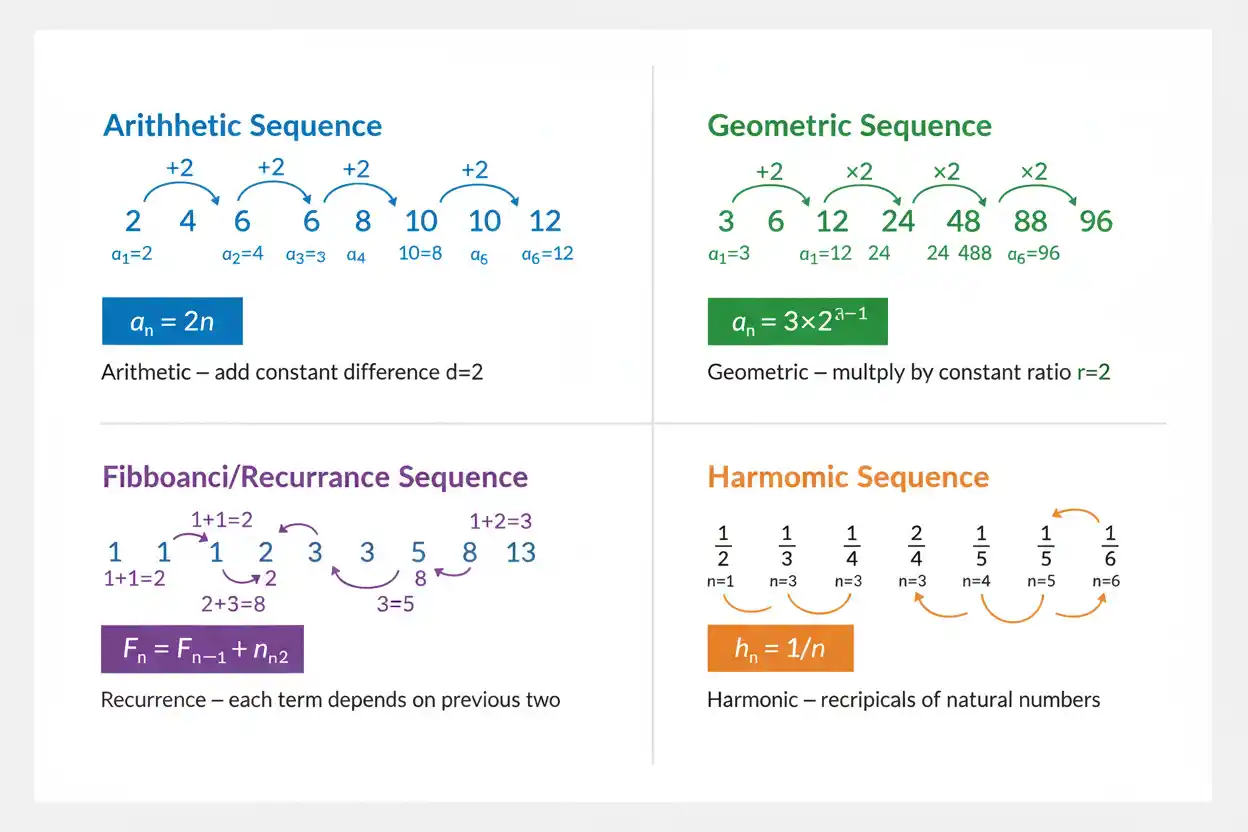

Number sequences are ordered lists of numbers generated according to a rule or recognizable mathematical relationship.
For example:
2, 4, 6, 8, 10, …
is a number sequence in which each term is obtained by adding 2 to the previous term.
Its nth-term formula is:
aₙ = 2n
Another sequence:
3, 6, 12, 24, 48, …
uses repeated multiplication by 2:
aₙ = 3 × 2^(n-1)
Number sequences can be finite or infinite, increasing or decreasing, arithmetic or geometric, recursive or explicit, and may involve integers, fractions, powers, roots, or other mathematical structures.
What Is a Number Sequence?
A sequence is an ordered collection:
a₁, a₂, a₃, a₄, …
Each value is called a term.
The subscript tells you the term’s position.
For example:
a₁ = first term
a₂ = second term
a₃ = third term
and:
aₙ = nth term
Order matters.
The list:
1, 2, 3
is not the same sequence as:
3, 2, 1
even though both contain the same three numbers.
Basic Sequence Notation
A sequence can be represented as:
{aₙ}
where aₙ describes its nth term.
For example:
aₙ = n²
generates:
a₁ = 1² = 1
a₂ = 2² = 4
a₃ = 3² = 9
a₄ = 4² = 16
Therefore the sequence is:
1, 4, 9, 16, 25, …
These values are the positive perfect squares.
Explicit Formula
An explicit formula calculates a term directly from its position n.
For example:
aₙ = 5n – 2
Generate the first terms:
For n = 1:
a₁ = 5(1) – 2 = 3
For n = 2:
a₂ = 10 – 2 = 8
For n = 3:
a₃ = 15 – 2 = 13
Therefore:
3, 8, 13, 18, 23, …
The formula can calculate the 100th term without generating the preceding 99 values.
Recursive Formula
A recursive formula defines a term using one or more earlier terms.
For example:
a₁ = 3
aₙ = aₙ₋₁ + 4
produces:
3, 7, 11, 15, 19, …
The starting term is necessary because the recurrence alone does not specify where the sequence begins.
Explicit vs. Recursive Sequences
For:
3, 7, 11, 15, …
an explicit formula is:
aₙ = 3 + 4(n – 1)
A recursive definition is:
a₁ = 3
aₙ = aₙ₋₁ + 4
Both describe the same sequence.
The explicit form jumps directly to a chosen term.
The recursive form generates terms sequentially.
Finite Number Sequences
A finite sequence contains a fixed number of terms.
For example:
2, 4, 6, 8, 10
has five terms.
It may be written:
a₁ through a₅
with no terms beyond that defined range.
Finite sequences often arise in data sets, scheduled events, geometric constructions, and combinatorial problems.
Infinite Number Sequences
An infinite sequence continues indefinitely.
For example:
1, 2, 3, 4, 5, …
The ellipsis indicates continuation according to the stated or implied rule.
Other examples include:
2, 4, 8, 16, 32, …
and:
1, 1/2, 1/3, 1/4, …
An infinite sequence has infinitely many indexed terms even if only the first several are displayed.
Arithmetic Sequences
An arithmetic sequence has a constant difference between consecutive terms.
For example:
5, 8, 11, 14, 17, …
has common difference:
d = 3
The formula is:
aₙ = a₁ + (n – 1)d
Here:
a₁ = 5
d = 3
So:
aₙ = 5 + 3(n – 1)
Simplify:
aₙ = 3n + 2
Arithmetic Sequence Example
Find the 20th term of:
4, 10, 16, 22, …
The common difference is:
6
Use:
aₙ = a₁ + (n – 1)d
Then:
a₂₀ = 4 + 19 × 6
= 4 + 114
= 118
Therefore:
a₂₀ = 118
Multiples as Number Sequences
Positive multiples of a fixed number form an arithmetic sequence.
Multiples of 7:
7, 14, 21, 28, 35, …
have:
a₁ = 7
and:
d = 7
The nth term is:
aₙ = 7n
Thus the 50th positive multiple of 7 is:
7 × 50 = 350
Geometric Sequences
A geometric sequence has a constant ratio between consecutive nonzero terms.
For example:
2, 6, 18, 54, …
has:
r = 3
because:
6/2 = 3
18/6 = 3
54/18 = 3
The formula is:
aₙ = a₁r^(n-1)
Here:
aₙ = 2 × 3^(n-1)
Geometric Sequence Example
Find the sixth term of:
5, 10, 20, 40, …
Here:
a₁ = 5
r = 2
Therefore:
a₆ = 5 × 2⁵
= 5 × 32
= 160
So:
a₆ = 160
Arithmetic vs. Geometric Sequences
Compare:
4, 7, 10, 13, …
The difference is consistently:
+3
so it is arithmetic.
Now:
4, 12, 36, 108, …
The ratio is consistently:
×3
so it is geometric.
A useful distinction is:
Arithmetic → constant difference
Geometric → constant ratio
Fibonacci Sequence
The Fibonacci sequence is generated recursively.
A common version begins:
0, 1, 1, 2, 3, 5, 8, 13, …
Each new term is the sum of the two preceding terms:
Fₙ = Fₙ₋₁ + Fₙ₋₂
For example:
5 + 8 = 13
and:
8 + 13 = 21
Unlike an arithmetic sequence, Fibonacci differences are not constant.
Unlike a geometric sequence, its consecutive ratios are not exactly constant.
Harmonic Sequences
A harmonic sequence is a sequence whose reciprocals form an arithmetic sequence.
For example:
1, 1/2, 1/3, 1/4, …
has reciprocals:
1, 2, 3, 4, …
which have constant difference 1.
A general harmonic form is:
hₙ = 1/[a + (n – 1)d]
provided the denominator is nonzero.
Square Number Sequence
The sequence:
1, 4, 9, 16, 25, …
is generated by:
aₙ = n²
The differences are:
3, 5, 7, 9, …
These first differences are not constant, so the sequence itself is not arithmetic.
However, the second differences are constant:
2, 2, 2, …
This provides an important clue that the sequence follows a quadratic rule.
Cube Number Sequence
The sequence:
1, 8, 27, 64, 125, …
has:
aₙ = n³
These are positive perfect cubes.
The first differences are:
7, 19, 37, 61, …
and are not constant.
Higher-order difference analysis can reveal polynomial sequence structure.
Nth Roots in Number Sequences
Nth roots can be used to generate or transform sequences.
For example:
√1, √4, √9, √16, …
simplifies to:
1, 2, 3, 4, …
Similarly:
∛1, ∛8, ∛27, ∛64, …
gives:
1, 2, 3, 4, …
The root operation itself does not define one standard sequence family; the rule depends on how the radicands are generated.
Alternating Sequences
A sequence may alternate signs.
For example:
1, -1, 1, -1, …
can be written:
aₙ = (-1)^(n-1)
Check:
For n = 1:
(-1)⁰ = 1
For n = 2:
(-1)¹ = -1
For n = 3:
(-1)² = 1
The powers produce the repeating sign pattern.
Alternating Magnitudes
Consider:
2, -4, 6, -8, 10, …
The magnitude pattern is:
2n
while the sign alternates.
One formula is:
aₙ = (-1)^(n-1) × 2n
For:
n = 4
we get:
(-1)³ × 8
= -8
as required.
Constant Sequences
A sequence may contain the same value at every position.
For example:
7, 7, 7, 7, …
has:
aₙ = 7
This sequence is arithmetic with:
d = 0
and can also be treated as geometric with:
r = 1
when the nonzero terms permit ratio interpretation.
Increasing Sequences
A sequence is increasing when later terms become larger according to the relevant formal definition.
For example:
2, 5, 8, 11, …
is strictly increasing because:
aₙ₊₁ > aₙ
for every displayed step.
An increasing sequence need not be arithmetic.
For example:
1, 4, 9, 16, …
also increases but follows:
aₙ = n²
Decreasing Sequences
A sequence can decrease:
20, 17, 14, 11, …
with common difference:
-3
A geometric example is:
16, 8, 4, 2, 1, …
with common ratio:
1/2
The type of decrease depends on whether the changes are additive, multiplicative, or governed by another rule.
Bounded Number Sequences
A sequence is bounded above if all its terms remain below or equal to some fixed value.
It is bounded below if all terms remain above or equal to some fixed value.
For example:
1, 1/2, 1/3, 1/4, …
is bounded above by:
1
and below by:
0
although none of the displayed positive terms equals zero.
Boundedness describes the range of sequence values rather than the rule that generates them.
Finding the Next Term
For a simple pattern:
7, 12, 17, 22, …
the difference is:
+5
So the next term is:
22 + 5 = 27
Therefore:
27
But finding a plausible next term is not always enough to identify a sequence uniquely. Many different formulas can agree on a finite initial list and then diverge later.
A valid problem normally supplies or strongly implies the intended rule.
Finding a Missing Arithmetic Term
Consider:
5, 9, ?, 17, 21
The difference appears to be:
+4
Therefore the missing term is:
9 + 4 = 13
Check:
13 + 4 = 17
So:
Missing term = 13
Finding a Missing Geometric Term
Consider:
3, 12, ?, 192
The apparent common ratio is:
4
because:
12/3 = 4
Therefore:
12 × 4 = 48
Check:
48 × 4 = 192
So:
Missing term = 48
First Differences
One useful pattern-finding method is to subtract consecutive terms.
Consider:
3, 8, 13, 18, 23
First differences:
5, 5, 5, 5
Because they are constant, the sequence is arithmetic.
Now consider:
2, 6, 12, 20, 30
Differences:
4, 6, 8, 10
They are not constant, but they have their own regular pattern.
Second Differences
For:
2, 6, 12, 20, 30
first differences are:
4, 6, 8, 10
Second differences:
2, 2, 2
The constant second difference suggests a quadratic formula.
Indeed:
aₙ = n² + n
Check:
For n = 1:
1 + 1 = 2
For n = 2:
4 + 2 = 6
For n = 3:
9 + 3 = 12
The rule matches.
Ratio Testing
When terms change multiplicatively, compare ratios instead of differences.
For:
5, 15, 45, 135
ratios are:
15/5 = 3
45/15 = 3
135/45 = 3
Therefore the sequence is geometric with:
r = 3
Checking only differences would obscure this simple structure.
Sequence Formula From an Arithmetic Pattern
Suppose:
11, 17, 23, 29, …
Here:
a₁ = 11
d = 6
Use:
aₙ = a₁ + (n – 1)d
Then:
aₙ = 11 + 6(n – 1)
Simplify:
aₙ = 11 + 6n – 6
aₙ = 6n + 5
Sequence Formula From a Geometric Pattern
Suppose:
4, 20, 100, 500, …
Here:
a₁ = 4
r = 5
Therefore:
aₙ = 4 × 5^(n-1)
This formula gives any term directly.
For example:
a₆ = 4 × 5⁵
= 4 × 3,125
= 12,500
Sequence Index From a Formula
Suppose:
aₙ = 4n + 1
and you want to determine which term equals:
61
Set:
4n + 1 = 61
Subtract:
4n = 60
Divide:
n = 15
Therefore:
61 is the 15th term
Sequence Index in a Geometric Pattern
Suppose:
aₙ = 3 × 2^(n-1)
and:
aₙ = 96
Set:
3 × 2^(n-1) = 96
Divide:
2^(n-1) = 32
Since:
32 = 2⁵
we get:
n – 1 = 5
Therefore:
n = 6
When powers are not exact, logarithms may be needed to solve for the index.
Number Sequences and Order of Operations
Sequence formulas must be evaluated using the standard order of operations.
Suppose:
aₙ = 3n² – 2n + 5
Find:
a₄
Substitute:
3(4²) – 2(4) + 5
Evaluate the exponent first:
4² = 16
Then:
3 × 16 – 8 + 5
= 48 – 8 + 5
= 45
Therefore:
a₄ = 45
Sequence Formulas With Fractions
A sequence can contain fractional terms.
For example:
aₙ = 1/n
produces:
1, 1/2, 1/3, 1/4, …
Another rule:
aₙ = n/(n+1)
produces:
1/2, 2/3, 3/4, 4/5, …
The numerator and denominator can each depend on the term index.
Sequence Formulas With Negative Integers
Consider:
aₙ = 5 – 3n
Then:
a₁ = 2
a₂ = -1
a₃ = -4
a₄ = -7
The sequence is:
2, -1, -4, -7, …
It is arithmetic with:
d = -3
Ordinary integer operations determine the signs and differences.
Sequence Formulas With Powers
Consider:
aₙ = 2^n
The terms are:
2, 4, 8, 16, 32, …
This is geometric with common ratio:
2
The exponential formula directly expresses repeated multiplication.
Sequence Formulas With Factorials
A sequence may use factorials:
aₙ = n!
The terms begin:
1!, 2!, 3!, 4!, 5!, …
which are:
1, 2, 6, 24, 120, …
The factorials grow rapidly because each new term multiplies by the next positive integer.
This sequence is neither arithmetic nor geometric with a constant ratio, because the ratio changes with n.
Modular Number Sequences
Modular arithmetic can create repeating sequences.
For example:
aₙ = n mod 4
for:
n = 1,2,3,4,5,…
gives:
1, 2, 3, 0, 1, 2, 3, 0, …
The values repeat with period:
4
Modular rules are therefore useful for cyclic sequences.
Sequence of Last Digits
Consider powers of 2:
2¹ = 2
2² = 4
2³ = 8
2⁴ = 16
2⁵ = 32
Their last digits are:
2, 4, 8, 6, 2, …
The pattern repeats every four powers.
This is a modular sequence because the last digit is determined by:
2ⁿ mod 10
Modular Inverse Patterns
A modular inverse can also generate finite residue mappings.
Modulo 7, for example, the nonzero residues have inverse pairs:
1 ↔ 1
2 ↔ 4
3 ↔ 5
6 ↔ 6
This is not an ordinary arithmetic or geometric sequence, but it illustrates how indexed or ordered numerical patterns can arise from modular relationships.
Number Sequences and Parallel or Perpendicular Lines
The mapped parallel and perpendicular lines topic belongs primarily to coordinate geometry, but number sequences can arise when coordinates are generated systematically.
For example:
(1,3), (2,5), (3,7), (4,9), …
has y-coordinates:
3,5,7,9,…
which form an arithmetic sequence.
The points satisfy:
y = 2x + 1
and therefore lie on one straight line.
Changing the sequence rule changes the coordinate pattern.
Sequence Terms as Coordinate Pairs
Two number sequences can be paired:
xₙ = n
and:
yₙ = 3n – 1
to generate points:
(1,2)
(2,5)
(3,8)
(4,11)
These points lie on:
y = 3x – 1
This illustrates how a sequence rule can generate geometric data without changing the core definition of a sequence.
Number Sequences and Nth Roots
The mapped nth roots page can help interpret sequences such as:
1, 16, 81, 256, …
Taking fourth roots gives:
1,2,3,4,…
because:
1 = 1⁴
16 = 2⁴
81 = 3⁴
256 = 4⁴
The original sequence has formula:
aₙ = n⁴
The nth-root operation reveals the underlying index pattern.
Number Sequences and Multiples
Multiples provide one of the simplest sequence families.
For positive integer k:
k, 2k, 3k, 4k, …
has:
aₙ = kn
For k = 12:
12,24,36,48,…
The common difference is also 12.
Thus every positive multiple sequence is arithmetic.
Does Every List of Numbers Have a Unique Rule?
No.
A finite list can often be extended in many mathematically valid ways.
For example:
1, 2, 3
might continue:
4,5,6,…
under the rule:
aₙ = n
But a more complicated formula could reproduce the same first three values and produce a different fourth term.
Therefore the intended pattern must come from context, simplicity, or an explicitly stated formula.
Pattern Recognition Should Be Verified
Suppose:
2, 4, 8, 16, …
A likely rule is:
multiply by 2
giving:
32
But after identifying a pattern, check it against every displayed transition:
4/2 = 2
8/4 = 2
16/8 = 2
The consistency supports the geometric interpretation.
Common Number Sequence Mistake: Using Differences for Every Pattern
For:
3, 9, 27, 81
differences are:
6,18,54
which do not reveal a constant arithmetic pattern.
Ratios are:
3,3,3
so the correct simple classification is geometric.
Choose a test appropriate to the suspected rule.
Common Mistake: Using Ratios for an Arithmetic Sequence
For:
5,8,11,14
ratios vary.
But differences are:
3,3,3
Therefore the sequence is arithmetic.
A changing ratio does not mean the sequence has no pattern.
Common Mistake: Forgetting n – 1
For an arithmetic sequence:
aₙ = a₁ + (n – 1)d
For a geometric sequence:
aₙ = a₁r^(n-1)
The n - 1 appears because the first term requires zero changes from itself.
At:
n = 1
the arithmetic formula gives:
a₁ + 0d = a₁
and the geometric formula gives:
a₁r⁰ = a₁
as required.
Common Mistake: Ignoring the Starting Index
A formula’s output depends on whether indexing begins with:
n = 0
or:
n = 1
For example:
aₙ = 2n
with n = 1,2,3,... gives:
2,4,6,…
But with n = 0,1,2,... it gives:
0,2,4,6,…
Always check the stated starting index.
Common Mistake: Confusing a Sequence With a Series
A sequence is an ordered list:
2,4,6,8,…
A series is a sum:
2 + 4 + 6 + 8 + …
The terms may be the same, but the mathematical object and question are different.
For example:
a₅ = 10
asks for a sequence term.
A sum problem asks for the combined value of several terms.
How to Check an Explicit Formula
Suppose a proposed formula for:
4,9,14,19,…
is:
aₙ = 5n – 1
Check several positions:
For n=1:
5(1)-1 = 4
For n=2:
10-1 = 9
For n=3:
15-1 = 14
The formula reproduces the sequence.
How to Check a Recursive Formula
Suppose:
a₁ = 2
aₙ = 3aₙ₋₁
Generate:
a₂ = 3 × 2 = 6
a₃ = 3 × 6 = 18
a₄ = 3 × 18 = 54
So the recursion produces:
2,6,18,54,…
as intended.
Frequently Asked Questions
What is a number sequence?
A number sequence is an ordered list of numbers generated according to a rule or mathematical relationship.
What is a term in a sequence?
A term is one value at a particular position in the sequence.
What does aₙ mean?
aₙ means the term at position n.
What is an explicit sequence formula?
It is a formula that calculates aₙ directly from n.
What is a recursive sequence formula?
It defines a term using one or more previous terms plus initial values.
What is an arithmetic sequence?
A sequence with a constant difference between consecutive terms.
What is a geometric sequence?
A sequence with a constant ratio between consecutive nonzero terms.
Is the Fibonacci sequence arithmetic?
No. Its terms are produced by adding the preceding two terms rather than by a constant difference.
Is 2, 4, 6, 8 a sequence?
Yes. A simple formula is:
aₙ = 2n
What is the next term in 5, 10, 15, 20?
Under the natural arithmetic rule of adding 5:
25
Can a sequence contain fractions?
Yes.
For example:
1, 1/2, 1/3, 1/4, …
Can a sequence contain negative numbers?
Yes.
For example:
5,2,-1,-4,…
is an arithmetic sequence with common difference -3.
Can one finite sequence have more than one possible rule?
Yes. A finite list does not mathematically determine a unique continuation unless additional constraints specify the intended pattern.
Final Example
Analyze the sequence:
7, 14, 28, 56, 112, …
First check differences:
7,14,28,56
They are not constant.
Now check ratios:
14/7 = 2
28/14 = 2
56/28 = 2
112/56 = 2
The sequence is geometric with:
a₁ = 7
r = 2
Therefore its nth-term formula is:
aₙ = 7 × 2^(n-1)
Find the eighth term:
a₈ = 7 × 2⁷
= 7 × 128
= 896
Therefore:
a₈ = 896
The broad strategy for number sequences is to identify how terms relate to their positions or neighbors, test that rule against the known terms, and then express it explicitly or recursively whenever possible. Arithmetic differences, geometric ratios, recurrences, powers, roots, multiples, and modular cycles are all common structures, but each sequence is ultimately defined by its own rule.