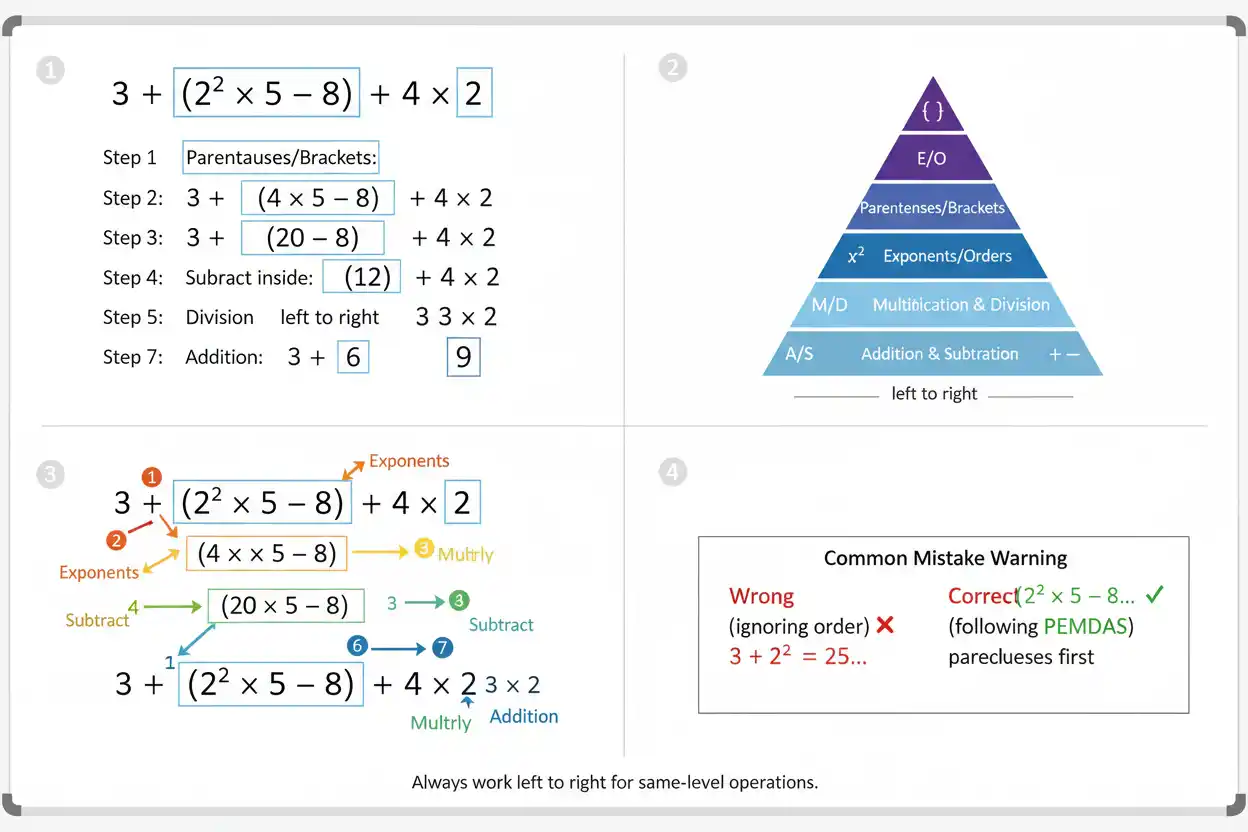

The order of operations is the agreed sequence used to evaluate mathematical expressions containing more than one operation. It prevents the same expression from producing different answers depending on which calculation is performed first.
The standard hierarchy is:
Grouping → Exponents → Multiplication and Division → Addition and Subtraction
Multiplication and division have equal priority and are evaluated from left to right. Addition and subtraction also have equal priority and are evaluated from left to right.
For example:
8 + 3 × 4
Multiply first:
3 × 4 = 12
Then add:
8 + 12 = 20
Therefore:
8 + 3 × 4 = 20
Calculating 8 + 3 first would produce 44, which is incorrect because multiplication has higher priority than addition.
What Is the Order of Operations?
The order of operations establishes which parts of an expression must be evaluated before others.
A common mnemonic is PEMDAS:
Parentheses
Exponents
Multiplication
Division
Addition
Subtraction
However, PEMDAS can be misleading if interpreted as six strictly separate levels.
The correct structure is:
1. Grouping symbols
2. Exponents and roots
3. Multiplication and division from left to right
4. Addition and subtraction from left to right
This distinction is essential.
Division does not automatically come after every multiplication, and subtraction does not automatically come after every addition.
Order of Operations Rule
For a standard numerical expression:
G → E → M/D → A/S
where:
G = grouping
E = exponents and roots
M/D = multiplication and division, left to right
A/S = addition and subtraction, left to right
The rule applies throughout arithmetic and number theory.
Example: Basic Order of Operations
Evaluate:
7 + 6 × 5
Multiplication comes before addition:
6 × 5 = 30
Then:
7 + 30 = 37
Therefore:
7 + 6 × 5 = 37
Example With Subtraction
Evaluate:
30 – 4 × 6
Multiply first:
4 × 6 = 24
Then:
30 – 24 = 6
Therefore:
30 – 4 × 6 = 6
Grouping Symbols Come First
Parentheses, brackets, fraction bars, and similar grouping symbols tell you which expression must be handled as a unit.
Evaluate:
(8 + 4) × 3
First:
8 + 4 = 12
Then:
12 × 3 = 36
Therefore:
(8 + 4) × 3 = 36
Compare that with:
8 + 4 × 3
which equals:
8 + 12 = 20
The parentheses completely change the result.
Nested Parentheses
When grouping symbols appear inside other grouping symbols, evaluate the innermost group first.
Consider:
5[3 + (8 – 6)]
Start with:
8 – 6 = 2
Then:
3 + 2 = 5
Finally:
5 × 5 = 25
Therefore:
5[3 + (8 – 6)] = 25
Brackets and Braces
Different grouping symbols may be used to make nested expressions easier to read:
( )
[ ]
{ }
They do not represent different arithmetic priorities by themselves.
For example:
2{3 + [4(5 – 2)]}
Start with:
5 – 2 = 3
Then:
4 × 3 = 12
Next:
3 + 12 = 15
Finally:
2 × 15 = 30
Therefore:
2{3 + [4(5 – 2)]} = 30
Exponents Come Before Multiplication
Evaluate:
3 × 2⁴
First calculate the exponent:
2⁴ = 16
Then multiply:
3 × 16 = 48
Therefore:
3 × 2⁴ = 48
The rules of exponents determine the power before ordinary multiplication is performed.
Exponents Inside Parentheses
Evaluate:
(2 + 3)²
Parentheses come first:
2 + 3 = 5
Then:
5² = 25
Therefore:
(2 + 3)² = 25
This is different from:
2 + 3²
which equals:
2 + 9
= 11
Negative Numbers and Exponents
Compare:
(-4)²
with:
-4²
For the first expression, the negative number is grouped:
(-4)² = (-4)(-4)
= 16
For the second:
-4²
the exponent applies to 4 first:
4² = 16
Then apply the negative sign:
-4² = -16
Thus:
(-4)² = 16
but:
-4² = -16
Grouping is crucial when powers and negative signs interact.
Roots in the Order of Operations
Roots function like powers and should be evaluated before multiplication, addition, and subtraction when their radicands are already determined.
Evaluate:
5 + √36 × 2
First:
√36 = 6
Then multiply:
6 × 2 = 12
Finally:
5 + 12 = 17
Therefore:
5 + √36 × 2 = 17
The same principle extends to nth roots.
Multiplication and Division Have Equal Priority
This is one of the most important order-of-operations rules.
Consider:
24 ÷ 6 × 2
Do not automatically multiply before dividing.
Instead, evaluate from left to right:
24 ÷ 6 = 4
Then:
4 × 2 = 8
Therefore:
24 ÷ 6 × 2 = 8
Another Multiplication-and-Division Example
Evaluate:
48 ÷ 4 × 3 ÷ 2
Move from left to right:
48 ÷ 4 = 12
12 × 3 = 36
36 ÷ 2 = 18
Therefore:
48 ÷ 4 × 3 ÷ 2 = 18
Multiplication does not outrank division.
Addition and Subtraction Have Equal Priority
Consider:
20 – 8 + 3
Evaluate from left to right:
20 – 8 = 12
Then:
12 + 3 = 15
Therefore:
20 – 8 + 3 = 15
It would be incorrect to calculate:
8 + 3 = 11
first and then:
20 – 11 = 9
unless parentheses explicitly required that grouping.
Another Addition-and-Subtraction Example
Evaluate:
30 + 10 – 8 + 2
From left to right:
30 + 10 = 40
40 – 8 = 32
32 + 2 = 34
Therefore:
30 + 10 – 8 + 2 = 34
Full Order of Operations Example
Evaluate:
6 + 2 × (8 – 3)² ÷ 5
First parentheses:
8 – 3 = 5
Then exponent:
5² = 25
The expression becomes:
6 + 2 × 25 ÷ 5
Multiplication and division from left to right:
2 × 25 = 50
50 ÷ 5 = 10
Finally:
6 + 10 = 16
Therefore:
6 + 2 × (8 – 3)² ÷ 5 = 16
Fraction Bars Act as Grouping Symbols
A fraction bar groups the entire numerator and denominator.
Consider:
(8 + 4) / (7 – 3)
Evaluate numerator:
8 + 4 = 12
Evaluate denominator:
7 – 3 = 4
Then divide:
12/4 = 3
Therefore:
(8 + 4)/(7 – 3) = 3
The fraction bar means the numerator and denominator should each be treated as grouped expressions.
Order of Operations With Fractions
Evaluate:
1/2 + 3/4 × 2
Multiplication comes first:
3/4 × 2 = 3/2
Then:
1/2 + 3/2 = 4/2
= 2
Therefore:
1/2 + 3/4 × 2 = 2
The arithmetic details follow the rules for fraction operations.
Order of Operations With Mixed Numbers
Suppose:
2 1/2 + 1 1/4 × 2
Convert the multiplication term using mixed numbers:
1 1/4 = 5/4
Multiply:
5/4 × 2 = 5/2
Also:
2 1/2 = 5/2
Now add:
5/2 + 5/2 = 10/2
= 5
Therefore:
2 1/2 + 1 1/4 × 2 = 5
Order of Operations With Improper Fractions
Evaluate:
7/3 + 5/2 × 6/5
Multiply first:
5/2 × 6/5
Cancel common factors:
= 3
Then:
7/3 + 3
Write:
3 = 9/3
So:
7/3 + 9/3 = 16/3
Therefore:
7/3 + 5/2 × 6/5 = 16/3
The result may remain an improper fraction unless another form is requested.
Decimal Order of Operations
The hierarchy does not change when decimals appear.
Evaluate:
4.5 + 2.3 × 4
First multiply:
2.3 × 4 = 9.2
Then add:
4.5 + 9.2 = 13.7
Therefore:
4.5 + 2.3 × 4 = 13.7
Ordinary decimal arithmetic handles the individual operations.
Order of Operations With Negative Integers
Evaluate:
-8 + 3 × (-4)
Multiply first:
3 × (-4) = -12
Then:
-8 + (-12) = -20
Therefore:
-8 + 3 × (-4) = -20
The sign rules come from integer operations.
Unary Negative vs. Subtraction
A negative sign can represent the sign of a number, while a minus sign between terms represents subtraction.
Consider:
7 – (-3)
The second negative belongs to the integer -3.
Subtracting a negative gives:
7 + 3
= 10
Therefore:
7 – (-3) = 10
Recognizing the role of each sign prevents common mistakes.
Absolute Value as Grouping
Absolute-value bars identify a quantity whose absolute value must be evaluated as a unit.
For example:
4 + |-7| × 2
First:
|-7| = 7
Then multiplication:
7 × 2 = 14
Finally:
4 + 14 = 18
Therefore:
4 + |-7| × 2 = 18
Factorials in Expressions
A factorial should be evaluated before ordinary multiplication and addition when it appears as an operation on a number.
For example:
3 + 4! ÷ 6
Using factorials:
4! = 4 × 3 × 2 × 1
= 24
Then:
24 ÷ 6 = 4
Finally:
3 + 4 = 7
Therefore:
3 + 4! ÷ 6 = 7
Logarithms in Expressions
Functions such as logarithms are evaluated according to their arguments before their resulting values participate in surrounding arithmetic.
For example:
5 + log₁₀(100) × 3
First:
log₁₀(100) = 2
Then:
2 × 3 = 6
Finally:
5 + 6 = 11
Therefore:
5 + log₁₀(100) × 3 = 11
Order of Operations in Number Sequences
A term formula from number sequences must be evaluated using the same hierarchy.
Suppose:
aₙ = 3n² – 2n + 5
Find:
a₄
Substitute:
3(4²) – 2(4) + 5
Exponent first:
4² = 16
Then multiplication:
3 × 16 = 48
2 × 4 = 8
Finally:
48 – 8 + 5
Move left to right:
40 + 5 = 45
Therefore:
a₄ = 45
Order of Operations With Multiples
Suppose the kth positive multiple of 7 is represented by:
Mₖ = 7k
and you need:
M_(3+2²)
First evaluate the index:
2² = 4
Then:
3 + 4 = 7
So:
M₇ = 7 × 7
= 49
Therefore:
M_(3+2²) = 49
Order of Operations and Percent Error
The percent error formula contains several operations:
Percent Error = |Observed – Actual| / |Actual| × 100%
The subtraction and absolute values must be handled before the final division and multiplication.
For example, if:
Observed = 52
Actual = 50
then:
|52 – 50| = 2
Next:
2/50 = 0.04
Then:
0.04 × 100% = 4%
Therefore:
Percent Error = 4%
Changing the calculation order would produce a different and incorrect quantity.
Order of Operations in Line Equations
Equations for parallel and perpendicular lines also rely on correct operation order.
Suppose:
y = -2x + 7
and:
x = 3
Substitute:
y = -2(3) + 7
Multiply:
-2 × 3 = -6
Then add:
-6 + 7 = 1
Therefore the point:
(3,1)
lies on the line.
Implied Multiplication
Expressions such as:
3(4 + 2)
mean:
3 × (4 + 2)
Evaluate parentheses first:
4 + 2 = 6
Then multiply:
3 × 6 = 18
Therefore:
3(4 + 2) = 18
Juxtaposition does not remove the ordinary multiplication role.
Expressions With Several Exponents
Evaluate:
2³ + 3² × 4
Calculate powers:
2³ = 8
3² = 9
Then multiply:
9 × 4 = 36
Then add:
8 + 36 = 44
Therefore:
2³ + 3² × 4 = 44
Exponent Towers Need Clear Grouping
An expression such as:
2^(3²)
means:
2^9
= 512
This differs from:
(2³)²
which gives:
8² = 64
Parentheses are the safest way to communicate which exponentiation is intended when stacked powers could be ambiguous.
Why Left-to-Right Matters
Consider:
60 ÷ 5 × 2
If you incorrectly calculate multiplication first:
5 × 2 = 10
then:
60 ÷ 10 = 6
But multiplication and division have equal priority.
Correct left-to-right evaluation is:
60 ÷ 5 = 12
then:
12 × 2 = 24
Therefore:
60 ÷ 5 × 2 = 24
Why Addition Does Not Always Come Before Subtraction
Consider:
15 – 9 + 4
Addition and subtraction have equal priority.
Move left to right:
15 – 9 = 6
Then:
6 + 4 = 10
Therefore:
15 – 9 + 4 = 10
Calculating:
9 + 4
first would be incorrect without parentheses.
Parentheses Can Override the Normal Hierarchy
Evaluate:
(3 + 5) × 2²
Parentheses:
3 + 5 = 8
Exponent:
2² = 4
Multiply:
8 × 4 = 32
Therefore:
(3 + 5) × 2² = 32
The parentheses deliberately force addition to occur before multiplication.
Redundant Parentheses
Some parentheses do not change a result but may improve readability.
For example:
2 + (3 × 4)
has the same value as:
2 + 3 × 4
because multiplication would occur first anyway.
Both equal:
14
Parentheses can therefore clarify intended grouping even when the ordinary hierarchy already produces that grouping.
Common Mistake: Treating PEMDAS as Six Independent Levels
It is incorrect to assume:
multiplication always before division
or:
addition always before subtraction
The correct paired levels are:
Multiplication and division: left to right
Addition and subtraction: left to right
This single distinction prevents many order-of-operations errors.
Common Mistake: Ignoring a Fraction Bar
Consider:
(6 + 2)/(5 – 1)
The numerator must be evaluated as one group:
8
The denominator:
4
Then:
8/4 = 2
Treating the fraction bar as if only the nearest terms were divided would misread the expression.
Common Mistake: Mishandling Negative Exponents
Consider:
2^-3
The negative sign belongs to the exponent:
2^-3 = 1/2³
= 1/8
This is different from:
-2³ = -8
and:
(-2)³ = -8
Carefully distinguish whether the negative sign belongs to the base, exponent, or overall expression.
Common Mistake: Doing Everything From Left to Right
Consider:
4 + 2 × 5
Pure left-to-right calculation would produce:
4 + 2 = 6
6 × 5 = 30
But the correct hierarchy evaluates multiplication first:
2 × 5 = 10
then:
4 + 10 = 14
Therefore:
4 + 2 × 5 = 14
Left-to-right applies only within operations of the same priority level.
Common Mistake: Doing Everything From Right to Left
There is no general right-to-left rule for ordinary multiplication/division or addition/subtraction.
For:
24 ÷ 6 × 2
evaluate left to right:
4 × 2 = 8
not right to left:
24 ÷ 12 = 2
How to Check an Expression
One useful check is to simplify the expression one priority level at a time.
For:
18 – 2(3 + 1)² ÷ 4
First grouping:
3 + 1 = 4
Then exponent:
4² = 16
Expression:
18 – 2 × 16 ÷ 4
Multiplication/division left to right:
2 × 16 = 32
32 ÷ 4 = 8
Finally:
18 – 8 = 10
Therefore:
18 – 2(3 + 1)² ÷ 4 = 10
Writing intermediate forms makes the calculation easier to audit.
Frequently Asked Questions
What is the order of operations?
The standard hierarchy is:
Grouping → Exponents → Multiplication/Division → Addition/Subtraction
What does PEMDAS mean?
It stands for Parentheses, Exponents, Multiplication, Division, Addition, and Subtraction.
However, multiplication and division share one priority level, as do addition and subtraction.
Does multiplication always come before division?
No. Multiplication and division are evaluated from left to right.
Does addition always come before subtraction?
No. Addition and subtraction are evaluated from left to right.
What comes first, parentheses or exponents?
Grouping symbols are handled before exponents outside those groups.
What comes first, multiplication or addition?
Multiplication has higher priority than addition.
What comes first, division or subtraction?
Division has higher priority than subtraction.
How are nested parentheses evaluated?
Start with the innermost grouping symbols and work outward.
Does a fraction bar count as grouping?
Yes. The numerator and denominator are each treated as grouped expressions.
Why is (-3)² different from -3²?
In (-3)², the negative is part of the squared base. In -3², the exponent applies to 3 before the leading negative sign.
What is 24 ÷ 6 × 2?
Evaluate left to right:
24 ÷ 6 = 4
4 × 2 = 8
Therefore:
8
What is 10 – 4 + 2?
Addition and subtraction have equal priority:
10 – 4 = 6
6 + 2 = 8
Therefore:
8
Final Example
Evaluate:
8 + 3[10 – 2(4 – 1)]² ÷ 6
Start with the innermost parentheses:
4 – 1 = 3
Then multiply inside the bracket:
2 × 3 = 6
Now:
10 – 6 = 4
The expression becomes:
8 + 3(4²) ÷ 6
Evaluate the exponent:
4² = 16
Then multiplication and division from left to right:
3 × 16 = 48
48 ÷ 6 = 8
Finally:
8 + 8 = 16
Therefore:
8 + 3[10 – 2(4 – 1)]² ÷ 6 = 16
The order of operations can be summarized accurately as:
Grouping → Exponents → Multiplication and Division left to right → Addition and Subtraction left to right
Following that hierarchy consistently ensures that a mathematical expression has one standard interpretation.