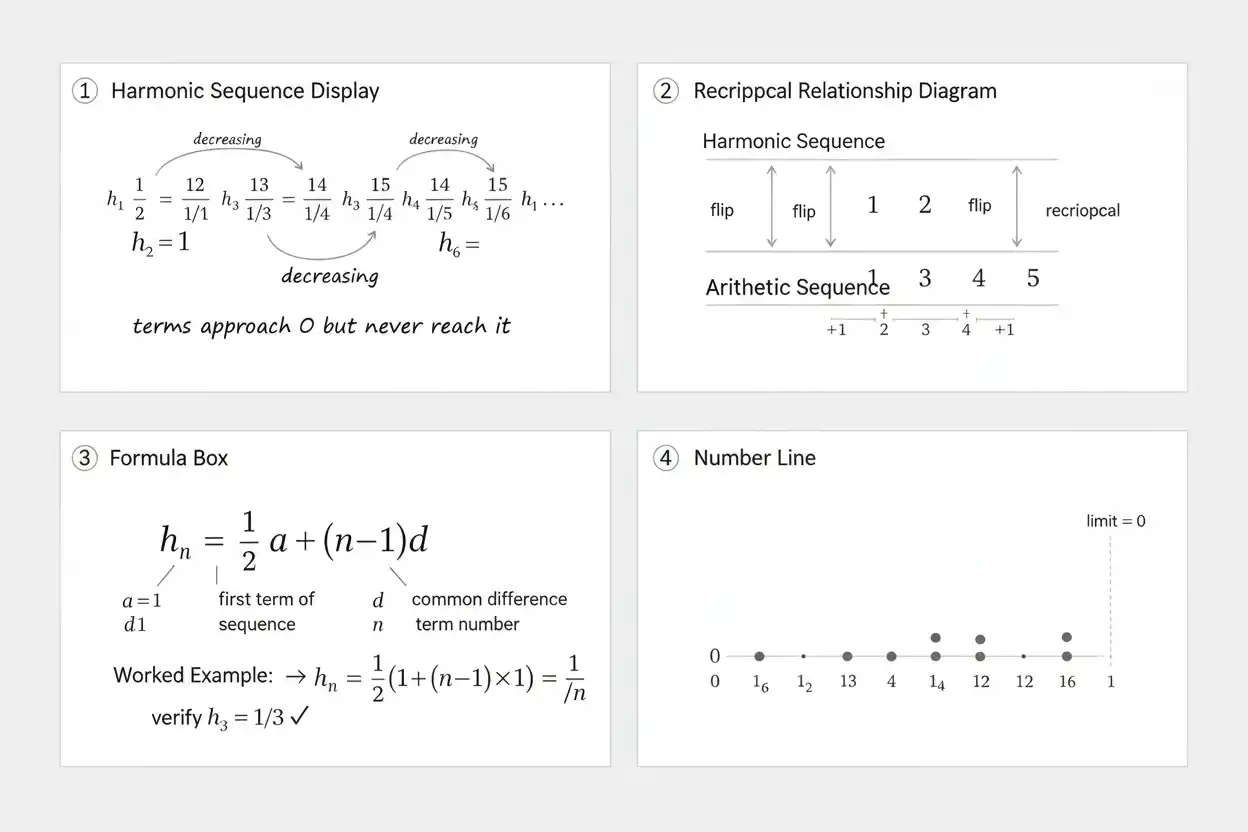

A harmonic sequence is a sequence of nonzero numbers whose reciprocals form an arithmetic sequence.
For example:
1, 1/2, 1/3, 1/4, 1/5, …
is harmonic because taking reciprocals gives:
1, 2, 3, 4, 5, …
and those values form an arithmetic sequence with common difference:
d = 1
If the reciprocal arithmetic sequence has first term a and common difference d, the corresponding harmonic sequence can be written:
hₙ = 1 / [a + (n – 1)d]
This definition distinguishes harmonic sequences from geometric sequences, which are defined by a constant ratio between consecutive terms.
What Is a Harmonic Sequence?
Suppose a sequence contains nonzero terms:
h₁, h₂, h₃, …
Take the reciprocal of every term:
1/h₁, 1/h₂, 1/h₃, …
If those reciprocal values form an arithmetic sequence, then the original sequence is harmonic.
In other words, there must be some constant d such that:
1/hₙ₊₁ – 1/hₙ = d
for consecutive terms.
The harmonic sequence belongs within the broader structure of arithmetic and number theory because its defining rule combines fractions, reciprocals, sequences, and arithmetic progression.
Harmonic Sequence Formula
Suppose the reciprocal sequence is arithmetic:
a, a + d, a + 2d, a + 3d, …
Its nth term is:
a + (n – 1)d
Taking reciprocals produces the harmonic sequence:
hₙ = 1 / [a + (n – 1)d]
where:
hₙ = nth harmonic-sequence term
a = first term of the reciprocal arithmetic sequence
d = common difference of the reciprocals
n = term number
The denominator must not equal zero for any term being considered.
Basic Harmonic Sequence Example
Consider:
1, 1/2, 1/3, 1/4, …
Take reciprocals:
1, 2, 3, 4, …
This is arithmetic with:
a = 1
d = 1
Therefore:
hₙ = 1 / [1 + (n – 1)]
Simplify:
hₙ = 1/n
So the familiar sequence:
1, 1/2, 1/3, 1/4, …
has the formula:
hₙ = 1/n
Another Harmonic Sequence
Consider:
1/2, 1/5, 1/8, 1/11, …
Take reciprocals:
2, 5, 8, 11, …
The difference between consecutive reciprocals is:
3
Therefore:
a = 2
d = 3
The nth term is:
hₙ = 1 / [2 + 3(n – 1)]
Simplify:
hₙ = 1 / (3n – 1)
So:
hₙ = 1/(3n – 1)
Checking the Formula
For:
hₙ = 1/(3n – 1)
find the first four terms.
For n = 1:
h₁ = 1/(3 – 1)
= 1/2
For n = 2:
h₂ = 1/(6 – 1)
= 1/5
For n = 3:
h₃ = 1/(9 – 1)
= 1/8
For n = 4:
h₄ = 1/(12 – 1)
= 1/11
This reproduces:
1/2, 1/5, 1/8, 1/11, …
How to Determine Whether a Sequence Is Harmonic
Use this procedure:
- Confirm the terms are nonzero.
- Take the reciprocal of each term.
- Find the difference between consecutive reciprocals.
- If the difference remains constant, the original sequence is harmonic.
For example:
1/3, 1/7, 1/11, 1/15
Reciprocals:
3, 7, 11, 15
Differences:
7 – 3 = 4
11 – 7 = 4
15 – 11 = 4
The differences are constant.
Therefore:
the original sequence is harmonic
Example of a Sequence That Is Not Harmonic
Consider:
1, 1/2, 1/4, 1/8
Take reciprocals:
1, 2, 4, 8
Differences:
1, 2, 4
The differences are not constant.
Therefore:
1, 1/2, 1/4, 1/8 is not harmonic
Instead, the original sequence is geometric with common ratio:
1/2
The distinction depends on what remains constant after examining the sequence.
Harmonic Sequence vs. Geometric Sequence
A geometric sequence satisfies:
aₙ = a₁r^(n-1)
because consecutive terms have a constant ratio.
A harmonic sequence is defined by reciprocals that have a constant difference.
For example:
1, 1/2, 1/3, 1/4
is harmonic.
Its consecutive ratios are:
1/2
2/3
3/4
These are not constant, so it is not geometric.
Harmonic Sequence vs. Arithmetic Sequence
An arithmetic sequence itself changes by a constant difference.
For example:
2, 5, 8, 11, …
has:
d = 3
Taking reciprocals gives:
1/2, 1/5, 1/8, 1/11, …
which is harmonic.
So the relationship is:
Arithmetic sequence → take reciprocals → harmonic sequence
and:
Harmonic sequence → take reciprocals → arithmetic sequence
General Reciprocal Relationship
Suppose:
aₙ = a₁ + (n – 1)d
is an arithmetic sequence with no zero terms.
Then:
hₙ = 1/aₙ
forms a harmonic sequence.
Substitute:
hₙ = 1/[a₁ + (n – 1)d]
This is the general harmonic-sequence formula.
Finding the nth Term
Consider:
1/4, 1/7, 1/10, 1/13, …
The reciprocals are:
4, 7, 10, 13, …
So:
a = 4
d = 3
The formula is:
hₙ = 1/[4 + 3(n – 1)]
Simplify:
hₙ = 1/(3n + 1)
Find:
h₁₀
Substitute:
h₁₀ = 1/(3 × 10 + 1)
= 1/31
Therefore:
h₁₀ = 1/31
Example: Find the 20th Term
Consider:
1/5, 1/9, 1/13, 1/17, …
The reciprocals form:
5, 9, 13, 17, …
with:
a = 5
d = 4
Therefore:
hₙ = 1/[5 + 4(n – 1)]
Simplify:
hₙ = 1/(4n + 1)
Then:
h₂₀ = 1/(4 × 20 + 1)
= 1/81
Therefore:
h₂₀ = 1/81
Finding the Reciprocal Common Difference
Suppose the harmonic sequence begins:
1/6, 1/10, 1/14, 1/18, …
Take reciprocals:
6, 10, 14, 18, …
Then:
d = 10 – 6
= 4
Therefore the common difference of the reciprocal arithmetic sequence is:
4
The harmonic terms themselves do not have a constant difference of 4.
Finding a Missing Harmonic Term
Suppose:
1/3, x, 1/9
are consecutive terms of a harmonic sequence.
Take reciprocals:
3, 1/x, 9
These must be consecutive arithmetic-sequence terms.
The middle arithmetic term is the average of 3 and 9:
1/x = (3 + 9)/2
= 6
Therefore:
x = 1/6
So:
1/3, 1/6, 1/9
forms a harmonic sequence.
Harmonic Mean
If positive numbers a and b have a harmonic mean H between them, then:
a, H, b
form a three-term harmonic sequence.
Taking reciprocals gives:
1/a, 1/H, 1/b
which must be arithmetic.
Therefore:
2/H = 1/a + 1/b
Solving:
H = 2ab/(a + b)
This is the harmonic mean of two positive numbers.
Example: Harmonic Mean of 4 and 12
Use:
H = 2ab/(a + b)
Substitute:
H = 2 × 4 × 12 / (4 + 12)
= 96/16
= 6
Therefore:
H = 6
Check the reciprocal sequence:
1/4, 1/6, 1/12
Differences:
1/6 – 1/4 = -1/12
1/12 – 1/6 = -1/12
The reciprocals are arithmetic.
Harmonic Mean vs. Arithmetic Mean
For two positive numbers a and b, the arithmetic mean is:
A = (a + b)/2
The harmonic mean is:
H = 2ab/(a + b)
For:
a = 4
b = 12
Arithmetic mean:
A = (4 + 12)/2
= 8
Harmonic mean:
H = 6
So:
H < A
unless the two original positive values are equal, in which case the means are the same.
Harmonic Mean and Rates
The harmonic mean is especially useful when averaging rates over equal distances or equivalent reciprocal-type quantities.
Suppose a vehicle travels the same distance at:
40 km/h
and:
60 km/h
The average speed is not simply:
(40 + 60)/2 = 50 km/h
For equal distances, the harmonic mean applies:
H = 2 × 40 × 60 / (40 + 60)
= 4800/100
= 48 km/h
Therefore:
Average speed = 48 km/h
This is an application of harmonic relationships, although the harmonic-sequence definition itself remains based on reciprocal arithmetic sequences.
Fractions in Harmonic Sequences
Harmonic sequence terms are often fractions.
For example:
1/2, 1/5, 1/8, 1/11, …
Calculations involving these terms may use ordinary fraction operations.
For example:
1/2 – 1/5
Use denominator 10:
5/10 – 2/10
= 3/10
But the fact that the sequence is harmonic comes from the reciprocals:
2, 5, 8, 11
not from the direct difference between the fractional terms.
Improper Fractions Can Appear
A harmonic sequence does not require every term to be a proper fraction.
Suppose the reciprocal arithmetic sequence is:
1/2, 1, 3/2, 2, …
Taking reciprocals produces:
2, 1, 2/3, 1/2, …
The first term is greater than 1.
Working with improper fractions does not prevent a sequence from being harmonic, provided the reciprocals form an arithmetic progression.
Simplifying Harmonic Terms
Suppose a formula produces:
hₙ = 6/(12n + 18)
6/(12n + 18) = 1/(2n + 3)
because:
12n + 18 = 6(2n + 3)
The simpler form makes the reciprocal structure clearer:
1/hₙ = 2n + 3
which is arithmetic in n.
Harmonic Sequence With Negative Terms
Harmonic sequences can contain negative values as long as the terms are nonzero and their reciprocals form an arithmetic sequence.
For example:
-1, -1/2, -1/3, -1/4, …
has reciprocals:
-1, -2, -3, -4, …
This is arithmetic with common difference:
-1
Therefore the original sequence is harmonic.
Harmonic Sequence Crossing Through a Zero Reciprocal Denominator
Consider a reciprocal arithmetic formula:
aₙ = 3 – n
Then the corresponding reciprocal expression would be:
hₙ = 1/(3 – n)
At:
n = 3
the denominator becomes:
0
and the term is undefined.
Therefore a harmonic sequence formula must exclude indices at which its reciprocal arithmetic term equals zero.
This domain restriction is essential.
Is the Harmonic Sequence 1/n Decreasing?
For positive integers n:
hₙ = 1/n
The sequence is:
1, 1/2, 1/3, 1/4, …
and each term is smaller than the previous one.
As:
n → infinity
the terms approach:
0
So:
1/n → 0
The terms become arbitrarily small while remaining positive.
A Harmonic Sequence Can Increase
Not every harmonic sequence decreases.
Consider reciprocals forming:
5, 4, 3, 2, 1
The corresponding harmonic terms are:
1/5, 1/4, 1/3, 1/2, 1
These increase.
The reciprocal arithmetic sequence has common difference:
-1
As its positive denominators get smaller, the harmonic terms get larger.
Therefore the direction of a harmonic sequence depends on the reciprocal arithmetic progression.
Harmonic Sequence and Percentages
Suppose one harmonic term is:
3/5
Its equivalent percentage is found using the fractions to percent rule:
3/5 × 100% = 60%
Changing the representation to 60% does not alter the underlying value.
However, a list of percentage forms should still be converted back to numerical reciprocals if you want to test whether the original values form a harmonic sequence.
Harmonic Sequence and Greatest Common Factor
The greatest common factor is an integer-divisibility concept.
A harmonic sequence is instead defined through reciprocals and constant arithmetic differences.
For example:
1/6, 1/10, 1/14
is harmonic because its reciprocals:
6, 10, 14
form an arithmetic sequence.
Those integers have:
GCF(6,10,14) = 2
but the GCF does not establish harmonicity.
The constant difference:
4
does.
Harmonic Sequence and GCF
The shorter GCF concept may still be useful when simplifying integer components inside fractional terms.
For instance:
6/18
can be reduced using:
GCF(6,18) = 6
to:
1/3
Simplifying fractions can make the reciprocal pattern easier to identify, but the harmonic-sequence test remains:
Are the reciprocals arithmetic?
Harmonic Sequence and Hexadecimal
A hexadecimal numeral is simply another representation of an underlying number.
For example, if reciprocal sequence terms are integers written in base 16, converting their notation does not change whether their numerical values form an arithmetic sequence.
The harmonic property depends on the values and reciprocal relationships, not on whether those values are displayed in decimal, binary, hexadecimal, or another numeral system.
Harmonic Sequence and Integer Operations
When the reciprocal arithmetic sequence contains integers, ordinary integer operations may be used to find differences.
For example:
-5, -2, 1, 4, …
has constant difference:
3
Provided none of these reciprocal values equals zero at the index being considered, taking their reciprocals creates a harmonic sequence.
The integer arithmetic determines the difference; reciprocal conversion determines the harmonic terms.
Is 1, 1/2, 1/3, 1/4 a Geometric Sequence?
No.
Check consecutive ratios:
(1/2)/1 = 1/2
(1/3)/(1/2) = 2/3
(1/4)/(1/3) = 3/4
The ratios are different.
Therefore it is not geometric.
Its reciprocals:
1, 2, 3, 4
have constant difference 1.
Therefore:
it is harmonic
Is 1, 1/3, 1/5, 1/7 Harmonic?
Take reciprocals:
1, 3, 5, 7
The differences are:
2, 2, 2
Therefore:
yes, the sequence is harmonic
Its formula is:
hₙ = 1/[1 + 2(n – 1)]
Simplify:
hₙ = 1/(2n – 1)
Is 1/2, 1/4, 1/6, 1/8 Harmonic?
Take reciprocals:
2, 4, 6, 8
The common difference is:
2
Therefore:
yes
The nth term is:
hₙ = 1/[2 + 2(n – 1)]
Simplify:
hₙ = 1/(2n)
or:
hₙ = 1/(2n)
The displayed sequence confirms:
n = 1 → 1/2
n = 2 → 1/4
n = 3 → 1/6
Is 1/2, 1/4, 1/8, 1/16 Harmonic?
Take reciprocals:
2, 4, 8, 16
Differences:
2, 4, 8
These are not constant.
Therefore:
the sequence is not harmonic
It is geometric because each original term is multiplied by:
1/2
Finding a Harmonic Sequence From an Arithmetic Sequence
Start with the arithmetic sequence:
4, 9, 14, 19, …
Its formula is:
aₙ = 4 + 5(n – 1)
Take reciprocals:
1/4, 1/9, 1/14, 1/19, …
Therefore the harmonic sequence has:
hₙ = 1/[4 + 5(n – 1)]
Simplify:
hₙ = 1/(5n – 1)
This is often the easiest way to construct a harmonic sequence intentionally.
Finding the Reciprocal Arithmetic Formula
Suppose:
hₙ = 1/(7 + 4n)
Then:
1/hₙ = 7 + 4n
The reciprocal sequence is linear in n.
Its common difference is:
4
Therefore the original sequence is harmonic wherever:
7 + 4n ≠ 0
For positive integer indices, that denominator is always positive.
Harmonic Sequence and Linear Denominators
A sequence of the form:
1/(an + b)
is harmonic whenever the denominator does not become zero for the relevant indices.
Why?
The reciprocals are:
an + b
As n increases by 1:
a(n+1) + b – (an+b) = a
So the reciprocal values have constant difference:
a
Therefore:
1/(an+b)
is a standard harmonic-sequence form.
Example With Linear Denominator
Consider:
hₙ = 1/(4n + 3)
First terms:
For n = 1:
1/7
For n = 2:
1/11
For n = 3:
1/15
For n = 4:
1/19
Reciprocals:
7, 11, 15, 19
Common difference:
4
Therefore the sequence is harmonic.
Harmonic Sequence vs. Harmonic Sum
The term harmonic sequence refers to terms such as:
1, 1/2, 1/3, 1/4, …
The expression:
1 + 1/2 + 1/3 + 1/4 + …
instead involves adding those terms.
A sequence is an ordered list; a sum is a different mathematical object.
This page focuses on the sequence structure and reciprocal arithmetic rule rather than on properties of infinite sums.
Common Harmonic Sequence Mistake: Checking Direct Differences
For:
1, 1/2, 1/3, 1/4
the direct differences are not constant.
That does not mean the sequence is not harmonic.
You must take reciprocals first:
1, 2, 3, 4
Then test the differences.
The harmonic condition applies to the reciprocal sequence.
Common Mistake: Checking Direct Ratios
The original terms do not need a constant ratio.
If their ratios were constant, the sequence would be geometric.
For harmonicity, use:
1/hₙ
and check for a constant difference.
Common Mistake: Forgetting Zero Restrictions
A harmonic-sequence term cannot be:
1/0
So a formula such as:
hₙ = 1/(n – 3)
is undefined when:
n = 3
That index must be excluded.
Common Mistake: Confusing Harmonic Mean With Arithmetic Mean
For 6 and 12:
Arithmetic mean:
(6 + 12)/2 = 9
Harmonic mean:
2 × 6 × 12 / (6 + 12)
= 144/18
= 8
Therefore:
Arithmetic mean = 9
Harmonic mean = 8
The correct mean depends on the structure of the problem.
How to Check a Harmonic Sequence
Suppose:
1/4, 1/10, 1/16, 1/22
Take reciprocals:
4, 10, 16, 22
Compute differences:
10 – 4 = 6
16 – 10 = 6
22 – 16 = 6
Because every difference is:
6
the original sequence is harmonic.
Its formula is:
hₙ = 1/[4 + 6(n – 1)]
Simplify:
hₙ = 1/(6n – 2)
Frequently Asked Questions
What is a harmonic sequence?
A harmonic sequence is a sequence of nonzero numbers whose reciprocals form an arithmetic sequence.
What is the harmonic sequence formula?
If the reciprocal arithmetic sequence has first term a and common difference d:
hₙ = 1/[a + (n – 1)d]
Is 1, 1/2, 1/3, 1/4 a harmonic sequence?
Yes. Its reciprocals are:
1, 2, 3, 4
which form an arithmetic sequence.
Is a harmonic sequence the same as a geometric sequence?
No. A geometric sequence has a constant ratio between its own consecutive terms. A harmonic sequence has reciprocals with a constant difference.
How do you test whether a sequence is harmonic?
Take the reciprocal of every term and check whether those reciprocal values have a constant difference.
What is the nth term of 1, 1/2, 1/3, 1/4, …?
hₙ = 1/n
What is the nth term of 1/3, 1/7, 1/11, 1/15, …?
The reciprocal sequence is:
3, 7, 11, 15, …
with common difference 4.
Therefore:
hₙ = 1/[3 + 4(n – 1)]
= 1/(4n – 1)
Can a harmonic sequence contain negative terms?
Yes, provided none of the terms is zero and the reciprocals form an arithmetic sequence.
Can a harmonic sequence increase?
Yes. If the positive reciprocal terms decrease while remaining nonzero, their reciprocals can increase.
What is the harmonic mean of two numbers?
For positive a and b:
H = 2ab/(a+b)
Why do reciprocals matter in a harmonic sequence?
The reciprocal transformation converts the harmonic sequence into an arithmetic sequence, whose constant difference defines the harmonic structure.
Final Example
Determine whether:
1/5, 1/9, 1/13, 1/17, 1/21
is harmonic and find its nth-term formula.
Take reciprocals:
5, 9, 13, 17, 21
Find consecutive differences:
9 – 5 = 4
13 – 9 = 4
17 – 13 = 4
21 – 17 = 4
The reciprocal sequence is arithmetic with:
a = 5
d = 4
Therefore the original sequence is harmonic.
Use:
hₙ = 1/[a + (n – 1)d]
Substitute:
hₙ = 1/[5 + 4(n – 1)]
Simplify:
hₙ = 1/(4n + 1)
Therefore:
hₙ = 1/(4n + 1)
The defining test for every harmonic sequence is the same: take the reciprocals. If those reciprocal values form an arithmetic sequence, the original sequence is harmonic.