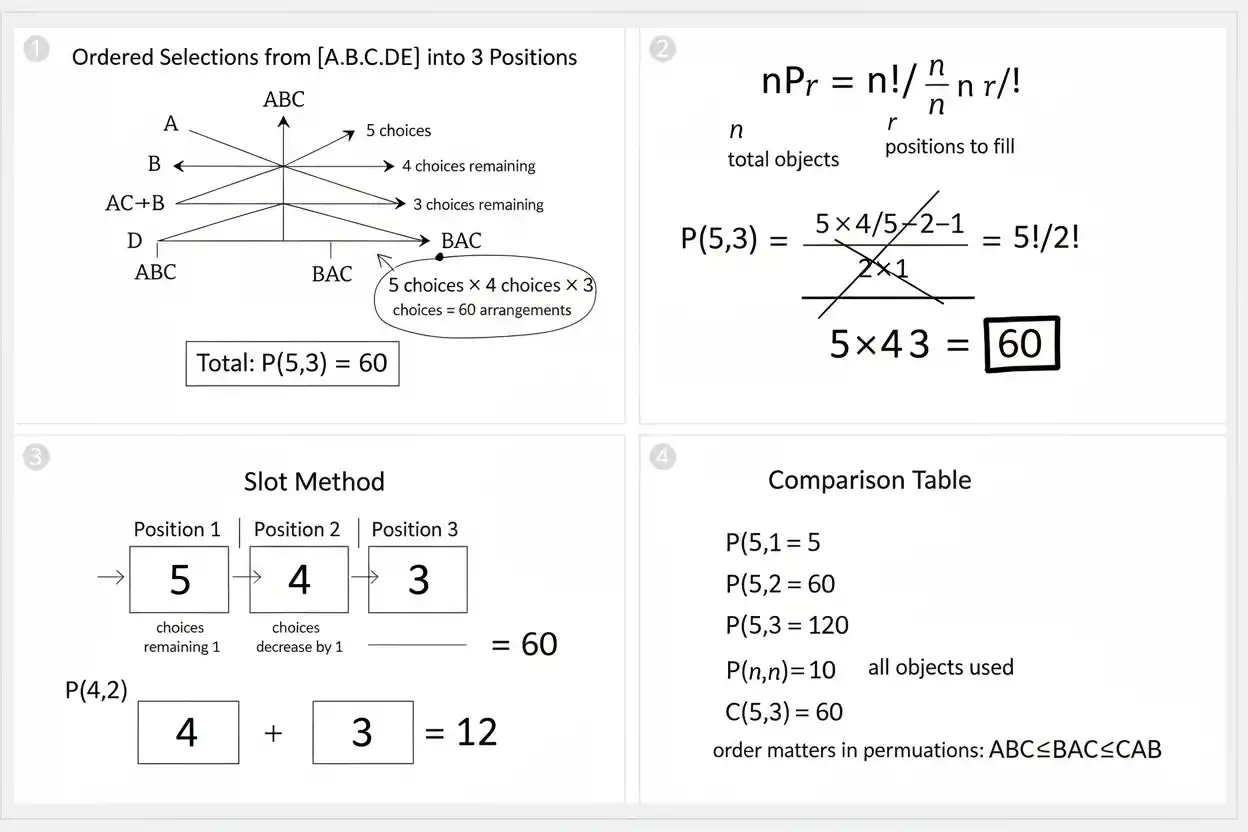

Permutations count arrangements or selections where order matters.
If r distinct objects are selected and arranged from n distinct available objects without replacement, the number of permutations is:
nPr = n! / (n-r)!
The same formula may be written:
P(n,r) = n!/(n-r)!
For example, if 3 positions must be filled from 5 distinct people:
5P3 = 5!/(5-3)!
= 5!/2!
= 5 × 4 × 3
= 60
Therefore:
There are 60 ordered selections of 3 people from 5.
The defining question is simple:
Would changing the order create a different outcome?
If yes, a permutation is often the appropriate counting model.
What Is a Permutation?
A permutation is an ordered arrangement.
Consider three letters:
A, B, C
The arrangements:
ABC
and:
ACB
use the same letters but in different orders.
Therefore they are different permutations.
All full permutations are:
ABC
ACB
BAC
BCA
CAB
CBA
There are:
6
which equals:
3! = 6
The broader counting principles belong to combinatorics.
What Does nPr Mean?
In:
nPr
n is the number of distinct available objects.
r is the number selected and arranged.
The result gives the number of ordered arrangements of length r that can be formed without reusing an object.
For example:
8P3
means:
choose and arrange 3 distinct objects from 8 distinct available objects.
Permutation Formula
The standard formula is:
nPr = n!/(n-r)!
for:
0 ≤ r ≤ n
when n and r are nonnegative integers.
The factorial notation means:
n! = n(n-1)(n-2)…2×1
Therefore:
n!/(n-r)!
cancels all factors below:
n-r+1
leaving exactly r descending factors.
Product Form of nPr
The formula can also be written:
nPr = n(n-1)(n-2)…(n-r+1)
There are exactly:
r
factors.
For example:
10P4
becomes:
10 × 9 × 8 × 7
= 5,040
This form is often easier than calculating complete factorials.
Why the Formula Works
Suppose r ordered positions must be filled from n distinct objects.
For the first position:
n choices
After one object is used:
n – 1 choices
For the second position:
n – 1
For the third:
n – 2
Continue until r positions are filled.
By the multiplication principle:
n × (n-1) × … × (n-r+1)
arrangements are possible.
That product is exactly:
n!/(n-r)!
Example: 5P2
Calculate:
5P2
Use the product form:
5 × 4
= 20
Therefore:
5P2 = 20
If the objects are:
A,B,C,D,E
then:
AB
and:
BA
are separate outcomes.
That order sensitivity is why the answer is larger than the corresponding unordered selection count.
Example: 6P3
Use:
6P3 = 6!/(6-3)!
= 6!/3!
Cancel:
= 6 × 5 × 4
= 120
Therefore:
6P3 = 120
Example: 10P3
Use:
10 × 9 × 8
= 720
Therefore:
10P3 = 720
Only three descending factors are needed because:
r = 3
Full Permutations
If every available object is arranged:
r = n
Then:
nPn = n!/(n-n)!
= n!/0!
Since:
0! = 1
we get:
nPn = n!
For example:
5P5 = 5!
= 120
Therefore five distinct objects can be fully ordered in:
120 ways
Why 0! Equals 1 Here
The formula:
nPn = n!/0!
must agree with the known full-permutation count:
n!
Therefore:
0! = 1
is consistent with the permutation formula.
The factorial identity has many other mathematical reasons as well, but permutations provide an intuitive example.
Selecting Zero Objects
What is:
nP0?
Use the formula:
nP0 = n!/(n-0)!
= n!/n!
= 1
Therefore:
nP0 = 1
There is exactly one way to make an ordered selection containing no objects: the empty arrangement.
Permutations and Factorials
A full permutation of n distinct elements has:
n!
possible arrangements.
The factorial formula is:
n! = n(n-1)…1
For:
n = 7
we have:
7! = 5,040
Therefore:
7 distinct objects have 5,040 full permutations
Cancel Factorials Before Multiplying
Consider:
12P3 = 12!/9!
Instead of calculating:
12!
and:
9!
separately, cancel directly:
12!/9! = 12 × 11 × 10
Therefore:
12P3 = 1,320
This is faster and keeps intermediate numbers smaller.
Example: 12P5
Use the product form:
12P5 = 12 × 11 × 10 × 9 × 8
Calculate:
12 × 11 = 132
10 × 9 × 8 = 720
Then:
132 × 720 = 95,040
Therefore:
12P5 = 95,040
When Order Matters
Suppose a competition awards:
first place,
second place,
and:
third place
from 10 finalists.
The outcomes:
Alice first, Ben second, Cara third
and:
Cara first, Ben second, Alice third
are different.
Therefore order matters.
The number of possible podiums is:
10P3
= 10 × 9 × 8
= 720
So:
720 podium arrangements are possible
Example: President, Vice President, Treasurer
Suppose 8 people are eligible for three distinct positions:
president,
vice president,
treasurer
One person cannot hold more than one position.
The first office has:
8 choices
The second:
7 choices
The third:
6 choices
Therefore:
8P3 = 8 × 7 × 6
= 336
So:
336 assignments are possible
The job titles make the order or role assignment significant.
Example: Four-Digit Arrangement From Distinct Digits
Suppose four distinct digits are selected and arranged from:
1,2,3,4,5,6
with no repetition.
The number of arrangements is:
6P4
= 6 × 5 × 4 × 3
= 360
Therefore:
360 ordered four-digit strings can be formed
Because zero is not included, no leading-zero complication arises.
Permutations Without Replacement
The standard:
nPr
formula assumes an object cannot be selected twice.
After one of n objects is used, only:
n-1
remain.
This declining choice count creates:
n(n-1)(n-2)…
If repetition is allowed, the formula changes.
Permutations With Repetition Allowed
Suppose there are:
n
possible symbols for each of:
r
positions, and symbols may be reused.
Then each position independently has:
n choices
Therefore:
Number of ordered sequences = n^r
For example, with:
4 symbols
and:
3 positions
when repetition is allowed:
4³ = 64
When repetition is not allowed:
4P3 = 4 × 3 × 2
= 24
These are different counting models.
Example: PIN-Like Strings
Suppose a three-position code uses digits:
0 through 9
and repetition is allowed.
Each position has:
10 choices
Therefore:
10³ = 1,000
possible strings.
This is not:
10P3
because digits can repeat.
If repetition were prohibited, then:
10P3 = 720
would be appropriate.
Permutations vs. Combinations
The central distinction is:
Permutation → order matters
Combination → order does not matter
Suppose three people are selected from:
A,B,C,D,E
If the selected people receive distinct roles, then:
ABC
and:
BAC
are different outcomes.
Use permutations.
If the question asks only which three people form a group, those two arrangements represent the same group.
The neighboring permutations and combinations page develops this distinction and both formulas together.
Relationship Between nPr and nCr
Once r objects are selected without regard to order, those r objects can themselves be arranged in:
r!
ways.
Therefore:
nPr = nCr × r!
Equivalently:
nCr = nPr/r!
This explains why permutation counts are larger whenever:
r > 1
because every unordered group corresponds to multiple ordered arrangements.
Example: 5P3 vs. 5C3
Permutation count:
5P3 = 5 × 4 × 3
= 60
Combination count:
5C3 = 10
Each selected group of three can be arranged in:
3! = 6
ways.
Check:
10 × 6 = 60
Therefore:
5P3 = 5C3 × 3!
Full Permutations With Repeated Identical Objects
The ordinary n! formula assumes all objects are distinct.
If some objects are indistinguishable, divide by factorials of repeated counts.
For example, the letters of:
LEVEL
include:
L twice
E twice
V once
The number of distinct full arrangements is:
5!/(2!2!)
Calculate:
120/4
= 30
Therefore:
LEVEL has 30 distinct letter arrangements
This is different from the ordinary nPr model of distinct objects.
Permutations and Prime Factorization
For large permutation calculations, prime factorization can help simplify factorial ratios or analyze divisibility.
For example:
8P4 = 8 × 7 × 6 × 5
Prime-factorize:
8 = 2³
6 = 2 × 3
Therefore:
8P4 = 2⁴ × 3 × 5 × 7
This makes divisibility properties immediately visible.
The numerical value is:
1,680
Prime Factors of a Permutation Count
Consider:
6P3 = 120
Prime factorization:
120 = 2³ × 3 × 5
Therefore the permutation count is divisible by:
2,3,4,5,6,8,10,…
according to its factor structure.
Prime-factor form can be useful when exact decimal expansion is less important than divisibility.
Permutation Rank
A permutation rank identifies the position of one particular full permutation within a specified ordering.
For example, there are:
4! = 24
full permutations of four distinct elements.
The permutation count says:
24 possibilities exist
Permutation ranking instead asks:
Which indexed position does a particular arrangement occupy?
The two ideas are closely connected through factorial structure but solve different problems.
Count First, Rank Second
Suppose the set is:
{1,2,3,4,5}
The number of full permutations is:
5! = 120
So a zero-based rank can range:
0 through 119
A ranking algorithm can then map any one of those 120 arrangements to its unique index.
The count establishes the size of the permutation space; ranking identifies one element within it.
Partial Permutations
A permutation does not have to use all available objects.
Suppose:
n = 9
and:
r = 4
Then:
9P4
counts ordered four-object selections from nine distinct objects.
Calculate:
9 × 8 × 7 × 6
= 3,024
Therefore:
9P4 = 3,024
The unused five objects do not receive positions.
Arrangement of Books
Suppose 6 distinct books are available and 4 will be placed in order on a shelf.
Because shelf position matters:
6P4
Calculate:
6 × 5 × 4 × 3
= 360
Therefore:
360 ordered arrangements are possible
If all six books were arranged:
6P6 = 6!
= 720
Seating in Distinct Seats
Suppose 7 people are available for 4 numbered seats.
Each seat is distinct, so arrangement matters.
Number of assignments:
7P4
= 7 × 6 × 5 × 4
= 840
Therefore:
840 seating assignments are possible
This assumes no person occupies more than one seat.
Race Finishing Order
Suppose 12 runners compete and only the first 3 places are recorded.
The number of possible ordered podium outcomes is:
12P3
= 12 × 11 × 10
= 1,320
Therefore:
1,320 different first-second-third results are possible
Choosing Then Arranging
Many permutation problems can be understood as two stages:
First:
choose
robjects fromn
Then:
arrange those
robjects
The count is:
nCr × r!
which simplifies to:
n!/(n-r)!
This provides another derivation of the permutation formula.
Permutations and Perfect Squares
A permutation count may happen to be a perfect square, although most nPr values are not.
For example:
9P1 = 9
and:
9 = 3²
Therefore this particular permutation count is a perfect square.
Its square status is a number-theory property of the result, separate from why the permutation formula produced it.
Permutations and Perfect Cubes
Likewise, a permutation count can occasionally be a perfect cube.
For example:
8P1 = 8
and:
8 = 2³
So the count 8 is a perfect cube.
Again, the cube classification does not change the permutation method.
Growth of Permutation Counts
Permutation counts can increase rapidly as the number of available elements grows.
For:
r = 2
we have:
6P2 = 6 × 5 = 30
while:
7P2 = 7 × 6 = 42
The increase is:
42 – 30 = 12
Using percentage growth:
12/30 × 100%
= 40%
Therefore the number of ordered pairs grows by:
40%
when the available distinct objects increase from 6 to 7 in this example.
Growth of Full Permutations
Full permutations grow factorially.
For:
5! = 120
and:
6! = 720
the count increases by:
600
Percentage growth:
600/120 × 100%
= 500%
Moving from six to seven elements:
7! = 5,040
Increase:
5,040 – 720 = 4,320
Relative growth:
4,320/720 × 100%
= 600%
In general:
(n+1)! = (n+1)n!
so adding one new distinct element multiplies the full permutation count by:
n+1
Recurrence for Full Permutations
Because:
n! = n(n-1)!
the number of permutations of n elements satisfies:
Pₙ = nPₙ₋₁
with:
P₀ = 1
For example:
P₄ = 4P₃
Since:
P₃ = 6
we get:
P₄ = 4 × 6
= 24
This recursive viewpoint reflects the choice of one first element followed by an arrangement of the remaining elements.
Relation Between nPr Values
For fixed n:
nP(r+1) = nPr × (n-r)
For example:
8P2 = 8 × 7 = 56
Then:
8P3 = 8P2 × 6
= 56 × 6
= 336
Each additional ordered position introduces one fewer available choice.
Example: Solve for a Missing Permutation Value
Suppose:
nP2 = 30
Then:
n(n-1) = 30
So:
n² – n – 30 = 0
Factor:
(n-6)(n+5) = 0
Since n must be nonnegative:
n = 6
Therefore:
6P2 = 30
Restrictions on nPr
For the standard selection-without-replacement interpretation:
0 ≤ r ≤ n
If:
r > n
you cannot choose more distinct objects than are available without repetition.
For example:
5P7
has no ordinary selection interpretation under the standard nPr model.
Why Order Creates More Outcomes
Suppose two objects are selected from:
A,B,C
Unordered selections are:
AB, AC, BC
But ordered selections are:
AB, BA, AC, CA, BC, CB
There are twice as many because:
2! = 2
arrangements exist for each selected pair.
As r grows, each group has:
r!
possible orderings.
Permutations and Number Sequences
For fixed r, values of:
nPr
as n changes form useful integer sequences.
For example, with:
r = 2
we obtain:
2P2 = 2
3P2 = 6
4P2 = 12
5P2 = 20
6P2 = 30
giving:
2,6,12,20,30,…
The formula is:
n(n-1)
This is a quadratic number sequence, not an arithmetic sequence.
Common Mistake: Using nCr When Order Matters
Suppose three medal positions are assigned from 10 people.
Using a combination would count only which three people were selected.
But:
A-B-C
and:
C-B-A
represent different medal assignments.
Therefore use:
10P3
not 10C3.
Common Mistake: Using nPr When Order Does Not Matter
Suppose 3 people are chosen from 10 to form an ordinary committee with no distinct roles.
The group:
A,B,C
is the same committee as:
C,B,A
Therefore order does not matter, and the problem belongs to combinations rather than permutations.
Common Mistake: Using n^r Without Repetition
For:
5 objects
and:
3 positions
without repetition:
5P3 = 5 × 4 × 3
= 60
Using:
5³ = 125
would incorrectly allow the same object to appear repeatedly.
Always determine whether replacement or repetition is permitted.
Common Mistake: Calculating Full Factorials Unnecessarily
For:
20P3
do not calculate:
20!
and:
17!
as huge separate numbers.
Cancel immediately:
20P3 = 20 × 19 × 18
= 6,840
This is faster and less error-prone.
Common Mistake: Treating Identical Objects as Distinct
For the letters:
AAB
ordinary:
3! = 6
counts labeled versions of the two A symbols separately.
But the visible distinct arrangements are only:
AAB
ABA
BAA
Therefore repeated objects require adjustment.
How to Check a Permutation Answer
Suppose:
7P3 = 210
Check using the product form:
7 × 6 × 5
= 42 × 5
= 210
Check using factorials:
7!/(7-3)!
= 7!/4!
= 7 × 6 × 5
= 210
The two forms agree.
Frequently Asked Questions
What is a permutation?
A permutation is an ordered arrangement or ordered selection.
What is the nPr formula?
nPr = n!/(n-r)!
What do n and r mean?
n is the number of distinct available objects. r is the number selected and arranged.
When should I use permutations?
Use permutations when changing the order creates a different outcome.
What is 5P2?
5 × 4 = 20
What is 5P3?
5 × 4 × 3 = 60
What is 6P3?
6 × 5 × 4 = 120
What is nPn?
n!
because arranging all n objects gives every full permutation.
What is nP0?
1
What is the difference between permutations and combinations?
Permutations count ordered selections. Combinations count selections where order does not matter.
What if repetition is allowed?
For r ordered positions with n choices independently available at each position:
n^r
rather than nPr.
Can permutation counts involve repeated identical objects?
Yes, but full arrangements with indistinguishable repeated objects require division by factorials of repeated counts rather than the basic distinct-object n! formula.
What is permutation rank?
Permutation rank identifies where one particular permutation occurs in a specified ordering of permutations.
Final Example
Eight distinct finalists compete for four different positions:
1st,
2nd,
3rd,
4th.
How many ordered outcomes are possible?
Because each position is different, order matters.
Use:
8P4 = 8!/(8-4)!
= 8!/4!
Cancel:
= 8 × 7 × 6 × 5
Calculate:
8 × 7 = 56
6 × 5 = 30
Then:
56 × 30 = 1,680
Therefore:
8P4 = 1,680
There are:
1,680 possible ordered top-four results
The central permutation rule is:
nPr = n!/(n-r)!
or equivalently:
nPr = n(n-1)(n-2)…(n-r+1)
Use it when r distinct positions are filled from n distinct available objects without repetition and changing the order creates a different outcome.