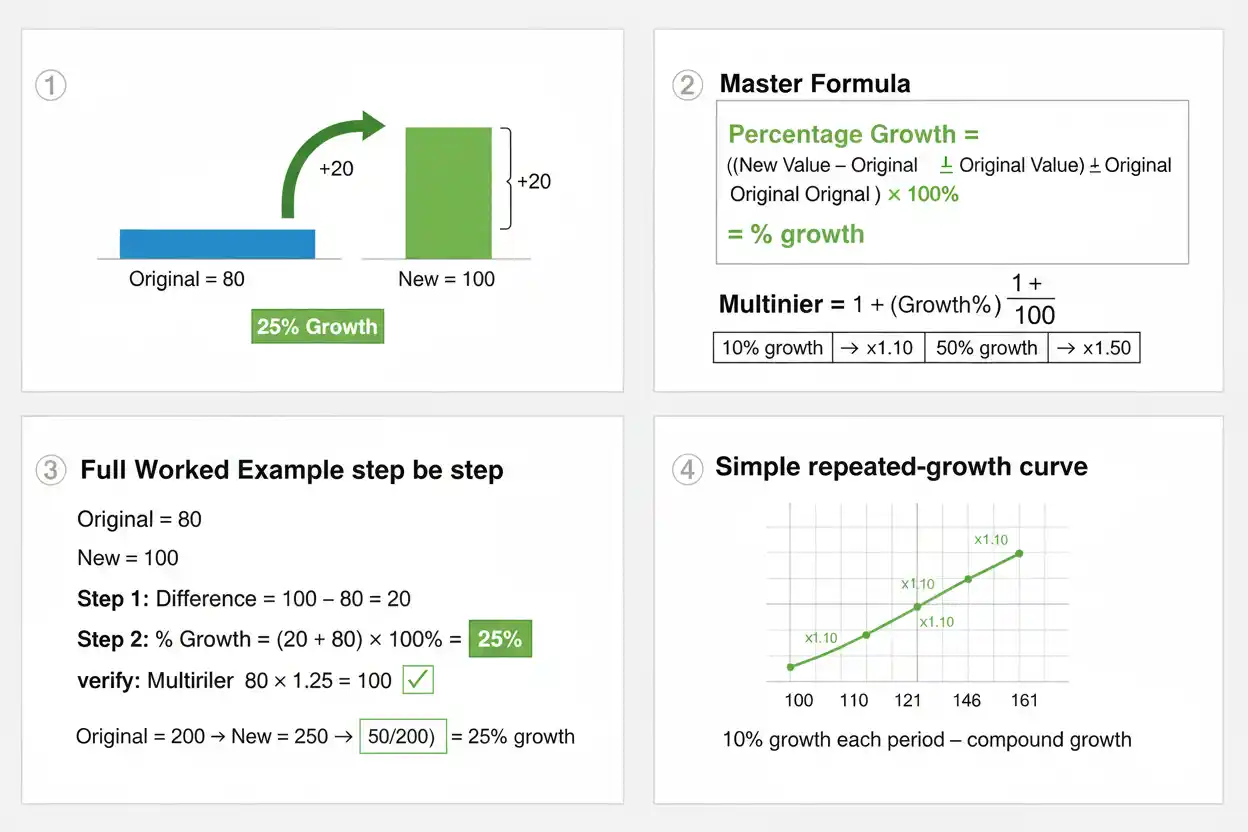

Percentage growth measures how much a positive quantity has increased relative to its original value.
For a positive, nonzero starting value:
Percentage Growth = (New Value – Original Value) / Original Value × 100%
For example, suppose a value increases from:
200
to:
250
The increase is:
250 – 200 = 50
Divide by the original value:
50/200 = 0.25
Convert to a percentage:
0.25 × 100% = 25%
Therefore:
The percentage growth is 25%.
Percentage growth is directional. The original value is the baseline, and the new value is larger. The broader percentage change framework also covers decreases and zero change, while percentage growth specifically focuses on increases.
What Is Percentage Growth?
Percentage growth tells you how large an increase is compared with the value before the increase occurred.
Let:
O = original value
N = new value
G = absolute growth
Then:
G = N – O
and:
Percentage Growth = G/O × 100%
provided:
O > 0
For growth:
N > O
so the result is positive.
Percentage Growth Formula
The standard formula is:
Percentage Growth = (New – Original) / Original × 100%
For example:
Original = 80
New = 100
Growth:
100 – 80 = 20
Then:
20/80 × 100%
= 25%
Therefore:
Percentage Growth = 25%
The original value is always the denominator because growth is measured relative to where the quantity started.
Percentage Growth as a Percentage Problem
The general percentage relationship is:
Percentage = Part / Whole × 100%
For percentage growth:
Part = Increase
Whole = Original Value
Therefore:
Percentage Growth = Increase / Original × 100%
This shows that percentage growth is not a separate arithmetic system; it is a specific part-to-reference percentage comparison.
Step-by-Step Percentage Growth
Suppose a quantity rises from:
150
to:
180
First calculate growth:
180 – 150 = 30
Then divide by the original:
30/150 = 0.20
Convert:
0.20 × 100% = 20%
Therefore:
Percentage Growth = 20%
Example: Growth From 50 to 65
Increase:
65 – 50 = 15
Divide by starting value:
15/50 = 0.30
Convert:
30%
Therefore:
Growth = 30%
Example: Growth From 400 to 460
Increase:
460 – 400 = 60
Then:
60/400 = 0.15
Convert:
15%
Therefore the value grew by:
15%
Example With Decimal Values
Suppose:
Original = 2.40
New = 2.76
Growth:
2.76 – 2.40 = 0.36
Divide:
0.36/2.40 = 0.15
Convert:
15%
Therefore:
Percentage Growth = 15%
Careful decimal arithmetic is important when the values are not integers.
Example With Large Numbers
Suppose a quantity rises from:
125,000
to:
137,500
Increase:
12,500
Divide:
12,500/125,000 = 0.10
Therefore:
Percentage Growth = 10%
The absolute increase looks large, but the percentage states it relative to the initial scale.
Finding the Growth Amount
If the original value and percentage growth are known:
Growth Amount = Original × Growth Rate
where the growth rate is expressed as a decimal.
For example:
Original = 600
Growth Rate = 12%
Convert:
12% = 0.12
Then:
Growth Amount = 600 × 0.12
= 72
Therefore the increase is:
72
Finding the New Value
The new value equals the original plus the growth amount:
New = Original + Growth
Since:
Growth = Original × r
we get:
New = Original(1 + r)
where r is the percentage growth written as a decimal.
For:
r = 20% = 0.20
the multiplier is:
1.20
Therefore:
20% growth means multiply the original value by 1.20
Example: Increase 250 by 18%
Use:
New = 250(1 + 0.18)
= 250 × 1.18
= 295
Therefore:
250 after 18% growth becomes 295
Check:
295 – 250 = 45
and:
45/250 × 100% = 18%
Growth Multiplier
A percentage growth rate can be represented by a multiplier:
Growth Multiplier = 1 + g
where g is the decimal growth rate.
Common examples:
| Growth | Multiplier |
|---|---|
| 1% | 1.01 |
| 5% | 1.05 |
| 10% | 1.10 |
| 20% | 1.20 |
| 25% | 1.25 |
| 50% | 1.50 |
| 100% | 2.00 |
A 100% increase doubles the starting value.
Finding the Original Value
If the new value and growth rate are known:
New = Original(1+g)
Therefore:
Original = New/(1+g)
For example, suppose:
New Value = 138
after:
15% growth
Then:
Original = 138/1.15
= 120
Therefore:
Original Value = 120
Check:
120 × 1.15 = 138
Example: New Value 360 After 20% Growth
Growth multiplier:
1.20
Therefore:
Original = 360/1.20
= 300
So:
The original value was 300
The increase was:
60
and:
60/300 = 20%
Percentage Growth vs. Percentage Change
Percentage change covers increases, decreases, and no change.
Percentage growth is narrower.
If:
New > Original
then percentage change is positive and may be described as percentage growth.
For:
100 → 125
percentage change:
+25%
percentage growth:
25%
But for:
100 → 80
the percentage change is:
-20%
That is a decrease, not percentage growth.
Percentage Growth vs. Percentage Difference
Percentage difference treats two values symmetrically.
Suppose:
80 → 100
Growth:
20/80 × 100%
= 25%
But percentage difference:
20/90 × 100%
≈ 22.22%
Growth uses:
original value = 80
Percentage difference uses:
average = 90
The appropriate formula depends on whether the values have a directional earlier-to-later relationship.
Growth Is Not Symmetric
Suppose:
80 → 100
Growth:
25%
If the direction is reversed:
100 → 80
the result is not “negative 25% growth.”
Instead:
(80-100)/100 × 100%
= -20%
which is a 20% decrease.
The denominator changes because the original value changes.
Percentage Growth From 100 to 200
Increase:
200 – 100 = 100
Divide:
100/100 = 1
Convert:
100%
Therefore:
100 to 200 is 100% growth
A 100% increase means the original quantity has doubled.
Percentage Growth From 100 to 300
Increase:
200
Relative growth:
200/100 = 2
Convert:
200%
Therefore:
100 to 300 is 200% growth
The new value is:
300%
of the original, while the growth itself is 200%.
These two percentages should not be confused.
New Value Percentage vs. Growth Percentage
Suppose:
Original = 80
New = 100
The new value as a percentage of the original is:
100/80 × 100%
= 125%
But growth is:
(100-80)/80 × 100%
= 25%
Therefore:
New value = 125% of original
while:
Percentage growth = 25%
The extra 25 percentage points above 100% represent the increase.
Repeated Percentage Growth
If the same growth rate is applied repeatedly, each period’s growth is calculated from the new, larger value.
Suppose:
Original = 100
Growth Rate = 10% per period
After one period:
100 × 1.10 = 110
After two:
110 × 1.10 = 121
After three:
121 × 1.10 = 133.1
Therefore:
100 becomes 133.1 after three 10% growth periods
The total growth is:
33.1%
not 30%.
Repeated Growth Formula
If:
P₀ = starting value
r = growth rate per period as a decimal
n = number of periods
then:
Pₙ = P₀(1+r)^n
This is exponential compounding.
The same structure is a geometric sequence because each new term is multiplied by the constant factor:
1+r
Example: 5% Growth for Four Periods
Start:
P₀ = 1,000
Growth rate:
r = 0.05
Periods:
n = 4
Use:
P₄ = 1,000(1.05)^4
Calculate:
1.05² = 1.1025
1.05⁴ = 1.21550625
Then:
P₄ = 1,215.50625
Therefore:
Final Value ≈ 1,215.51
Cumulative growth:
(1,215.50625 – 1,000)/1,000 × 100%
≈ 21.55%
Four periods of 5% compounded growth produce more than a simple 20% increase.
Simple Addition of Growth Rates Can Be Wrong
Suppose growth is:
10%
in one period and:
20%
in the next.
The combined multiplier is:
1.10 × 1.20
= 1.32
Therefore:
Total growth = 32%
not 30%.
The second growth rate applies to a quantity that already includes the first increase.
General Multiple-Growth Formula
For successive growth rates:
g₁, g₂, …, gₙ
the final multiplier is:
(1+g₁)(1+g₂)…(1+gₙ)
Therefore total cumulative growth is:
[(1+g₁)(1+g₂)…(1+gₙ) – 1] × 100%
For growth rates of:
5%, 10%, and 8%
the multiplier is:
1.05 × 1.10 × 1.08
= 1.2474
Therefore:
Cumulative Growth = 24.74%
Growth Over Several Years
Suppose a quantity changes:
Year 0: 500
Year 1: 550
Year 2: 594
From Year 0 to Year 1:
(550-500)/500 × 100%
= 10%
From Year 1 to Year 2:
(594-550)/550 × 100%
= 8%
Overall growth from 500 to 594 is:
(594-500)/500 × 100%
= 18.8%
This is not simply:
10% + 8% = 18%
because the 8% applies after the first increase.
Growth Rate vs. Compound Annual Growth Rate
When growth occurs across several years and you want one constant annual rate that would connect the beginning and ending values, the concept is compound annual growth rate.
Ordinary percentage growth between two values is:
(Ending – Beginning)/Beginning × 100%
CAGR instead accounts for the number of compounding periods.
For a one-period comparison, the two concepts coincide. Across multiple periods, they answer different questions.
Percentage Growth in Number Sequences
A sequence with constant percentage growth forms a geometric pattern.
For example:
100, 120, 144, 172.8, …
Each term is:
20%
larger than the previous term.
The common ratio is:
1.20
Therefore its formula follows the number sequences framework:
aₙ = 100(1.20)^(n-1)
Constant percentage growth means constant multiplicative change, not constant absolute difference.
Percentage Growth Between Perfect Squares
The mapped perfect squares provide simple examples of how growth depends on the starting value.
Compare:
4 = 2²
to:
9 = 3²
Growth:
(9-4)/4 × 100%
= 5/4 × 100%
= 125%
Therefore:
4 to 9 represents 125% growth
Now compare:
9 to 16
Growth:
7/9 × 100%
≈ 77.78%
Although consecutive perfect squares increase by progressively larger absolute amounts, their relative percentage growth does not stay constant.
Percentage Growth Between Perfect Cubes
The same idea can be seen with perfect cubes.
Compare:
8 = 2³
and:
27 = 3³
Growth:
(27-8)/8 × 100%
= 19/8 × 100%
= 237.5%
Therefore:
8 to 27 represents 237.5% growth
Compare instead:
27 to 64
Growth:
37/27 × 100%
≈ 137.04%
The absolute increase is larger, but the percentage growth is smaller because the starting baseline is also much larger.
Constant Absolute Growth Is Not Constant Percentage Growth
Consider:
100, 120, 140, 160
Each step adds:
20
But percentage growth changes.
First step:
20/100 = 20%
Second:
20/120 ≈ 16.67%
Third:
20/140 ≈ 14.29%
Therefore a constant numerical increase does not imply a constant percentage growth rate.
Constant Percentage Growth Is Not Constant Absolute Growth
Consider:
100, 110, 121, 133.1
Each step grows:
10%
But absolute increases are:
10
11
12.1
The increases become larger because the same percentage is applied to progressively larger bases.
This is the core distinction between additive and multiplicative growth.
Finding a Required Growth Rate
Suppose a value must rise from:
320
to:
400
Increase:
400 – 320 = 80
Divide:
80/320 = 0.25
Therefore:
Required Percentage Growth = 25%
Finding a Target After Required Growth
Suppose a starting value is:
480
and the required growth is:
12.5%
Convert:
12.5% = 0.125
Growth amount:
480 × 0.125
= 60
New value:
480 + 60
= 540
Therefore:
Target Value = 540
Growth Needed to Double
If a quantity doubles:
New = 2 × Original
Then:
Growth = 2O – O
= O
Therefore:
Growth/Original = O/O
= 1
Convert:
100%
So:
Doubling requires 100% growth
Growth Needed to Triple
If:
New = 3O
then:
Increase = 2O
Therefore:
2O/O × 100%
= 200%
So:
Tripling represents 200% growth
The final value is 300% of the original, but the growth is 200%.
Growth Needed to Quadruple
If:
New = 4O
then:
Growth = 3O
Therefore:
Percentage Growth = 300%
The final value equals:
400%
of the starting value.
Percentage Growth and Exponents
Repeated percentage growth uses powers:
Pₙ = P₀(1+r)^n
The exponents determine how the growth multiplier compounds.
For example:
1.08³
means the 8% growth multiplier is applied three times.
This is why repeated percentage growth differs fundamentally from multiplying the original value by:
1 + 3(0.08)
which would represent simple, noncompounded addition of the same original-based increment.
Percentage Growth and Order of Operations
The order of operations is important in:
(New – Original)/Original × 100%
For:
Original = 250
New = 310
first evaluate the grouped difference:
310 – 250 = 60
Then divide:
60/250 = 0.24
Finally:
0.24 × 100%
= 24%
Therefore:
Percentage Growth = 24%
Percentage Growth From Zero
If:
Original = 0
the ordinary formula becomes:
(New – 0)/0
which requires division by zero.
Therefore:
standard percentage growth from zero is undefined
If a quantity moves from:
0 to 50
the absolute growth is clearly:
+50
but there is no finite percentage growth relative to a zero baseline under the standard formula.
Negative Starting Values
Ordinary percentage growth is designed primarily for positive starting quantities.
Suppose:
-100 → -50
The value has moved upward numerically, but applying:
(-50 – (-100))/(-100)
gives:
-50%
The negative denominator creates an interpretation that conflicts with ordinary growth language.
When baselines are negative, report the actual change and use a domain-specific relative measure if one is defined.
Percentage Growth Can Exceed 100%
Suppose:
Original = 20
New = 60
Growth:
40
Then:
40/20 × 100%
= 200%
Therefore:
Percentage Growth = 200%
This means the quantity increased by twice its original amount and ended at three times the original value.
Small Percentage Growth
Suppose:
1,000 → 1,005
Growth:
5
Then:
5/1,000 × 100%
= 0.5%
Therefore:
Percentage Growth = 0.5%
Percentages below 1% can still represent meaningful changes when the original quantity is large.
Rounding Growth Rates
Suppose:
Original = 83
New = 91
Growth:
8
Then:
8/83 × 100%
≈ 9.638554%
A reasonable rounded result might be:
9.64%
Avoid rounding the ratio too early if the final result requires accurate decimal places.
Common Mistake: Dividing by the New Value
For:
80 → 100
the correct growth is:
20/80 × 100%
= 25%
Using:
20/100
would give 20%, which measures the increase as a percentage of the new value rather than the starting value.
Percentage growth uses the original baseline.
Common Mistake: Confusing Final Percentage With Growth Percentage
If a value grows from:
100 to 140
the new value is:
140%
of the original.
But percentage growth is only:
40%
because:
140 – 100 = 40
Always distinguish:
final value as % of original
from:
increase as % of original
Common Mistake: Adding Compound Growth Rates
Three years of 10% growth do not produce exactly:
30%
cumulative growth.
Instead:
1.10³ = 1.331
Therefore:
Cumulative Growth = 33.1%
The percentage is applied to a changing base each period.
Common Mistake: Calling a Decrease Negative Growth Without Context
Mathematically, the general percentage-change formula can produce a negative value.
But a page or calculation specifically asking for percentage growth usually implies:
New > Original
If:
New < Original
describe the result as a percentage decrease or negative percentage change rather than treating it as ordinary positive growth.
Common Mistake: Calculating Growth From Zero
For:
0 → 100
you cannot divide by the original value because:
Original = 0
The absolute increase is 100, but standard percentage growth is undefined.
How to Check a Percentage Growth Result
Suppose:
Original = 240
New = 300
Claimed growth:
25%
Check using the multiplier:
240 × 1.25
= 300
The new value is recovered exactly.
Therefore:
25% growth is correct
Frequently Asked Questions
What is percentage growth?
Percentage growth measures how much a positive quantity increased relative to its original value.
What is the percentage growth formula?
Percentage Growth = (New – Original)/Original × 100%
for a positive, nonzero original value.
What is the percentage growth from 100 to 120?
20%
What is the percentage growth from 80 to 100?
25%
What is the percentage growth from 200 to 300?
100/200 × 100%
= 50%
What is the percentage growth from 100 to 200?
100%
Is 100% growth the same as doubling?
Yes. A 100% increase adds the entire original value again, producing twice the starting amount.
Can percentage growth exceed 100%?
Yes. A value that grows from 100 to 300 has 200% growth.
How do you find the new value after growth?
New = Original × (1 + growth rate)
with the rate written as a decimal.
How do you find the original value?
Original = New / (1 + growth rate)
Is percentage growth the same as percentage change?
Percentage growth is the positive-increase case of the broader percentage-change concept.
Is percentage growth the same as percentage difference?
No. Growth uses the original value as the baseline. Percentage difference treats two values symmetrically and uses their average.
Can you calculate percentage growth from zero?
Not with the standard formula because division by zero is undefined.
How do repeated growth rates combine?
Multiply their growth factors rather than simply adding percentages.
For example:
10% then 20% → 1.10 × 1.20 = 1.32
so total growth is:
32%
Final Example
A quantity increases from:
640
to:
800
Find the percentage growth.
First calculate the increase:
800 – 640 = 160
Divide by the original value:
160/640
= 0.25
Convert:
0.25 × 100%
= 25%
Therefore:
Percentage Growth = 25%
Check with the growth multiplier:
1 + 0.25 = 1.25
Then:
640 × 1.25
= 800
The new value is recovered exactly.
The central relationship is:
Percentage Growth = (New – Original) / Original × 100%
For repeated growth, use the multiplicative form:
Final Value = Original × (1 + r)^n
Percentage growth therefore measures a directional increase from a positive starting baseline, while repeated growth compounds through multiplication rather than simple addition.