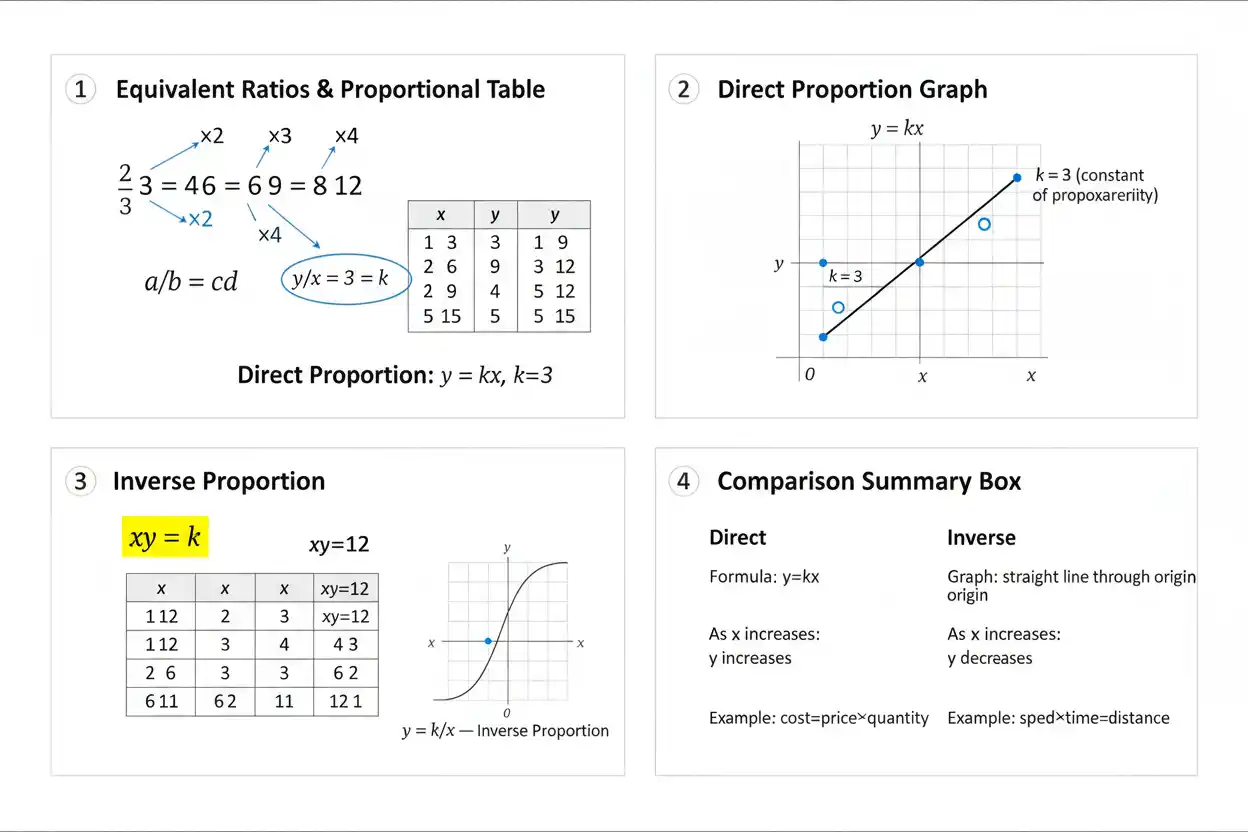

Proportions describe relationships in which two ratios are equal or two quantities vary according to a consistent multiplicative rule.
A basic proportion has the form:
a/b = c/d
where:
b ≠ 0
and:
d ≠ 0
For example:
3/5 = 12/20
because both ratios equal:
0.6
A proportion can also be checked by cross multiplication:
ad = bc
For the example:
3 × 20 = 60
5 × 12 = 60
so the proportion is true.
Beyond a single equation, proportions are useful for understanding scaling, direct variation, inverse variation, equivalent ratios, rates, percentages, maps, recipes, similar figures, and other relationships where quantities change systematically.
What Are Proportions?
A proportion states that two comparisons have the same value.
If:
a/b = c/d
then the ratios:
a:b
and:
c:d
represent the same multiplicative relationship.
For example:
2/7 = 6/21
because the second ratio is obtained by multiplying both parts of the first by:
3
This connection begins with the idea of a ratio. A ratio expresses one comparison; a proportion states that two ratios are equivalent.
Basic Proportion Formula
The standard equation is:
a/b = c/d
For nonzero denominators, this is equivalent to:
ad = bc
The equality of cross products provides a quick way to test proportionality or solve a missing value.
The neighboring proportion page focuses specifically on solving an individual proportion equation. Here the broader emphasis is on how proportional relationships behave across values, tables, formulas, and applications.
Equivalent Ratios Create Proportions
Start with:
4/9
Multiply numerator and denominator by 5:
(4 × 5)/(9 × 5)
= 20/45
Therefore:
4/9 = 20/45
These are equivalent ratios, so they form a proportion.
More generally:
a/b = ka/kb
for any nonzero scale factor k.
Example: Check a Proportion
Determine whether:
8/12 = 14/21
Simplify:
8/12 = 2/3
and:
14/21 = 2/3
Therefore:
8/12 = 14/21
Cross multiplication confirms:
8 × 21 = 168
12 × 14 = 168
The proportion is true.
Example: A False Proportion
Check:
5/8 = 12/20
Cross multiply:
5 × 20 = 100
8 × 12 = 96
Since:
100 ≠ 96
the ratios are not proportional.
Therefore:
5/8 ≠ 12/20
Direct Proportions
Two quantities are in direct proportion when one is a constant multiple of the other.
The formula is:
y = kx
where:
k = constant of proportionality.
Equivalently:
y/x = k
As x increases by a scale factor, y increases by the same scale factor.
Direct Proportion Example
Suppose 4 identical items cost:
$12
The cost per item is:
12/4 = 3
Therefore:
k = 3
and the proportional rule is:
Cost = 3 × Quantity
For 10 items:
Cost = 3 × 10
= 30
Therefore:
10 items cost $30
Direct Proportion Table
For:
y = 4x
a proportional table is:
| x | y |
|---|---|
| 1 | 4 |
| 2 | 8 |
| 3 | 12 |
| 5 | 20 |
| 10 | 40 |
Check the ratio:
y/x = 4
for every nonzero x.
That constant ratio proves the quantities are directly proportional.
Constant of Proportionality
For direct proportions:
k = y/x
Suppose:
x = 6
y = 27
Then:
k = 27/6
= 4.5
Therefore the proportional relationship is:
y = 4.5x
If:
x = 20
then:
y = 4.5 × 20
= 90
Direct Proportion Between Two Pairs
If:
y = kx
for two corresponding pairs:
(x₁,y₁)
and:
(x₂,y₂)
then:
y₁/x₁ = y₂/x₂
Therefore:
y₁/x₁ = y₂/x₂
This is the familiar proportion equation applied to a direct relationship.
Example: Distance at Constant Speed
A vehicle travels:
150 km in 3 hours
At constant speed, distance is directly proportional to time.
Set:
150/3 = x/8
Cross multiply:
3x = 1,200
x = 400
Therefore:
The vehicle travels 400 km in 8 hours
The constant of proportionality is:
50 km/h
Proportional Graphs
A direct proportion:
y = kx
graphs as a straight line through:
(0,0)
For example:
y = 3x
contains:
(0,0)
(1,3)
(2,6)
(4,12)
The slope is:
3
which equals the constant of proportionality.
A straight line that does not pass through the origin is linear but not a direct proportion.
Example: Linear but Not Proportional
Consider:
y = 3x + 2
Its slope is constant, but when:
x = 0
we get:
y = 2
The graph does not pass through the origin.
Furthermore:
y/x
does not stay constant.
Therefore:
y = 3x + 2 is not a direct proportional relationship
Proportions and Number Sequences
A proportional rule can generate a number sequence.
For:
y = 5x
and:
x = 1,2,3,4,…
the y values are:
5,10,15,20,…
These are the positive multiples of 5.
Thus a direct proportional relationship evaluated at consecutive positive integers generates an arithmetic sequence.
Inverse Proportions
Two quantities are inversely proportional when their product remains constant.
The basic formula is:
xy = k
or:
y = k/x
If one variable doubles, the other is divided by 2.
If one triples, the other becomes one-third as large.
Inverse Proportion Formula
For two corresponding pairs:
(x₁,y₁)
and:
(x₂,y₂)
inverse proportion gives:
x₁y₁ = x₂y₂
This differs from direct proportion, where the ratios remain constant.
Inverse Proportion Example
Suppose 4 identical machines complete a fixed job in:
12 hours
If productivity scales ideally, increasing the number of machines reduces the time inversely.
Constant product:
4 × 12 = 48
For 8 machines:
8 × t = 48
Therefore:
t = 6
So:
8 machines complete the job in 6 hours
The number of machines doubled, while time was halved.
Inverse Proportion Table
For:
xy = 24
we have:
| x | y |
|---|---|
| 1 | 24 |
| 2 | 12 |
| 3 | 8 |
| 4 | 6 |
| 6 | 4 |
| 8 | 3 |
Every pair satisfies:
x × y = 24
Therefore the product, not the ratio, is constant.
Direct vs. Inverse Proportions
For direct proportion:
y = kx
and:
y/x = k
For inverse proportion:
y = k/x
and:
xy = k
Direct relationship:
x doubles → y doubles
Inverse relationship:
x doubles → y halves
Recognizing which quantity remains constant is usually enough to distinguish the two.
Proportional Scaling
Suppose a diagram uses:
2 cm : 5 m
If a line on the diagram measures:
8 cm
the scale factor from 2 to 8 is:
4
Apply the same factor:
5 × 4 = 20
Therefore:
8 cm represents 20 m
A proportion could also be written:
2/5 = 8/x
giving:
x = 20
Recipe Proportions
Suppose a recipe uses:
3 cups of flour for 8 servings
For:
20 servings
set:
3/8 = x/20
Cross multiply:
8x = 60
Therefore:
x = 7.5
So:
7.5 cups of flour are required
The serving count was multiplied by:
20/8 = 2.5
and the ingredient amount was multiplied by the same scale factor.
Unit Rates and Proportions
A unit rate reduces a comparison to a denominator of 1.
Suppose:
180 km in 3 hours
Unit rate:
180/3
= 60 km/h
At the same rate:
distance = 60 × time
This creates a direct proportion.
For 7 hours:
distance = 60 × 7
= 420 km
Proportions and Percentages
A percentage is naturally expressed using a proportion:
Part/Whole = Percent/100
For example:
18 is what percent of 72?
Write:
18/72 = p/100
Cross multiply:
72p = 1,800
Then:
p = 25
Therefore:
18 is 25% of 72
Find a Part Using a Proportion
Find:
35% of 160
Write:
x/160 = 35/100
Cross multiply:
100x = 5,600
Therefore:
x = 56
So:
35% of 160 = 56
Proportions and Fractions
Equivalent fractions form proportions.
For example:
15/25 = 3/5
The first fraction can be reduced using fraction simplification:
15/25
divide numerator and denominator by 5:
= 3/5
Therefore the two fractions are proportional.
Proportions and Rational Numbers
Every ratio of two integers with a nonzero denominator represents a rational number.
For example:
3/4
and:
12/16
both represent the rational number:
0.75
Their equality creates the proportion:
3/4 = 12/16
A proportion therefore often expresses two different representations of the same rational value.
Prime Factorization Can Reveal Proportions
Prime factorization can make equivalent ratios easier to recognize.
Consider:
84/126
Factor:
84 = 2² × 3 × 7
126 = 2 × 3² × 7
Cancel common factors:
84/126 = 2/3
Now consider:
110/165
Factor or simplify:
110/165 = 2/3
Therefore:
84/126 = 110/165
and the ratios form a proportion.
Prime Numbers in Proportional Scaling
Prime numbers can be terms or scale factors in proportional relationships just like composite numbers.
For example:
3/7 = 15/35
Both 3 and 7 are prime.
The second ratio is produced by multiplying each term by:
5
Another prime.
The proportional relationship depends on multiplicative equality, not on whether the numbers involved are prime.
Proportional Allocation
Suppose:
$600
must be divided in the ratio:
2:3
Total ratio parts:
2 + 3 = 5
First share:
2/5 × 600
= 240
Second share:
3/5 × 600
= 360
Therefore the allocation is:
$240 and $360
Check:
240/360 = 2/3
The division preserves the required proportion.
Three-Part Proportional Allocation
Divide:
720
in the ratio:
2:3:4
Total parts:
2 + 3 + 4 = 9
Value per ratio part:
720/9 = 80
Shares:
2 × 80 = 160
3 × 80 = 240
4 × 80 = 320
Therefore:
160 : 240 : 320
Check:
160:240:320
divide each by 80:
2:3:4
Proportion From Similar Measurements
Suppose corresponding lengths in two scaled figures are:
4 and 10
and:
6 and x
Write:
4/10 = 6/x
Cross multiply:
4x = 60
Therefore:
x = 15
So:
The missing corresponding length is 15
The common scale factor is:
10/4 = 2.5
and:
15/6 = 2.5
Proportions With Decimals
Consider:
1.2/3 = x/15
Cross multiply:
3x = 18
Therefore:
x = 6
Check:
1.2/3 = 0.4
and:
6/15 = 0.4
The decimal operations do not change the underlying proportional rule.
Proportions With Negative Numbers
An algebraic proportion can contain negative quantities.
For example:
-3/5 = x/20
Cross multiply:
5x = -60
Therefore:
x = -12
Check:
-12/20 = -3/5
The mathematical proportion is valid, though an application may impose additional restrictions on whether negative quantities make sense.
Zero in Proportions
A numerator may be zero:
0/5 = 0/12
Both sides equal zero.
A denominator may not be zero.
Therefore:
a/b = c/d
requires:
b ≠ 0 and d ≠ 0
Division by zero is undefined.
Multi-Step Proportional Reasoning
Suppose 6 machines produce:
900 units in 5 hours
Assuming direct proportionality to both machine count and time, how many units would 10 machines produce in 8 hours?
Production per machine-hour:
900/(6 × 5)
= 900/30
= 30
For 10 machines and 8 hours:
10 × 8 = 80 machine-hours
Then:
80 × 30 = 2,400
Therefore:
2,400 units
This combines more than one proportional factor in a single calculation.
Proportion and Scale Factors
If all corresponding quantities are multiplied by the same nonzero number k, the relationship remains proportional.
Starting:
a:b
Scaled:
ka:kb
Then:
ka/kb = a/b
because k cancels.
This is why enlargements, reductions, recipes, and unit conversions can preserve proportional relationships.
Percentage Change Is Not Always a Proportion
A percentage change compares:
New – Original
with:
Original
That percentage may describe a change between two proportional values, but the calculation itself is not simply a test of equal ratios.
For example:
100 → 120
is a 20% increase.
If all quantities in a table are multiplied by 1.20, however, the new table remains proportional to the original through scale factor:
1.20
Recognizing a Proportional Table
Suppose:
| x | y |
|---|---|
| 2 | 7 |
| 4 | 14 |
| 6 | 21 |
| 10 | 35 |
Calculate:
y/x
For each row:
7/2 = 3.5
14/4 = 3.5
21/6 = 3.5
35/10 = 3.5
The ratio is constant.
Therefore:
y and x are directly proportional
with:
y = 3.5x
Recognizing a Nonproportional Table
Consider:
| x | y |
|---|---|
| 1 | 4 |
| 2 | 7 |
| 3 | 10 |
| 4 | 13 |
The differences in y are constant:
+3
but:
y/x
is not constant.
Therefore the relationship is linear but:
not directly proportional
Its equation is:
y = 3x + 1
which does not pass through the origin.
Common Mistake: Using Additive Instead of Multiplicative Change
Suppose:
3/5 = 9/15
The second ratio comes from multiplying both terms by:
3
It is not the fact that:
3 → 9 is +6
and:
5 → 15 is +10
that preserves the proportion.
Proportionality depends on a common multiplicative factor.
Common Mistake: Mixing Corresponding Quantities
If:
5 books cost $20
and:
8 books cost
x
consistent ratios include:
5/20 = 8/x
or:
20/5 = x/8
Do not write:
5/20 = x/8
because the second ratio reverses the unit order.
Common Mistake: Assuming Every Straight Line Is Proportional
A direct proportion has:
y = kx
and therefore passes through:
(0,0)
A line:
y = 4x + 7
does not pass through the origin.
It is linear, but it is not a direct proportion.
Common Mistake: Treating Inverse Proportion as Direct
If:
xy = 60
then:
x = 5
gives:
y = 12
If x doubles to:
10
then:
y = 6
The ratio:
y/x
does not remain constant.
The product:
xy
does.
Therefore this is inverse proportion, not direct proportion.
Common Mistake: Cross Multiplying Without Checking Denominators
An equation such as:
4/(x-2) = 2/3
requires:
x ≠ 2
Cross multiplication may produce a candidate solution, but any value making an original denominator zero must be rejected.
How to Verify Direct Proportions
Suppose:
y = 6x
and a point is:
(7,42)
Check:
42/7 = 6
The constant matches.
For another point:
(10,60)
we also have:
60/10 = 6
Therefore the two points belong to the same proportional relationship.
How to Verify Inverse Proportions
Suppose pairs are:
(3,20)
and:
(5,12)
Calculate products:
3 × 20 = 60
5 × 12 = 60
The products match.
Therefore:
the pairs satisfy the same inverse proportion
with:
xy = 60
Frequently Asked Questions
What are proportions?
Proportions are equalities between ratios or relationships governed by a consistent multiplicative rule.
What is the basic proportion formula?
a/b = c/d
What is the cross-product rule?
ad = bc
for nonzero denominators.
What is direct proportion?
A relationship of the form:
y = kx
where y/x is constant.
What is inverse proportion?
A relationship of the form:
y = k/x
where:
xy = k
How do you know whether a table is proportional?
For direct proportion, calculate y/x. If the same constant appears for every nonzero x, the relationship is proportional.
Does a proportional graph pass through the origin?
A direct proportion y = kx does.
Can proportions contain fractions?
Yes.
Can proportions contain decimals?
Yes.
Can proportions be used for percentages?
Yes. A common setup is:
Part/Whole = Percent/100
What is the difference between ratio and proportion?
A ratio is one comparison. A proportion states that two ratios are equal.
What is the difference between direct and inverse proportion?
Direct proportion keeps a ratio constant. Inverse proportion keeps a product constant.
Final Example
A factory uses:
8 kilograms
of material to produce:
120 units
Assuming material use is directly proportional to production, how much material is required for:
450 units?
Set:
8/120 = x/450
Cross multiply:
120x = 8 × 450
120x = 3,600
Divide:
x = 30
Therefore:
30 kilograms of material are required
Check the constant rate:
8/120 = 1/15 kilogram per unit
For 450 units:
450 × 1/15
= 30
The calculation agrees.
The central ideas behind proportions are:
Equal ratios: a/b = c/d
Direct proportion: y = kx
Inverse proportion: xy = k
Recognizing which relationship stays constant—ratio or product—makes proportional reasoning much more reliable across scaling, rates, percentages, tables, and real-world applications.