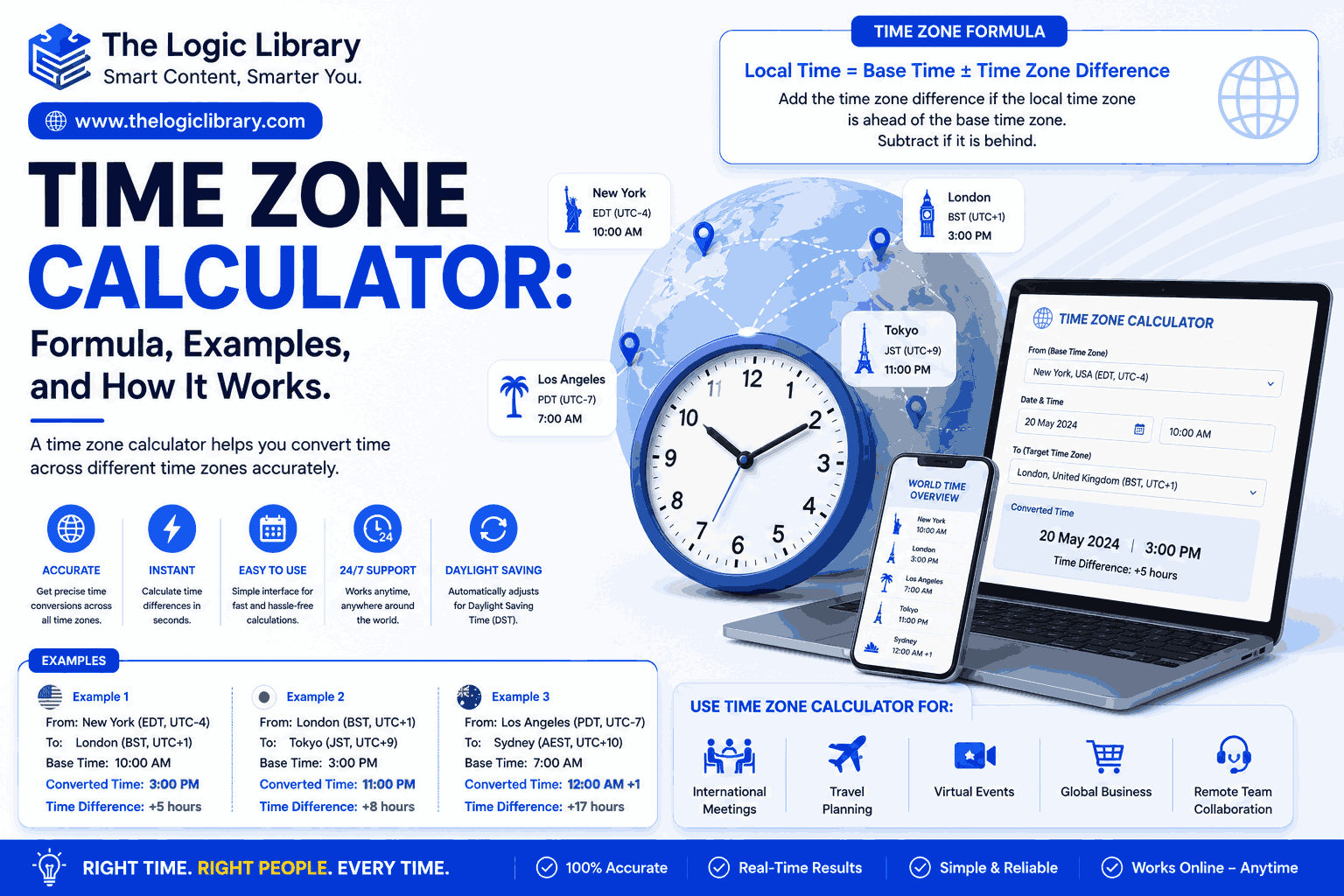
A Time Zone Calculator is an essential tool for anyone working, traveling, or communicating across different regions of the world. Whether you’re scheduling an international business meeting, planning a flight, coordinating with remote teams, or simply checking the current time in another country, a Time Zone Calculator helps you convert time accurately between different time zones.
With businesses operating globally and remote work becoming more common, understanding time zone differences is more important than ever. A Time Zone Calculator eliminates confusion by instantly converting time from one location to another while accounting for factors such as UTC offsets and daylight saving time. This guide explains how a Time Zone Calculator works, the formulas behind it, practical examples, and the benefits of using one.
What Is a Time Zone Calculator?
A Time Zone Calculator is a digital tool that converts time between different geographical locations. It calculates the time difference between regions and provides accurate local times based on global time standards.
A Time Zone Calculator can help users:
- Convert time between countries
- Calculate time differences
- Schedule international meetings
- Plan travel itineraries
- Coordinate remote teams
- Track global events
- Account for daylight saving time
- Convert UTC to local time
Instead of manually calculating offsets, users can rely on a Time Zone Calculator to get instant and accurate results.
Why Use a Time Zone Calculator?
The world is divided into multiple time zones, and manually converting times can lead to errors. A Time Zone Calculator simplifies the process and ensures accuracy.
Benefits of Using a Time Zone Calculator
- Saves time and effort
- Prevents scheduling mistakes
- Supports global communication
- Accounts for daylight saving changes
- Improves productivity
- Provides instant conversions
Whether you’re a business professional, student, traveler, or freelancer, a Time Zone Calculator can help you manage time more effectively.
How a Time Zone Calculator Works
A Time Zone Calculator works by comparing the UTC (Coordinated Universal Time) offset of one location with another.
Every time zone has a UTC offset that indicates how many hours it is ahead of or behind UTC.
Examples:
| Time Zone | UTC Offset |
|---|---|
| UTC | UTC+0 |
| Pakistan Standard Time (PKT) | UTC+5 |
| India Standard Time (IST) | UTC+5:30 |
| Greenwich Mean Time (GMT) | UTC+0 |
| Eastern Time (ET) | UTC−5 |
| Central European Time (CET) | UTC+1 |
A Time Zone Calculator uses these offsets to determine the correct local time.
Time Zone Calculator Formula
The basic Time Zone Calculator formula is:
Target Time = Source Time + Time Zone Difference
Example
Source Time:
10:00 AM in Pakistan (UTC+5)
Target Location:
United Kingdom (UTC+0)
Calculation:
10:00 AM − 5 Hours
Result:
5:00 AM in the United Kingdom
This formula forms the basis of most time zone calculations.
Time Zone Calculator Formula Using UTC
Many advanced tools calculate time using UTC as an intermediate reference.
Formula
UTC Time = Local Time − UTC Offset
Target Time = UTC Time + Target UTC Offset
Example
Local Time:
3:00 PM in Pakistan (UTC+5)
Step 1:
3:00 PM − 5 Hours
UTC Time = 10:00 AM
Step 2:
Convert UTC to New York (UTC−5)
10:00 AM − 5 Hours
Result:
5:00 AM in New York
This method ensures consistency across global time calculations.
Understanding UTC and Its Role
UTC (Coordinated Universal Time) is the world’s primary time standard. Every time zone is measured relative to UTC.
Examples:
- Pakistan = UTC+5
- India = UTC+5:30
- Japan = UTC+9
- Germany = UTC+1
- Australia (Sydney) = UTC+10
A Time Zone Calculator uses UTC as the reference point for accurate conversions.
Time Zone Calculator and Daylight Saving Time
One of the biggest challenges in time conversion is Daylight Saving Time (DST).
Some countries move their clocks forward or backward during certain months of the year.
Example
New York:
- Standard Time: UTC−5
- Daylight Saving Time: UTC−4
A Time Zone Calculator automatically adjusts for these seasonal changes, ensuring accurate results throughout the year.
Time Zone Calculator Example: International Meeting
Imagine a meeting is scheduled for:
9:00 AM in London (UTC+0)
Participants are located in:
- Pakistan (UTC+5)
- India (UTC+5:30)
- Japan (UTC+9)
Calculation
Pakistan:
9:00 AM + 5 Hours
Result:
2:00 PM
India:
9:00 AM + 5 Hours 30 Minutes
Result:
2:30 PM
Japan:
9:00 AM + 9 Hours
Result:
6:00 PM
A Time Zone Calculator performs these calculations instantly.
Time Zone Calculator Example: Flight Planning
Travelers frequently use a Time Zone Calculator to understand arrival times.
Example
Departure:
Dubai (UTC+4)
Departure Time:
10:00 AM
Flight Duration:
8 Hours
Destination:
London (UTC+0)
Step 1:
10:00 AM + 8 Hours
= 6:00 PM Dubai Time
Step 2:
Convert to London Time
6:00 PM − 4 Hours
Result:
2:00 PM London Time
This helps travelers avoid confusion when crossing multiple time zones.
Time Zone Calculator Example: Remote Team Collaboration
A company has employees in:
- Pakistan (UTC+5)
- Germany (UTC+1)
- Canada (UTC−5)
Meeting Time:
3:00 PM Pakistan Time
Conversion
Germany:
3:00 PM − 4 Hours
Result:
11:00 AM
Canada:
3:00 PM − 10 Hours
Result:
5:00 AM
A Time Zone Calculator helps teams schedule meetings efficiently.
Common Uses of a Time Zone Calculator
International Business
Companies use Time Zone Calculators to coordinate meetings and deadlines across different countries.
Remote Work
Distributed teams rely on accurate time conversions to collaborate effectively.
Travel Planning
Travelers use a Time Zone Calculator to understand departure and arrival times.
Online Events
Webinars, conferences, and virtual events often attract participants from multiple time zones.
Education
Students attending international online courses need accurate time conversions.
Financial Markets
Traders use time zone conversions to track stock market opening and closing times worldwide.
Key Features of a Modern Time Zone Calculator
Modern Time Zone Calculators include features such as:
- Real-time conversions
- Daylight saving adjustments
- Multiple time zone comparison
- UTC conversion
- World clock integration
- Meeting planner tools
- Mobile compatibility
- Historical date conversions
These features make time management easier in a globalized world.
Time Zone Calculator vs Manual Conversion
| Feature | Manual Conversion | Time Zone Calculator |
|---|---|---|
| Speed | Slow | Instant |
| Accuracy | Moderate | High |
| Daylight Saving Support | Difficult | Automatic |
| Multiple Time Zones | Complex | Easy |
| Global Scheduling | Limited | Efficient |
A Time Zone Calculator significantly reduces the risk of human error.
Common Mistakes a Time Zone Calculator Helps Avoid
Forgetting UTC Offsets
Different regions may have offsets ranging from UTC−12 to UTC+14.
Ignoring Daylight Saving Time
DST changes can alter time differences by one hour.
Confusing AM and PM
Incorrect time formats can lead to scheduling errors.
Assuming Time Differences Stay Constant
Some countries observe DST while others do not, causing seasonal changes in time differences.
A Time Zone Calculator automatically handles these complexities.
Benefits of Using a Time Zone Calculator
Improved Scheduling
Meetings and events can be planned accurately across multiple regions.
Better Communication
Teams avoid missed calls and scheduling conflicts.
Increased Productivity
Users spend less time calculating time differences manually.
Enhanced Travel Planning
Travelers can better understand local arrival and departure times.
Greater Accuracy
Automatic calculations reduce errors and confusion.
Who Should Use a Time Zone Calculator?
A Time Zone Calculator is useful for:
- Business professionals
- Remote workers
- Freelancers
- Project managers
- Travelers
- Students
- Teachers
- Event organizers
- Financial traders
- Customer support teams
Anyone dealing with multiple time zones can benefit from this tool.
Best Practices for Time Zone Conversion
When using a Time Zone Calculator:
- Verify the source time zone.
- Check if daylight saving time applies.
- Use local dates along with times.
- Confirm AM/PM or 24-hour format.
- Double-check meeting invitations.
These practices help avoid scheduling mistakes.
The Future of Time Zone Calculators
As global communication continues to grow, Time Zone Calculators are becoming more advanced. Modern tools integrate with calendars, project management software, virtual meeting platforms, and travel applications to provide seamless time conversions.
Artificial intelligence and automation are also improving how Time Zone Calculators handle scheduling, making international collaboration easier than ever before.
Conclusion
A Time Zone Calculator is an indispensable tool for converting time between different regions of the world. Whether you’re scheduling international meetings, managing remote teams, planning travel, attending virtual events, or tracking global markets, a Time Zone Calculator ensures accurate and reliable time conversions.
By using UTC offsets, accounting for daylight saving time, and automating complex calculations, a Time Zone Calculator removes confusion and saves valuable time. In today’s connected world, where people regularly interact across continents, this tool has become essential for effective communication, productivity, and planning.
Understanding how a Time Zone Calculator works can help individuals and businesses make smarter scheduling decisions and avoid costly time-related mistakes.
Frequently Asked Questions (FAQs) About Time Zone Calculator
1. What is a Time Zone Calculator?
A Time Zone Calculator is an online tool that converts time between different locations around the world. It helps users determine the correct local time in another city, country, or time zone based on a selected date and time.
2. How does a Time Zone Calculator work?
A Time Zone Calculator uses UTC (Coordinated Universal Time) offsets to calculate the time difference between two locations. It automatically adjusts for factors such as daylight saving time when applicable.
3. Why should I use a Time Zone Calculator?
A Time Zone Calculator helps avoid scheduling mistakes when working with people in different countries, planning international travel, attending virtual events, or managing remote teams.
4. What is the formula used by a Time Zone Calculator?
The basic formula is:
Target Time = Source Time + Time Zone Difference
For more advanced calculations:
UTC Time = Local Time − UTC Offset
Target Time = UTC Time + Target UTC Offset
5. What is UTC in a Time Zone Calculator?
UTC (Coordinated Universal Time) is the global standard used to measure time worldwide. Every time zone is based on its difference from UTC.
6. Can a Time Zone Calculator account for daylight saving time?
Yes. Most modern Time Zone Calculators automatically adjust for daylight saving time (DST), ensuring accurate time conversions throughout the year.
7. What is daylight saving time (DST)?
Daylight saving time is the practice of moving clocks forward by one hour during certain months to maximize daylight. Not all countries observe DST.
8. Can a Time Zone Calculator convert time between any two countries?
Yes. A Time Zone Calculator can convert time between virtually any city, state, or country worldwide.
9. How accurate is a Time Zone Calculator?
A Time Zone Calculator is highly accurate because it uses official time zone databases, UTC offsets, and daylight saving rules.
10. Can I use a Time Zone Calculator for international meetings?
Absolutely. Many professionals use a Time Zone Calculator to schedule meetings across multiple countries and avoid confusion about local times.
11. Is a Time Zone Calculator useful for remote teams?
Yes. Remote teams frequently use Time Zone Calculators to coordinate work schedules, meetings, and project deadlines across different regions.
12. Can a Time Zone Calculator help with travel planning?
Yes. Travelers use a Time Zone Calculator to understand arrival times, departure times, layovers, and local time differences when traveling internationally.
13. Does a Time Zone Calculator show current local times?
Many Time Zone Calculators provide real-time local clock information for cities and countries around the world.
14. Can a Time Zone Calculator convert UTC to local time?
Yes. Most Time Zone Calculators can convert UTC time into any local time zone and vice versa.
15. What is a UTC offset?
A UTC offset represents the number of hours and minutes a time zone is ahead of or behind UTC.
Examples:
- Pakistan: UTC+5
- India: UTC+5:30
- Japan: UTC+9
- New York (Standard Time): UTC−5
16. Can a Time Zone Calculator compare multiple time zones at once?
Yes. Many advanced Time Zone Calculators allow users to compare several time zones simultaneously for easier scheduling.
17. Is a Time Zone Calculator useful for online events?
Yes. Webinar organizers, conference hosts, and virtual event planners use Time Zone Calculators to ensure participants know the correct event time in their location.
18. Can a Time Zone Calculator calculate future time conversions?
Yes. You can enter future dates and times to determine what the corresponding time will be in another location.
19. Does a Time Zone Calculator work with historical dates?
Some advanced Time Zone Calculators support historical time conversions and account for past daylight saving time changes.
20. What is the difference between GMT and UTC?
GMT (Greenwich Mean Time) and UTC are often used interchangeably for everyday purposes. However, UTC is the modern international time standard used by Time Zone Calculators.
21. Can a Time Zone Calculator help financial traders?
Yes. Traders use Time Zone Calculators to track opening and closing times of global stock exchanges, forex markets, and cryptocurrency markets.
22. Is a Time Zone Calculator free to use?
Most online Time Zone Calculators are completely free and accessible from desktop computers, tablets, and mobile devices.
23. Can I use a Time Zone Calculator on my smartphone?
Yes. Most modern Time Zone Calculators are mobile-friendly and work seamlessly on Android and iOS devices.
24. What information do I need to use a Time Zone Calculator?
Typically, you need:
- Source location or time zone
- Target location or time zone
- Date
- Time
The calculator will then generate the converted time automatically.
25. Can a Time Zone Calculator prevent scheduling mistakes?
Yes. A Time Zone Calculator reduces the risk of missed meetings, incorrect event times, and communication delays caused by manual time conversions.
26. Who should use a Time Zone Calculator?
A Time Zone Calculator is useful for:
- Business professionals
- Remote workers
- Freelancers
- Project managers
- Travelers
- Students
- Teachers
- Event planners
- Financial traders
- Customer support teams
27. Does a Time Zone Calculator account for half-hour and quarter-hour time zones?
Yes. Advanced Time Zone Calculators accurately handle regions with non-standard offsets such as:
- India (UTC+5:30)
- Nepal (UTC+5:45)
- Australia Central Time (UTC+9:30)
28. What is the most common use of a Time Zone Calculator?
The most common use of a Time Zone Calculator is converting time between countries for meetings, travel, business communication, and international collaboration.
29. Can a Time Zone Calculator be used for project management?
Yes. Project managers often use Time Zone Calculators to coordinate deadlines, meetings, and workflows among globally distributed teams.
30. Why is a Time Zone Calculator important in today’s world?
As businesses, education, and communication increasingly operate across borders, a Time Zone Calculator helps people stay synchronized, avoid confusion, and collaborate effectively regardless of location.
Related Topics:
- Time Calculator: Formula, Examples, and How It Works
- Salary Conversions Explained: Hourly to Annual (Examples, Tables, & Unpaid Time Adjustments)
- Hours Calculator: Formula, Examples, and How It Works
- Interest Calculator: Formula, Examples, and How It Works
- Work Hours Calculator: Formula, Examples, and How It Works