What Is a Time and a Half Calculator?
A time and a half calculator is a tool that computes the overtime pay rate for hours worked beyond a defined threshold — typically 40 hours in a workweek under federal law — by multiplying the regular hourly rate by 1.5. The result is the overtime rate; multiply that by the number of overtime hours and you have the overtime pay owed.
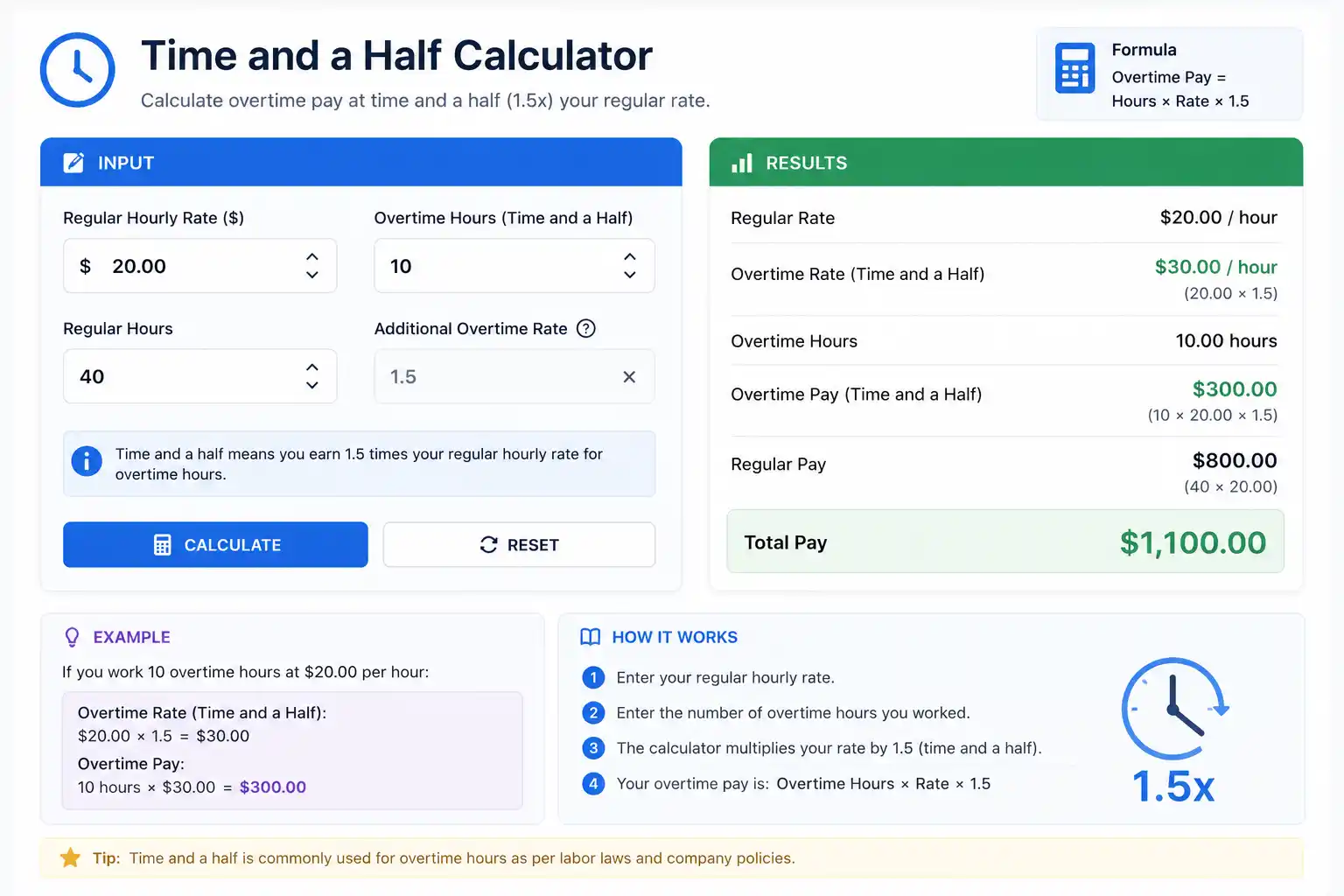
“Time and a half” is the colloquial name for the overtime premium mandated by the Fair Labor Standards Act (FLSA) since 1938. It means an employee earns one and a half times their regular rate of pay for every overtime hour — their normal rate (the “time”) plus an additional half of that rate (the “half”). At $20.00/hour regular, the time-and-a-half rate is $30.00/hour.
Despite being one of the most frequently discussed figures in employment, time and a half is also one of the most frequently miscalculated — particularly for salaried employees, workers with multiple pay rates, employees who receive commissions or bonuses, and workers in states with daily overtime rules. Understanding how the calculation works in each scenario protects employees from underpayment and protects employers from wage claims, back pay liability, and Department of Labor investigations.
The Core Time and a Half Formula
The time-and-a-half calculation is built on two sequential steps: finding the overtime rate, then applying it to overtime hours.
Step 1: Calculate the Overtime Rate
Overtime Rate = Regular Hourly Rate × 1.5
Step 2: Calculate Overtime Pay
Overtime Pay = Overtime Hours × Overtime Rate
Step 3: Calculate Total Gross Pay
Gross Pay = (Regular Hours × Regular Rate) + (Overtime Hours × Overtime Rate)
Or equivalently, combining the formulas:
Gross Pay = (Regular Hours × Regular Rate) + (Overtime Hours × Regular Rate × 1.5)
The 0.5 Multiplier Shortcut
Since total hours already include overtime hours at the regular rate, an alternative formula computes the overtime premium (the additional half) rather than the full overtime rate:
Gross Pay = (Total Hours × Regular Rate) + (Overtime Hours × Regular Rate × 0.5)
Both formulas produce identical results. The 0.5 multiplier approach is mathematically cleaner when total hours are already known.
Proof with an example:
- Regular rate: $20.00/hour
- Total hours: 45 (40 regular + 5 OT)
Method 1 (full rate):
(40 × $20.00) + (5 × $30.00) = $800.00 + $150.00 = $950.00
Method 2 (premium only):
(45 × $20.00) + (5 × $10.00) = $900.00 + $50.00 = $950.00 ✓
Time and a Half Rate Table by Hourly Rate
For quick reference, here are time-and-a-half overtime rates for common hourly wages:
| Regular Rate | × 1.5 | Overtime Rate |
|---|---|---|
| $10.00 | × 1.5 | $15.00 |
| $11.00 | × 1.5 | $16.50 |
| $12.00 | × 1.5 | $18.00 |
| $13.00 | × 1.5 | $19.50 |
| $14.00 | × 1.5 | $21.00 |
| $15.00 | × 1.5 | $22.50 |
| $16.00 | × 1.5 | $24.00 |
| $17.00 | × 1.5 | $25.50 |
| $18.00 | × 1.5 | $27.00 |
| $19.00 | × 1.5 | $28.50 |
| $20.00 | × 1.5 | $30.00 |
| $22.00 | × 1.5 | $33.00 |
| $25.00 | × 1.5 | $37.50 |
| $28.00 | × 1.5 | $42.00 |
| $30.00 | × 1.5 | $45.00 |
| $35.00 | × 1.5 | $52.50 |
| $40.00 | × 1.5 | $60.00 |
| $45.00 | × 1.5 | $67.50 |
| $50.00 | × 1.5 | $75.00 |
Step-by-Step Time and a Half Examples
Example 1: Standard Hourly Employee
Employee: Kevin Marsh, Warehouse Associate Regular Rate: $18.50/hour Hours Worked: 47 hours
Overtime Rate = $18.50 × 1.5 = $27.75/hour
Regular Hours = 40
Overtime Hours = 47 − 40 = 7 hours

Regular Pay  = 40 × $18.50 = $740.00
Overtime Pay = 7 × $27.75  = $194.25
Gross Pay    = $740.00 + $194.25 = $934.25
Example 2: Employee Earning Exactly Minimum Federal Wage
Employee: Daniela Cruz, Food Service Worker Regular Rate: $7.25/hour (federal minimum wage) Hours Worked: 50 hours
Overtime Rate = $7.25 × 1.5 = $10.875/hour
Regular Hours = 40
Overtime Hours = 50 − 40 = 10 hours

Regular Pay  = 40 × $7.25   = $290.00
Overtime Pay = 10 × $10.875 = $108.75
Gross Pay    = $290.00 + $108.75 = $398.75
Example 3: High Earner Approaching Exempt Threshold
Employee: Priya Nair, Senior Analyst (non-exempt) Regular Rate: $38.00/hour Hours Worked: 44 hours 30 minutes = 44.5 decimal hours
Overtime Rate = $38.00 × 1.5 = $57.00/hour
Regular Hours = 40
Overtime Hours = 44.5 − 40 = 4.5 hours

Regular Pay  = 40.0 × $38.00 = $1,520.00
Overtime Pay = 4.5 × $57.00  = $256.50
Gross Pay    = $1,520.00 + $256.50 = $1,776.50
Example 4: Two Weeks with Different Overtime Amounts
Employee: Tyler Brooks, Non-Exempt Logistics Coordinator Regular Rate: $24.00/hour Pay Period: Biweekly
| Week | Total Hours | Regular Hours | OT Hours |
|---|---|---|---|
| Week 1 | 52.5 | 40 | 12.5 |
| Week 2 | 36.0 | 36 | 0 |
Week 1 Calculation:
Regular Pay  = 40 × $24.00 = $960.00
OT Pay       = 12.5 × ($24.00 × 1.5) = 12.5 × $36.00 = $450.00
Week 1 Total = $1,410.00
Week 2 Calculation:
Regular Pay  = 36 × $24.00 = $864.00
Week 2 Total = $864.00
Biweekly Gross Pay: $1,410.00 + $864.00 = $2,274.00
Critical note: The 88.5 total biweekly hours cannot be split evenly across two weeks for overtime purposes. Week 1 overtime (12.5 hours) must be calculated independently at 1.5× — regardless of Week 2’s lower hours.
Time and a Half for Salaried Non-Exempt Employees
Salary does not automatically exempt an employee from overtime. Under the FLSA, employees must meet specific duties tests AND earn above the salary threshold ($684/week as of 2024, subject to DOL updates) to qualify as exempt. Non-exempt salaried employees are entitled to overtime — and the calculation is more complex than for hourly workers.
The Regular Rate for Salaried Non-Exempt Employees
The regular rate for a salaried non-exempt employee is calculated by dividing the weekly salary by the number of hours the salary is intended to cover.
For a salary intended to cover 40 hours:
Regular Rate = Weekly Salary ÷ 40
Overtime Rate = Regular Rate × 1.5
Example:
- Weekly salary: $800.00 (intended to cover 40 hours)
- Hours worked: 48
- Regular rate: $800.00 ÷ 40 = $20.00/hour
- Overtime hours: 48 − 40 = 8 hours
- Overtime pay: 8 × ($20.00 × 1.5) = 8 × $30.00 = $240.00
- Total pay: $800.00 + $240.00 = $1,040.00
The Fluctuating Workweek Method
An alternative method — the fluctuating workweek (FWW) — applies when a salaried non-exempt employee’s hours genuinely vary from week to week and the employer and employee have a clear mutual understanding that the salary covers all hours worked, regardless of number.
Under FWW, the regular rate changes each week:
Regular Rate (FWW) = Fixed Weekly Salary ÷ Total Hours Worked That Week
Overtime Premium = 0.5 × Regular Rate × Overtime Hours
Because the salary already compensates all hours at straight time, only the 0.5× premium is owed for overtime hours — not the full 1.5×.
Example:
- Fixed weekly salary: $900.00
- Hours worked: 50
- Regular rate: $900.00 ÷ 50 = $18.00/hour
- Overtime hours: 50 − 40 = 10 hours
- Overtime premium: 0.5 × $18.00 × 10 = $90.00
- Total pay: $900.00 + $90.00 = $990.00
Important: The FWW method is not available in all states. California, for instance, does not recognize it. Always verify state law before applying FWW.
Time and a Half When Multiple Pay Rates Apply
Employees who work at different rates during the same workweek — common in healthcare, hospitality, retail, and manufacturing — require a blended (weighted average) regular rate for overtime calculation.
The Blended Rate Formula
Blended Regular Rate = Total Straight-Time Earnings ÷ Total Hours Worked

Overtime Premium = 0.5 × Blended Regular Rate × Overtime Hours

Total Pay = Total Straight-Time Earnings + Overtime Premium
Blended Rate Example
Employee: Carmen Reyes, Nursing Assistant Hours and rates in one week:
- 28 hours at $19.00/hour (regular floor duty)
- 14 hours at $22.50/hour (ICU differential)
- Total: 42 hours → 2 hours OT
Straight-Time Earnings:
  28 × $19.00 = $532.00
  14 × $22.50 = $315.00
  Total: $847.00

Blended Rate = $847.00 ÷ 42 = $20.167/hour

OT Premium = 0.5 × $20.167 × 2 = $20.17

Total Pay = $847.00 + $20.17 = $867.17
Why Not Simply Use the Higher Rate for Overtime?
The FLSA does not require using the higher rate for overtime calculation — it requires using the blended rate. Employers who use the higher rate are not violating the law (they are overpaying, which is permissible), but they are not required to do so. The blended rate is the legal minimum.
Time and a Half When Bonuses Are Included
Non-discretionary bonuses — bonuses promised in advance, tied to productivity or hours worked, or used to attract employees — must be included in the regular rate before overtime is calculated. This is one of the most frequently overlooked FLSA requirements and one of the most common sources of wage claim liability.
Regular Rate with Non-Discretionary Bonus
Adjusted Regular Rate = (Weekly Straight-Time Pay + Allocable Bonus Amount) ÷ Total Hours Worked

OT Premium = 0.5 × Adjusted Regular Rate × OT Hours
Bonus Overtime Example
Employee: Ben Torres, Production Line Worker Regular Rate: $17.00/hour Hours Worked: 48 hours Weekly Attendance Bonus: $50.00 (non-discretionary)
Straight-Time Pay = 48 × $17.00 = $816.00
Total Compensation for Rate Calculation = $816.00 + $50.00 = $866.00
Adjusted Regular Rate = $866.00 ÷ 48 = $18.042/hour

OT Premium = 0.5 × $18.042 × 8 OT hours = $72.17

Total Pay = $866.00 + $72.17 = $938.17
Without including the bonus in the regular rate, using only $17.00:
OT Pay = 8 × ($17.00 × 0.5) = $68.00
Total = $866.00 + $68.00 = $934.00
Underpayment: $4.17 — small per instance, but a systematic compliance failure across a workforce and time.
Discretionary bonuses — those decided at the employer’s sole discretion after the fact, with no prior promise or formula — do not need to be included in the regular rate.
State-Specific Time and a Half Rules
Federal FLSA sets the floor. Several states impose stricter standards that require time-and-a-half calculations at the daily level — not just weekly.
California
California has the most comprehensive daily overtime law in the country:
| Hours Worked | Pay Rate |
|---|---|
| First 8 hours/day | Regular rate (1×) |
| 8–12 hours/day | Time and a half (1.5×) |
| Over 12 hours/day | Double time (2×) |
| 7th consecutive day, first 8 hours | Time and a half (1.5×) |
| 7th consecutive day, over 8 hours | Double time (2×) |
In California, an employee working 10 hours/day for 4 days (40 hours total) earns daily overtime on each of the four days — even though weekly hours do not exceed 40.
Colorado
Colorado requires daily overtime (1.5×) for hours worked beyond 12 in a single day and beyond 12 consecutive hours across a day boundary.
Alaska
Daily overtime (1.5×) applies after 8 hours in a single day AND after 40 hours in a workweek — whichever triggers first.
Nevada
Nevada requires daily overtime (1.5×) after 8 hours in a day for employees earning less than 1.5 times the applicable minimum wage.
All Other States
The majority of states follow federal FLSA weekly overtime rules only — time and a half after 40 hours in a workweek. No daily overtime obligation applies unless explicitly stated in state law.
Time and a Half on Holidays: The Common Misconception
One of the most widespread misunderstandings about time and a half is the belief that employees are automatically entitled to it for working on holidays. Federal law does not require holiday premium pay. The FLSA mandates overtime pay only when hours exceed 40 in a workweek — not when hours are worked on a specific calendar date.
An employee working a full 40-hour week that includes Christmas Day is entitled to no overtime premium under federal law, regardless of the holiday. Holiday pay is a matter of employer policy — many companies offer time and a half or double time on recognized holidays as a retention benefit — but it is not a legal requirement at the federal level.
Several states provide additional holiday protections for specific industries (notably Massachusetts’s Blue Laws for retail workers), but these are exceptions rather than the rule.
If an employee works on a holiday and the combined week’s hours exceed 40, the hours above 40 earn overtime — not because of the holiday, but because of the weekly hours threshold.
How to Calculate Time and a Half in Excel
For Hourly Employees
Assuming:
- B2 = Hourly Rate
- C2 = Total Hours Worked
Regular Hours     = MIN(C2, 40)
Overtime Hours    = MAX(C2 - 40, 0)
Regular Pay       = MIN(C2, 40) * B2
Overtime Pay      = MAX(C2 - 40, 0) * (B2 * 1.5)
Gross Pay         = (MIN(C2,40) * B2) + (MAX(C2-40,0) * B2 * 1.5)
Single-cell gross pay formula:
= (MIN(C2,40) * B2) + (MAX(C2-40,0) * B2 * 1.5)
For Biweekly Timesheets (Two Workweeks)
Where D2 = Week 1 Total Hours, E2 = Week 2 Total Hours, B2 = Hourly Rate:
Week 1 Pay = (MIN(D2,40)*B2) + (MAX(D2-40,0)*B2*1.5)
Week 2 Pay = (MIN(E2,40)*B2) + (MAX(E2-40,0)*B2*1.5)
Total Pay  = Week1Pay + Week2Pay
Time and a Half vs. Double Time: When Each Applies
| Scenario | Pay Rate | When It Applies |
|---|---|---|
| Regular hours | 1× | Hours up to 40/week (federal) or 8/day (CA) |
| Time and a half | 1.5× | Hours over 40/week (federal); over 8/day (CA, AK, NV, CO); 7th consecutive day first 8 hours (CA) |
| Double time | 2× | Over 12 hours/day (CA); 7th consecutive day over 8 hours (CA) |
Double time is not required by federal law and exists primarily as a California mandate and as a voluntary employer policy in other states (often negotiated into union contracts or offered as a holiday incentive).
Who Is NOT Entitled to Time and a Half?
The FLSA exempts certain categories of employees from overtime requirements entirely. These exempt employees are not entitled to time and a half regardless of hours worked:
- Executive, administrative, and professional employees earning above the salary threshold ($684/week federally) who meet specific duties tests
- Outside sales employees
- Computer employees meeting specific criteria and earning above $27.63/hour or $684/week salary
- Highly compensated employees earning above $107,432/year (total annual compensation threshold)
- Independent contractors — not employees under the FLSA
- Certain agricultural workers
- Seasonal recreational employees
Misclassifying employees as exempt when they do not meet the legal tests is one of the most litigated wage and hour issues in U.S. employment law. When in doubt, treating a worker as non-exempt is the lower-risk compliance posture.
Frequently Asked Questions
What is time and a half?
Time and a half means one and a half times an employee’s regular hourly rate, applied to overtime hours. At $20.00/hour regular, time and a half is $30.00/hour.
How do you calculate time and a half?
Multiply the regular hourly rate by 1.5 to get the overtime rate. Then multiply the overtime rate by the number of overtime hours. Add the result to regular pay (40 hours × regular rate) to get gross pay.
When does time and a half kick in?
Under federal law, time and a half is required for all hours worked beyond 40 in a single workweek. California, Alaska, Nevada, and Colorado require it daily after 8 hours worked in a single day.
Do salaried employees get time and a half?
Non-exempt salaried employees are entitled to overtime, calculated by dividing their weekly salary by 40 to find the regular rate, then applying 1.5× to overtime hours. Exempt salaried employees — those meeting FLSA exemption criteria — do not receive overtime regardless of hours worked.
Is time and a half required on weekends?
No. Federal law does not require weekend premium pay. Weekend overtime is owed only if the employee’s total weekly hours exceed 40. Some employers voluntarily offer weekend differentials, but it is not legally mandated.
Is time and a half required on holidays?
No. The FLSA does not mandate holiday premium pay. Holiday pay is an employer policy matter. Overtime is owed on holiday hours only if those hours push the weekly total beyond 40.
How do you calculate time and a half for a $15 hourly rate?
$15.00 × 1.5 = $22.50 per overtime hour. For 5 overtime hours: 5 × $22.50 = $112.50 in overtime pay.
What is time and a half for $20 an hour?
$20.00 × 1.5 = $30.00 per overtime hour.
What is time and a half for $25 an hour?
$25.00 × 1.5 = $37.50 per overtime hour.
Do bonuses affect overtime calculations?
Non-discretionary bonuses must be included in the regular rate before overtime is calculated, increasing the overtime rate above what the base hourly rate alone would produce. Discretionary bonuses paid at the employer’s sole discretion after the fact are excluded from the regular rate.
Conclusion
Time and a half is one of the most fundamental concepts in employment compensation — legally mandated, widely misunderstood, and critically important to get right. The formula is straightforward: multiply the regular rate by 1.5, apply it to overtime hours, and add the result to regular pay. The complexity lives in the edge cases: salaried employees, multiple pay rates, non-discretionary bonuses, state daily overtime laws, and the exemption classifications that determine who the formula applies to at all.
Getting time and a half right is not only a legal obligation — it is a matter of fundamental fairness to the workers who earn it. Every hour of overtime correctly calculated and correctly paid is a hour of labor properly valued.
Related Topics
- Overtime Hours Calculator: Formula, Examples, and How It Works
- Salary Calculator: Formula, Examples, and How It Works
- Hours Calculator: Formula, Examples, and How It Works
- Work Hours Calculator: Formula, Examples, and How It Works
- Salary Conversions Explained: Hourly to Annual (Examples, Tables, & Unpaid Time Adjustments)