What Is a Habit Tracker?
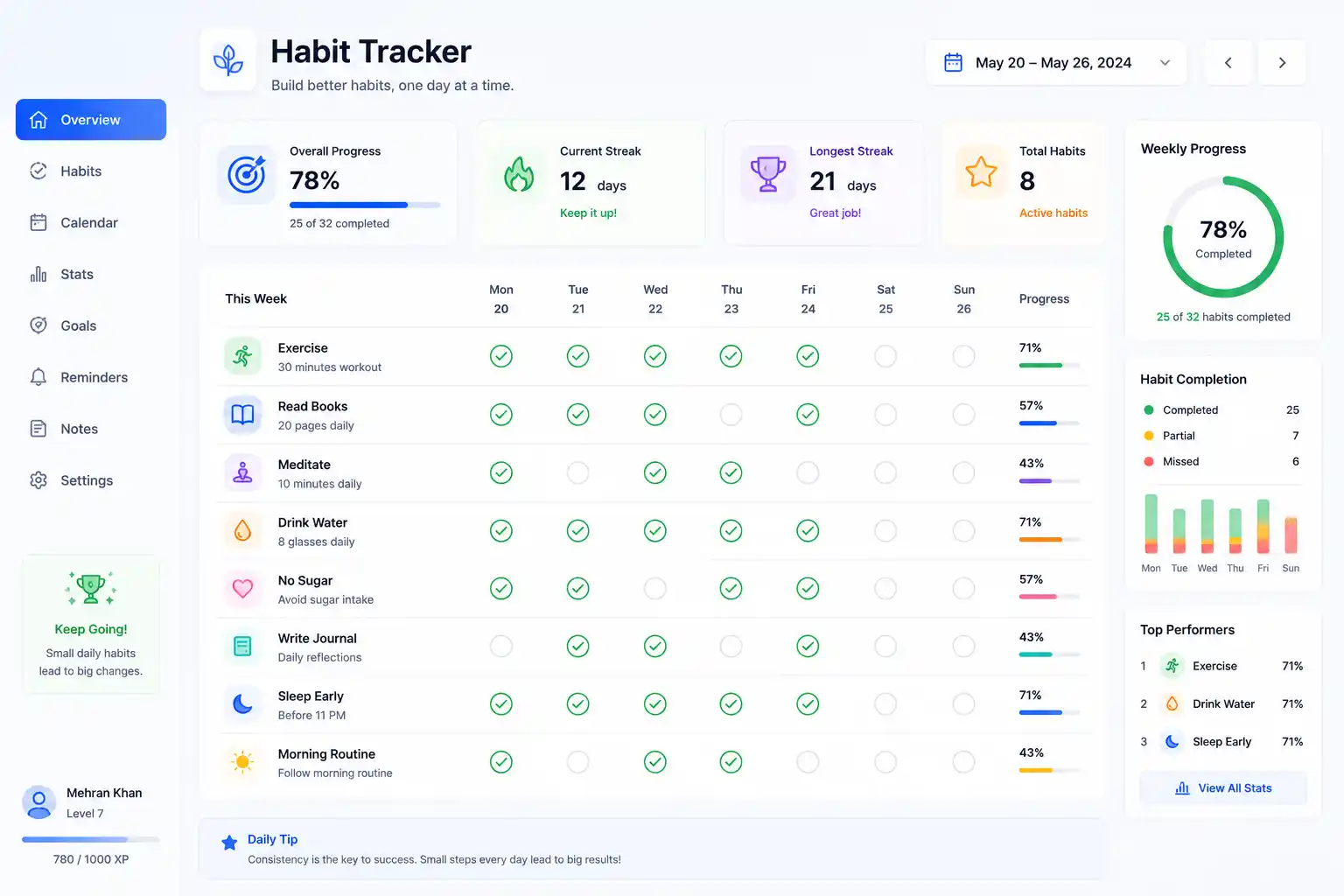
A habit tracker is a tool — digital, paper, or spreadsheet-based — that records whether you completed a desired behavior on a given day. At its simplest, it is a grid with habits listed on one axis and dates on the other. Each day you complete a habit, you mark it. Each day you don’t, the cell stays empty. Over time, the tracker produces a visual record of consistency that is simultaneously a measurement tool, a motivational system, and a behavioral feedback loop.
The concept sounds almost embarrassingly simple. Yet habit trackers are used by elite athletes, Fortune 500 executives, military special forces, and productivity researchers precisely because they work — not through complexity, but through a fundamental truth about human behavior: what gets measured gets managed, and what gets visualized gets repeated.
Understanding why habit trackers work requires understanding the neuroscience of habit formation. Understanding how to build an effective habit tracking system requires knowing which methods fit which behaviors, which pitfalls derail even motivated people, and how to recover from the inevitable missed days without abandoning the entire system.
The Neuroscience of Habit Formation
A habit is not simply a repeated behavior. At the neurological level, a habit is a behavior that has been encoded into the basal ganglia — a cluster of structures deep in the brain associated with procedural learning, automatic behavior, and reward processing — through a process of repetition and reinforcement.
The Habit Loop
MIT neuroscientist Ann Graybiel’s research in the 1990s identified the fundamental structure of all habits: a three-part neurological pattern now widely known as the habit loop.
Cue: A trigger that initiates the behavior. It can be a time of day, a location, an emotional state, a preceding action, or the presence of other people. The cue signals to the brain that a particular routine is available and appropriate.
Routine: The behavior itself — the sequence of actions performed in response to the cue. This is the habit as most people conceive of it.
Reward: The positive outcome that follows the routine, which signals to the brain that the loop is worth remembering and repeating. Rewards range from a neurochemical hit of dopamine to the satisfaction of checking a box on a tracker.
When this loop is repeated consistently, the basal ganglia begins to chunk the cue-routine-reward sequence into a single automated unit. The behavior becomes progressively less dependent on conscious decision-making — it becomes, in the most literal neurological sense, automatic.
The Role of Dopamine
Dopamine is frequently described as the “pleasure chemical,” but research by neuroscientist Wolfram Schultz and later by Dr. Andrew Huberman has refined this understanding significantly. Dopamine is not primarily a reward signal — it is an anticipation and motivation signal. Dopamine surges not when the reward arrives, but when the cue predicts the reward.
This distinction is critical for habit trackers. The visual streak on a habit tracker — the unbroken chain of completed days — becomes a cue that predicts the reward of completion. Over time, the act of opening the tracker and seeing the streak generates a dopamine response that motivates continuation. The tracker itself becomes a behavioral cue, completing the loop.
How Long Does Habit Formation Actually Take?
The commonly cited “21 days to form a habit” originates from a misreading of Dr. Maxwell Maltz’s 1960 book Psycho-Cybernetics, in which he observed that amputees took a minimum of 21 days to adjust to the loss of a limb. This figure was never about habit formation and was never the result of controlled research.
The most rigorous study on habit formation duration — a 2010 study by Phillippa Lally and colleagues at University College London, published in the European Journal of Social Psychology — followed 96 participants over 12 weeks as they attempted to form new habits. The findings: habit automaticity took between 18 and 254 days to achieve, with a median of 66 days.
The variation depended heavily on the complexity of the behavior (drinking a glass of water was faster than going to the gym), individual differences in neurology and motivation, and consistency of performance. The practical implication: commit to at least 10 weeks of consistent tracking before evaluating whether a habit has been successfully formed.
How a Habit Tracker Works
The Basic Mechanics
A habit tracker operates on a deceptively simple principle: binary daily accountability. For each habit and each day, there are only two states — done or not done. This binary clarity is psychologically powerful because it eliminates the gray zone of “I sort of did it” that allows rationalization and self-deception to erode behavioral consistency.
The core components of any habit tracker are:
Habit list: The specific behaviors being tracked, defined precisely enough to make the done/not-done determination unambiguous. “Exercise” is too vague. “Complete 30 minutes of intentional physical activity” is trackable.
Time frame: The period being tracked — daily, weekly, or monthly grid. Daily tracking is most effective for habit formation because it maintains the continuous feedback loop.
Completion marker: The action of recording completion. On paper trackers, this is typically an X, a checkmark, or a filled circle. On digital trackers, a tap or click. The physical act of marking completion is itself a micro-reward that reinforces the behavior.
Visual streak: The accumulating sequence of completed days. The “don’t break the chain” psychology — popularized by comedian Jerry Seinfeld, who reportedly used a calendar to track daily writing — works because streaks create a loss aversion dynamic: the longer the streak, the more psychologically painful it is to break it.
The Measurement Effect
A body of research in behavioral psychology demonstrates that the act of measurement itself changes behavior — a phenomenon known as the Hawthorne Effect in organizational settings and the self-monitoring effect in behavioral science. When people track a behavior, they perform it more consistently, even before any external incentive or consequence is introduced.
A 2019 meta-analysis published in Psychological Bulletin examining 138 studies on self-monitoring found that self-monitoring interventions produced significant improvements in goal achievement across health, academic, and professional domains — with the effect size roughly doubling when tracking was combined with goal-setting.
Types of Habit Trackers
Paper and Bullet Journal Trackers
The analog habit tracker — a hand-drawn grid in a notebook or planner — remains the most popular format among dedicated personal development practitioners. Paper trackers offer complete customization, require no technology, and produce a tactile completion experience that many users find more satisfying than a digital tap.
The bullet journal method, developed by Ryder Carroll and popularized through his 2018 book The Bullet Journal Method, uses monthly habit tracker spreads as a core component of the system. The monthly grid format — habits as rows, days as columns — gives an immediate visual overview of the entire month’s consistency at a glance.
Strengths: Fully customizable, no subscription cost, offline, tactile satisfaction, no notifications or distractions.
Limitations: No reminders, no data analysis, no syncing across devices, easy to lose or damage.
Spreadsheet Trackers
Excel and Google Sheets habit trackers add data analysis capabilities to the basic tracking grid. Conditional formatting can automatically color cells based on completion (green for done, red for missed), formulas can calculate weekly and monthly completion percentages, and charts can visualize trends over time.
Basic Google Sheets formula for completion percentage:
=COUNTIF(B2:AF2, "✓") / COUNTA(B2:AF2) * 100
Where B2:AF2 represents the 30 days of a month for a single habit row.
Strengths: Free, flexible, data analysis, shareable, cross-device access.
Limitations: No mobile notifications, requires manual entry, setup time investment.
Digital Habit Tracker Apps
Dedicated habit tracking applications offer the most feature-rich experience: push notification reminders, streak tracking with gamification, progress visualizations, habit stacking suggestions, and in some cases, community accountability features.
Leading habit tracker apps as of 2026 include:
Habitica: Gamifies habit tracking by turning your habits into a role-playing game. Completing habits earns experience points and gold; missing habits causes character damage. Particularly effective for gamers and those motivated by extrinsic reward systems.
Streaks (iOS): Minimalist design focused on maintaining streaks for up to 12 habits. Integrates with Apple Health for automatic tracking of certain health behaviors. Apple Design Award winner.
Habitify: Clean interface with data visualization, habit stacking support, and cross-platform sync. Strong analytics for users who want to review long-term patterns.
Done: Flexible habit frequency settings (daily, every X days, X times per week) that accommodate habits that don’t need to be performed every single day.
Loop Habit Tracker (Android, open source): Free, ad-free, privacy-focused, and feature-rich. Stores all data locally on the device. Strong data export options.
Notion and Obsidian: Knowledge management tools increasingly used as habit trackers via database templates. Highly customizable for users already embedded in these ecosystems.
How to Build an Effective Habit Tracking System
The difference between a habit tracker that transforms behavior and one that gets abandoned after two weeks is not the tool — it is the system design. These principles, grounded in behavioral science, determine whether a tracking system succeeds or fails.
1. Define Habits with Precision
Vague habits cannot be tracked reliably. The done/not-done determination must be unambiguous. Apply this test: could a stranger observe you and determine definitively whether you completed the habit?
| Vague | Precise and Trackable |
|---|---|
| Exercise | 30 minutes of intentional movement |
| Read more | Read for 20 minutes before bed |
| Eat healthy | Eat vegetables with at least 2 meals |
| Meditate | 10-minute guided meditation using app |
| Drink water | Drink 8 glasses (2 liters) of water |
| Practice guitar | 15 minutes of deliberate guitar practice |
2. Start with Two to Three Habits Maximum
The most common habit tracker failure mode is overloading the system. Tracking 10 habits simultaneously creates a compliance burden so heavy that a single missed day on multiple habits triggers cascading discouragement. Research on habit formation consistently supports starting with fewer habits and adding more only after the initial habits have achieved automaticity — typically after 60–90 days.
James Clear, author of Atomic Habits, advocates for the “two-minute rule” when initiating new habits: scale the habit down to a version that takes two minutes or less to complete. The goal is not the two-minute version — it is establishing the behavioral identity and the tracking pattern. The habit scales naturally once the foundation is set.
3. Anchor Habits to Existing Routines
Habit stacking — a term coined by BJ Fogg in Tiny Habits and elaborated by James Clear — links a new habit to an existing established behavior as its cue. The formula:
"After I [CURRENT HABIT], I will [NEW HABIT]."
Examples:
- “After I pour my morning coffee, I will write three things I am grateful for.”
- “After I sit down at my desk, I will review my habit tracker.”
- “After I brush my teeth at night, I will read for 20 minutes.”
Habit stacking works because the existing behavior already has a strong neurological cue. The new habit hijacks that cue rather than requiring the brain to encode an entirely new one.
4. Never Miss Twice
Missing a single day is inevitable. Missing two consecutive days is the beginning of a new habit — the habit of not doing the behavior. Research on habit disruption consistently finds that single missed days do not significantly damage habit formation; multiple consecutive misses do.
The “never miss twice” rule — articulated by James Clear and supported by behavioral research — treats a single missed day as a normal variance and an immediate return to the behavior as the essential recovery action. The habit tracker makes this rule visible: one empty cell in a streak is recoverable; two consecutive empty cells require explicit intervention.
5. Design for Failure Recovery
Every effective habit tracking system includes a predetermined response to disruption. Travel, illness, work crises, and life events will interrupt habits. Without a recovery protocol, the disruption becomes abandonment.
Practical failure recovery strategies:
- The minimum viable habit: Define a “travel version” of each habit — a reduced version that counts as completion during disruption periods. 30 minutes of exercise becomes 10 minutes. Full meditation becomes 3 deep breaths.
- The restart date: If a streak is broken, immediately log the restart date and treat it as a new streak rather than a failed attempt.
- The retrospective fill: Some practitioners allow filling in past days if a habit was genuinely completed but not logged. Others prohibit retrospective fills to maintain accountability. Choose deliberately and apply consistently.
Habit Tracking Frequency: Daily vs. Weekly vs. Monthly
Not all habits need daily tracking. Matching tracking frequency to habit frequency is an often-overlooked design decision.
Daily tracking is appropriate for habits intended to be performed every day: morning routine, hydration, sleep timing, journaling, meditation. The continuous visual streak is maximally motivating for daily behaviors.
Weekly tracking suits habits with a natural weekly frequency: gym sessions (3× per week), meal prep (once per week), financial review (once per week), deep work blocks. Weekly tracking counts completions per week rather than individual days.
Monthly tracking works for habits with lower frequency or longer time horizons: reading a book per month, completing a course module, visiting family, scheduling health appointments.
The tracking grid should match the intended frequency — a daily grid for a 3×-per-week habit creates false failure signals when legitimate rest days appear as empty cells.
The Habit Tracker and Identity
The most durable habit formation research points to a mechanism that transcends behavioral reinforcement: identity change. Habits that align with a person’s self-concept are substantially more likely to persist than habits pursued purely for external outcomes.
James Clear’s framework in Atomic Habits structures this explicitly: the most effective way to change behavior is to change the identity behind it. Instead of “I am trying to exercise,” the internal narrative becomes “I am someone who moves their body every day.” The habit tracker then becomes evidence for the identity claim — each completed day is a vote cast for the person you are becoming.
This is why long-term habit trackers function differently from short-term ones. A 30-day streak is motivating. A 6-month record is identity-confirming. A 2-year unbroken log becomes part of how a person defines themselves. The tracker is no longer just a measurement tool — it is a chronicle of character.
Common Habit Tracking Mistakes
Tracking too many habits at once. The motivational math works against you: ten habits with an 80% daily completion rate means two habits are missed every day, producing daily failure signals that erode motivation faster than the completions build it.
Tracking outcomes instead of behaviors. “Lose 5 pounds” is an outcome — it cannot be done or not done on a given day. “Follow my meal plan” is a behavior. Habit trackers measure behaviors; outcomes are measured separately.
Abandoning the tracker after a broken streak. The streak is motivational scaffolding, not the goal itself. Breaking the streak does not undo the completed days or diminish the neurological progress made. Restarting immediately is always more valuable than abandoning the system.
Choosing aspirational habits instead of foundational ones. Starting with meditation, cold showers, a 5 AM wake time, and daily exercise simultaneously — none of which are currently habitual — creates a compliance burden virtually guaranteed to collapse. Build one foundational habit fully before adding another.
Not reviewing the tracker. A tracker not reviewed regularly loses its feedback loop function. Weekly reviews — looking at the previous week’s completion, identifying patterns, and adjusting as needed — are as important as daily logging.
Frequently Asked Questions
How does a habit tracker work?
A habit tracker records whether you completed a specific behavior each day. By creating a visual record of consistency, it leverages the psychological power of streaks, loss aversion, and the self-monitoring effect to reinforce behavioral repetition over time.
How many habits should I track at once?
Most behavioral scientists and habit formation researchers recommend starting with two to three habits maximum. Add new habits only after existing ones have achieved genuine automaticity — typically after 60–90 days of consistent performance.
How long does it take to form a habit?
The most rigorous research places habit formation at 18 to 254 days, with a median of 66 days. The commonly cited “21 days” figure is a myth with no scientific basis. Expect 10–12 weeks of consistent tracking before a behavior becomes truly automatic.
What is the best habit tracker app?
The best habit tracker depends on your priorities. Streaks (iOS) is excellent for minimalists. Habitica works well for gamers. Loop Habit Tracker is the best free, privacy-focused Android option. Habitify offers the strongest analytics. For those already using Notion, a database template can serve as a highly customizable tracker.
Does missing one day ruin a habit?
No. Research shows that a single missed day does not significantly impair habit formation. What matters is the immediate return to the behavior — the “never miss twice” principle. One missed day is a variance; two consecutive misses is the beginning of a counter-habit.
What is habit stacking?
Habit stacking is the practice of linking a new habit to an existing established behavior as its cue, using the formula: “After I [current habit], I will [new habit].” It works by anchoring the new behavior to a neurological cue that already exists, reducing the cognitive effort required to initiate it.
Should I track habits on paper or digitally?
Both work. Paper trackers offer tactile satisfaction and zero technology friction; digital trackers offer reminders, data analysis, and cross-device syncing. The best format is the one you will actually use consistently — start with the lower-friction option for your lifestyle.
Can habit trackers help with mental health?
Yes. Research supports behavioral activation — the systematic increase of positive behaviors — as an effective component of treatment for depression and anxiety. Habit trackers used to log sleep, exercise, social connection, and mindfulness practices have documented therapeutic benefit when used as part of a broader wellness strategy. They are a behavioral tool, not a clinical intervention, and should supplement rather than replace professional mental health support.
Conclusion
A habit tracker is the intersection of neuroscience and accountability — a tool that makes the invisible process of behavioral change visible, measurable, and self-reinforcing. The science is clear: behaviors that are tracked are performed more consistently, and consistent performance is the only path to genuine automaticity.
The mechanics are simple: define the behavior precisely, mark it done or not done each day, never miss twice, and review regularly. The system compounds over time — not through dramatic transformation but through the quiet accumulation of completed days, each one a piece of evidence that the person in the mirror is exactly who they are choosing to become.