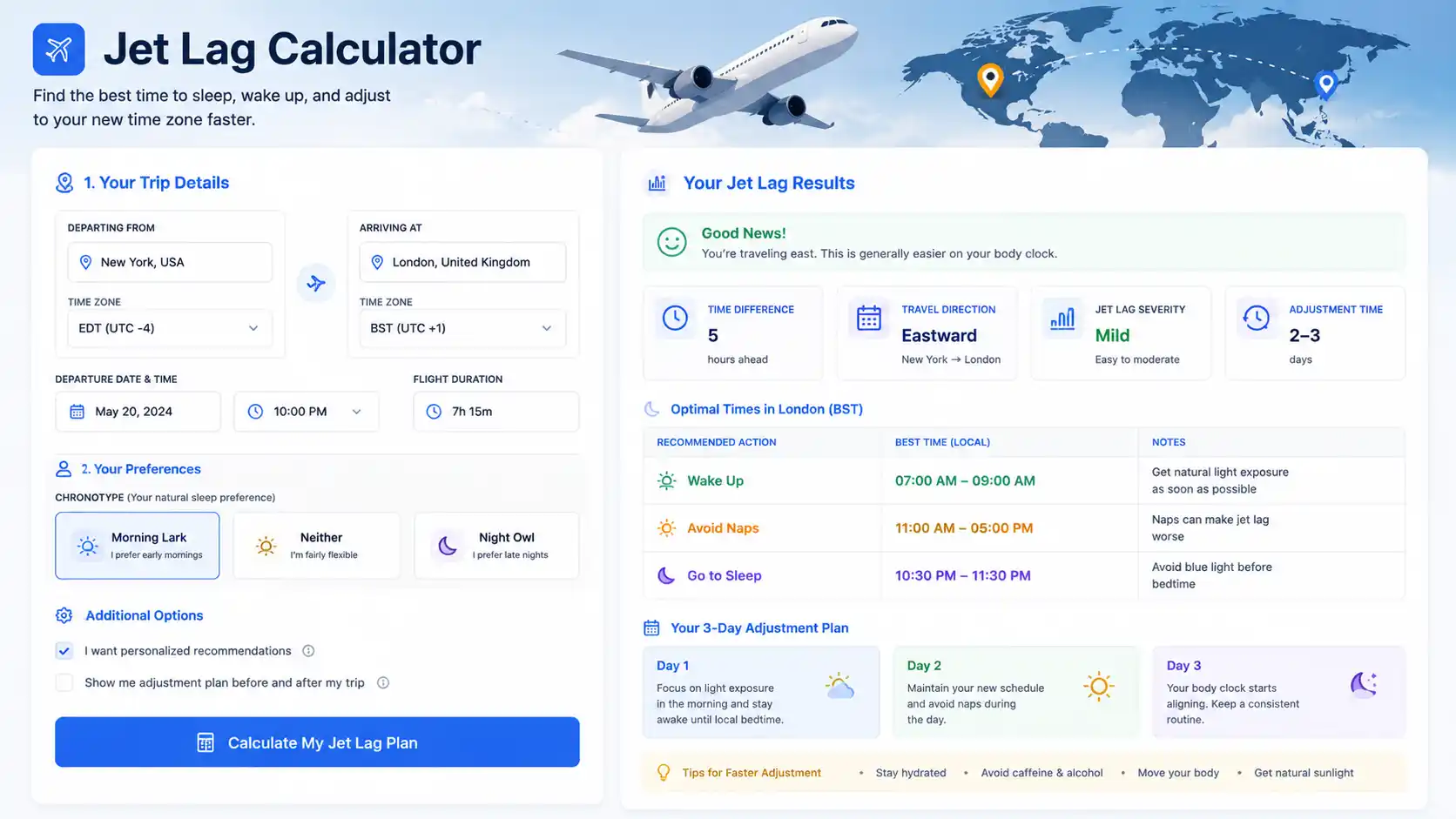
What Is a Jet Lag Calculator?
A jet lag calculator is a tool that estimates how long it will take your body to recover from the circadian disruption caused by rapid travel across multiple time zones. It takes your departure location, destination, flight direction, and sometimes your chronotype and sleep habits as inputs — then returns an estimated recovery timeline and, in more advanced versions, a personalized light exposure and sleep schedule to accelerate realignment.
Jet lag is not simply tiredness from a long flight. It is a genuine physiological condition — formally classified as Circadian Rhythm Sleep-Wake Disorder, Jet Lag Type by the American Academy of Sleep Medicine — caused by a mismatch between your internal body clock and the external time cues of your destination. Your biology is synchronized to one time zone while the world around you runs on another, and every major system in your body — sleep, digestion, hormonal release, body temperature, cognitive performance — operates on a schedule that no longer matches its environment.
Understanding how jet lag calculators work, what variables drive recovery time, and how the science of circadian biology can be applied practically makes the difference between arriving somewhere ready to perform and spending three days in a fog.
The Science Behind Jet Lag
The human body clock — the circadian rhythm — is governed by a cluster of approximately 20,000 neurons in the hypothalamus called the suprachiasmatic nucleus (SCN). This biological timekeeper runs on a cycle of roughly 24.2 hours and is continuously reset by environmental cues called zeitgebers (German for “time givers”). The most powerful zeitgeber is light — specifically, the blue wavelength component of natural sunlight detected by specialized photoreceptive cells (ipRGCs) in the retina.
When you fly across time zones, your SCN remains synchronized to your departure time zone. Your melatonin rises and falls, your cortisol peaks and troughs, your core body temperature oscillates — all on your origin schedule. But your destination’s light-dark cycle, meal times, and social cues are demanding a completely different schedule. The result is the constellation of symptoms we call jet lag: difficulty sleeping at the local nighttime, excessive daytime sleepiness, impaired concentration and memory, gastrointestinal disturbance, mood disruption, and general malaise.
The rate at which the SCN can shift its timing is biologically limited — which is why jet lag recovery is not instantaneous and cannot be fully rushed regardless of willpower or caffeine.
The Jet Lag Recovery Formula
The most widely cited rule of thumb for jet lag recovery is:
Recovery Time (days) = Number of Time Zones Crossed ÷ Adjustment Rate per Day
Where the adjustment rate differs by direction of travel:
Eastward travel: ~1 hour of adjustment per day
Westward travel: ~1.5 hours of adjustment per day
Why Direction Matters
The circadian rhythm’s natural free-running period is approximately 24.2 hours — slightly longer than a solar day. This means the body clock naturally drifts later if left without external correction. Westward travel — which asks you to delay your internal clock (stay awake and sleep later) — aligns with this natural drift. Eastward travel — which asks you to advance your internal clock (sleep earlier, wake earlier) — runs against the natural drift direction.
The practical result: flying west is biologically easier to recover from than flying east, for most people.
Recovery Time Examples
New York to London (5 time zones east):
Recovery = 5 ÷ 1 = approximately 5 days
Los Angeles to Tokyo (17 time zones east, or 7 west — always use the shorter path):
Shorter path: 7 time zones west
Recovery = 7 ÷ 1.5 = approximately 4–5 days
London to Sydney (10 time zones east, or 14 west — use east):
Shorter path: 10 time zones east
Recovery = 10 ÷ 1 = approximately 10 days
Paris to New York (6 time zones west):
Recovery = 6 ÷ 1.5 = approximately 4 days
These are population averages. Individual recovery times vary based on age, chronotype, overall sleep health, hydration, alcohol consumption during the flight, and how aggressively light exposure and sleep timing are managed upon arrival.
Time Zone Crossing Reference Table
| Route | Time Zones Crossed | Direction | Est. Recovery |
|---|---|---|---|
| New York → London | 5 | East | ~5 days |
| London → New York | 5 | West | ~3–4 days |
| Los Angeles → London | 8 | East | ~8 days |
| London → Los Angeles | 8 | West | ~5–6 days |
| New York → Los Angeles | 3 | West | ~2 days |
| Los Angeles → New York | 3 | East | ~3 days |
| New York → Tokyo | 14 east / 10 west | West (shorter) | ~6–7 days |
| London → Sydney | 10 | East | ~9–10 days |
| Dubai → New York | 9 | West | ~6 days |
| Sydney → Los Angeles | 17 east / 7 west | West (shorter) | ~4–5 days |
Rule of thumb for choosing direction: Always calculate both directions and travel through the fewer time zones — your body crosses the actual arc, not the nominal flight route.
Jet Lag Symptoms by Severity
Jet lag intensity scales with the number of time zones crossed and direction of travel. Understanding severity helps set realistic recovery expectations.
Mild (1–3 time zones): Slight fatigue and sleep timing irregularity. Most healthy adults adapt within 1–2 days with minimal intervention. Often dismissed as “travel tiredness” rather than true jet lag.
Moderate (4–6 time zones): Noticeable sleep disruption, daytime fatigue, reduced concentration, possible digestive irregularity. Recovery typically requires 3–5 days. Strategic light exposure and sleep timing make a measurable difference at this level.
Severe (7+ time zones): Significant insomnia at destination nighttime, excessive daytime sleepiness, substantial cognitive impairment, mood disruption, and GI symptoms. Full physiological realignment can take 7–10+ days. Pre-travel preparation and structured recovery protocols are strongly recommended.
Transmeridian travel (10+ time zones / near-180° crossing): Among the most disorienting travel scenarios. The body clock must shift so far in one direction that the shorter path calculation becomes critical, and recovery may require two or more weeks of full adaptation. Travelers crossing the International Date Line regularly — flight crews, business travelers on transpacific routes — face chronic circadian disruption with documented long-term health consequences.
How Advanced Jet Lag Calculators Work
Simple jet lag calculators apply the time-zone-per-day formula above. Advanced calculators — such as Timeshifter, which was developed with input from circadian neuroscientist Dr. Charles Czeisler of Harvard Medical School — build a personalized adaptation schedule using a mathematical model of circadian physiology.
These advanced tools take into account:
Chronotype: Morning types adapt to eastward travel more easily; evening types adapt to westward travel more easily. A calculator that knows your chronotype produces more accurate light and sleep timing recommendations.
Flight itinerary: Specific departure and arrival times determine when you are on the plane versus on the ground, affecting when to seek and avoid light during the adaptation window.
Light exposure windows: The circadian system responds to light differently depending on what phase of the cycle you are in. Light in the late biological night and early morning advances the clock (shifts it earlier); light in the early biological evening delays it (shifts it later). Advanced calculators map your biological clock phase onto your travel timeline to identify precisely when light exposure helps and when it harms adaptation.
Melatonin timing: Exogenous melatonin taken at low doses (0.5–1 mg) at the right biological time can accelerate circadian realignment by up to a day or two. Advanced calculators specify exact timing windows for melatonin administration relative to the destination time zone.
Sleep timing: Rather than simply advising “try to sleep on local schedule,” advanced calculators specify optimal target sleep windows that shift gradually toward the destination time zone across the travel day and subsequent nights.
The Jet Lag Light Exposure Formula
Light is the most powerful tool for resetting the circadian clock — and the most commonly misused. Understanding when to seek and avoid light during jet lag recovery is the single highest-leverage intervention available.
The Phase Response Curve (PRC)
The phase response curve is a graph that describes how the circadian clock responds to a pulse of bright light at different biological times. Its key findings:
- Light received 6–10 hours before your habitual wake time (the biological late night) strongly advances the clock — shifts it earlier. This is what eastward travelers need.
- Light received in the first few hours after your habitual sleep time (biological early evening) strongly delays the clock — shifts it later. This is what westward travelers need.
- Light during the middle of the biological day has minimal phase-shifting effect.
Practical Light Strategy by Travel Direction
Eastward travel (clock needs to advance — shift earlier):
- Seek bright light exposure in the morning at your destination, especially in the first 3–4 days.
- Avoid bright light in the evening at your destination for the first few days.
- Outdoor morning light is most effective; blue-light therapy lamps (10,000 lux) are a strong indoor alternative.
- If arriving in the morning after an overnight flight, stay awake through the day, get outside, and resist the urge to nap beyond 20 minutes.
Westward travel (clock needs to delay — shift later):
- Seek bright light in the evening at your destination.
- Avoid morning light for the first 1–2 days (if flying west from the U.S. to Asia, morning light in your destination is actually your biological “night” — it will worsen adaptation).
- A simple strategy: wear blue-light blocking glasses outdoors in the morning if you must be outside.
The danger zone — light at the wrong time: Getting light exposure at the wrong phase of your biological clock actively delays recovery. A traveler flying New York to London who gets bright light at 6:00 AM London time on day one is receiving light at what is still biologically 1:00 AM — which delays the clock rather than advancing it, and extends jet lag duration.
Melatonin for Jet Lag: Dosing and Timing
Melatonin is the most evidence-supported pharmacological intervention for jet lag, with a 2002 Cochrane review and multiple subsequent studies confirming its efficacy when used correctly. The key word is “correctly” — melatonin timing is everything, and most travelers use it wrong.
How Melatonin Works
Melatonin is a hormone produced by the pineal gland in response to darkness. It does not cause sleep directly — it signals biological nighttime to the circadian system, helping shift the clock’s phase. Taken at the appropriate time relative to the destination time zone, it accelerates realignment. Taken at the wrong time, it can delay adaptation.
Dosing Recommendations
Research consistently shows that low doses (0.5–1 mg) are as effective as higher doses (5–10 mg) for circadian phase shifting — and produce fewer side effects including next-day grogginess. Higher doses are sedating but do not improve phase-shifting efficacy. Most over-the-counter melatonin products in the U.S. are massively overdosed at 5–10 mg; cutting tablets or using liquid formulations allows for lower, more physiologically appropriate doses.
Timing by Direction
Eastward travel: Take 0.5–1 mg melatonin at the target bedtime in your destination time zone, beginning the night before travel or on the first night at the destination. Continue for 3–5 nights or until adaptation is complete.
Westward travel: Melatonin is less critical for westward travel, but if used, take it in the early morning hours of your destination time zone to reinforce the later sleep timing signal. Some travelers find it more useful to simply let the circadian system self-adjust westward, since it aligns with the natural clock drift.
Contraindications: Melatonin interacts with blood thinners, immunosuppressants, and diabetes medications. It should not be combined with alcohol. Consult a physician before use if you take prescription medications or have a seizure disorder.
Pre-Travel Jet Lag Preparation
The most effective jet lag management begins before departure, not after arrival. Gradual pre-travel shifting of sleep timing reduces the adjustment burden on the circadian system and can cut recovery time by 1–3 days for long-haul routes.
The Pre-Travel Shifting Protocol
For eastward travel: Beginning 3–5 days before departure, shift your bedtime and wake time 1 hour earlier each day. Seek morning light and avoid evening light during this window.
For westward travel: Beginning 3–5 days before departure, shift your bedtime and wake time 1 hour later each day. Seek evening light and avoid morning light during this window.
This protocol is most practical for planned business travel and is used systematically by professional athletes competing internationally. A 2019 study on professional sports teams found that pre-travel circadian shifting improved performance metrics significantly compared to teams that traveled without preparation.
On the Plane
- Set your watch to the destination time zone immediately upon boarding. Begin eating, drinking, and sleeping on destination time rather than origin time.
- Stay hydrated. Cabin air humidity is approximately 20% — well below comfortable levels — and dehydration worsens jet lag symptoms. Aim for 250 ml of water per hour of flight.
- Avoid alcohol. Alcohol suppresses REM sleep and dehydrates the body, compounding both sleep disruption and cognitive impairment at the destination.
- Use light strategically during the flight. If you should be sleeping per destination time, use an eye mask and avoid screen light. If you should be awake, keep window blinds open during daylight portions of the flight.
- Move regularly. Circulation reduces the risk of deep vein thrombosis (DVT) and combats the stiffness and fatigue that compound jet lag symptoms.
Jet Lag vs. Travel Fatigue: An Important Distinction
Not everything you feel after a long flight is jet lag. Travel fatigue — the physical tiredness from sitting in a pressurized cabin for 10–14 hours, disrupted sleep in a strange seat, dehydration, and the stress of airports — is a separate phenomenon that overlaps with jet lag but resolves much more quickly.
Travel fatigue typically resolves within 24–48 hours of rest, regardless of time zones crossed. Jet lag persists and follows the time-zone-per-day recovery formula.
The clinical distinction matters because travelers who feel better after one good night’s sleep in a comfortable bed may assume they have adapted — and then be surprised when circadian symptoms (waking at 3:00 AM fully alert, intense midday fatigue) persist for days afterward. Travel fatigue is gone; jet lag is still progressing.
Jet Lag in Special Populations
Business Travelers on Short Trips
Travelers spending fewer than 3 days at a destination face a unique dilemma: if the trip is shorter than the recovery time, full adaptation is impossible — and adapting then re-adapting on return doubles the disruption. For short trips across many time zones, the evidence-based recommendation is to stay on home time rather than attempt adaptation. Schedule meetings during what is daytime in your home time zone, sleep on home schedule (using blackout curtains), and treat the trip as a temporary displacement rather than a relocation.
Older Adults
Circadian amplitude — the strength of the circadian rhythm signal — weakens with age. Older adults experience more severe jet lag symptoms, slower adaptation rates, and greater sleep disruption from time zone transitions. The adjustment rate of 1 hour per day (eastward) may be more accurately modeled as 0.7–0.8 hours per day for adults over 60, extending recovery estimates by 20–30%.
Frequent Flyers and Flight Crews
Chronic circadian disruption from repeated transmeridian travel is associated with measurable long-term health effects including increased risk of certain cancers (particularly breast cancer in female flight crew), metabolic disruption, impaired immune function, and cognitive decline. The International Agency for Research on Cancer classified shift work involving circadian disruption as a Group 2A probable carcinogen in 2007 — a classification that encompasses flight crew working conditions.
Frequently Asked Questions
How long does jet lag last per time zone?
As a general rule, eastward travel requires approximately 1 day of recovery per time zone crossed; westward travel requires approximately 1 day per 1.5 time zones. A 6-time-zone eastward crossing takes roughly 6 days to fully resolve.
Is eastward or westward travel worse for jet lag?
Eastward travel is generally harder because it requires advancing the circadian clock — shifting it earlier — which runs against the body’s natural tendency to drift later. Most people find westward travel easier to recover from.
Does melatonin help with jet lag?
Yes, when timed correctly. Low doses of melatonin (0.5–1 mg) taken at the destination bedtime help shift the circadian clock faster. Timing is more important than dose — melatonin taken at the wrong biological time can delay adaptation.
What is the fastest way to recover from jet lag?
The most effective combination is: morning light exposure for eastward travel (or evening light for westward), low-dose melatonin at the destination bedtime, staying awake until local nighttime on arrival day, avoiding alcohol and staying hydrated, and beginning pre-travel clock shifting 3–5 days before departure.
Does staying on home time help for short trips?
Yes — for trips of 3 days or fewer across many time zones, research supports staying on home time rather than attempting adaptation. Schedule activities during your home daytime and sleep on home schedule using blackout curtains.
Why do I feel worse flying east than west?
Because eastward travel requires advancing your body clock — sleeping and waking earlier than your system is currently set for — which conflicts with the circadian rhythm’s natural tendency to drift slightly later each day. Westward travel asks the clock to delay, which is more biologically natural.
Can children get jet lag?
Yes. Children experience jet lag similarly to adults, though they may express it differently — through irritability, disrupted feeding schedules, and unusual sleep timing rather than the cognitive complaints adults typically report. Gradual pre-travel schedule adjustment is particularly beneficial for young children.
Does caffeine help with jet lag?
Caffeine can temporarily mask daytime sleepiness but does not accelerate circadian adaptation and can worsen nighttime sleep quality if consumed too late in the day. Use it strategically for daytime alertness management, not as a recovery tool.
Conclusion
A jet lag calculator translates the biology of the circadian system into an actionable recovery timeline. The core formula — one day of recovery per time zone for eastward travel, one day per 1.5 time zones westward — gives a reliable baseline. The variables that refine that estimate: direction of travel, individual chronotype, pre-travel preparation, in-flight behavior, light exposure management, and melatonin timing.
Jet lag is not a minor inconvenience to push through with willpower. It is a genuine physiological disruption of one of the body’s most fundamental regulatory systems. Treating it with the seriousness it deserves — using the tools circadian science has validated — is how frequent travelers protect their health, performance, and wellbeing across a lifetime of crossing time zones.
Related Topics
- Sleep Calculator: How It Works, Sleep Cycles Explained, and What Time to Wake Up
- Time Zone Calculator: Formula, Examples, and How It Works
- Time Clock Rounding Calculator: Rules, Formulas, and Examples
- Time Calculator: Formula, Examples, and How It Works
- Hours Calculator: Formula, Examples, and How It Works