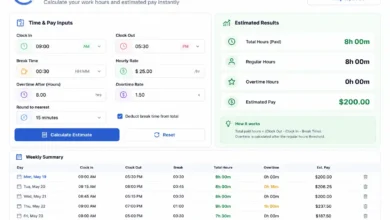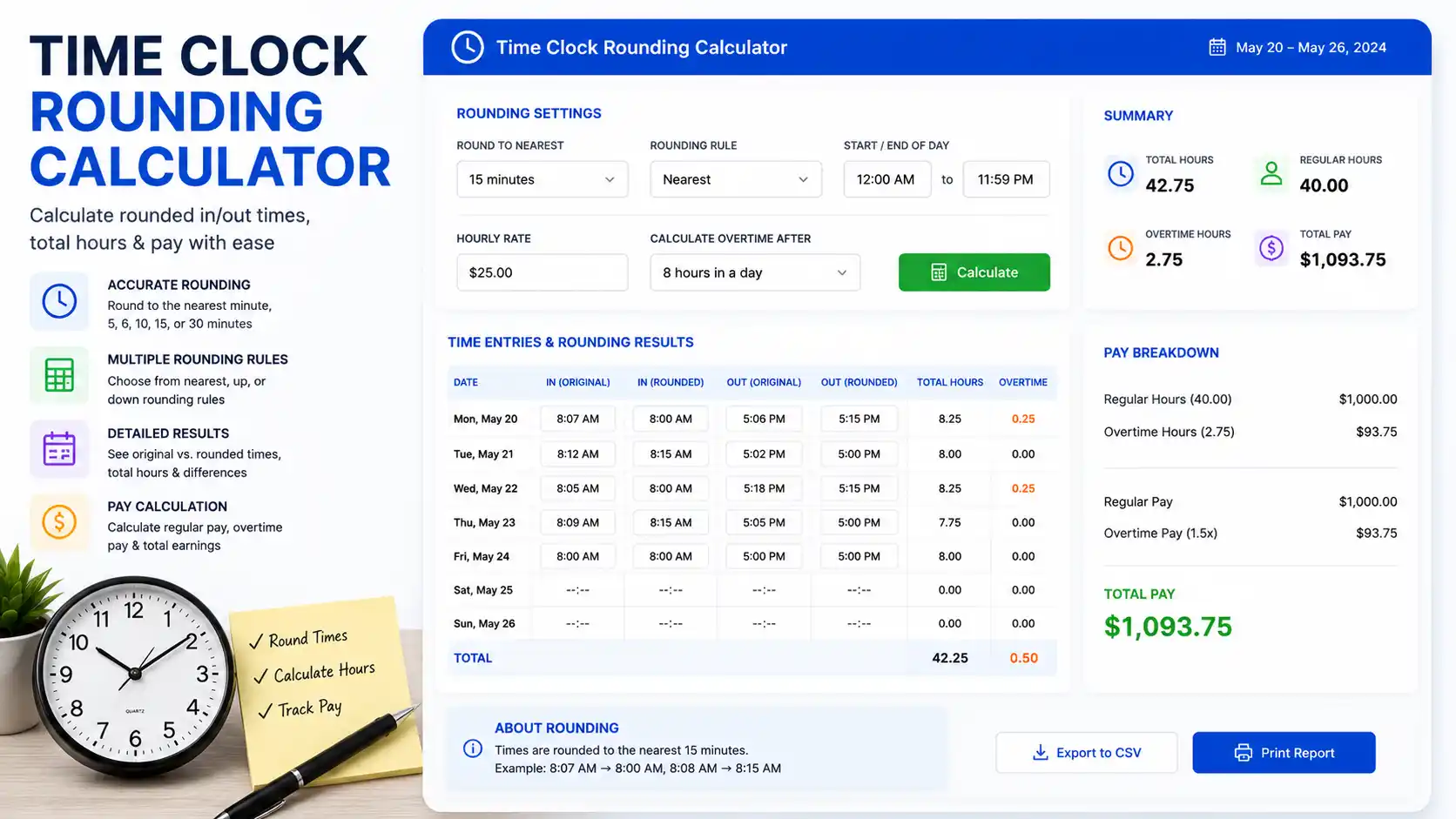
What Is a Time Clock Rounding Calculator?
A time clock rounding calculator is a tool that adjusts raw clock-in and clock-out times to the nearest predetermined interval — such as 5 minutes, 6 minutes, or 15 minutes — before calculating total hours worked. Rather than paying employees to the exact second, most employers apply a standardized rounding method to simplify payroll processing while staying compliant with federal labor law.
Rounding is not arbitrary. The U.S. Department of Labor, under the Fair Labor Standards Act (FLSA), permits time clock rounding only when it is applied neutrally — meaning it must not consistently favor the employer over time. When implemented correctly, rounding benefits and disadvantages employees in roughly equal measure across a pay period. When implemented incorrectly, it becomes wage theft — and that carries serious legal consequences.
Understanding how time clock rounding calculators work, which rounding rules are legally permissible, and how to calculate rounded time accurately is essential for HR professionals, payroll managers, small business owners, and employees who want to verify their own pay.
Why Employers Use Time Clock Rounding
Before digital time tracking became widespread, precise to-the-minute payroll was computationally expensive and logistically impractical for large workforces. Rounding to standard intervals allowed payroll clerks to process time records quickly and consistently.
Even today, rounding remains common for several practical reasons:
Employees rarely clock in or out at exactly the same time every day. A worker scheduled for 9:00 AM might clock in at 8:57 one day and 9:03 the next. Without rounding, each minute variation creates a slightly different pay calculation. Rounding normalizes these small fluctuations and produces cleaner, more predictable payroll figures.
Rounding also simplifies scheduling compliance. When an employee’s time is rounded to the nearest quarter hour, it is easier to verify that scheduled shifts were actually worked and that meal and rest break rules were followed.
That said, rounding is a tool that must be managed carefully. The FLSA’s permissive stance on rounding comes with a firm condition: over time, the rounding must average out in employees’ favor — or at worst, neutrally. Employers who configure their systems to always round against employees face back-pay liability, penalties, and class-action exposure.
FLSA Rules for Time Clock Rounding
The legal foundation for time clock rounding comes from 29 C.F.R. § 785.48, the Department of Labor regulation governing rounding practices. The key provisions are:
Employers may round employee time to the nearest 5 minutes, one-tenth of an hour (6 minutes), or one-quarter hour (15 minutes) — provided the rounding is applied consistently and does not, over time, result in employees being paid less than the actual time worked.
The regulation explicitly states that rounding is permissible as long as it “averages out so that the employees are fully compensated for all the time they actually work.” This is the legal standard every rounding policy must meet.
What this means in practice:
- If an employee clocks in early frequently, rounding their time back to the scheduled start time must be balanced by instances where rounding works in their favor.
- Rounding may never be configured to always favor the employer. Systems that consistently shave minutes from employee timesheets violate the FLSA regardless of how small the individual deductions appear.
- California courts have applied even stricter standards, with some rulings questioning whether any rounding policy — even a neutral one — is permissible under California Labor Code when precise tracking technology is available.
The Three Standard Rounding Methods
Method 1: 5-Minute Rounding
Time is rounded to the nearest 5-minute interval. This is the most granular of the three common approaches.
Rounding breakpoints:
- 0–2 minutes past the interval → round back
- 3–4 minutes past the interval → round forward
Example:
- Clock-in at 8:02 → rounded to 8:00
- Clock-in at 8:03 → rounded to 8:05
- Clock-out at 5:02 → rounded to 5:00
- Clock-out at 5:03 → rounded to 5:05
5-minute rounding is most common in industries where shifts start at the top of every 5 minutes and where precision matters, such as healthcare and call centers.
Method 2: One-Tenth Hour Rounding (6-Minute Rounding)
Time is rounded to the nearest tenth of an hour — intervals of 6 minutes. This method is favored by payroll systems that express time in decimal format, since each interval corresponds cleanly to 0.1 hours.
The 6-minute intervals:
- :00, :06, :12, :18, :24, :30, :36, :42, :48, :54
Rounding breakpoints:
- 0–2 minutes past the interval → round back
- 3–5 minutes past the interval → round forward
Example:
- Clock-in at 8:04 → rounded to 8:06 (0.1 hours into the hour)
- Clock-in at 8:08 → rounded to 8:06
- Clock-in at 8:10 → rounded to 8:12
6-minute rounding is popular with accounting and legal professionals because it maps directly to decimal billing increments.
Method 3: Quarter-Hour Rounding (15-Minute / 7-Minute Rule)
The most widely used rounding method in the United States. Time is rounded to the nearest 15-minute mark using the 7-minute rule: the first 7 minutes past a quarter hour round back; 8 minutes or more round forward.
The quarter-hour intervals: :00, :15, :30, :45
Rounding breakpoints:
- 1–7 minutes past a quarter hour → round back to the quarter hour
- 8–14 minutes past a quarter hour → round forward to the next quarter hour
Full breakpoint table:
| Actual Clock-In | Rounds To | Direction |
|---|---|---|
| 8:00–8:07 | 8:00 | Back |
| 8:08–8:14 | 8:15 | Forward |
| 8:15–8:22 | 8:15 | Back |
| 8:23–8:29 | 8:30 | Forward |
| 8:30–8:37 | 8:30 | Back |
| 8:38–8:44 | 8:45 | Forward |
| 8:45–8:52 | 8:45 | Back |
| 8:53–8:59 | 9:00 | Forward |
The 7-minute rule is symmetrical by design: for any given 15-minute window, 7 minutes round in the employee’s favor and 7 minutes round against them, with the 8th minute being the tipping point. Across thousands of clock-ins, this produces a neutral average — which is exactly what the FLSA requires.
Time Clock Rounding Formulas
For those building rounding logic into spreadsheets or custom payroll systems, here are the mathematical formulas.
Quarter-Hour Rounding Formula
Rounded Time = ROUND(Actual Time × (1/0.25), 0) × 0.25
In Excel, applied to a time value in cell A1:
=MROUND(A1, "0:15")
5-Minute Rounding Formula (Excel)
=MROUND(A1, "0:05")
6-Minute (Tenth-Hour) Rounding Formula (Excel)
=MROUND(A1, "0:06")
General Rounding Formula (Decimal Hours)
Rounded Decimal Hours = ROUND(Actual Decimal Hours / Interval, 0) × Interval
Where Interval = 0.25 for quarter-hour, 0.1 for sixth-hour, 0.0833 for 5-minute.
Step-by-Step Rounding Calculation Examples
Example 1: Applying the 7-Minute Rule (Quarter-Hour)
Employee: Jason Mercer, Customer Service Rep Scheduled Shift: 8:00 AM – 5:00 PM Unpaid Lunch: 30 minutes
| Day | Raw In | Raw Out | Rounded In | Rounded Out | Raw Hrs | Rounded Hrs |
|---|---|---|---|---|---|---|
| Mon | 7:54 AM | 5:03 PM | 8:00 AM | 5:00 PM | 9.15 | 8.5 |
| Tue | 8:06 AM | 5:11 PM | 8:00 AM | 5:15 PM | 9.08 | 8.75 |
| Wed | 8:09 AM | 4:58 PM | 8:15 AM | 5:00 PM | 8.82 | 8.25 |
| Thu | 7:57 AM | 5:07 PM | 8:00 AM | 5:15 PM | 9.17 | 8.75 |
| Fri | 8:03 AM | 4:52 PM | 8:00 AM | 4:45 PM | 8.82 | 8.25 |
(All hours above already exclude the 30-minute lunch break)
Raw Total: 45.04 hours Rounded Total: 42.50 hours
In this specific week, rounding worked against the employee — a 2.54-hour difference. This is why the FLSA requires evaluating rounding over time, not just week by week. Across many weeks, the differences should even out. If they consistently favor the employer, the policy is unlawful.
Example 2: 5-Minute Rounding Applied
Employee: Maria Santos, Retail Associate Hourly Rate: $16.00
| Day | Raw In | Rounded In | Raw Out | Rounded Out | Hours |
|---|---|---|---|---|---|
| Mon | 9:02 AM | 9:00 AM | 5:04 PM | 5:05 PM | 8.08 |
| Tue | 9:03 AM | 9:05 AM | 4:58 PM | 5:00 PM | 7.92 |
| Wed | 9:01 AM | 9:00 AM | 5:02 PM | 5:00 PM | 8.00 |
| Thu | 9:04 AM | 9:05 AM | 5:03 PM | 5:05 PM | 8.00 |
| Fri | 8:58 AM | 9:00 AM | 4:57 PM | 4:55 PM | 7.92 |
Rounded Total: 39.92 hours Gross Pay: 39.92 × $16.00 = $638.72
Notice how some days round in Maria’s favor (Mon: clocks out at 5:04, rounds to 5:05 — gains 1 minute) and others round against her (Fri: clocks out at 4:57, rounds back to 4:55 — loses 2 minutes). This is the neutral balance the law requires.
Example 3: When Rounding Creates a Legal Problem
Consider an employer whose system is configured to always round clock-in times forward (to the next interval) and always round clock-out times back (to the prior interval). This configuration systematically reduces employee pay.
Employee: 4 weeks of clock data
| Week | Minutes Lost to Rounding | Minutes Gained from Rounding | Net Loss |
|---|---|---|---|
| 1 | 42 min | 0 min | −42 min |
| 2 | 38 min | 0 min | −38 min |
| 3 | 45 min | 0 min | −45 min |
| 4 | 40 min | 0 min | −40 min |
Total: 165 minutes (2 hours 45 minutes) of unpaid work in one month.
At $20/hour, this employee loses approximately $55/month, or $660/year. Across 50 employees, that’s $33,000 in annual wage theft — and the liability compounds with every pay period the policy remains in place.
This is precisely the scenario that triggers DOL investigations and class-action lawsuits. Courts have awarded back pay, liquidated damages (equal to the back pay amount), and attorney fees in cases like these.
Rounding at Scheduled Start Times: The “Grace Period” Issue
Many employers configure their time systems to apply rounding only relative to an employee’s scheduled start time rather than to a fixed clock interval. This approach — sometimes called “schedule-based rounding” — treats early arrivals and late clock-outs differently.
For example, if an employee is scheduled to start at 8:00 AM:
- Clocks in at 7:52 → system records 8:00 (company doesn’t pay for early arrival)
- Clocks in at 8:08 → system records 8:00 (within the 7-minute grace window, no penalty)
- Clocks in at 8:09 → records as 8:15 (late, and rounded forward)
This configuration is legally risky. While the FLSA permits rounding, it does not permit employers to simply ignore early clock-ins while still capturing early clock-outs. If the system consistently benefits the employer — rounding early arrivals to the scheduled time but also rounding early departures back — it will fail the neutrality test.
The safest approach is always fixed-interval rounding applied symmetrically to all time entries, regardless of the employee’s schedule.
Rounding vs. Precise Tracking: Which Is Better?
The growing availability of precise digital time tracking has made some courts and regulators skeptical of rounding altogether. The argument is straightforward: if technology can record time to the minute, why should employers be permitted to round it?
California has become the most restrictive jurisdiction on this issue. In Donohue v. AMN Services (2021), the California Supreme Court held that employers using time-keeping systems capable of recording precise time cannot rely on rounding policies to establish that employees were paid for all hours worked. The case effectively pushed California employers toward precise-to-the-minute tracking.
Federal law (FLSA) still permits rounding as of 2026, but the DOL’s enforcement posture has tightened, and employers in any state should be aware that courts are increasingly skeptical of rounding policies — particularly where precise tracking technology is deployed.
Practical recommendation: If your time tracking system already captures exact clock-in/clock-out times, use those times for payroll. The compliance risk of rounding outweighs the administrative convenience, especially in California, New York, and other employee-protective states.
How to Audit Your Rounding Policy for FLSA Compliance
If your business currently uses a rounding policy, a periodic audit is essential to confirm neutrality. Here is a straightforward audit process:
Step 1: Export 3–6 months of raw (pre-rounding) time data alongside rounded time data for all employees.
Step 2: Calculate the difference between raw hours and rounded hours for each employee each week: a positive number means rounding added time (favors employee); negative means rounding removed time (favors employer).
Step 3: Sum all differences across the audit period. The total should be close to zero or slightly positive (favoring employees). A consistently negative total signals a compliance problem.
Step 4: Break the audit down by shift type, department, and day of week. Rounding bias sometimes clusters in specific scenarios — such as morning shifts where employees frequently clock in a few minutes early.
Step 5: If you identify systematic underpayment, correct the rounding configuration immediately and consult an employment attorney about potential back-pay obligations to affected employees.
Time Clock Rounding for Meal and Rest Breaks
Rounding applies not just to shift start and end times, but also to break periods — and this is where many employers create unintentional compliance gaps.
If an employee takes a 32-minute unpaid lunch and the system rounds that to 30 minutes, the employee is credited with 2 extra minutes of unpaid break time. Over 250 workdays per year, that’s more than 8 hours of unpaid time — over an entire extra day of work the employee never gets paid for.
Best practice for break rounding:
- Round break durations using the same interval and rules as shift times.
- Apply rounding neutrally: a 28-minute break rounds to 30 minutes; a 32-minute break rounds to 30 minutes.
- In states with mandatory minimum break durations (California’s 30-minute meal period, for example), ensure rounding never results in a recorded break shorter than the legal minimum.
Frequently Asked Questions
What is the 7-minute rule for time clocks?
The 7-minute rule is the most common implementation of quarter-hour rounding. Employees who clock in within 7 minutes of a quarter hour have their time rounded back to that quarter hour. Those who clock in 8 or more minutes past a quarter hour have their time rounded forward to the next quarter hour.
Is time clock rounding legal?
Yes — under federal law (FLSA), time clock rounding to the nearest 5, 6, or 15 minutes is legal, provided the rounding is neutral over time and does not consistently result in employees being paid less than actual hours worked. California has stricter standards.
Can an employer always round down?
No. Consistently rounding employee time in the employer’s favor violates the FLSA. Rounding must average out to neutral across a pay period.
Does rounding apply to overtime?
Yes. Rounding can affect whether an employee’s total hours cross the 40-hour overtime threshold. Employers must ensure rounding does not cause employees to miss earned overtime pay.
What is the most common rounding method?
Quarter-hour rounding using the 7-minute rule is by far the most common method used by U.S. employers. It is explicitly referenced in DOL guidance and is the standard approach in most commercial payroll systems.
How do I calculate rounded time in Excel?
Use the MROUND function. For quarter-hour rounding: =MROUND(A1,”0:15″). For 5-minute rounding: =MROUND(A1,”0:05″). For 6-minute rounding: =MROUND(A1,”0:06″).
Should I use rounding or precise time tracking?
Where possible, precise tracking is the safer compliance choice — especially in California and other employee-protective states. If you already capture exact times, use them. Rounding is a legacy convenience that carries increasing legal risk as technology makes precision tracking universally accessible.
Conclusion
Time clock rounding is a deeply practical concept with significant legal weight behind it. When applied correctly — using one of the three FLSA-approved methods, symmetrically, and audited regularly for neutrality — it is a legitimate and efficient payroll tool. When misapplied, even unintentionally, it becomes a liability that compounds with every pay period.
The formulas and examples in this guide give you the tools to understand exactly how rounding works, verify that your policy is lawful, and calculate rounded time accurately for any shift type. Whether you are building a rounding calculator in Excel, auditing an existing payroll system, or simply trying to understand why your timesheet shows slightly different hours than your clock-in records, the underlying math is always the same: round symmetrically, audit regularly, and when in doubt, pay for every minute worked.