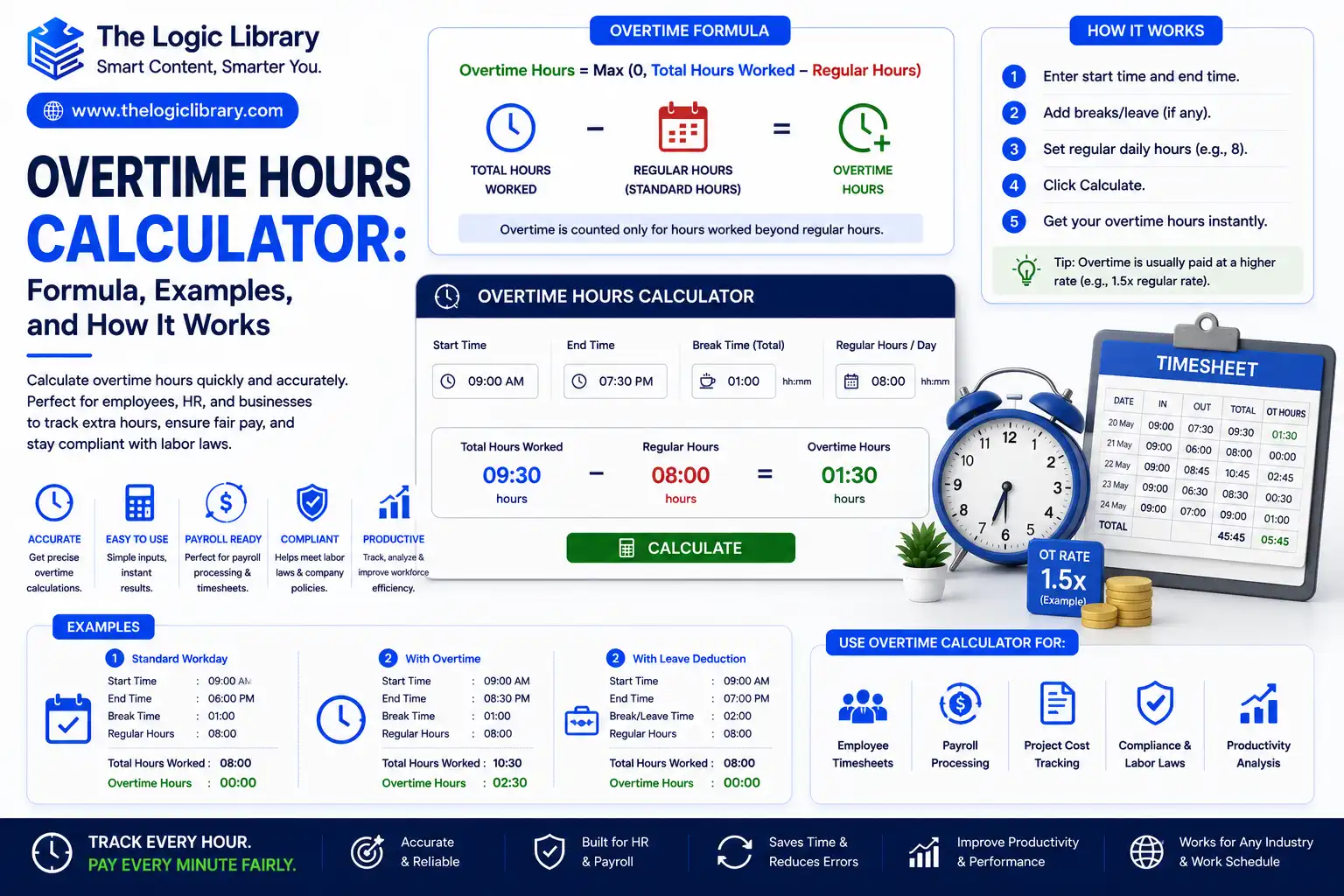
An overtime hours calculator is a tool that works out how many extra hours an employee worked beyond their standard schedule and how much those hours are worth at a higher pay rate. At its core, it applies one simple idea: hours worked past a set threshold are paid at a premium—most commonly 1.5 times the regular hourly wage, often called “time and a half.”
This guide breaks down the exact overtime formula, walks through real examples, and explains how an overtime calculator works step by step—so you can verify any paycheck or build your own calculation with confidence.
What Is Overtime Pay?
Overtime pay is the additional compensation employees earn for working more hours than a defined limit, usually within a single workweek. In the United States, the federal Fair Labor Standards Act (FLSA) sets the standard threshold at 40 hours per week. Any hour worked beyond 40 is typically paid at no less than 1.5× the regular rate for eligible (non-exempt) employees.
Other regions calculate it differently:
- Daily overtime: Some places (like California) trigger overtime after 8 hours in a single day, not just 40 in a week.
- Double time: Certain hours—such as work beyond 12 hours in a day, or hours on a seventh consecutive workday—may be paid at 2× the regular rate.
- Country-specific rules: Many countries set their own thresholds, premium multipliers, and exemptions.
Key takeaway: Always confirm the rules that apply to your specific country, state, or province. The formulas below are universal, but the threshold and multiplier depend on local law and your employment contract.
The Overtime Pay Formula
The overtime calculation rests on three core formulas. Once you understand these, every variation becomes easy.
1. Find the Overtime Hours
Overtime Hours = Total Hours Worked − Standard Hours Threshold
If the result is zero or negative, no overtime is owed.
2. Calculate the Overtime Rate
Overtime Rate = Regular Hourly Rate × Overtime Multiplier
The standard multiplier is 1.5 (time and a half). For double time, use 2.0.
3. Calculate Total Overtime Pay
Overtime Pay = Overtime Hours × Overtime Rate
4. Calculate Total Gross Pay
Total Pay = (Regular Hours × Regular Rate) + Overtime Pay
That’s the complete chain. Now let’s see it in action.
How an Overtime Calculator Works (Step by Step)
A well-built overtime calculator follows the same logic a payroll specialist would. Here’s the workflow:
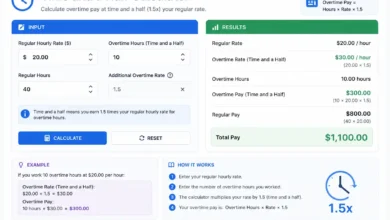
Step 1 — Capture the inputs. The calculator collects three values: total hours worked, the regular hourly rate, and the overtime threshold (default: 40 hours/week).
Step 2 — Separate regular hours from overtime hours. It compares total hours against the threshold. Everything up to the threshold is “regular,” and everything above is “overtime.”
Step 3 — Apply the multiplier. It multiplies the regular rate by 1.5 (or 2.0 for double time) to find the premium rate for overtime hours.
Step 4 — Compute each pay component. Regular pay and overtime pay are calculated separately, then combined.
Step 5 — Return the results. The tool displays overtime hours, overtime pay, and total gross pay—usually before taxes and deductions.
Worked Examples
Example 1: Standard Weekly Overtime
Scenario: Maria earns $20/hour and worked 46 hours this week. Overtime kicks in after 40 hours at 1.5×.
| Step | Calculation | Result |
|---|---|---|
| Overtime hours | 46 − 40 | 6 hours |
| Overtime rate | $20 × 1.5 | $30/hour |
| Regular pay | 40 × $20 | $800 |
| Overtime pay | 6 × $30 | $180 |
| Total gross pay | $800 + $180 | $980 |
Maria earns $980 for the week, including $180 in overtime.
Example 2: Double Time
Scenario: James earns $25/hour. He worked 40 regular hours, plus 4 hours at time-and-a-half, plus 3 hours at double time on a holiday.
| Component | Calculation | Result |
|---|---|---|
| Regular pay | 40 × $25 | $1,000 |
| Time-and-a-half pay | 4 × ($25 × 1.5) | $150 |
| Double-time pay | 3 × ($25 × 2.0) | $150 |
| Total gross pay | $1,000 + $150 + $150 | $1,300 |
James earns $1,300 for the week.
Example 3: Daily Overtime
Scenario: In a region with daily overtime, Priya earns $18/hour and works a 10-hour day. Overtime applies after 8 hours.
| Step | Calculation | Result |
|---|---|---|
| Overtime hours | 10 − 8 | 2 hours |
| Overtime rate | $18 × 1.5 | $27/hour |
| Regular pay | 8 × $18 | $144 |
| Overtime pay | 2 × $27 | $54 |
| Total daily pay | $144 + $54 | $198 |
Priya earns $198 for that single day.
How to Calculate Overtime for Salaried Employees
Salaried, non-exempt workers can still qualify for overtime. The trick is converting their salary into an hourly rate first.
Regular Hourly Rate = Weekly Salary ÷ Standard Hours Worked
Example: Tom earns a $960 weekly salary for an expected 40-hour week.
- Regular hourly rate = $960 ÷ 40 = $24/hour
- If Tom works 45 hours, his 5 overtime hours pay at $24 × 1.5 = $36/hour
- Overtime pay = 5 × $36 = $180
- Total = $960 + $180 = $1,140
Note that exempt salaried employees—typically those in executive, administrative, or professional roles above a certain salary level—are generally not entitled to overtime. Eligibility depends on job duties and local thresholds, not just whether someone is paid a salary.
Overtime Multipliers at a Glance
| Type | Multiplier | Common Trigger |
|---|---|---|
| Time and a half | 1.5× | Hours over 40/week (or over 8/day in some regions) |
| Double time | 2.0× | Hours over 12/day or 7th consecutive workday in some regions |
| Regular pay | 1.0× | Standard scheduled hours |
These are common conventions, but your actual rates are set by law and contract.
Common Mistakes to Avoid
Even simple math goes wrong when these details are overlooked:
- Forgetting the threshold differs by location. A 40-hour federal rule doesn’t override a stricter state rule. Use whichever benefits the employee where required.
- Mixing daily and weekly overtime. In regions with both, you must avoid paying the same hour twice—apply the rule that yields the higher pay, not both stacked.
- Excluding bonuses from the “regular rate.” Non-discretionary bonuses and certain incentives can raise the regular rate used to calculate overtime. The base hourly wage isn’t always the full picture.
- Misclassifying employees. Treating an overtime-eligible worker as “exempt” is one of the most costly payroll errors.
- Rounding incorrectly. Track minutes accurately; small rounding errors compound across pay periods.
Why Use an Overtime Calculator?
Manual calculations are error-prone, especially with mixed rates, multiple thresholds, and partial hours. An overtime calculator helps you:
- Verify your paycheck quickly and catch underpayments.
- Estimate earnings before picking up extra shifts.
- Budget labor costs if you’re an employer or manager.
- Reduce payroll disputes by showing transparent, repeatable math.
For employees, it’s a quick way to confirm you’re being paid fairly. For employers, it’s a safeguard against compliance penalties.
Frequently Asked Questions
How do you calculate overtime hours?
Subtract the standard hours threshold (usually 40 per week) from the total hours worked. The remainder is your overtime hours. For example, 47 total hours − 40 = 7 overtime hours.
What is the overtime pay formula?
Overtime pay = Overtime hours × (Regular hourly rate × Overtime multiplier). With a $20 rate, 5 overtime hours, and a 1.5 multiplier: 5 × ($20 × 1.5) = $150.
Is overtime always 1.5 times pay?
No. Time and a half (1.5×) is the most common rate, but double time (2.0×) applies in certain situations, and the exact rules depend on your jurisdiction and contract.
How is overtime calculated for salaried employees?
First convert the salary to an hourly rate by dividing the weekly salary by the standard hours worked. Then apply the standard overtime formula to any hours above the threshold—provided the employee is non-exempt.
Does overtime get calculated daily or weekly?
It depends on local law. The U.S. federal standard is weekly (over 40 hours), but some states and countries also apply daily overtime (for example, over 8 hours in a day).
Are bonuses included in overtime calculations?
Non-discretionary bonuses and certain incentive pay can be included in the “regular rate” used to calculate overtime, which may raise the overtime amount owed. Discretionary bonuses usually are not.
Final Thoughts
Calculating overtime comes down to three things: knowing your threshold, your regular rate, and your multiplier. Once you have those, the formula is straightforward—total hours minus the threshold gives your overtime hours, and those hours are paid at the premium rate.
An overtime hours calculator simply automates this logic so you don’t have to do the math by hand or risk costly mistakes. Whether you’re an employee checking a paycheck or an employer managing payroll, understanding the formula behind the calculator puts you in control.
This article is for general educational purposes and is not legal or payroll advice. Overtime laws, thresholds, and multipliers vary by country, state, and employment agreement—always verify the rules that apply to your situation.