Mathematics
-

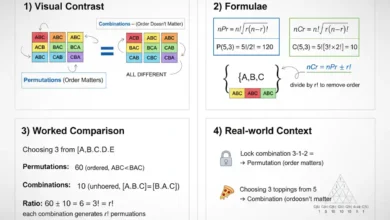
Permutations and Combinations: Definition, Formula & Example
Permutations and combinations are counting methods used when selecting objects from a larger set. The key difference is whether order…
Read More » -
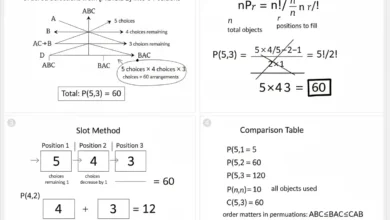
Permutations: nPr
Permutations count arrangements or selections where order matters. If r distinct objects are selected and arranged from n distinct available…
Read More » -
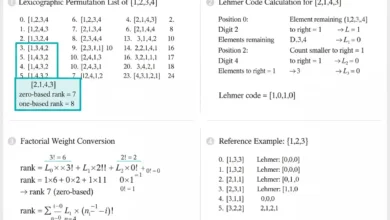
Permutation Rank: Definition, Formula & Example
A permutation rank identifies the position of a permutation within a specified ordering of all permutations of the same elements.…
Read More » -
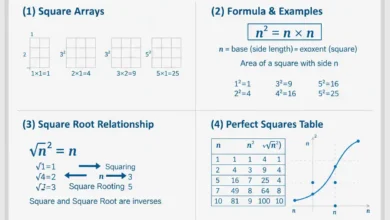
Perfect Squares: Formula, Rules & Examples
Perfect squares are numbers obtained by multiplying an integer by itself. The defining formula is: S = n² = n…
Read More » -
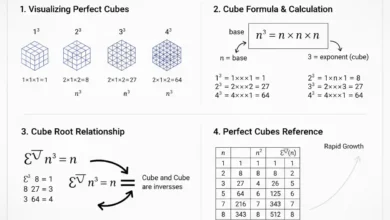
Perfect Cubes: Formula, Rules & Examples
Perfect cubes are numbers obtained by multiplying an integer by itself three times. The basic formula is: C = n³…
Read More » -
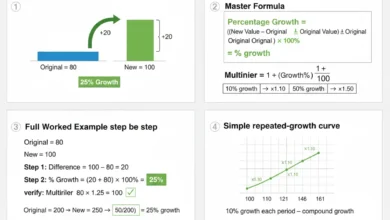
Percentage Growth: Definition, Formula & Example
Percentage growth measures how much a positive quantity has increased relative to its original value. For a positive, nonzero starting…
Read More » -
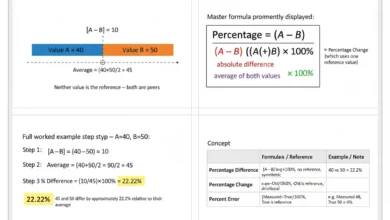
Percentage Difference: Definition, Formula & Example
Percentage difference measures how far apart two comparable values are relative to their average. It is useful when neither value…
Read More » -
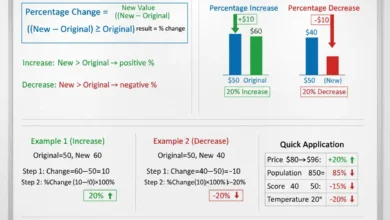
Percentage Change: Definition, Formula & Example
Percentage change measures how much a quantity has increased or decreased relative to its original value. For a positive, nonzero…
Read More » -
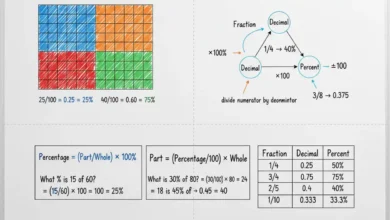
Percentage: Formula, Rules & Examples
A percentage expresses a quantity as a proportion of 100. The symbol: % means: per hundred So: 25% = 25/100…
Read More » -
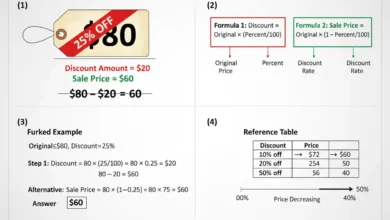
Percent Off: Definition, Formula & Example
Percent off tells you how much an original price or quantity is reduced as a percentage of that original amount.…
Read More »