Mathematics
-

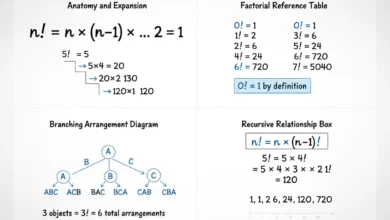
Factorial: Formula, Rules & Examples
A factorial is the product of a positive integer and every positive integer below it. Factorial notation uses an exclamation…
Read More » -
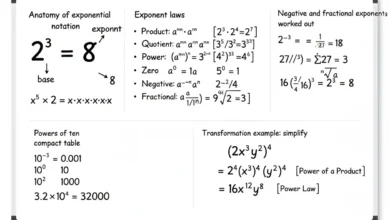
Exponents: Rules & Examples
Exponents provide a compact way to represent repeated multiplication and powers. In an expression such as: 5³ the number 5…
Read More » -
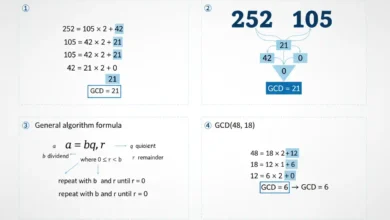
Euclidean Algorithm: Formula, Rules & Examples
The Euclidean algorithm is a systematic method for finding the greatest common divisor of two integers. It repeatedly divides the…
Read More » -
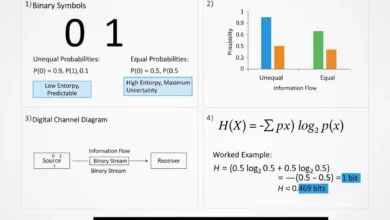
Entropy: Information Theory
Entropy in information theory is a mathematical measure of uncertainty associated with a probability distribution. A source whose next outcome…
Read More » -
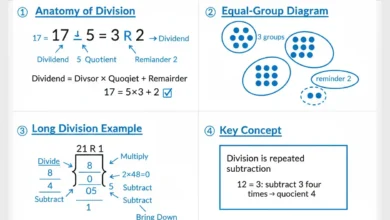
Division: Quotient & Remainder
Division is the arithmetic operation used to split a quantity into equal groups or determine how many times one number…
Read More » -
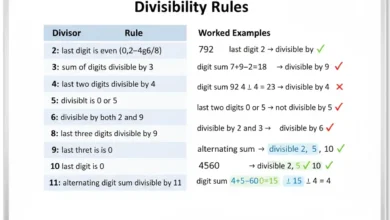
Divisibility Rules: Formula, Rules & Examples
Divisibility rules are shortcuts for determining whether one integer divides another exactly without performing the full division calculation. They are…
Read More » -
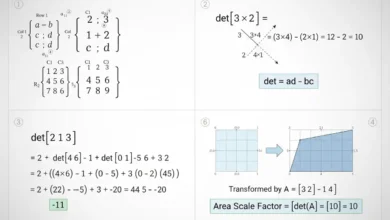
Determinants: Definition, Formula & Example
Determinants are numerical values calculated from square matrices. A determinant summarizes important structural information about a matrix, including whether the…
Read More » -
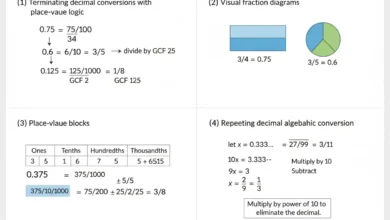
Decimal to Fraction: Including Repeating
Converting a decimal to fraction form means expressing the same numerical value as a ratio of integers. For a terminating…
Read More » -
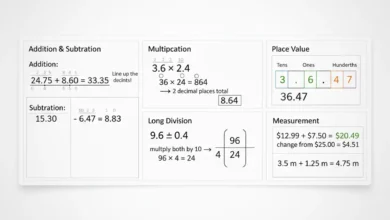
Decimal Operations: Formula, Rules & Examples
Decimal operations are the rules used to add, subtract, multiply, and divide numbers written in decimal form. The arithmetic principles…
Read More » -
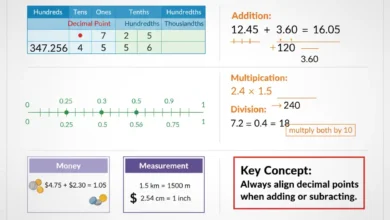
Decimal Arithmetic: Definition, Formula & Example
Decimal arithmetic is the process of calculating with numbers written in decimal notation. It includes working with whole-number places and…
Read More »