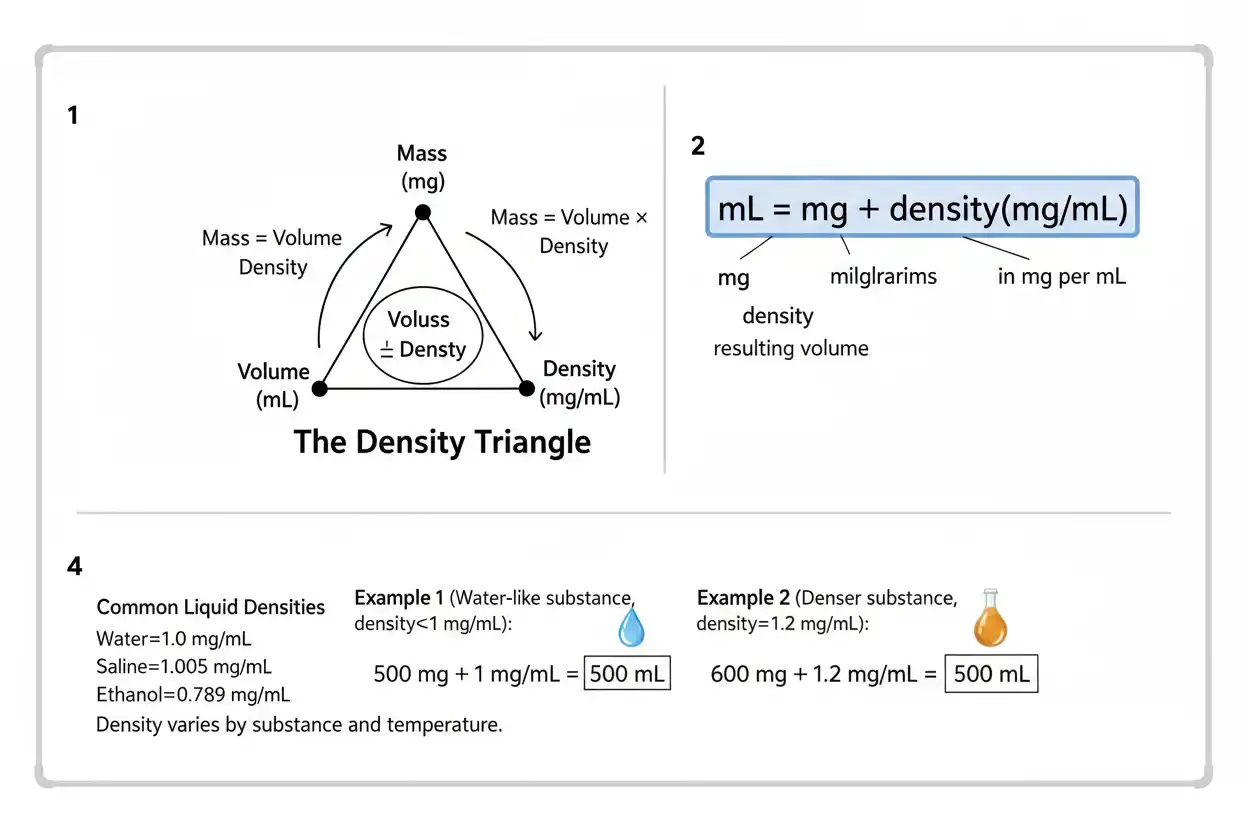
Converting milligrams to milliliters is not a direct unit conversion because milligrams measure mass, while milliliters measure volume. You need the substance’s density to connect the two.
The core formula is:
Volume (mL) = Mass (mg) / Density (mg/mL)
If density is given in grams per milliliter instead, an especially useful form is:
Volume (mL) = Mass (mg) / [1,000 × Density (g/mL)]
For example, if a substance has density:
1 g/mL
then:
1 g/mL = 1,000 mg/mL
So:
500 mg / 1,000 mg/mL = 0.5 mL
Therefore, for a substance with density exactly 1 g/mL:
500 mg = 0.5 mL
The result changes when density changes. There is no universal rule saying that a particular number of milligrams always equals the same number of milliliters.
Why mg and mL Cannot Be Converted Directly
A milligram is a unit of mass:
1 mg = 0.001 g
A milliliter is a unit of volume:
1 mL = 0.001 L
Mass and volume describe different physical quantities.
A given volume of a dense substance contains more mass than the same volume of a less dense substance.
For example, one milliliter of a material with density:
2 g/mL
has twice the mass of one milliliter of a material with density:
1 g/mL
Density provides the required connection.
The broader relationship is developed under density.
Density Formula
Density is defined as:
Density = Mass / Volume
Symbolically:
ρ = m / V
where:
ρ = density
m = mass
V = volume
To solve for volume:
V = m / ρ
That rearranged equation is the basis for converting milligrams to milliliters.
Milligrams to Milliliters Formula
If density is already expressed in:
mg/mL
then:
mL = mg / (mg/mL)
The milligram units cancel:
mg × mL/mg = mL
leaving the required volume unit.
Example
Suppose:
Mass = 750 mg
Density = 1,500 mg/mL
Then:
Volume = 750 / 1,500
= 0.5 mL
Therefore:
750 mg = 0.5 mL
for that particular density.
Formula When Density Is in g/mL
Density values are frequently expressed as:
g/mL
Because:
1 g = 1,000 mg
convert density to mg/mL:
Density (mg/mL) = Density (g/mL) × 1,000
Therefore:
Volume (mL) = Mass (mg) / [Density (g/mL) × 1,000]
For example:
Mass = 800 mg
Density = 0.8 g/mL
Convert density:
0.8 g/mL × 1,000 = 800 mg/mL
Then:
Volume = 800 mg / 800 mg/mL
= 1 mL
Therefore:
800 mg = 1 mL at 0.8 g/mL
A Useful Simplified Formula
When mass is in milligrams and density is in grams per milliliter:
mL = mg / (1,000ρ)
where:
ρ = density in g/mL
For example:
mg = 1,200
ρ = 1.2 g/mL
Then:
mL = 1,200 / (1,000 × 1.2)
= 1,200 / 1,200
= 1 mL
Therefore:
1,200 mg corresponds to 1 mL at a density of 1.2 g/mL
Can You Convert 1 mg to mL?
Only when density is known.
Suppose density is:
1 g/mL
Convert:
1 g/mL = 1,000 mg/mL
Then:
1 mg / 1,000 mg/mL = 0.001 mL
Therefore:
1 mg = 0.001 mL only when density = 1 g/mL
If density were:
2 g/mL
then:
2 g/mL = 2,000 mg/mL
and:
1 mg / 2,000 mg/mL = 0.0005 mL
So the same mass can correspond to different volumes.
100 mg to mL
At density:
1 g/mL
use:
Volume = 100 / 1,000
= 0.1 mL
Therefore:
100 mg = 0.1 mL at 1 g/mL
At density:
0.8 g/mL
the denominator becomes:
800 mg/mL
So:
100 / 800 = 0.125 mL
Therefore:
100 mg = 0.125 mL at 0.8 g/mL
The density must always accompany the answer.
250 mg to mL
Suppose density is:
1.25 g/mL
Convert:
1.25 g/mL = 1,250 mg/mL
Then:
Volume = 250 / 1,250
= 0.2 mL
Therefore:
250 mg = 0.2 mL at 1.25 g/mL
500 mg to mL
At density:
1 g/mL
we have:
500 / 1,000 = 0.5 mL
Therefore:
500 mg = 0.5 mL at 1 g/mL
But suppose:
Density = 1.25 g/mL
Then:
Density = 1,250 mg/mL
and:
500 / 1,250 = 0.4 mL
Therefore:
500 mg = 0.4 mL at 1.25 g/mL
1,000 mg to mL
First note:
1,000 mg = 1 g
If density is:
1 g/mL
then:
Volume = 1 g / (1 g/mL)
= 1 mL
Therefore:
1,000 mg = 1 mL at 1 g/mL
This familiar equality is a special case based on density—not a universal equivalence between mg and mL.
2,000 mg to mL
At density:
1 g/mL
convert:
2,000 mg = 2 g
Then:
Volume = 2 g / (1 g/mL)
= 2 mL
Therefore:
2,000 mg = 2 mL at 1 g/mL
At:
1.25 g/mL
we instead obtain:
Volume = 2 / 1.25
= 1.6 mL
So:
2,000 mg = 1.6 mL at 1.25 g/mL
Example With Density Below 1 g/mL
Suppose:
Mass = 600 mg
Density = 0.75 g/mL
Convert density:
0.75 × 1,000 = 750 mg/mL
Then:
Volume = 600/750
= 0.8 mL
Therefore:
600 mg = 0.8 mL at 0.75 g/mL
Because the density is below 1 g/mL, a given mass occupies a larger volume than it would at 1 g/mL.
Example With Density Above 1 g/mL
Suppose:
Mass = 600 mg
Density = 1.5 g/mL
Convert:
1.5 g/mL = 1,500 mg/mL
Then:
Volume = 600/1,500
= 0.4 mL
Therefore:
600 mg = 0.4 mL at 1.5 g/mL
The higher-density material occupies less volume for the same mass.
Understanding the Density Effect
From:
V = m/ρ
if mass stays constant:
- increasing density decreases volume;
- decreasing density increases volume.
For example, keep:
Mass = 1,000 mg
At:
0.5 g/mL
volume is:
1,000/(500) = 2 mL
At:
1 g/mL
volume is:
1 mL
At:
2 g/mL
volume is:
0.5 mL
So doubling density halves the volume for a fixed mass.
Converting Density Units First
Unit consistency is essential.
Suppose:
Mass = 450 mg
Density = 0.9 g/mL
You cannot directly calculate:
450 ÷ 0.9
and label the result milliliters because the numerator is in milligrams while the density numerator is in grams.
First convert one side.
Convert density:
0.9 g/mL = 900 mg/mL
Then:
Volume = 450/900
= 0.5 mL
Therefore:
450 mg = 0.5 mL at 0.9 g/mL
The wider principles of changing measurement units are covered under unit conversions.
Alternative Method: Convert mg to g First
Instead of converting density into mg/mL, convert the mass from mg to g.
Suppose:
Mass = 450 mg
Since:
1,000 mg = 1 g
we have:
450 mg = 0.45 g
Now use:
V = m/ρ
with:
ρ = 0.9 g/mL
Then:
V = 0.45/0.9
= 0.5 mL
Both methods produce the same result.
Dimensional Check
Suppose:
m = 0.45 g
and:
ρ = 0.9 g/mL
Then:
V = (0.45 g)/(0.9 g/mL)
Dividing by g/mL is equivalent to multiplying by mL/g:
0.45 g × mL/(0.9 g)
The grams cancel, leaving:
mL
This confirms that the formula produces volume.
mg/mL as a Density or Concentration Unit
A value written:
mg/mL
has dimensions of mass per volume.
For a pure material or mixture, this may represent mass density in those units.
In other contexts, especially solutions, mg/mL can describe a concentration of a particular component rather than the density of the entire liquid.
That distinction matters.
If the task asks for the volume containing a specified mass of a dissolved component and gives concentration in mg/mL, the same algebraic form applies:
Volume = Mass / Concentration
But concentration and bulk density should not be treated as interchangeable physical properties.
Example Using mg/mL Directly
Suppose a liquid specification is:
25 mg/mL
and you need a quantity containing:
100 mg
Then:
Volume = 100 mg / (25 mg/mL)
= 4 mL
Therefore:
100 mg at 25 mg/mL corresponds to 4 mL
Here the given 25 mg/mL directly supplies the required mass-per-volume ratio.
Important Difference: Density vs. Medication Concentration
A statement such as:
Density = 1.1 g/mL
describes total mass per unit volume.
A statement such as:
Concentration = 20 mg/mL
may describe how much of one ingredient exists per unit volume of a mixture.
Both can appear in a mass-to-volume formula, but they answer different physical questions.
For medication or other health-critical dosing, use the concentration and instructions supplied by the product or a qualified professional rather than assuming the liquid has a particular density.
Why Water Is Often Used in Simple Examples
At ordinary conditions, water has a density close to:
1 g/mL
This creates the convenient approximate relationship:
1,000 mg ≈ 1 mL
for water.
However, density changes somewhat with temperature, and other substances may differ substantially from water.
Therefore:
mg ÷ 1,000 = mL
is not a universal mass-to-volume rule.
It is only appropriate when the relevant density is exactly or approximately 1 g/mL.
Density of Different Materials
Suppose equal masses of two hypothetical substances are compared.
Mass:
1,000 mg
Substance A density:
0.8 g/mL
Substance B density:
1.6 g/mL
For A:
V = 1,000/(800)
= 1.25 mL
For B:
V = 1,000/(1,600)
= 0.625 mL
The same 1,000 mg therefore occupies twice as much volume in substance A because its density is half as large.
Density Must Match the Substance
If you are converting the mass of a specific liquid or material into volume, use the density of that material under the relevant conditions.
For example, using a density value for water to convert the mass of a substantially denser liquid would produce an incorrect volume.
The density relationship is substance-specific.
Temperature Can Matter
Density can depend on temperature.
If a problem supplies a density at a particular temperature, use that density for the calculation.
For ordinary educational problems, the supplied value should be treated as the governing value unless the problem explicitly asks you to account for temperature variation.
This is another reason a universal mg-to-mL factor cannot be assigned to every substance.
Significant Figures and Precision
Suppose:
Mass = 825 mg
Density = 1.13 g/mL
Convert:
1.13 g/mL = 1,130 mg/mL
Then:
V = 825/1,130
≈ 0.730088…
The number of displayed decimal places should reflect the precision of the input data.
A reasonable result may be:
0.730 mL
when three significant figures are appropriate.
The exact unrounded calculator result should not imply greater measurement certainty than the supplied values support.
Long Division in mg-to-mL Calculations
When a calculator is unavailable, the final density quotient can be evaluated using long division.
For example:
750/1,500
simplifies immediately to:
1/2
and therefore:
0.5
A less obvious quotient such as:
875/1,250
can also be simplified:
875/1,250 = 7/10
so:
0.7 mL
Simplification often reduces the amount of decimal division required.
Mixed Numbers and Volume
A conversion may produce a value greater than 1 mL that can be written as a decimal, improper fraction, or mixed number.
For example:
1,750 mg
at:
1,000 mg/mL
gives:
1.75 mL
This is equivalent to:
7/4 mL
or:
1 3/4 mL
For metric measurement, decimal notation is usually the most natural representation, but all three forms describe the same volume.
Fraction Simplification in Density Calculations
Suppose:
Volume = 900/1,200 mL
Before converting to decimal, use fraction simplification:
900/1,200 = 3/4
Then:
3/4 = 0.75
Therefore:
Volume = 0.75 mL
Reducing common factors can make the arithmetic easier to inspect.
Decimal Arithmetic in Conversion Problems
Many density calculations end with a decimal quotient.
For example:
325 mg / 800 mg/mL
gives:
0.40625 mL
Accurate decimal arithmetic is important when multiplying density by 1,000, dividing mass by density, or rounding the final result.
Keeping units attached to the quantities helps prevent scale errors.
Milligrams to Milliliters and Logarithms
The mapped logarithms topic is mathematically distinct from ordinary mass-to-volume conversion.
The formula:
V = m/ρ
requires division rather than logarithms.
Logarithms might appear in a specialized scientific model involving concentrations or exponential relationships, but they are not part of the basic mg-to-mL conversion.
For an ordinary conversion, density and consistent units are sufficient.
Milligrams to Milliliters and Least Common Multiple
The least common multiple solves integer common-multiple problems and is not part of the core density conversion.
For example:
LCM(6,8) = 24
addresses divisibility.
By contrast:
Volume = Mass/Density
addresses a relationship between physical quantities.
The formulas should not be mixed merely because both involve division.
Milligrams to Milliliters and Modular Arithmetic
modular arithmetic focuses on remainders under a modulus.
For example:
17 mod 5 = 2
That concept is distinct from converting mass to volume.
A density calculation generally uses ordinary real-number division rather than reducing results modulo an integer.
Convert mL Back to mg
The density formula can be rearranged to recover mass:
Density = Mass/Volume
Therefore:
Mass = Density × Volume
If density is in:
mg/mL
then:
mg = (mg/mL) × mL
For example:
Density = 800 mg/mL
Volume = 2.5 mL
Then:
Mass = 800 × 2.5
= 2,000 mg
This reverse calculation is useful for checking a mg-to-mL result.
Check a Conversion by Reversing It
Suppose:
600 mg
at:
1.5 g/mL
was converted to:
0.4 mL
Convert density:
1.5 g/mL = 1,500 mg/mL
Reverse:
Mass = 1,500 mg/mL × 0.4 mL
= 600 mg
The original mass is recovered.
Therefore the conversion is consistent.
Quick Reference at Density 1 g/mL
When the density is exactly:
1 g/mL = 1,000 mg/mL
the following relationships hold:
| Mass | Volume |
|---|---|
| 1 mg | 0.001 mL |
| 10 mg | 0.01 mL |
| 50 mg | 0.05 mL |
| 100 mg | 0.1 mL |
| 250 mg | 0.25 mL |
| 500 mg | 0.5 mL |
| 750 mg | 0.75 mL |
| 1,000 mg | 1 mL |
| 2,000 mg | 2 mL |
These values must not be applied to substances with a different density.
Quick Reference at Density 0.8 g/mL
For:
ρ = 0.8 g/mL = 800 mg/mL
| Mass | Volume |
|---|---|
| 100 mg | 0.125 mL |
| 200 mg | 0.25 mL |
| 400 mg | 0.5 mL |
| 800 mg | 1 mL |
| 1,600 mg | 2 mL |
The lower density produces more volume for the same mass than a 1 g/mL material.
Quick Reference at Density 1.25 g/mL
For:
ρ = 1.25 g/mL = 1,250 mg/mL
| Mass | Volume |
|---|---|
| 125 mg | 0.1 mL |
| 250 mg | 0.2 mL |
| 500 mg | 0.4 mL |
| 625 mg | 0.5 mL |
| 1,250 mg | 1 mL |
| 2,500 mg | 2 mL |
The higher density gives less volume per milligram.
Common Mistake: Assuming 1 mg = 1 mL
This is incorrect.
At density:
1 g/mL
the relationship is:
1,000 mg = 1 mL
Therefore:
1 mg = 0.001 mL
Even that equality depends on the specified density.
Milligrams and milliliters are not equivalent units.
Common Mistake: Ignoring Density
If a question provides only:
500 mg
and asks for milliliters without giving density or a mass-per-volume concentration, there is not enough information for a unique answer.
You need:
density in mass/volume units
or another equivalent relationship between mass and volume.
Different substances produce different answers.
Common Mistake: Mixing g/mL and mg
Suppose:
Mass = 500 mg
Density = 1.2 g/mL
Writing:
500/1.2 = 416.67 mL
is wrong because the mass units do not match.
Either convert:
500 mg = 0.5 g
then:
0.5/1.2 ≈ 0.4167 mL
or convert:
1.2 g/mL = 1,200 mg/mL
then:
500/1,200 ≈ 0.4167 mL
Both correct approaches agree.
Common Mistake: Multiplying Instead of Dividing
To solve for volume:
V = m/ρ
not:
V = mρ
A dimensional check exposes the error.
Correct:
mg ÷ (mg/mL) = mL
Incorrect multiplication would give:
mg × mg/mL
which does not reduce to a volume unit.
Common Mistake: Confusing Density With Concentration
A medicine or solution labeled:
50 mg/mL
may mean 50 mg of a particular active ingredient per mL of solution.
That is not automatically the same thing as saying the entire solution has density:
50 mg/mL
Use the quantity specified by the actual problem.
For dosage-related decisions, follow the labeled concentration and professional instructions rather than inferring one quantity from the other.
Common Mistake: Using an Unrelated Substance’s Density
Density must correspond to the material being converted.
If a liquid has:
ρ = 0.85 g/mL
using:
1 g/mL
would underestimate the volume for a fixed mass.
For:
850 mg
the correct calculation is:
850/(850) = 1 mL
Using 1 g/mL incorrectly would produce:
0.85 mL
which is a different answer.
How to Solve Any mg-to-mL Density Problem
Start with:
V = m/ρ
Then make the units compatible.
If mass is in mg and density in g/mL, either:
convert mg → g
or:
convert g/mL → mg/mL
Then divide mass by density.
Finally, verify that the remaining unit is:
mL
This unit check is one of the strongest safeguards against conversion mistakes.
Frequently Asked Questions
How do you convert milligrams to milliliters?
Use density:
mL = mg / density(mg/mL)
What if density is given in g/mL?
Use:
mL = mg / [1,000 × density(g/mL)]
Is 1 mg equal to 1 mL?
No. Milligrams measure mass and milliliters measure volume.
Is 1,000 mg equal to 1 mL?
Only for a material with density:
1 g/mL
because:
1,000 mg = 1 g
How many mL is 500 mg?
It depends on density.
At:
1 g/mL
the answer is:
0.5 mL
At:
0.8 g/mL
the answer is:
0.625 mL
How many mL is 1,000 mg?
At density 1 g/mL:
1 mL
At density 2 g/mL:
0.5 mL
Why is density necessary?
Mass and volume are different physical quantities. Density tells you how much mass exists per unit volume.
What density unit works directly with mg and mL?
mg/mL
because:
mg ÷ (mg/mL) = mL
Can I use g/mL?
Yes. Convert the milligram mass to grams or multiply the density by 1,000 to express it in mg/mL.
Is mg/mL always density?
No. It can also represent the concentration of one component in a solution. Interpret the quantity according to the problem.
Can the same number of milligrams have different milliliter values?
Yes. Lower-density materials occupy more volume for the same mass; higher-density materials occupy less.
Final Example
Convert:
1,350 mg
to milliliters when density is:
0.9 g/mL
First make the units consistent.
Convert density:
0.9 g/mL × 1,000 mg/g
= 900 mg/mL
Now use:
Volume = Mass/Density
Substitute:
Volume = 1,350 mg / 900 mg/mL
The milligrams cancel:
Volume = 1.5 mL
Therefore:
1,350 mg = 1.5 mL at a density of 0.9 g/mL
Check by reversing the calculation:
900 mg/mL × 1.5 mL
= 1,350 mg
The original mass is recovered.
The essential rule for converting milligrams to milliliters is:
Volume = Mass / Density
Without a density or equivalent mass-per-volume relationship, there is no unique conversion from mg to mL.