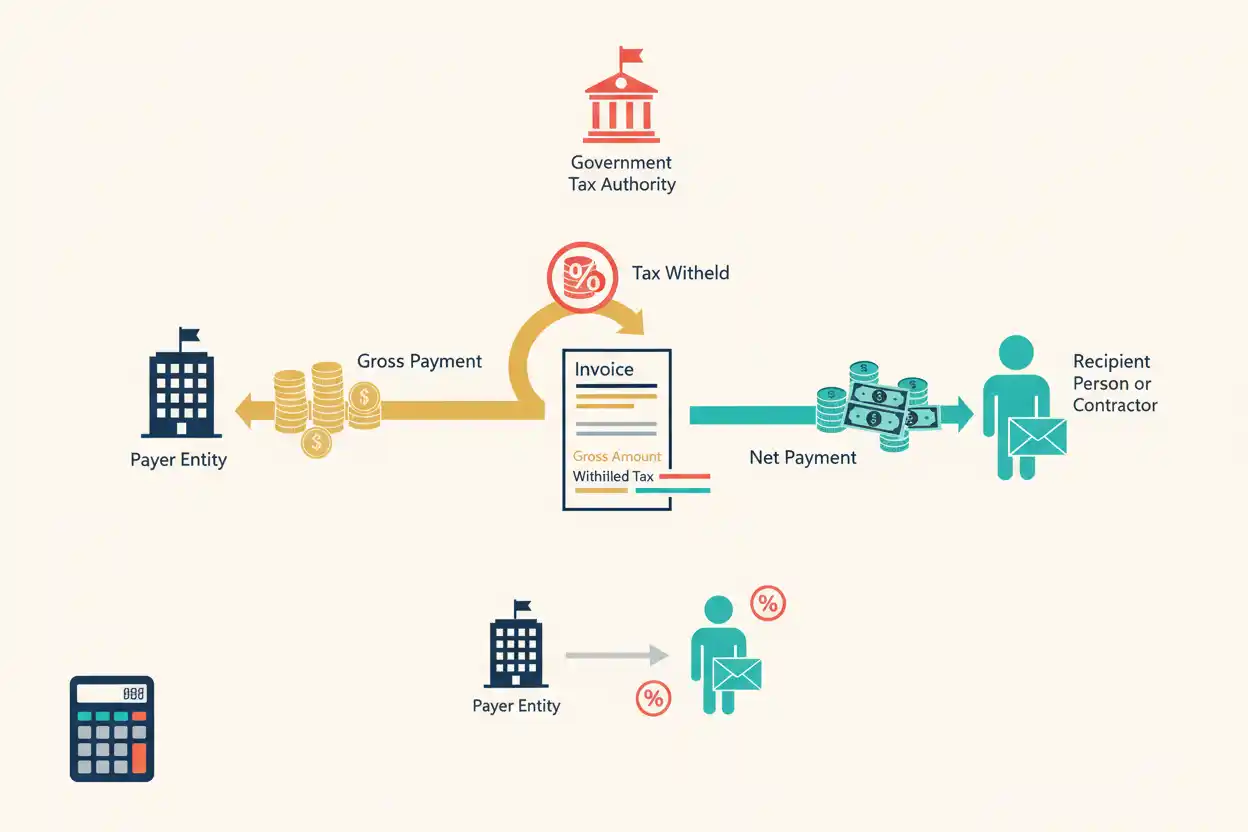

Withholding tax is tax deducted from a payment before the recipient receives the remaining cash.
Suppose a gross payment is $5,000 and an illustrative 10% withholding rate applies.
Withholding Tax = $5,000 × 10%
= $500
Net payment:
$5,000 − $500
= $4,500
The recipient receives $4,500, while $500 is withheld and handled according to the applicable tax rules.
Withholding is often a prepayment mechanism, which means the amount withheld does not necessarily equal the recipient’s final tax liability.
Withholding Tax Formula
The basic formula is:
Withholding Tax = Gross Payment × Withholding Rate
Then:
Net Payment = Gross Payment − Withholding Tax
Combined:
Net Payment = Gross Payment × (1 − Withholding Rate)
Basic Withholding Example
Suppose:
Gross Payment = $8,000
Withholding Rate = 12%
Withholding:
$8,000 × 12%
= $960
Net cash:
$8,000 − $960
= $7,040
The gross income or payment remains $8,000 in this simplified example even though the recipient receives only $7,040 in cash.
Reverse a Withholding Calculation
Suppose net payment is:
$7,040
and the withholding rate is 12%.
Gross Payment = Net Payment ÷ (1 − Withholding Rate)
$7,040 ÷ 0.88
= $8,000
This is the correct reverse calculation.
Adding 12% to $7,040 would not recover the original gross amount.
Why Adding the Rate Back Is Wrong
Suppose:
$7,040 × 1.12
= $7,884.80
The original gross payment was $8,000.
The reason is that the 12% withholding was calculated from $8,000, not from the smaller $7,040 net amount.
The reverse operation requires division by the remaining-payment factor.
Find the Withholding Rate
If gross and withheld amounts are known:
Withholding Rate = Tax Withheld ÷ Gross Payment × 100
Suppose:
Gross Payment = $6,000
Withheld = $900
Then:
Rate = $900 ÷ $6,000 × 100
= 15%
Find Gross Payment From Tax Withheld
Suppose:
Tax Withheld = $750
Rate = 15%
Then:
Gross Payment = $750 ÷ 0.15
= $5,000
Net payment:
$4,250
U.S. Wage Withholding
For U.S. employee wages, employers generally withhold federal income tax from employees’ wages. The withholding calculation uses information from the employee’s Form W-4 together with the applicable federal withholding methods and tables in Publication 15-T.
This means ordinary federal wage withholding is not normally calculated by applying one universal flat percentage to every employee’s gross paycheck.
Payroll circumstances and Form W-4 information matter.
Withholding Is Not Final Income Tax
Suppose an employee has:
$15,000 Federal Income Tax Withheld
during the year.
The final calculated income tax is:
$13,500
Simplified overpayment:
$15,000 − $13,500
= $1,500
The $15,000 was withholding.
The $13,500 was the modeled final tax liability.
They are different concepts.
Underwithholding Example
Suppose:
Final Tax = $18,000
while withholding totals:
$14,000
Remaining modeled balance:
$4,000
The taxpayer did not have a 22.22% “withholding error” merely because $4,000 remains unpaid.
The correct analysis compares payments already made with the final tax calculation.
Withholding Tax and Taxable Income
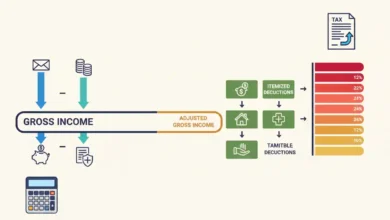
Taxable income is the income base that remains after applicable adjustments and deductions.
Withholding tax is an amount paid in advance or deducted from a payment.
Suppose:
Gross Wage Payment = $5,000
Withholding = $700
Net cash:
$4,300
The $700 does not automatically reduce taxable income to $4,300.
Payroll cash flow and annual taxable-income calculations are different processes.
Withholding Tax and VAT
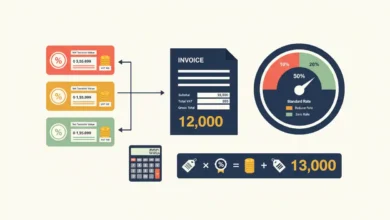
VAT commonly adds tax to a net transaction amount:
Net Price + VAT = Gross Price
Withholding tax works in the opposite cash-flow direction:
Gross Payment − Withholding = Net Payment
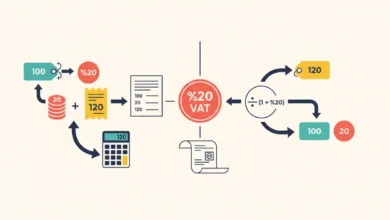
For example, a $1,000 net VAT base might become a $1,200 customer invoice at 20% VAT, while a $1,000 gross payment subject to 20% withholding would leave $800 net cash.
The percentage can be identical while the economic mechanics are different.
Withholding Tax and VAT Rate
A vat rate should not be substituted for a withholding rate.
Suppose a transaction uses:
20% VAT
and a separate payment is subject to:
10% Withholding
The two percentages apply to different tax mechanisms and potentially different bases.
They should be calculated independently.
Withholding Tax and Tax-Inclusive Prices
A tax-inclusive price already contains transaction tax within the displayed amount.
Withholding tax instead reduces the cash delivered to the recipient.
For example:
Customer Invoice Including VAT = $1,200
does not automatically mean the recipient receives $1,200 if a separate withholding obligation also applies.
The invoice and payment calculations may need separate tax bases.
Withholding Tax and Tax-Loss Harvesting
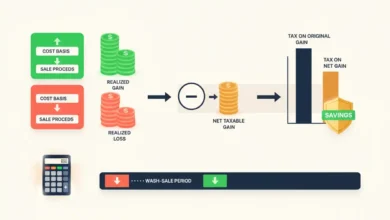
Tax-loss harvesting can reduce or defer certain investment tax effects through realized losses.
That does not automatically instruct a payer to reduce withholding on a wage or other payment.
Investment tax planning and payer withholding obligations operate under different rules.
Payroll Withholding Example
Suppose a paycheck shows:
Gross Wages = $4,000
Federal income-tax withholding:
$450
Other employee payroll taxes:
$306
Benefits and deductions:
$244
Net paycheck:
$4,000 − $450 − $306 − $244
= $3,000
Only the $450 in this example is federal income-tax withholding.
The entire $1,000 difference should not be labeled withholding tax.
Effective Withholding Percentage
Using:
Federal Income Tax Withholding = $450
Gross Pay = $4,000
Effective paycheck withholding ratio:
$450 ÷ $4,000 × 100
= 11.25%
This describes the paycheck.
It does not establish that the employee’s final federal income-tax rate for the year is 11.25%.
Variable Withholding Between Paychecks
Suppose gross pay varies because of overtime or bonuses.
Paycheck 1:
Gross = $4,000
Withholding = $450
Paycheck 2:
Gross = $7,000
Withholding = $1,100
The withholding ratio can differ between checks.
This does not necessarily mean the employee’s statutory tax bracket changed by the same amount.
Payroll withholding is designed to prepay an estimated annual tax obligation rather than to label each paycheck with a final tax rate.
Increasing Withholding
Suppose an employee expects additional income and increases annual withholding by:
$2,400
Average additional monthly withholding:
$2,400 ÷ 12
= $200
Net monthly paycheck cash falls by approximately $200 if everything else remains constant.
Final annual tax liability does not increase merely because more was prepaid.
Decreasing Withholding
Suppose withholding is reduced by:
$150 per Month
Annual reduction in prepayments:
$150 × 12
= $1,800
Take-home cash rises during the year.
If final tax remains unchanged, the taxpayer may receive a smaller refund or owe a larger balance later.
Withholding and Estimated Taxes
A taxpayer with income not fully covered by withholding may use estimated tax payments to address the remaining expected liability.
Suppose:
Expected Tax = $20,000
Expected Withholding = $12,000
Remaining projected tax:
$8,000
Separate estimated payments can potentially address that shortfall under the applicable rules.
The $12,000 withholding and $8,000 estimated payments are different payment channels toward the same broader tax obligation.
Nonwage Withholding
Withholding can also apply to certain payments outside ordinary employee wages, depending on the payment type, recipient, jurisdiction, and tax rules.
The same mathematical form can still be used when a specific withholding rate is provided:
Gross Payment × Rate = Amount Withheld
However, the correct rate and tax base must come from the relevant rule rather than from an employee wage example.
Cross-Border Payment Example
Suppose a hypothetical cross-border payment is:
$20,000
and applicable withholding is:
10%
Tax withheld:
$2,000
Recipient cash:
$18,000
Whether the $2,000 represents final tax, a creditable prepayment, or another form of withholding depends on the governing domestic law and any applicable treaty.
The arithmetic cannot answer the legal classification.
Gross-Up Calculation
Sometimes a payer agrees that the recipient must receive a specified net amount after withholding.
Suppose the recipient must receive:
$9,000 Net
and withholding is:
10% of Gross
Required gross payment:
$9,000 ÷ 0.90
= $10,000
Withholding:
$1,000
Net:
$9,000
This is commonly called a gross-up calculation.
Gross-Up at 20%
Suppose target net payment is:
$8,000
Withholding rate:
20%
Required gross:
$8,000 ÷ 0.80
= $10,000
Tax withheld:
$2,000
The payer’s cost is $10,000 even though the recipient receives only $8,000.
Multiple Withholding Components
Suppose one payment faces two deductions calculated independently from the same gross base:
Tax A:
5%
Tax B:
3%
If both simply apply to the same $10,000 gross amount:
Tax A = $500
Tax B = $300
Total withholding:
$800
Net:
$9,200
This works only when both tax rules genuinely use the same gross base.
Sequential Withholding
If one deduction is calculated after another has already reduced the base, the calculation changes.
Suppose:
$10,000 Gross
First deduction:
5% = $500
Remaining:
$9,500
Second deduction:
3% of $9,500 = $285
Total deductions:
$785
Net:
$9,215
The tax rules determine whether components are parallel or sequential.
Withholding Certificate Changes
For U.S. wage withholding, employees can submit updated Form W-4 information, and employers use applicable withholding procedures when processing wages.
Changing withholding information can alter paycheck deductions.
It does not retroactively change salary already earned or automatically change final annual taxable income.
Common Withholding Tax Mistakes
A common mistake is treating withholding as final tax liability.
Another is adding the withholding rate to net cash to reverse a payment rather than dividing by the remaining-payment factor.
People can also combine payroll taxes, benefits, and income-tax withholding into one unlabeled percentage or apply a VAT rate as though it were a withholding rate.
Frequently Asked Questions
What is withholding tax?
Withholding tax is tax deducted from a payment before the recipient receives the remaining cash.
What is the basic formula?
Withholding Tax = Gross Payment × Withholding Rate
How do I calculate net payment?
Net Payment = Gross Payment × (1 − Withholding Rate)
How do I reverse the calculation?
Gross Payment = Net Payment ÷ (1 − Withholding Rate)
What is 10% withholding on $5,000?
$500
leaving $4,500 net.
Is withholding the same as final income tax?
Not necessarily.
How is U.S. wage withholding determined?
Employers generally use the employee’s Form W-4 together with applicable federal withholding procedures and Publication 15-T methods.
Does a larger withholding amount mean my final tax rate is higher?
Not necessarily.
Can I have both withholding and estimated tax payments?
Yes, depending on the taxpayer’s income and payment situation.
Is withholding the same as VAT?
No.
What is a gross-up?
It calculates the gross payment required so the recipient receives a target net amount after withholding.
Why must the tax base be identified first?
Because the same percentage can produce different results depending on whether it applies to gross payment, net payment, wages, or another defined tax base.