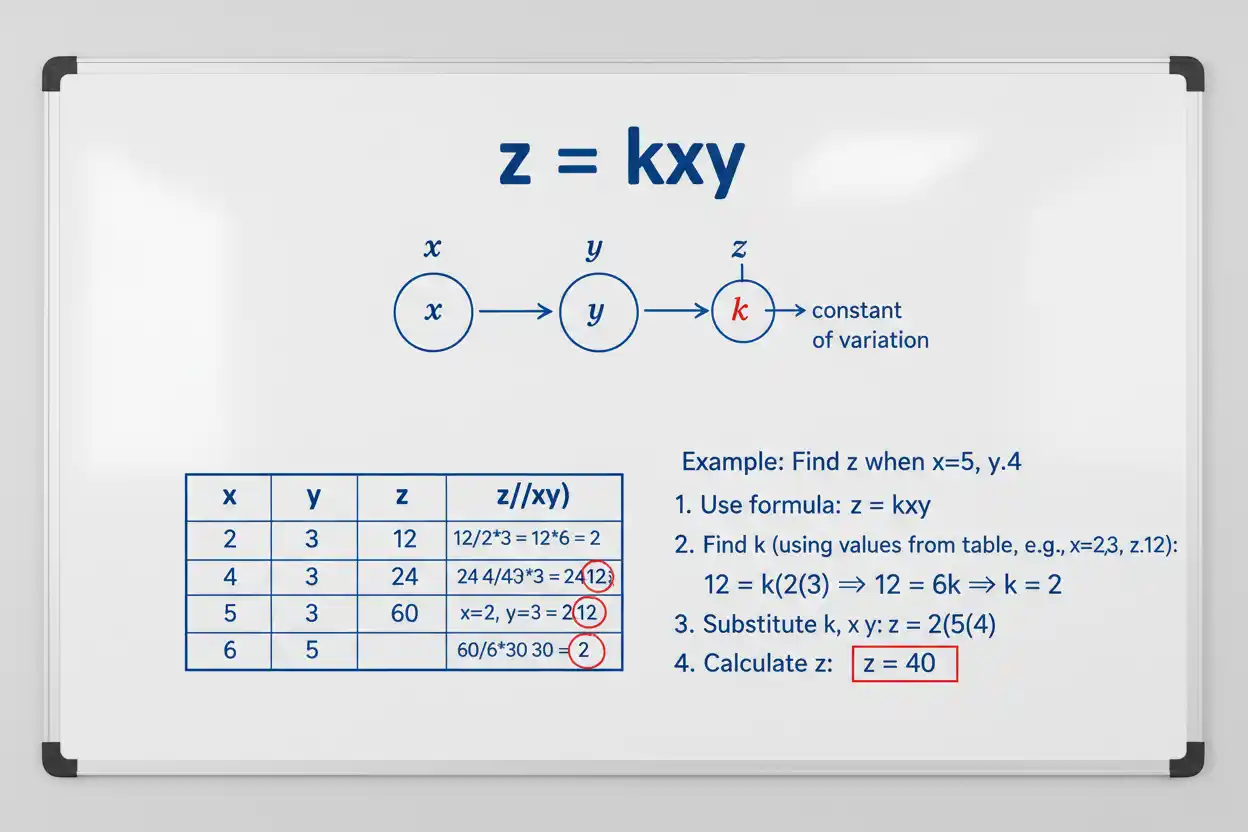
Joint variation describes a relationship in which one variable varies directly with the product of two or more other variables. If z varies jointly as x and y, the standard formula is:
z = kxy
where k is the constant of variation.
For example, if:
z = 3xy
then k = 3. When x = 2 and y = 5:
z = 3(2)(5) = 30
The defining feature of joint variation is that the ratio of the dependent variable to the product of the independent variables remains constant:
z / (xy) = k
This distinguishes joint variation from inverse variation, where the product of two variables is constant because one variable is proportional to the reciprocal of another.
What Is Joint Variation?
Joint variation occurs when a quantity depends directly on two or more variables at the same time.
If z varies jointly as x and y:
z ∝ xy
Introducing the constant of variation k gives:
z = kxy
This means that z responds to changes in both x and y.
If x doubles while y stays constant, z doubles.
If y triples while x stays constant, z triples.
If x doubles and y triples simultaneously, z increases by a factor of:
2 × 3 = 6
provided k remains unchanged.
Joint variation therefore extends the idea of direct proportionality to multiple variables.
Joint Variation Formula
For a quantity z varying jointly as x and y:
z = kxy
The constant can be found from:
k = z / (xy)
where:
- z = dependent variable
- x and y = variables affecting z
- k = constant of variation
If more than two independent variables are involved, the same principle applies.
For example, if w varies jointly as x, y, and z:
w = kxyz
and:
k = w / (xyz)
The number of variables changes, but the proportional structure remains the same.
How to Find the Constant of Variation
Suppose z varies jointly as x and y, and:
z = 48 when x = 4 and y = 3
Start with:
z = kxy
Substitute:
48 = k(4)(3)
48 = 12k
Divide by 12:
k = 4
The joint variation equation is therefore:
z = 4xy
You can verify the constant directly:
k = 48 / (4 × 3) = 4
Example 1: Write the Joint Variation Equation
Suppose p varies jointly as q and r. When:
p = 70
q = 5
r = 2
find the variation equation.
Begin with:
p = kqr
Substitute the known values:
70 = k(5)(2)
70 = 10k
Therefore:
k = 7
The equation is:
p = 7qr
This equation now represents every set of values belonging to the same joint variation relationship.
Example 2: Find the Dependent Variable
Suppose:
z = 5xy
Find z when:
x = 4
and:
y = 6
Substitute:
z = 5(4)(6)
z = 120
Therefore:
z = 120
Because both x and y enter through multiplication, either variable can proportionally affect z.
Example 3: Find a Missing Variable
Suppose:
z = 3xy
and:
z = 90
x = 5
Find y.
Substitute:
90 = 3(5)y
90 = 15y
Divide by 15:
y = 6
Once the variation equation is established, finding an unknown variable often reduces to solving a simple linear equation.
The Constant-Ratio Test
If values are claimed to follow:
z = kxy
calculate:
z / (xy)
for each set of data.
If the result is constant, the data represent the same joint variation.
Consider:
| x | y | z | z/(xy) |
|---|---|---|---|
| 2 | 3 | 24 | 4 |
| 4 | 5 | 80 | 4 |
| 6 | 2 | 48 | 4 |
The ratio is always:
4
Therefore:
k = 4
and the relationship is:
z = 4xy
Example That Is Not Joint Variation
Consider:
| x | y | z | z/(xy) |
|---|---|---|---|
| 2 | 3 | 18 | 3 |
| 4 | 2 | 24 | 3 |
| 5 | 3 | 50 | 10/3 |
The first two rows give k = 3, but the third does not.
Because:
z / (xy)
is not constant, these values do not describe one exact joint variation.
How Changes in Variables Affect Joint Variation
Suppose:
z = kxy
If x changes by a factor a and y changes by a factor b, then z changes by:
ab
times its original value.
For example, suppose x doubles and y quadruples.
Then:
z(new) = k(2x)(4y)
z(new) = 8kxy
So:
z(new) = 8z(original)
This scaling property is often the quickest way to answer comparison questions without first calculating k.
Example: Effect of Changing Both Variables
Suppose z varies jointly as x and y.
Initially:
x = 3
y = 4
Now x is tripled and y is halved.
The combined factor is:
3 × 1/2 = 3/2
Therefore z becomes:
3/2
of its original value.
In other words, z increases by 50%.
No specific value of k is needed because the comparison uses the same variation relationship.
Joint Variation With Three Variables
A quantity can vary jointly with more than two variables.
If w varies jointly as x, y, and z:
w = kxyz
Suppose:
w = 120
when:
x = 2
y = 3
z = 4
Find k:
120 = k(2)(3)(4)
120 = 24k
k = 5
Therefore:
w = 5xyz
If x = 3, y = 2, and z = 6:
w = 5(3)(2)(6)
w = 180
Joint Variation With Powers
The wording of a variation problem may specify powers.
For example:
“z varies jointly as x and the square of y.”
This translates to:
z = kxy²
If instead z varies jointly as the square of x and the cube of y:
z = kx²y³
The exact powers come from the stated relationship.
The word jointly tells you that the relevant factors are multiplied. It does not mean every variable automatically has an exponent of 1.
Example With a Squared Variable
Suppose z varies jointly as x and y². When:
z = 72
x = 2
y = 3
find k.
Write:
z = kxy²
Substitute:
72 = k(2)(3²)
72 = k(2)(9)
72 = 18k
Therefore:
k = 4
The equation is:
z = 4xy²
If x = 5 and y = 2:
z = 4(5)(2²)
z = 4(5)(4)
z = 80
Joint Variation vs Direct Variation
Simple direct variation usually involves one independent variable:
y = kx
Joint variation extends the same direct proportionality to the product of multiple variables:
z = kxy
Both relationships contain a constant of variation and direct proportionality.
The difference is the number and structure of the variables determining the dependent quantity.
Joint Variation vs Inverse Variation
Joint variation and inverse variation behave differently.
Joint variation:
z = kxy
places the jointly varying variables in the numerator as multiplicative factors.
Inverse variation:
y = k/x
places an inversely related variable in the denominator.
For joint variation, increasing one independent variable while holding the others constant increases the dependent variable proportionally.
For inverse variation, increasing the denominator variable decreases the dependent variable.
Joint Variation vs Inverse Function
Joint variation is also unrelated to the operation represented by an inverse function.
An inverse function reverses a function’s mapping:
f(a) = b ⇒ f⁻¹(b) = a
Joint variation instead specifies how one quantity depends proportionally on the product of multiple quantities.
The shared word “inverse” in neighboring algebra topics does not change the definition of joint variation.
Joint and Combined Variation
Some relationships contain both direct or joint variation and inverse variation.
For example, if z varies jointly as x and y and inversely as w:
z = kxy / w
Here x and y multiply in the numerator because z varies jointly with them, while w appears in the denominator because z varies inversely with w.
This is often described as combined variation.
The joint portion remains:
xy
while the inverse portion contributes:
1/w
Example of a Combined Relationship
Suppose:
z = kxy / w
and:
z = 12
when:
x = 2
y = 9
w = 3
Substitute:
12 = k(2)(9) / 3
12 = 6k
Therefore:
k = 2
The relationship is:
z = 2xy / w
If x = 4, y = 5, and w = 2:
z = 2(4)(5) / 2
z = 20
Joint Variation in Geometry
Joint variation frequently appears when one geometric quantity depends on several dimensions.
Suppose a quantity Q is directly proportional to length l and width w:
Q = klw
If the proportionality constant is 1:
Q = lw
This resembles the familiar structure of a rectangular area formula.
The important point in a joint variation problem is not the specific geometric formula but the multiplicative dependence of one quantity on several others.
Joint Variation in Physical Models
Many simplified physical models contain products of variables.
If a modeled quantity F varies jointly as m and a:
F = kma
If the relevant units and physical definition imply k = 1, the relationship becomes:
F = ma
Variation language is useful because it identifies the proportional structure before a particular constant is known.
Real applications may impose restrictions such as:
x > 0
or:
y ≥ 0
Those conditions can be expressed using an inequality when negative values would have no meaning in the model.
Solving for a Variable in Joint Variation
Suppose:
z = kxy
To solve for x:
x = z / (ky)
To solve for y:
y = z / (kx)
To solve for k:
k = z / (xy)
These rearrangements are valid when the quantities being divided by are nonzero.
The same balancing principles used in ordinary algebra apply.
Joint Variation With an Unknown Exponent
Standard joint variation problems usually specify the powers of the variables. If an exponent itself becomes unknown, the problem changes character.
For example:
z = kx^n y
with known z, k, x, and y may require solving for n.
After isolating the exponential term, the remaining equation may require techniques associated with a logarithmic equation.
That is different from an ordinary joint variation problem, where the exponents are already stated and the main tasks are finding k or an unknown variable.
Common Joint Variation Mistakes
Adding the Variables Instead of Multiplying Them
If z varies jointly as x and y, write:
z = kxy
not:
z = k(x + y)
Joint variation is based on their product.
Forgetting the Constant k
The statement that z varies jointly as x and y does not automatically mean:
z = xy
The correct general relationship is:
z = kxy
Only after finding k can you know whether k happens to equal 1.
Finding k With the Wrong Ratio
For:
z = kxy
the constant is:
k = z / (xy)
not z/x, z/y, or xy/z.
Treating Joint Variation as Inverse Variation
Putting one of the jointly varying variables in the denominator changes the relationship.
Ignoring Stated Powers
If a problem says z varies jointly as x and the square of y, the formula is:
z = kxy²
not kxy.
Assuming All Data Show Joint Variation
A collection of values represents joint variation only if the calculated constant k remains the same.
Worked Joint Variation Example
Suppose p varies jointly as q and r. When:
p = 84
q = 7
r = 4
find p when:
q = 9
r = 6
First find k:
p = kqr
84 = k(7)(4)
84 = 28k
k = 3
Therefore:
p = 3qr
Now substitute the new values:
p = 3(9)(6)
p = 162
Check the proportional change.
q increased by:
9/7
and r increased by:
6/4 = 3/2
The combined factor is:
(9/7)(3/2) = 27/14
Apply it to the original p:
84 × 27/14 = 162
The two methods agree.
Frequently Asked Questions
What is joint variation?
Joint variation is a proportional relationship in which one variable varies directly with the product of two or more other variables.
What is the joint variation formula?
If z varies jointly as x and y:
z = kxy
where k is the constant of variation.
How do you find k in joint variation?
Use:
k = z / (xy)
For example, if z = 60, x = 4, and y = 3:
k = 60 / 12 = 5
What does “varies jointly as x and y” mean?
It means the dependent variable is directly proportional to the product xy:
z ∝ xy
and therefore:
z = kxy
What happens if one variable doubles?
If z = kxy and only x doubles, z also doubles. The same is true if only y doubles.
What happens if both variables double?
For:
z = kxy
doubling both x and y multiplies z by:
2 × 2 = 4
So z becomes four times as large.
How can you tell whether a table shows joint variation?
Calculate z/(xy) for every row. If the value is the same constant throughout, the table represents joint variation.
Can joint variation involve more than two variables?
Yes. If w varies jointly as x, y, and z:
w = kxyz
Can joint variation include powers?
Yes. If z varies jointly as x and the square of y:
z = kxy²
The wording of the problem determines the powers.
What is the difference between joint and inverse variation?
Joint variation uses a product such as kxy. Inverse variation contains a reciprocal factor such as k/x.
Can joint and inverse variation occur together?
Yes. For example, if z varies jointly as x and y and inversely as w:
z = kxy/w
This is a combined variation relationship.