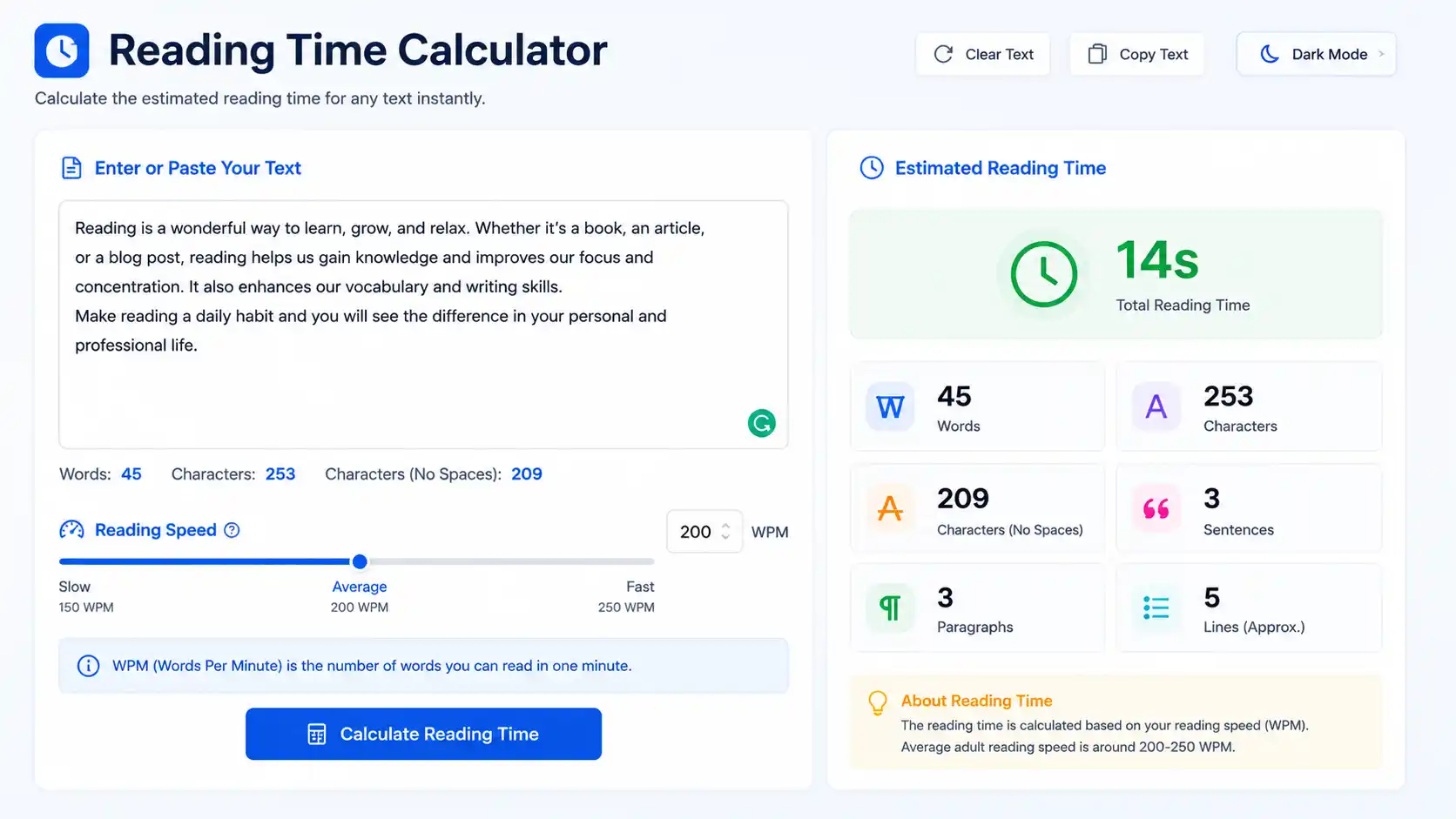
What Is a Reading Time Calculator?
A reading time calculator is a tool that estimates how long it will take the average reader to finish a piece of text. You input a word count — or paste your full text — and the calculator returns an estimated duration in minutes and seconds. The result helps writers, editors, content strategists, and UX designers set accurate reader expectations before anyone reads a single word.
Reading time estimates appear everywhere in modern content: the “X min read” label on Medium articles, the time stamps on email newsletters, the duration badges on blog posts and news features. These small pieces of metadata have a measurable impact on engagement. Readers who know what they are committing to before they start are more likely to finish — and more likely to trust the source that gave them that honest signal upfront.
Understanding how reading time is calculated, what variables affect it, and how to apply estimates accurately across different content types and audiences makes you a sharper writer and a more informed content strategist. Check our guide about: Overtime Hours Calculator: Formula, Examples, and How It Works
The Core Reading Time Formula
Every reading time calculator runs on a straightforward formula:
Reading Time (minutes) = Total Word Count ÷ Average Reading Speed (WPM)
Where WPM stands for words per minute.
The Standard Reading Speed
The most widely cited figure for adult silent reading speed is 200–250 words per minute, with research consistently placing the median around 238 WPM for non-fiction prose. This is the figure used by Medium, which popularized the “X min read” label, and it remains the industry default for most reading time calculators.
For a complete reading time calculation:
Reading Time (seconds) = (Word Count ÷ WPM) × 60
Reading Time (minutes) = Word Count ÷ WPM
Remaining seconds = (Reading Time in decimal − whole minutes) × 60
Full Example:
- Word count: 1,500 words
- Reading speed: 238 WPM
- Reading time: 1,500 ÷ 238 = 6.30 minutes
- = 6 minutes and (0.30 × 60) = 6 minutes 18 seconds
Most calculators round to the nearest whole minute for simplicity — so a 1,500-word article displays as a “6 min read.”
Reading Speed by Content Type
The 238 WPM figure is an average for standard prose — but reading speed is not constant. It varies significantly based on the complexity of the content, the density of the vocabulary, the presence of visuals, and the reader’s familiarity with the subject matter.
A universal reading time calculator that applies 238 WPM to all content types will produce inaccurate estimates for technical documentation, poetry, or data-heavy reports. Calibrating to content type produces meaningfully better estimates.
Adjusted Reading Speeds by Content Type
| Content Type | Adjusted WPM | Notes |
|---|---|---|
| Light fiction / casual blog | 250–300 WPM | Simple vocabulary, high familiarity |
| Standard non-fiction prose | 230–250 WPM | Industry default |
| News articles | 200–250 WPM | Mixed vocabulary, moderate density |
| Academic / scholarly text | 150–180 WPM | Dense vocabulary, unfamiliar concepts |
| Technical documentation | 100–150 WPM | Code, specs, precise definitions |
| Legal documents | 100–130 WPM | Complex sentence structure, precision reading |
| Poetry | 100–130 WPM | Deliberate, slow engagement |
| Medical / scientific papers | 80–120 WPM | Highly specialized terminology |
| Code-heavy content | 50–100 WPM | Code blocks require close reading |
Using 238 WPM for a technical API documentation page will systematically underestimate reading time, leaving readers feeling slower than the estimate predicted — which subtly damages trust. Matching WPM to content type produces estimates readers experience as accurate. Also, check our guide: Date Calculator: Formula, Examples, and How It Works
Reading Time Formula Examples Across Word Counts
Using the standard 238 WPM rate, here is how reading time scales across common content lengths:
| Word Count | Calculation | Reading Time |
|---|---|---|
| 100 words | 100 ÷ 238 | ~0.4 min (25 sec) |
| 300 words | 300 ÷ 238 | ~1.3 min (1 min 15 sec) |
| 500 words | 500 ÷ 238 | ~2.1 min (2 min 6 sec) |
| 750 words | 750 ÷ 238 | ~3.2 min (3 min 9 sec) |
| 1,000 words | 1,000 ÷ 238 | ~4.2 min (4 min 12 sec) |
| 1,500 words | 1,500 ÷ 238 | ~6.3 min (6 min 18 sec) |
| 2,000 words | 2,000 ÷ 238 | ~8.4 min (8 min 24 sec) |
| 2,500 words | 2,500 ÷ 238 | ~10.5 min (10 min 30 sec) |
| 3,000 words | 3,000 ÷ 238 | ~12.6 min (12 min 36 sec) |
| 5,000 words | 5,000 ÷ 238 | ~21.0 min (21 min) |
| 10,000 words | 10,000 ÷ 238 | ~42.0 min (42 min) |
Speaking Time vs. Reading Time: Key Differences
Reading time calculators are also used to estimate speaking time — how long it takes to deliver written content aloud. This is essential for speechwriters, podcast hosts, presentation designers, and broadcasters.
The formula is identical but uses a different WPM rate:
Speaking Time (minutes) = Word Count ÷ Speaking Speed (WPM)
Standard Speaking Speeds
| Speaking Context | WPM Range | Notes |
|---|---|---|
| Conversational speech | 130–150 WPM | Natural, relaxed pace |
| Presentations / lectures | 120–150 WPM | Deliberate, audience-aware |
| Audiobooks | 150–160 WPM | Optimized for comprehension |
| Podcasts | 150–180 WPM | Energetic, edited delivery |
| Radio broadcasting | 160–180 WPM | Fast, professional delivery |
| Auctioneers | 250–400 WPM | Extreme outlier |
Speaking Time Examples
Using 130 WPM (standard presentation pace):
| Word Count | Speaking Time |
|---|---|
| 500 words | ~3.8 min (3 min 50 sec) |
| 750 words | ~5.8 min (5 min 46 sec) |
| 1,000 words | ~7.7 min (7 min 42 sec) |
| 1,500 words | ~11.5 min (11 min 32 sec) |
| 2,000 words | ~15.4 min (15 min 23 sec) |
| 3,000 words | ~23.1 min (23 min 5 sec) |
Practical application: A standard 20-minute conference presentation at 130 WPM requires approximately 2,600 words of script. A 45-minute keynote requires approximately 5,850 words. A 5-minute TED-style talk requires approximately 650–750 words.
Variables That Affect Reading Time Accuracy
A reading time calculator produces an estimate, not a guarantee. Several real-world variables cause actual reading time to diverge from the calculated figure.
1. Reader Skill and Familiarity
Reading speed is not fixed — it varies by individual and by context. A subject-matter expert reads technical content significantly faster than a novice. A native speaker reads faster than a second-language reader. Research by the scientific literacy firm Legible News found reading speeds ranging from 100 WPM to over 700 WPM across a large adult sample, with the 200–250 WPM range representing the median — not the mode.
2. Content Formatting
Heavy formatting — numbered lists, tables, callout boxes, headers — slows linear reading speed but often improves comprehension and reduces the total time needed to extract key information. A well-formatted 2,000-word article with headers and bullet points may feel faster to read than a 1,500-word wall of prose, even though the calculator assigns it a longer estimate.
3. Images, Charts, and Embedded Media
Most reading time calculators count only words and ignore visual content entirely. But images add viewing time — typically 10–12 seconds per image for infographics or data visualizations, and up to 20–30 seconds for complex charts that require interpretation.
A more accurate formula for image-heavy content:
Adjusted Reading Time = (Word Count ÷ WPM) + (Number of Images × 12 seconds ÷ 60)
Example:
- 1,500 words at 238 WPM = 6.30 minutes
- 8 images × 12 seconds = 96 seconds = 1.6 minutes
- Adjusted estimate: 7.9 minutes (~8 min read)
Medium’s reading time algorithm uses a variant of this approach — adding 12 seconds per image to the base word-count estimate.
4. Interactive and Embedded Content
Content with embedded videos, interactive calculators, quizzes, or expandable sections adds engagement time that no reading time calculator accounts for. For this type of content, “reading time” is better framed as “time on page” — a metric tracked by analytics platforms rather than calculated from word count.
5. Device and Environment
Reading speed on mobile devices is measurably slower than on desktop — studies suggest a 20–30% reduction due to smaller text, more scrolling, and higher distraction rates. If your primary audience is mobile, consider adjusting your WPM baseline down to 180–200 WPM for more accurate mobile estimates. Also, check: Time Calculator: Formula, Examples, and How It Works
How to Calculate Reading Time in Different Tools
Manual Calculation
Step 1: Count total words in your content.
Step 2: Divide by 238 (or your adjusted WPM for content type).
Step 3: The integer part = minutes. Multiply the decimal by 60 = seconds.
Step 4: Round to the nearest whole minute for display.
In Microsoft Word
Word does not have a built-in reading time calculator, but you can calculate it manually using the word count from Review → Word Count divided by your chosen WPM.
Alternatively, paste the text into any of the major online calculators: Read-O-Meter, WordCounter.net, or Online-Utility.org all provide immediate reading time estimates alongside word and character counts.
In Google Docs
Google Docs also lacks a native reading time display, but third-party add-ons such as “Word Count Plus” add real-time reading time to the toolbar. The same manual formula applies: Tools → Word Count provides the word total; divide by 238.
For Blog Posts and CMS Platforms
Most modern content management systems have reading time built in or available as a plugin:
- WordPress: The Yoast SEO plugin and Jetpack both calculate and display reading time. The Classic Editor and Gutenberg both support reading time metadata.
- Medium: Reading time is calculated automatically and displayed at the top of every article. Medium uses 265 WPM for words and adds 12 seconds per image.
- Ghost CMS: Reading time is a native feature, displayed automatically based on word count at 275 WPM.
- Substack: Does not display reading time natively but word count is available in the editor.
- HubSpot: Blog posts display estimated reading time automatically using 200 WPM.
Building a Reading Time Calculator in JavaScript
For developers embedding reading time estimates in custom applications:
function calculateReadingTime(text, wpm = 238) {
  const words = text.trim().split(/\s+/).length;
  const minutes = Math.floor(words / wpm);
  const seconds = Math.round(((words / wpm) - minutes) * 60);
  return { minutes, seconds, totalWords: words };
}

// Example usage:
const result = calculateReadingTime(articleText);
console.log(`${result.minutes} min ${result.seconds} sec read`);
console.log(`Total words: ${result.totalWords}`);
For image-adjusted estimates:
function calculateAdjustedReadingTime(text, imageCount = 0, wpm = 238) {
  const words = text.trim().split(/\s+/).length;
  const wordTimeSeconds = (words / wpm) * 60;
  const imageTimeSeconds = imageCount * 12;
  const totalSeconds = wordTimeSeconds + imageTimeSeconds;
  const minutes = Math.floor(totalSeconds / 60);
  const seconds = Math.round(totalSeconds % 60);
  return { minutes, seconds };
}
Why Reading Time Estimates Matter for Content Strategy and SEO
Reading time is not just a reader-facing feature — it has measurable impacts on content performance, user behavior signals, and indirectly on search rankings.
Reduces Bounce Rate
When readers know a piece will take 8 minutes to read and they have 8 minutes, they start reading with intent to finish. When there is no estimate and the content turns out longer than expected, abandonment rates rise sharply. Research from Medium’s internal data found that articles with reading time labels had significantly higher completion rates than equivalent content without them.
Improves User Experience Signals
Google’s ranking systems incorporate behavioral signals — dwell time, scroll depth, return visits — as indirect quality indicators. Content with higher completion rates and longer dwell times sends stronger positive signals. Reading time estimates that set accurate expectations improve these metrics by attracting readers who intend to engage fully rather than those who leave after the first paragraph.
Supports Content Planning and Editorial Calendars
Reading time helps editorial teams plan content mix. A content calendar with only 10-minute reads puts heavy demands on the reader; balancing with 2-minute reads, 5-minute reads, and deeper long-form pieces creates a more sustainable reading experience across a publication or blog.
Sets Expectations in Email Marketing
Email newsletters that display reading time in the subject line or preview text see measurably higher open rates, according to data from email marketing platforms including Mailchimp and Campaign Monitor. Readers making a split-second decision to open an email are more likely to do so when they know the commitment is “2 min read” rather than an unknown.
Aids Accessibility
For readers with attention-related conditions, dyslexia, or those reading in a second language, knowing a content’s length in time rather than words is more intuitive and less intimidating. A “6 min read” is more meaningful than “1,450 words” for most casual readers making a content consumption decision. Interest Calculator: Formula, Examples, and How It Works
Reading Time Calculator for Specific Content Formats
Podcast Scripts
At 150 WPM (standard podcast pace):
- 30-minute podcast → approximately 4,500 words of script
- 60-minute podcast → approximately 9,000 words of script
- 10-minute segment → approximately 1,500 words of script
YouTube Video Scripts
At 150 WPM (natural on-camera delivery):
- 5-minute video → approximately 750 words
- 10-minute video → approximately 1,500 words
- 20-minute video → approximately 3,000 words
Academic Presentations
At 120 WPM (deliberate academic pace):
- 10-minute conference talk → approximately 1,200 words
- 20-minute presentation → approximately 2,400 words
- 45-minute lecture → approximately 5,400 words
Audiobooks
The standard audiobook narration rate is 150–160 WPM. Using 155 WPM:
- A 70,000-word novel → approximately 451 minutes → 7.5 hours of audio
- A 100,000-word novel → approximately 645 minutes → 10.7 hours of audio
This aligns closely with Audible’s average audiobook duration of 9–11 hours for standard fiction.
Frequently Asked Questions
How is reading time calculated?
Reading time is calculated by dividing the total word count by the average adult reading speed (typically 238 words per minute). The result gives minutes; multiply the decimal remainder by 60 to get seconds.
What is the average reading speed for adults?
Research consistently places the median adult silent reading speed between 200 and 250 words per minute, with 238 WPM being the most commonly used figure in reading time calculators and content platforms.
How long does it take to read 1,000 words?
At 238 WPM, 1,000 words takes approximately 4 minutes and 12 seconds to read. At 200 WPM, it takes exactly 5 minutes.
How long does it take to read 500 words?
At 238 WPM, 500 words takes approximately 2 minutes and 6 seconds. Most reading time calculators display this as “2 min read.”
Does reading time include image viewing time?
Standard reading time calculators count words only. More sophisticated calculators — including Medium’s algorithm — add approximately 12 seconds per image to account for the time readers spend viewing visual content.
What WPM should I use for technical content?
For technical documentation, code-heavy articles, or scientific papers, a reading speed of 100–150 WPM produces more accurate estimates than the standard 238 WPM. The denser and more specialized the vocabulary, the lower the reading speed.
How do I add reading time to a WordPress blog?
The Yoast SEO plugin and Jetpack both add reading time to WordPress posts automatically. In Gutenberg, the word count is visible in the editor sidebar, and you can calculate reading time manually or use a plugin.
Is speaking time the same as reading time?
No. Speaking time uses a lower WPM — typically 120–150 WPM for presentations, compared to 238 WPM for silent reading. A 1,000-word script takes about 4 minutes to read silently but 7–8 minutes to deliver aloud at a comfortable presentation pace. Work Hours Calculator: Formula, Examples, and How It Works
Conclusion
A reading time calculator is a small tool with a large impact on how readers experience and engage with content. By translating word count into the currency readers actually think in — time — it removes ambiguity, sets honest expectations, and creates the conditions for deeper engagement.
The formula is simple: divide word count by your target audience’s reading speed. The nuance is in calibrating that speed to content type, accounting for images and formatting, and applying the estimate consistently across every piece you publish. Done well, it is one of the lowest-effort, highest-return improvements any content operation can make.