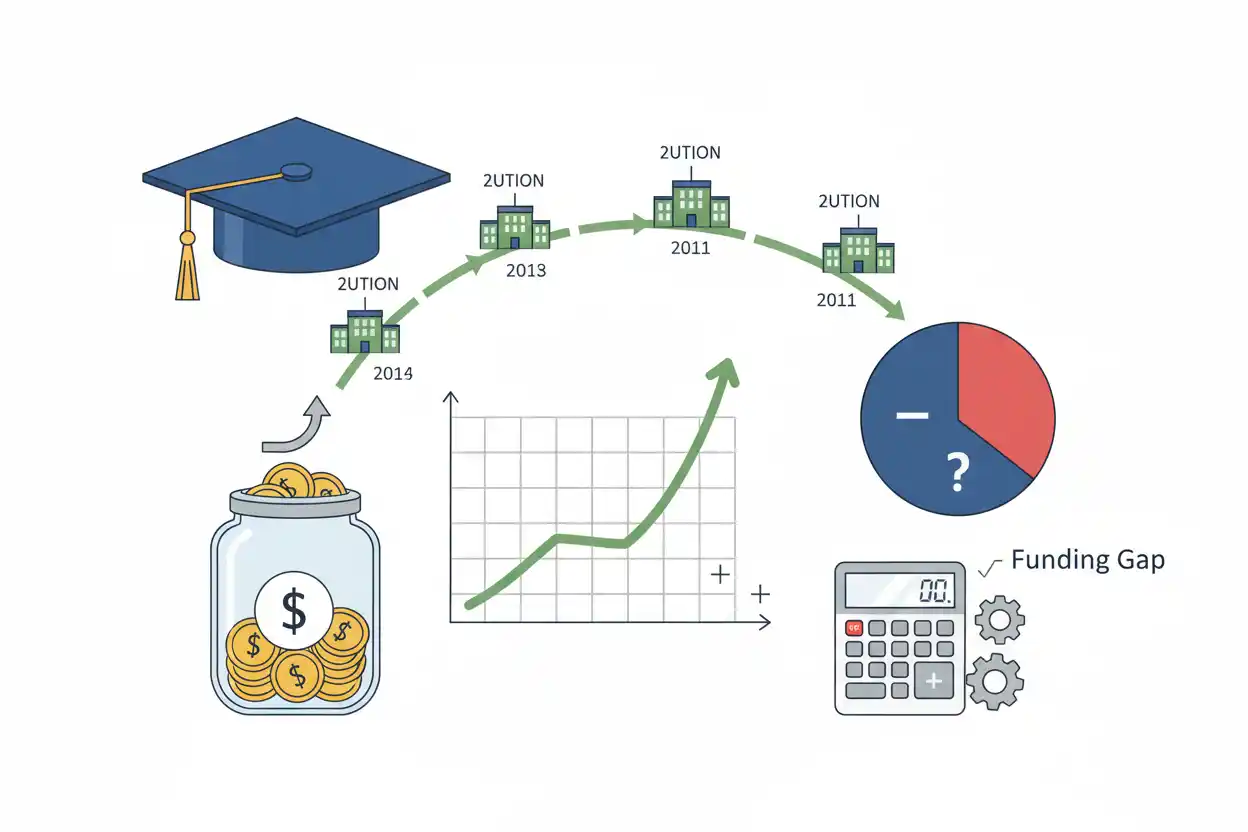

College cost planning turns a distant education goal into a series of measurable financial questions.
How much might college cost when the student enrolls? How much could existing savings grow by then? What could future contributions add? And after those amounts are compared, how large is the remaining funding gap?
The calculations cannot predict future tuition, investment returns, financial aid, or family circumstances perfectly. Their purpose is to create a planning range and show which assumptions have the greatest effect on the result.
What Is College Cost Planning?
College cost planning estimates future education expenses and compares them with resources expected to be available when the costs occur.
A basic model has four stages:
- Estimate today’s education cost.
- Project that cost to the enrollment date.
- Project existing and future savings.
- Calculate the difference.
The central equation is:
Funding Gap = Estimated Future College Cost − Projected Available Funds
A positive result indicates an estimated shortfall.
A zero or negative result indicates that projected resources meet or exceed the assumed cost under the model.
Step 1: Estimate Future College Costs
If today’s annual cost is known, a compound-growth formula can estimate what the same cost would be after several years.
Future Cost = Current Cost × (1 + Cost Growth Rate)^Years
Suppose:
- Current annual cost = $25,000
- Years until college = 10
- Assumed annual cost growth = 4%
Then:
Future First-Year Cost = $25,000 × (1.04)^10
Future First-Year Cost ≈ $25,000 × 1.480244
Future First-Year Cost ≈ $37,006.11
Under these assumptions, a $25,000 annual cost today becomes approximately $37,006 by the first college year.
This is an estimate, not a forecast guarantee.
Step 2: Estimate All Four College Years
If costs continue growing by 4% during college, each year has a different projected amount.
Year 1
$25,000 × 1.04^10 ≈ $37,006.11
Year 2
$25,000 × 1.04^11 ≈ $38,486.35
Year 3
$25,000 × 1.04^12 ≈ $40,025.81
Year 4
$25,000 × 1.04^13 ≈ $41,626.84
Now add the four projected years.
Total Estimated Cost ≈ $37,006.11 + $38,486.35 + $40,025.81 + $41,626.84
Total Estimated Cost ≈ $157,145.11
Under this simplified model, the four-year projected cost is approximately $157,145.
Step 3: Project Existing College Savings
Suppose $40,000 has already been saved and there are 10 years until enrollment.
Assume a hypothetical 5% annual return.
Future Value = Present Savings × (1 + Return)^Years
Future Value = $40,000 × 1.05^10
Future Value ≈ $65,155.79
If the assumed return occurred consistently and the money remained invested, today’s $40,000 would grow to approximately $65,156.
Actual investment results can be higher or lower.
Step 4: Project Future Annual Contributions
Now suppose the family contributes $6,000 at the end of each year for the next 10 years and earns the same assumed 5% annual return.
The future value of an ordinary series of contributions is:
Future Value of Contributions = Contribution × [(1 + r)^n − 1] ÷ r
Where:
- Contribution = annual deposit;
- r = assumed annual return;
- n = number of contributions.
Insert the assumptions:
Future Value = $6,000 × [(1.05)^10 − 1] ÷ 0.05
Calculate the growth factor:
1.05^10 ≈ 1.628895
Subtract 1:
1.628895 − 1 = 0.628895
Divide by 0.05:
0.628895 ÷ 0.05 ≈ 12.5779
Multiply by $6,000:
Future Value of Contributions ≈ $75,467.36
The annual contributions could therefore grow to approximately $75,467 under these assumptions.
Step 5: Calculate Total Projected Savings
Combine the projected value of existing savings with projected future contributions.
Projected Savings = $65,155.79 + $75,467.36
Projected Savings ≈ $140,623.15
Now compare this figure with the projected four-year education cost.
Step 6: Calculate the College Funding Gap
Projected cost:
$157,145.11
Projected savings:
$140,623.15
Therefore:
Funding Gap = $157,145.11 − $140,623.15
Funding Gap ≈ $16,521.96
The estimated funding gap is approximately $16,522.
That does not necessarily mean the family must save exactly another $16,522 today. The gap occurs in future dollars and may be addressed through additional contributions, different assumptions, scholarships, current income during college, changes in school cost, or other resources.
Why the Cost-Growth Assumption Matters
College cost planning is highly sensitive to the assumed rate at which costs rise.
Using the same $25,000 starting cost over 10 years:
At 2% growth:
$25,000 × 1.02^10 ≈ $30,474.86
At 4%:
$25,000 × 1.04^10 ≈ $37,006.11
At 6%:
$25,000 × 1.06^10 ≈ $44,771.19
A two-percentage-point difference in the assumption produces a meaningful difference over a decade.
For that reason, relying on one precise forecast can create false confidence.
Why the Investment-Return Assumption Matters
The savings projection is equally sensitive to return assumptions.
Consider the existing $40,000 balance over 10 years.
At 3%:
$40,000 × 1.03^10 ≈ $53,756.65
At 5%:
$40,000 × 1.05^10 ≈ $65,155.79
At 7%:
$40,000 × 1.07^10 ≈ $78,686.06
Higher assumed returns reduce the projected funding gap, but expected returns are not guaranteed.
Planning should therefore avoid solving a shortfall merely by inserting an aggressive return assumption.
Compound Interest and College Savings
The mathematics of long-term education saving depends heavily on compound interest.
Money saved earlier has more time for gains to generate additional gains.
For example, $10,000 compounded at 5% for 15 years becomes:
$10,000 × 1.05^15 ≈ $20,789.28
The same $10,000 compounded for only five years becomes:
$10,000 × 1.05^5 ≈ $12,762.82
Starting earlier does not guarantee investment success, but it gives compounding more time to operate.
College Planning and CAGR
Compound annual growth rate can help describe the annualized rate connecting a beginning value with an ending value.
For college planning, however, a projected return should not be mistaken for a known CAGR.
Future investment performance is uncertain.
CAGR is most reliable as a way to summarize a growth path mathematically; it does not turn an assumed future return into a guarantee.
Using CDs for Near-Term College Costs
As the enrollment date approaches, some families may evaluate lower-volatility assets or term-based savings products such as CDs for money expected to be spent relatively soon.
The maturity schedule matters.
For example, money needed for first-year tuition should not be locked into a CD whose maturity falls after the payment deadline unless early access is acceptable under the product’s terms.
The investment approach should become increasingly aligned with the timing of actual expenses.
Using Bonds in College Planning
Bonds can also appear in education portfolios, but they should not automatically be treated as fixed-value substitutes for cash.
Marketable bond prices can rise or fall before maturity.
Their suitability depends partly on maturity, credit risk, yield, liquidity, and when the funds will be needed.
The closer the spending date, the more important it becomes to understand the relationship between investment maturity and liability timing.
Bank Strength vs College Savings Growth
A capital adequacy ratio measures regulatory bank capital relative to risk-weighted assets.
It does not calculate college savings growth.
This distinction matters because financial planning uses many ratios and percentages, but each metric has a specific purpose.
College planning depends primarily on cost projections, savings, contributions, time, and investment assumptions.
Should You Plan to Fund 100% of College Costs?
Not necessarily.
A family’s target may be:
- 100% of projected costs;
- tuition only;
- a fixed dollar amount;
- a percentage of total cost;
- costs at a particular type of institution.
The correct funding target depends on the family’s financial priorities.
Trying to fully fund one goal should not automatically override retirement security, emergency reserves, debt obligations, or other essential financial needs.
Planning With a Target Percentage
Suppose the estimated future four-year cost is $157,145, but the family plans to fund 75%.
Target Funding = $157,145 × 75%
Target Funding ≈ $117,859
If projected savings equal $140,623, the family would exceed that specific target under the assumed scenario.
This demonstrates why the funding target should be defined before deciding whether a projected “gap” exists.
Inflation and College Cost Planning
General inflation and education-specific cost changes are not necessarily identical.
Therefore, applying a general inflation estimate to college expenses is a simplifying assumption.
A more robust plan can test several possible cost-growth rates rather than presenting one estimate as certain.
Scenario analysis might include:
- lower-cost scenario;
- base scenario;
- higher-cost scenario.
The purpose is not to predict one exact future tuition bill. It is to understand how much the savings plan changes under different plausible assumptions.
Financial Aid and the Funding Gap
Projected savings should not automatically be reduced by an assumed amount of future financial aid unless there is a defensible basis for the estimate.
Eligibility rules, family finances, institutional policies, and aid availability can change over time.
A conservative model can first calculate the gross funding requirement and then show aid or scholarships as separate scenarios.
This keeps uncertain assistance from being embedded invisibly in the baseline projection.
Revisit the Plan Over Time
College planning should be updated as the enrollment date approaches.
Useful inputs to revisit include:
- actual account balance;
- updated school-cost estimates;
- years remaining;
- savings contributions;
- investment allocation;
- available scholarships or aid;
- the family’s funding target.
A ten-year projection does not need to remain unchanged for ten years.
Better information should replace older assumptions as it becomes available.
Common College Cost Planning Mistakes
One mistake is projecting only first-year tuition and forgetting that multiple years of costs may rise during enrollment.
Another is treating an assumed investment return as guaranteed.
Families can also overlook the timing of withdrawals. Money needed in the first year has a shorter investment horizon than money needed in the fourth year.
Finally, planning exclusively around education can create problems if it ignores emergency savings, retirement, debt, or other financial priorities within the broader Savings & Investing plan.
Frequently Asked Questions
What is college cost planning?
College cost planning estimates future education expenses and compares them with projected savings and other funding resources.
How do you estimate future college costs?
A simplified formula is:
Future Cost = Current Cost × (1 + Cost Growth Rate)^Years
What is a college funding gap?
It is the difference between estimated future education costs and projected funds available to pay those costs.
Funding Gap = Future Cost − Available Funds
Should I calculate one year or all four years?
For a four-year education goal, projecting each expected year generally provides a more useful estimate than calculating only the first year.
How does starting earlier affect college savings?
Starting earlier gives saved money more time to compound and can reduce the contribution required later, assuming positive investment growth.
What return should I assume?
There is no universally correct future return assumption. It depends on the portfolio, time horizon, risk, and planning methodology. Testing multiple scenarios is generally more informative than relying on one aggressive estimate.
Should college costs be adjusted for inflation?
Future costs should generally reflect some assumption about cost changes, but education costs may not move at exactly the same rate as broad consumer inflation.
What if projected savings exceed estimated costs?
The model indicates a surplus under its assumptions. The result should still be reviewed because future costs and investment returns can differ from projections.
What if I cannot save enough to cover 100%?
A plan can target a specific dollar amount or percentage rather than automatically assuming the family must fund every future expense.
Can CDs be used for college savings?
They can potentially be used for funds with suitable time horizons, but maturity dates, yields, liquidity, and withdrawal provisions should align with when the money will be needed.
Are investment returns guaranteed in a college projection?
No. Return assumptions are modeling inputs. Actual investment performance can be higher or lower.
How often should a college savings plan be updated?
Reviewing it periodically and after meaningful changes in costs, savings, family finances, or time remaining can keep the funding estimate aligned with current information.