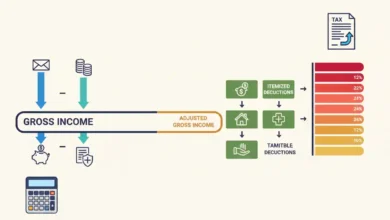

Gross income is the total income included at the starting stage of a financial or tax calculation before specified adjustments, deductions, taxes, or expenses are applied.
Suppose someone earns a $72,000 salary, a $6,000 bonus, $8,000 in commissions, and $1,500 of other included income during the year.
Their simplified gross income is:
$72,000 + $6,000 + $8,000 + $1,500 = $87,500
Gross income is not the same as take-home pay. It can also differ from adjusted gross income and taxable income because those figures are calculated at later stages.
Gross Income Formula
For an individual with several income sources, a simplified formula is:
Gross Income = Sum of Included Income Sources
For example:
Gross Income = Salary + Bonus + Commission + Other Included Income
The exact items included depend on the financial or tax definition being used.
The arithmetic is straightforward once the relevant components are identified.
Gross Income Example
Suppose annual income consists of:
Salary:
$72,000
Bonus:
$6,000
Commission:
$8,000
Other included income:
$1,500
Then:
Gross Income = $72,000 + $6,000 + $8,000 + $1,500
= $87,500
The simplified annual gross income is $87,500.
Average Monthly Gross Income
To convert the annual amount into an average monthly figure:
Monthly Gross Income = Annual Gross Income ÷ 12
Using $87,500:
$87,500 ÷ 12
≈ $7,291.67
This does not mean the person receives exactly $7,291.67 every month.
Bonuses and commissions can make actual monthly income uneven.
Gross Income vs Gross Pay
Gross pay generally refers to compensation from employment before payroll deductions.
Gross income can be broader.
Suppose an employee receives:
Gross Employment Pay = $80,000
and also has:
$5,000 of Other Included Income
Then:
Gross Income = $85,000
Gross pay is one component of the broader gross-income total.
Gross Income vs Hourly Wage
An hourly wage is a rate of pay per hour.
Gross income is a dollar amount accumulated over a period.
Suppose:
Hourly Wage = $25
Hours per Week = 40
Paid Weeks = 52
Annualized gross wages:
$25 × 40 × 52
= $52,000
The $25 is a rate.
The $52,000 is annual gross compensation under the simplified schedule.
Gross Income and FICA Tax
Fica tax is calculated from applicable payroll wages rather than simply from every possible category included in gross income.
Suppose gross income includes:
- salary;
- investment income.
Investment income does not automatically become FICA wages merely because it appears in the broader gross-income calculation.
Different taxes can use different tax bases.
Gross Income and Estimated Taxes
Estimated taxes should not generally be calculated by multiplying gross income by one arbitrary tax rate.
Suppose:
Gross Income = $100,000
This alone does not tell you annual tax liability.
Adjustments, deductions, credits, income classification, withholding, and applicable tax rules still matter.
Gross Income and Export Duty
A business can earn income from international trade while also paying export duty on qualifying transactions.
The export duty is a transaction cost or tax under customs rules; gross income is an income measure.
One should not automatically subtract export duty from sales and label the result gross income without applying the relevant accounting or tax definition.
Gross Income From Salary and Bonus
Suppose:
Salary = $90,000
Bonus = $12,000
Simplified gross employment income:
$102,000
If there are no other included income sources in the example:
Gross Income = $102,000
Taxes and payroll deductions occur after the gross amount is established.
Gross Income From Variable Pay
Suppose a salesperson earns:
Base Salary = $50,000
and commissions vary during the year.
Total commissions:
$35,000
Simplified gross employment income:
$50,000 + $35,000
= $85,000
Monthly cash can be highly uneven even though annual gross income is $85,000.
Gross Income With Multiple Jobs
Suppose:
Job A:
$45,000
Job B:
$20,000
Other included income:
$3,000
Then:
Gross Income = $45,000 + $20,000 + $3,000
= $68,000
Looking at only the highest-paying job would understate the total by $23,000.
Gross Income vs Adjusted Gross Income
Gross income is the starting point.
Adjusted gross income, or AGI, applies qualifying adjustments.
A simplified relationship is:
Adjusted Gross Income = Gross Income − Qualifying Adjustments
Suppose:
Gross Income = $87,500
and qualifying adjustments total:
$4,500
Then:
AGI = $87,500 − $4,500
= $83,000
Gross income and AGI are therefore distinct figures.
Gross Income vs Taxable Income
Taxable income can be calculated later after additional tax rules or deductions are applied.
Conceptually:
Gross Income → Adjusted Gross Income → Taxable Income
The exact pathway depends on the tax system.
Therefore, multiplying gross income directly by the highest income-tax rate can produce a misleading tax estimate.
Gross Income vs Net Income
Net income generally describes an amount after specified expenses, taxes, or deductions.
Suppose:
Gross Income = $87,500
and total modeled deductions and taxes reduce available income by:
$25,000
Simplified net amount:
$87,500 − $25,000
= $62,500
The word “net” must still be defined because net pay, business net income, and after-tax income can mean different things.
Gross Income vs Take-Home Pay
Suppose an employee’s monthly gross pay is:
$6,000
while monthly net paycheck is:
$4,500
Take-home percentage:
$4,500 ÷ $6,000
= 75%
The employee’s budget can use the $4,500 cash figure even though payroll and tax calculations begin from the $6,000 gross amount.
Gross Income for Budgeting
A household budget should distinguish gross income from money available to spend.
Suppose:
Annual Gross Income = $90,000
Average monthly gross:
$7,500
If monthly take-home cash is:
$5,600
planning recurring expenses around $7,500 would overstate available cash by:
$1,900 per month
Gross income is useful for tax and compensation analysis; net cash flow is more useful for day-to-day spending.
Gross Business Receipts vs Gross Income
Businesses can have gross receipts that differ from gross income under applicable accounting or tax rules.
Suppose a business receives:
$500,000 of Customer Payments
That does not automatically mean the tax-law gross-income figure is $500,000.
Returns, allowances, cost treatment, and business-specific tax rules can change the relevant amount.
The term being used should always be defined.
Gross Margin Is Not Gross Income
Suppose a business has:
Revenue = $500,000
Cost of Goods Sold = $300,000
Gross profit:
$200,000
Gross margin:
$200,000 ÷ $500,000
= 40%
This profitability calculation is not the same as an individual’s gross-income calculation.
Similar terminology can refer to different financial statements and contexts.
Percentage of Income From Salary
Using the $87,500 example:
Salary = $72,000
Salary share:
$72,000 ÷ $87,500 × 100
≈ 82.29%
The remaining:
17.71%
comes from bonus, commission, and other modeled income.
This can help analyze dependence on variable compensation.
Percentage of Income From Commissions
Commission:
$8,000
Gross income:
$87,500
Then:
Commission Share = $8,000 ÷ $87,500
≈ 9.14%
An employee whose commissions represent 40% of gross income has more variable compensation exposure than someone whose commissions represent 9%.
Annualizing Partial-Year Income
Suppose someone earns:
$30,000 over 4 months
A simple annualized run rate is:
$30,000 ÷ 4 × 12
= $90,000
That does not mean actual annual gross income will be $90,000.
The calculation assumes the same income pace continues for the remaining eight months.
Irregular Income
A freelancer may receive:
$4,000 one month
$9,000 the next
$2,500 after that
Monthly gross income therefore fluctuates.
For annual analysis, sum the actual included income rather than multiplying the strongest month by 12.
Refunds and Reimbursements
Not every cash deposit received during a year is automatically gross income.
For example, certain reimbursements or returned funds can have different treatment from compensation or business revenue.
Cash flow and gross income are therefore not universally identical.
Classification should occur before totaling income.
Loans Are Not Automatically Income
Borrowed money increases cash available but also creates a liability.
Suppose someone receives:
$20,000 Loan Proceeds
Cash rises by $20,000, but the person also owes $20,000.
The receipt should not automatically be added to employment gross income merely because money entered the bank account.
Common Gross Income Mistakes
A common error is treating take-home pay as gross income.
Another is looking only at salary while ignoring bonuses, commissions, or other included sources.
People also confuse gross income with AGI, taxable income, gross profit, or gross business receipts.
Frequently Asked Questions
What is gross income?
Gross income is the total income included at the starting stage of a financial or tax calculation before specified adjustments or deductions.
What is the basic formula?
Gross Income = Sum of Included Income Sources
Is salary the same as gross income?
Not necessarily. Salary can be one component of gross income.
Is gross pay the same as gross income?
Gross pay generally refers to employment compensation, while gross income can include additional sources.
Is gross income the same as take-home pay?
No.
Is gross income the same as AGI?
No. AGI generally begins with gross income and then applies qualifying adjustments.
Is gross income the same as taxable income?
Not necessarily.
Do commissions count toward gross income?
They can be part of gross compensation or gross income depending on the context.
Are loans gross income?
Borrowed funds are not automatically income simply because cash was received.
How do I calculate monthly gross income?
Average Monthly Gross Income = Annual Gross Income ÷ 12
for a simple annual average.
Can monthly gross income vary?
Yes, especially when bonuses, commissions, or self-employment income fluctuate.
Why calculate gross income separately?
It provides the starting income measure needed for payroll, tax, and financial calculations throughout the broader Taxes & Pay framework.