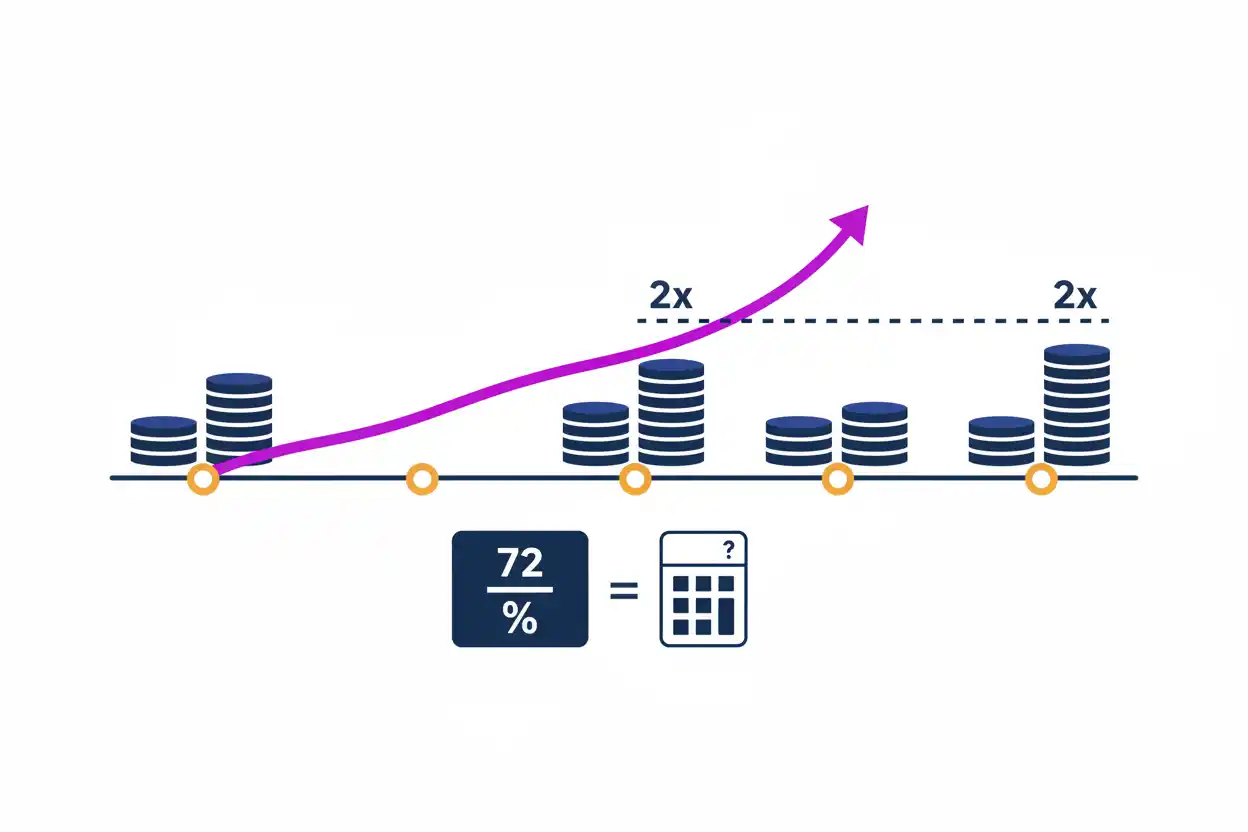

The Rule of 72 is a quick mental-math shortcut for estimating how long an amount of money takes to double at a fixed compounded annual rate.
If an investment grows at 6% per year:
Doubling Time ≈ 72 ÷ 6
Doubling Time ≈ 12 years
The exact annual-compounding result is approximately 11.90 years, so the shortcut is remarkably close.
The Rule of 72 is useful for fast comparisons, but it is an approximation. It does not account for changing returns, contributions, withdrawals, investment fees, taxes, or inflation.
What Is the Rule of 72?
The basic formula is:
Doubling Time in Years ≈ 72 ÷ Annual Return (%)
The return is entered as a percentage number.
For example:
8% → Enter 8
not:
0.08
At an 8% annual return:
72 ÷ 8 = 9 years
So money growing at approximately 8% per year would double in about nine years.
Rule of 72 Example at 6%
Suppose:
- starting investment = $10,000;
- annual return = 6%.
Rule of 72:
72 ÷ 6 = 12 years
The shortcut predicts that $10,000 will become approximately $20,000 in 12 years.
Using exact annual compounding:
Future Value = $10,000 × 1.06¹²
Future Value ≈ $20,121.96
The Rule of 72 produces a very close estimate.
Exact Doubling-Time Formula
For annual compounding:
Exact Doubling Time = ln(2) ÷ ln(1 + r)
Where r is entered as a decimal.
At 6%:
Exact Time = ln(2) ÷ ln(1.06)
≈ 11.90 years
Rule of 72:
12 years
Difference:
≈ 0.10 year
That is why the shortcut is useful for mental calculations.
Rule of 72 Table
| Annual Return | Rule of 72 | Exact Annual-Compounding Time |
|---|---|---|
| 3% | 24.00 years | 23.45 years |
| 4% | 18.00 years | 17.67 years |
| 5% | 14.40 years | 14.21 years |
| 6% | 12.00 years | 11.90 years |
| 8% | 9.00 years | 9.01 years |
| 9% | 8.00 years | 8.04 years |
| 12% | 6.00 years | 6.12 years |
The approximation is particularly convenient around commonly encountered mid-single-digit and high-single-digit rates.
Why the Rule of 72 Works
The exact annual-compounding relationship for doubling is:
2 = (1 + r)^t
Solving for time gives:
t = ln(2) ÷ ln(1 + r)
For moderate rates, dividing 72 by the percentage rate closely approximates that logarithmic calculation.
The number 72 is also convenient because it divides cleanly by many common integers:
- 2;
- 3;
- 4;
- 6;
- 8;
- 9;
That makes it particularly useful for mental math.
Solve for the Return Instead
The Rule of 72 can be rearranged:
Approximate Annual Return (%) = 72 ÷ Doubling Time
Suppose you want money to double in 10 years.
Required Return ≈ 72 ÷ 10
≈ 7.2%
The exact annual-compounding return needed is:
Required Return = 2^(1/10) − 1
≈ 7.18%
Again, the shortcut is very close.
Example: Doubling $50,000
Suppose $50,000 earns an assumed 8% annual return.
Rule of 72:
72 ÷ 8 = 9 years
Exact value after nine years:
$50,000 × 1.08⁹
≈ $99,950.23
The ending value is almost exactly $100,000.
Rule of 72 vs Rule of 69
The Rule of 69 is more naturally associated with continuous compounding.
At 6%:
Rule of 72:
72 ÷ 6 = 12 years
Rule of 69.3:
69.3 ÷ 6 ≈ 11.55 years
The exact annual-compounding doubling time is approximately 11.90 years, while the exact continuous-compounding time is approximately 11.55 years.
The shortcuts therefore correspond to different compounding assumptions.
Rule of 72 and Savings Growth
The savings growth calculation is broader because most savers make recurring deposits.
Suppose:
- current savings = $10,000;
- monthly deposit = $500;
- return = 6%.
The Rule of 72 can estimate how long the original $10,000 might take to double at the assumed rate, but it cannot correctly model the additional $500 deposits.
Recurring contributions require a future-value-of-cash-flows calculation.
Rule of 72 and Roth IRA Growth
A Roth IRA may contain investments held for decades.
The Rule of 72 can provide quick intuition about long-term compounding.
At 8%:
Approximate Doubling Time = 9 years
A $50,000 balance would theoretically move through roughly:
$50,000 → $100,000 → $200,000
over about 18 years if the balance remained invested and actually compounded steadily at the assumed rate.
Real investment returns fluctuate, so this is an illustration rather than a forecast.
Rule of 72 and Safe Withdrawal Rate
A safe withdrawal rate addresses how money is removed from a retirement portfolio.
The Rule of 72 assumes money remains invested and compounds without withdrawals.
Once recurring distributions begin, the portfolio no longer follows the simple uninterrupted doubling path.
A retirement portfolio earning an average 8% does not automatically double every nine years if substantial amounts are being withdrawn.
Rule of 72 and Risk-Reward Ratio
The risk-reward ratio compares potential trade loss with potential trade profit.
The Rule of 72 does not measure trading risk.
A highly speculative investment might have a potential return high enough to imply a short doubling time, but the shortcut says nothing about the probability of achieving that return or losing capital instead.
Fees Change Doubling Time
Suppose:
- gross return = 8%;
- annual investment costs = 1%;
- simplified net return = 7%.
Using the gross rate:
72 ÷ 8 = 9 years
Using the simplified net rate:
72 ÷ 7 ≈ 10.29 years
A one-percentage-point recurring cost increases the approximate doubling period by more than a year in this example.
Inflation Also Has a Doubling Effect
The Rule of 72 can illustrate how quickly prices might double.
At 3% annual inflation:
72 ÷ 3 = 24 years
At 6%:
72 ÷ 6 = 12 years
This does not mean every individual product doubles on that schedule. It illustrates the compound effect of a constant price-growth rate.
Nominal Doubling vs Real Doubling
Suppose investments earn 8% while inflation is 3%.
Nominal Rule of 72:
72 ÷ 8 = 9 years
But purchasing power grows more slowly than the nominal account balance.
A doubling of nominal wealth is not necessarily a doubling of real wealth.
For long-term financial planning, inflation-adjusted growth matters.
What Happens at Low Rates?
At a 1% annual rate:
72 ÷ 1 = 72 years
Exact annual-compounding doubling time is approximately:
69.66 years
The approximation becomes less precise at very low rates.
For rough intuition it can still be useful, but exact formulas are easy to use when precision matters.
What Happens at High Rates?
At 20%:
72 ÷ 20 = 3.6 years
Exact annual-compounding time:
ln(2) ÷ ln(1.20) ≈ 3.80 years
The difference becomes more noticeable.
Rule of 72 is designed for quick approximation, not extreme-rate precision.
Changing Returns Break the Shortcut
Suppose an investment earns:
- Year 1 = 20%;
- Year 2 = −10%;
- Year 3 = 15%;
- Year 4 = 3%.
There is no single fixed annual return that describes the actual path.
You can calculate the realized compound return after the fact, but simply applying the Rule of 72 to one year’s return would not provide a meaningful doubling estimate.
Contributions Also Break the Simple Interpretation
Suppose an account grows:
$10,000 → $20,000
over five years.
If $7,000 of additional money was contributed during those five years, the account did not double solely because of investment return.
The Rule of 72 applies to compounded growth of an existing amount, not growth caused by new deposits.
Withdrawals Change the Result
Likewise, if money is withdrawn while the investment grows, the account may take longer to double—or never double at all.
The shortcut assumes:
- constant rate;
- no deposits;
- no withdrawals.
When these assumptions do not hold, use a full cash-flow calculation.
Common Rule of 72 Mistakes
One mistake is entering 0.08 instead of 8 for an 8% rate.
Another is treating the estimate as an exact forecast.
People also apply the shortcut to irregular returns or portfolios receiving large deposits.
A further mistake is ignoring investment expenses and inflation when interpreting the economic significance of doubling.
Frequently Asked Questions
What is the Rule of 72?
It is a shortcut for estimating how long an investment takes to double at a fixed compounded annual rate.
What is the formula?
Doubling Time ≈ 72 ÷ Annual Return (%)
How long does money take to double at 6%?
Approximately 12 years by the Rule of 72.
What is the exact answer at 6% annual compounding?
Approximately 11.90 years.
How long does money take to double at 8%?
Approximately nine years.
Can I solve for the required return?
Yes:
Required Return (%) ≈ 72 ÷ Desired Doubling Time
Is Rule of 72 exact?
No. It is a mental-math approximation.
Is Rule of 72 the same as Rule of 69?
No. Rule of 69.3 aligns more naturally with continuous compounding, while Rule of 72 is a convenient approximation for ordinary periodic compounding.
Does Rule of 72 include contributions?
No.
Does it account for investment fees?
Not unless you first reduce the rate to an appropriate net-return assumption.
Can Rule of 72 be used for inflation?
Yes, as a rough estimate of how long a constant inflation rate would take to double a price level.
Why is the Rule of 72 useful?
It provides fast intuition about compound growth before moving to more detailed calculations within the broader Savings & Investing framework.