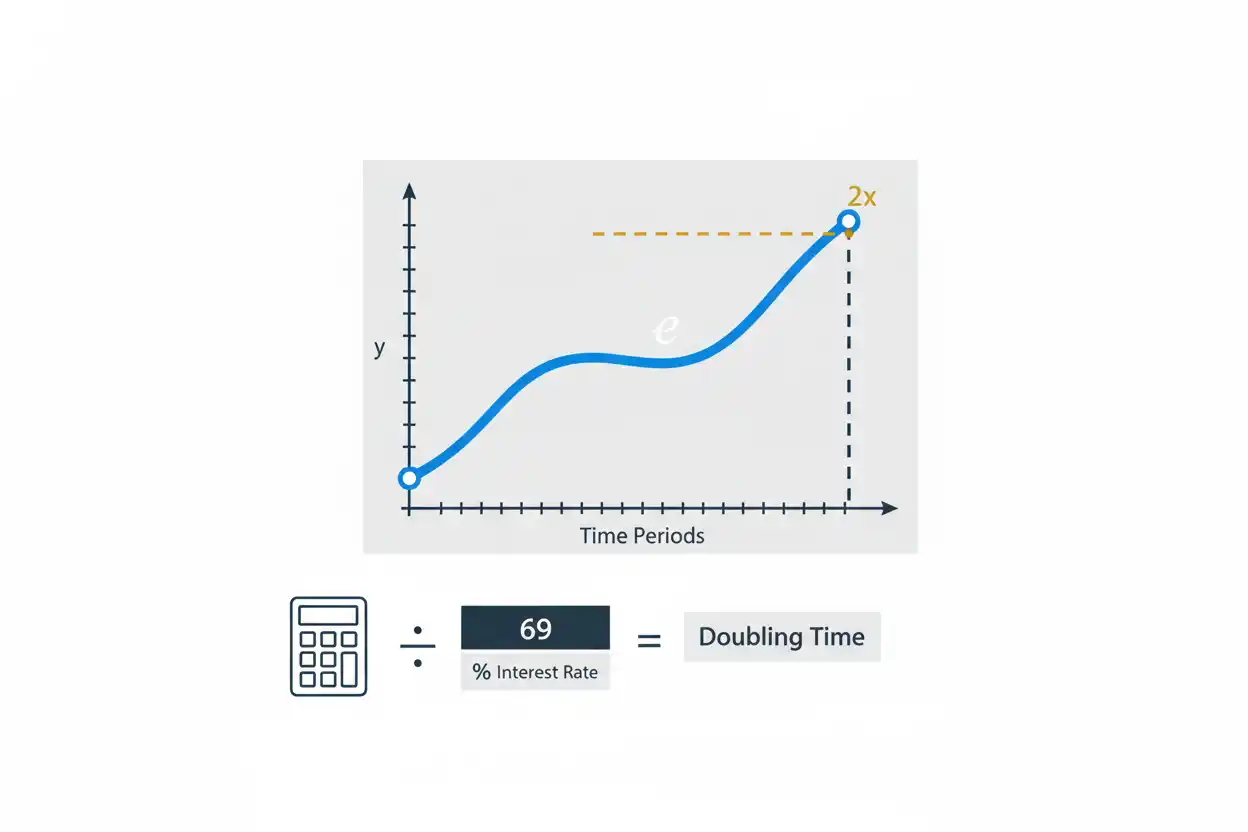

The Rule of 69 is a mental-math shortcut for estimating how long money takes to double when growth is modeled using continuous compounding.
If an investment grows continuously at 6% per year:
Rule of 69 Estimate = 69 ÷ 6
≈ 11.5 years
The mathematically more precise constant is about 69.3, producing:
69.3 ÷ 6 ≈ 11.55 years
The exact continuous-compounding answer is approximately 11.55 years.
The shortcut comes directly from the natural logarithm of 2.
What Is the Rule of 69?
The Rule of 69 estimates doubling time from a continuously compounded annual percentage rate.
The simple version is:
Doubling Time ≈ 69 ÷ Annual Rate (%)
A more accurate version is:
Doubling Time ≈ 69.3 ÷ Annual Rate (%)
Because:
100 × ln(2) ≈ 69.3147
The 69.3 version is extremely close to the exact continuous-compounding solution.
Continuous Compounding Formula
Continuous compounding uses:
Future Value = Present Value × e^(rt)
Where:
- e ≈ 2.71828;
- r = annual rate as a decimal;
- t = time in years.
To find doubling time:
Future Value = 2 × Present Value
Therefore:
2P = Pe^(rt)
Cancel P:
2 = e^(rt)
Take the natural logarithm:
ln(2) = rt
Solve for time:
t = ln(2) ÷ r
Since:
ln(2) ≈ 0.693147
the exact doubling-time formula is:
t ≈ 0.693147 ÷ r
Convert the Formula to Percentage Rates
If the rate is expressed as a percentage rather than a decimal:
r(decimal) = Rate (%) ÷ 100
Therefore:
t = 0.693147 ÷ [Rate (%) ÷ 100]
which becomes:
t ≈ 69.3147 ÷ Rate (%)
This is the mathematical source of the Rule of 69.
Rule of 69 Example at 6%
Suppose:
Rate = 6%
Simple Rule of 69:
69 ÷ 6 = 11.5 years
Rule of 69.3:
69.3 ÷ 6 = 11.55 years
Exact formula:
0.693147 ÷ 0.06
≈ 11.5525 years
The 69.3 version is almost exact.
Verify With Continuous Compounding
Suppose:
- principal = $10,000;
- continuous rate = 6%;
- time = 11.5525 years.
Then:
FV = $10,000 × e^(0.06 × 11.5525)
Because:
0.06 × 11.5525 ≈ 0.69315
and:
e^0.69315 ≈ 2
the future value is approximately:
$20,000
The investment has doubled.
Example at 5%
Rule of 69:
69 ÷ 5 = 13.8 years
Rule of 69.3:
69.3 ÷ 5 = 13.86 years
Exact:
0.693147 ÷ 0.05
≈ 13.8629 years
Again, 69.3 is extremely close.
Example at 8%
Rule of 69:
69 ÷ 8 = 8.625 years
Rule of 69.3:
69.3 ÷ 8 = 8.6625 years
Exact:
0.693147 ÷ 0.08
≈ 8.6643 years
Doubling-Time Table
| Continuous Annual Rate | Rule of 69 | Rule of 69.3 | Exact Approx. |
|---|---|---|---|
| 2% | 34.50 yrs | 34.65 yrs | 34.66 yrs |
| 4% | 17.25 yrs | 17.33 yrs | 17.33 yrs |
| 5% | 13.80 yrs | 13.86 yrs | 13.86 yrs |
| 6% | 11.50 yrs | 11.55 yrs | 11.55 yrs |
| 8% | 8.63 yrs | 8.66 yrs | 8.66 yrs |
| 10% | 6.90 yrs | 6.93 yrs | 6.93 yrs |
The approximation becomes almost exact when 69.3 is used because it closely matches 100 × ln(2).
Rule of 69 vs Rule of 69.3
The difference is simply precision.
Rule of 69 = Easier mental arithmetic
Rule of 69.3 = More mathematically precise
For a 6% rate:
69 ÷ 6 = 11.50
while:
69.3 ÷ 6 = 11.55
Difference:
0.05 years
That is only about 18 days.
For quick mental estimates, 69 is often sufficient.
Rule of 69 vs Rule of 72
The Rule of 72 is commonly used for ordinary periodically compounded interest.
At 6%:
Rule of 72:
72 ÷ 6 = 12 years
Rule of 69.3 for continuous compounding:
69.3 ÷ 6 = 11.55 years
Continuous compounding grows slightly faster than annual compounding at the same nominal annual percentage rate, so the continuous doubling time is shorter.
Exact Annual-Compounding Doubling Time
For annual compounding:
2 = (1 + r)^t
Solve:
t = ln(2) ÷ ln(1 + r)
At 6%:
t = ln(2) ÷ ln(1.06)
≈ 11.90 years
Rule of 72 gives:
12 years
which is very close.
The Rule of 69.3 is instead tied specifically to continuous compounding.
Why Continuous Compounding Doubles Faster
At a 6% nominal annual rate:
Annual compounding:
Growth Factor = 1.06
Continuous compounding:
Growth Factor = e^0.06
≈ 1.06184
The continuously compounded amount grows approximately 6.184% effectively over one year.
That slightly higher effective growth produces the shorter doubling period.
Effective Annual Rate From Continuous Compounding
The effective annual rate is:
Effective Annual Rate = e^r − 1
At a 6% continuously compounded rate:
e^0.06 − 1
≈ 6.1837%
This is different from an ordinary 6% annual compounded return.
Rate conventions should therefore be identified before applying a doubling shortcut.
Rule of 69 and Roth IRA Growth
A Roth IRA may contain long-term investments, making doubling-time shortcuts useful for intuition.
However, actual Roth IRA returns:
- vary from year to year;
- include contributions;
- can include fees;
- are not necessarily continuously compounded.
For a real retirement projection, future-value formulas are more appropriate than simply applying the Rule of 69.
Rule of 69 and Risk-Reward Ratio
The risk-reward ratio evaluates a trade’s potential loss versus gain.
Rule of 69 evaluates doubling time.
An investment can have an attractive theoretical doubling time but still experience significant market risk.
The shortcut says nothing about the probability of actually earning the assumed return.
Rule of 69 and Risk-Adjusted Return
Risk-adjusted return asks how much performance was achieved relative to risk.
Rule of 69 ignores risk entirely.
For example, two investments might both be modeled with an 8% return and therefore show:
Doubling Time ≈ 8.66 years
under continuous compounding.
One could be dramatically more volatile than the other.
The doubling calculation would not reveal that difference.
Rule of 69 and Safe Withdrawal Rate
A safe withdrawal rate concerns how much may be withdrawn from a retirement portfolio while attempting to manage longevity and market risk.
Rule of 69 does not answer that question.
A portfolio theoretically doubling every 10 years under one assumed return does not imply that half the portfolio can safely be withdrawn every 10 years.
Withdrawals, market sequences, inflation, and risk require separate modeling.
Rule of 69 and Retirement Planning
Doubling shortcuts can illustrate why long investment horizons matter.
Suppose a continuously compounded 6% rate doubles money in approximately 11.55 years.
Over roughly 23.1 years, the amount would double twice:
1 → 2 → 4
A $100,000 starting amount would theoretically become approximately $400,000.
But actual retirement portfolios experience changing returns, contributions, withdrawals, and fees.
Solve for the Rate Instead of Time
The Rule of 69 can be rearranged.
Required Rate (%) ≈ 69.3 ÷ Doubling Time
Suppose you want money to double in 10 years under continuous compounding.
Required Rate ≈ 69.3 ÷ 10
≈ 6.93%
Exact:
r = ln(2) ÷ 10
≈ 0.06931
≈ 6.93%
Triple-Time Formula
The same logarithmic idea can estimate how long money takes to triple.
For continuous compounding:
3 = e^(rt)
Therefore:
t = ln(3) ÷ r
Since:
ln(3) ≈ 1.098612
with a percentage rate:
Triple Time ≈ 109.86 ÷ Rate (%)
At 6%:
109.86 ÷ 6 ≈ 18.31 years
The Rule of 69 is specifically a doubling shortcut because it comes from ln(2).
Quadrupling Time
To quadruple:
4 = 2²
Therefore, under a constant continuously compounded rate:
Quadrupling Time = 2 × Doubling Time
At 6%:
2 × 11.5525
≈ 23.105 years
This follows because doubling twice turns 1 into 4.
What the Rule Does Not Include
The Rule of 69 does not account for:
- taxes;
- investment fees;
- changing interest rates;
- contributions;
- withdrawals;
- inflation;
- volatility;
- losses.
It answers one narrow mathematical question:
How long does one amount take to double at a constant continuously compounded rate?
Inflation Can Also Be Viewed With Doubling Time
The same mathematics can estimate how quickly a price level doubles under continuously compounded inflation.
At 3% continuous inflation:
69.3 ÷ 3
≈ 23.1 years
Under that artificial constant assumption, the price level doubles in about 23 years.
This illustrates the long-term impact of compounding even when the growth variable is a cost rather than an investment.
Negative Rates
A negative continuously compounded rate does not produce a conventional positive doubling time.
Instead, the amount declines.
For example:
r = −5%
means:
FV = PV × e^(−0.05t)
The balance moves downward rather than toward twice the starting value.
The Rule of 69 should therefore be used for positive growth rates.
Rule of 69 Is an Estimate
Using 69 rather than 69.3147 intentionally sacrifices a small amount of precision for easier mental arithmetic.
At 10%:
Rule of 69:
6.9 years
Exact:
6.9315 years
Difference:
0.0315 years
approximately 11.5 days.
That level of error is small for quick estimation.
Common Rule of 69 Mistakes
One mistake is applying it to ordinary annual compounding and expecting the exact annual-compounding answer.
Another is entering a decimal rate into a formula designed for percentage rates.
For example:
69 ÷ 0.06
is wrong when 6% should be entered as 6 in the shortcut.
A further mistake is treating doubling time as a guaranteed investment forecast.
Frequently Asked Questions
What is the Rule of 69?
It is a shortcut for estimating doubling time under continuous compounding.
What is the formula?
Doubling Time ≈ 69 ÷ Annual Rate (%)
Is 69 or 69.3 more accurate?
69.3 is more precise because:
100 × ln(2) ≈ 69.3147
How long does money take to double at 6% continuous growth?
Approximately 11.55 years.
How long does it take at 8%?
Approximately 8.66 years.
Why does the Rule of 69 work?
It comes from solving:
2 = e^(rt)
for time.
What is the exact formula?
t = ln(2) ÷ r
when r is expressed as a decimal.
Is the Rule of 69 the same as the Rule of 72?
No. Rule of 69.3 corresponds naturally to continuous compounding; Rule of 72 is a convenient approximation for ordinary periodic compounding.
Can I use the Rule of 69 for a Roth IRA?
Only as a rough illustration if the assumed return is treated as continuously compounded. Actual Roth IRA growth requires a more complete model.
Does Rule of 69 account for investment risk?
No.
Can I calculate the rate needed to double?
Yes:
Required Rate (%) ≈ 69.3 ÷ Doubling Time
Why is the Rule of 69 useful?
It provides fast intuition for continuous compound growth while more detailed Savings & Investing projections use full cash-flow and return models.