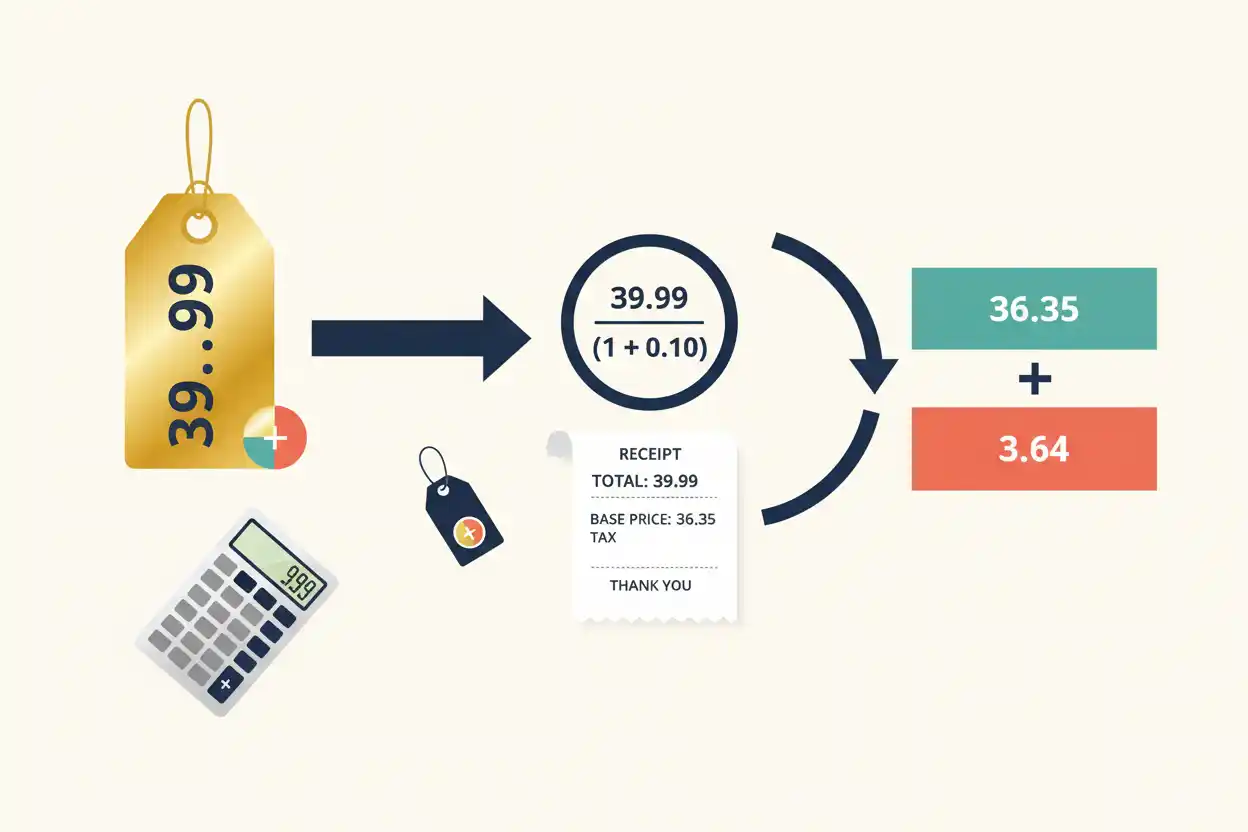

A tax-inclusive price already contains the applicable transaction tax.
If an item is displayed at $108 including an 8% tax, the pre-tax price is not $100.64 or $99.36 based on subtracting 8% from $108.
The correct calculation is:
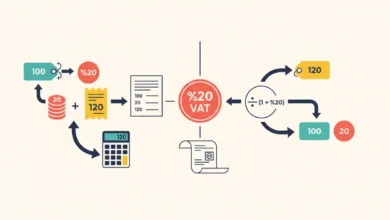
Tax-Exclusive Price = Tax-Inclusive Price ÷ (1 + Tax Rate)
Therefore:
$108 ÷ 1.08 = $100
The tax included in the price is:
$108 − $100 = $8
Understanding this reverse-percentage calculation prevents one of the most common errors in tax-inclusive pricing.
Tax-Inclusive Price Formula
Starting from a tax-exclusive price:
Tax-Inclusive Price = Tax-Exclusive Price × (1 + Tax Rate)
Suppose:
Pre-Tax Price = $250
Tax Rate = 8%
Then:
Tax-Inclusive Price = $250 × 1.08
= $270
The final displayed or checkout price is $270.
Reverse Formula
When the final total and rate are known:
Tax-Exclusive Price = Tax-Inclusive Price ÷ (1 + Tax Rate)
For:
Tax-Inclusive Price = $270
Tax Rate = 8%
Then:
$270 ÷ 1.08
= $250
Tax:
$270 − $250
= $20
Extract the Tax Amount Directly
The tax contained in a tax-inclusive price can also be found from:
Tax Amount = Tax-Inclusive Price − Tax-Exclusive Price
Using $270:
Tax Amount = $270 − $250
= $20
Another direct formula is:
Tax Amount = Inclusive Price × Tax Rate ÷ (1 + Tax Rate)
For $270 at 8%:
$270 × 0.08 ÷ 1.08
= $20
Why 8% of $270 Is Not the Included Tax
Suppose someone calculates:
$270 × 8%
= $21.60
That is wrong for an 8%-inclusive price.
The 8% rate applies to the pre-tax price of $250:
$250 × 8% = $20
The $270 total is already 108% of the pre-tax amount.
Tax as a Percentage of Inclusive Price
In the same example:
Tax = $20
Inclusive Total = $270
Tax as a percentage of final price:
$20 ÷ $270 × 100
≈ 7.41%
This does not mean the underlying tax rate is 7.41%.
The specified tax rate is still 8% of the $250 pre-tax base.
Example at 20%
Suppose the tax-inclusive price is:
$120
and the tax rate is:
20%
Pre-tax price:
$120 ÷ 1.20
= $100
Included tax:
$20
Tax is:
$20 ÷ $120 ≈ 16.67%
of the final total even though the rate applied to the pre-tax base is 20%.
Example at 5%
Suppose:
Tax-Inclusive Price = $525
Tax Rate = 5%
Pre-tax:
$525 ÷ 1.05
= $500
Tax:
$25
The reverse formula works at any positive percentage rate.
Tax-Inclusive Pricing With Several Units
Suppose one unit costs:
$54 Including 8% Tax
Pre-tax unit price:
$54 ÷ 1.08
= $50
For five units:
Inclusive total:
$54 × 5 = $270
Pre-tax total:
$50 × 5 = $250
Included tax:
$20
The unit and transaction-level calculations reconcile.
Find the Tax Rate From Inclusive and Exclusive Prices
Suppose:
Exclusive Price = $200
Inclusive Price = $216
Tax amount:
$16
Rate:
$16 ÷ $200 × 100
= 8%
Equivalently:
Rate = Inclusive Price ÷ Exclusive Price − 1
$216 ÷ $200 − 1
= 8%
Discount From a Tax-Inclusive Price
Suppose a tax-inclusive price is:
$216
and a 25% discount is applied directly to that displayed total.
Discount:
$216 × 25% = $54
New inclusive price:
$162
If the underlying tax rate remains 8%, the implied pre-tax price is:
$162 ÷ 1.08
= $150
Included tax:
$12
Pre-Tax Discount Example
Starting instead with:
Pre-Tax Price = $200
Apply a 25% discount:
$200 × 75% = $150
Then 8% tax:
$150 × 1.08
= $162
The result is the same because the same multiplicative factors are applied.
Real transaction rules still determine which discounts affect the taxable base.
Tax-Inclusive Price and Tax Deduction
A tax deduction reduces an income amount for an income-tax calculation.
The tax component embedded in a tax-inclusive retail price does not automatically become a personal income-tax deduction.
For example:
Inclusive Purchase = $108
Embedded Transaction Tax = $8
The existence of the $8 tax does not by itself establish that the buyer may deduct $8 from taxable income.
Tax-Inclusive Price and Tax Credit
Similarly, a tax credit reduces qualifying tax liability.
A consumer who qualifies for a $1,000 personal income-tax credit does not normally calculate:
$108 Purchase − $1,000 Credit
The credit and retail price belong to different calculations unless a specific subsidy or credit program explicitly connects them.
Tax-Inclusive Price and Taxable Income
Taxable income is an income-tax base.
Tax-inclusive price is a transaction-price measure.
Suppose a taxpayer buys a $540 tax-inclusive product.
That purchase does not automatically reduce taxable income by $540.
Whether any amount receives tax treatment depends on the applicable deduction or business-expense rules.
Tax-Inclusive Price and Tax-Loss Harvesting
Tax-loss harvesting focuses on realizing investment losses to manage capital-gain and tax exposure.
It should not be confused with extracting tax from a tax-inclusive retail price.
The word “tax” appears in both subjects, but the underlying calculations are unrelated.
Mixed Tax Rates
Suppose an invoice includes:
Item A:
$108 Including 8% Tax
Item B:
$210 Including 5% Tax
Extract Item A:
$108 ÷ 1.08 = $100 Pre-Tax
Tax:
$8
Extract Item B:
$210 ÷ 1.05 = $200 Pre-Tax
Tax:
$10
Combined:
Pre-Tax Value = $300
Total Tax = $18
Inclusive Total = $318
Using one blended rate to reverse both items individually would produce inaccurate component values.
Effective Tax Rate Across Mixed Items
Using the previous example:
Total Tax = $18
Total Pre-Tax Value = $300
Blended rate:
$18 ÷ $300
= 6%
Neither item actually uses a 6% rate.
It is only the weighted average across the two amounts.
Tax-Free Component Mixed With Inclusive Price
Suppose a $300 receipt contains:
$216 Including 8% Tax
and:
$84 Defined as Tax-Free
Taxable component before tax:
$216 ÷ 1.08
= $200
Tax:
$16
Combined pre-tax merchandise:
$200 + $84
= $284
Final receipt:
$300
The tax-free component should not be divided by 1.08.
Target Tax-Inclusive Price
Suppose a business wants a final displayed price of:
$99
including 10% tax.
Required pre-tax price:
$99 ÷ 1.10
= $90
Embedded tax:
$9
This approach is useful when customer-facing pricing must hit a specific final amount.
Target Profit Before Tax
Suppose the seller’s cost is:
$60
and desired pre-tax profit is:
$30
Required tax-exclusive selling price:
$90
At an 8% transaction tax:
Inclusive Customer Price = $90 × 1.08
= $97.20
The tax does not increase the seller’s modeled pre-tax $30 profit merely because the customer pays more.
Margin From an Inclusive Price
Suppose the customer pays:
$108 Including 8% Tax
Pre-tax selling price:
$100
Seller’s cost:
$70
Gross profit before other costs:
$100 − $70
= $30
Gross margin:
$30 ÷ $100
= 30%
Calculating margin from the full $108 would incorrectly treat embedded transaction tax as ordinary selling revenue under this simplified commercial example.
Increase in Tax Rate
Suppose pre-tax price remains $100.
At 5%:
Inclusive Price = $105
At 8%:
Inclusive Price = $108
Customer price increase:
$3
Percentage increase in final price:
$3 ÷ $105
≈ 2.86%
Although the tax rate rises by 3 percentage points, the final purchase price rises by only about 2.86% from its previous tax-inclusive level.
Reverse a Rate Increase
Suppose an inclusive price is $108 at 8% tax.
If the rate falls to 5% while the pre-tax price stays at $100:
New Inclusive Price = $105
The final price falls by:
$3
or:
$3 ÷ $108 ≈ 2.78%
Again, percentage changes depend on the starting base.
Sequential Charges
Suppose a $100 pre-tax price receives an 8% tax and then a separate 2% charge calculated from the tax-inclusive subtotal.
After tax:
$108
After additional 2%:
$108 × 1.02
= $110.16
The final amount represents a:
10.16%
increase over the original $100, not exactly 10%.
Sequential percentage charges compound when each new charge uses the already increased amount.
Common Tax-Inclusive Price Mistakes
The most common error is multiplying the final inclusive price by the tax rate to calculate the included tax.
Another is subtracting the tax percentage directly to recover the pre-tax price.
Businesses can also reverse mixed-rate invoices using one average percentage or mistakenly treat collected transaction tax as part of operating margin.
Frequently Asked Questions
What is a tax-inclusive price?
It is a displayed or final price that already contains the applicable transaction tax.
How do I calculate an inclusive price from a pre-tax price?
Inclusive Price = Exclusive Price × (1 + Tax Rate)
How do I extract the pre-tax price?
Exclusive Price = Inclusive Price ÷ (1 + Tax Rate)
How much tax is included in $108 at an 8% rate?
$8
Why isn’t it $8.64?
Because 8% applies to the $100 pre-tax base, not the $108 final total.
How do I extract the tax directly?
Included Tax = Inclusive Price × Tax Rate ÷ (1 + Tax Rate)
Can different items in one invoice have different embedded rates?
Yes.
Can a tax-free item be reversed using the tax factor?
No, not when that item is defined as tax-free.
Is embedded sales or transaction tax automatically an income-tax deduction?
No.
Does a personal tax credit reduce a tax-inclusive retail price?
Not unless a specific program explicitly connects the credit to that transaction.
Can I set a target final price and solve backward?
Yes.
Why divide instead of subtracting the tax percentage?
Because the final price represents more than 100% of the original pre-tax base.