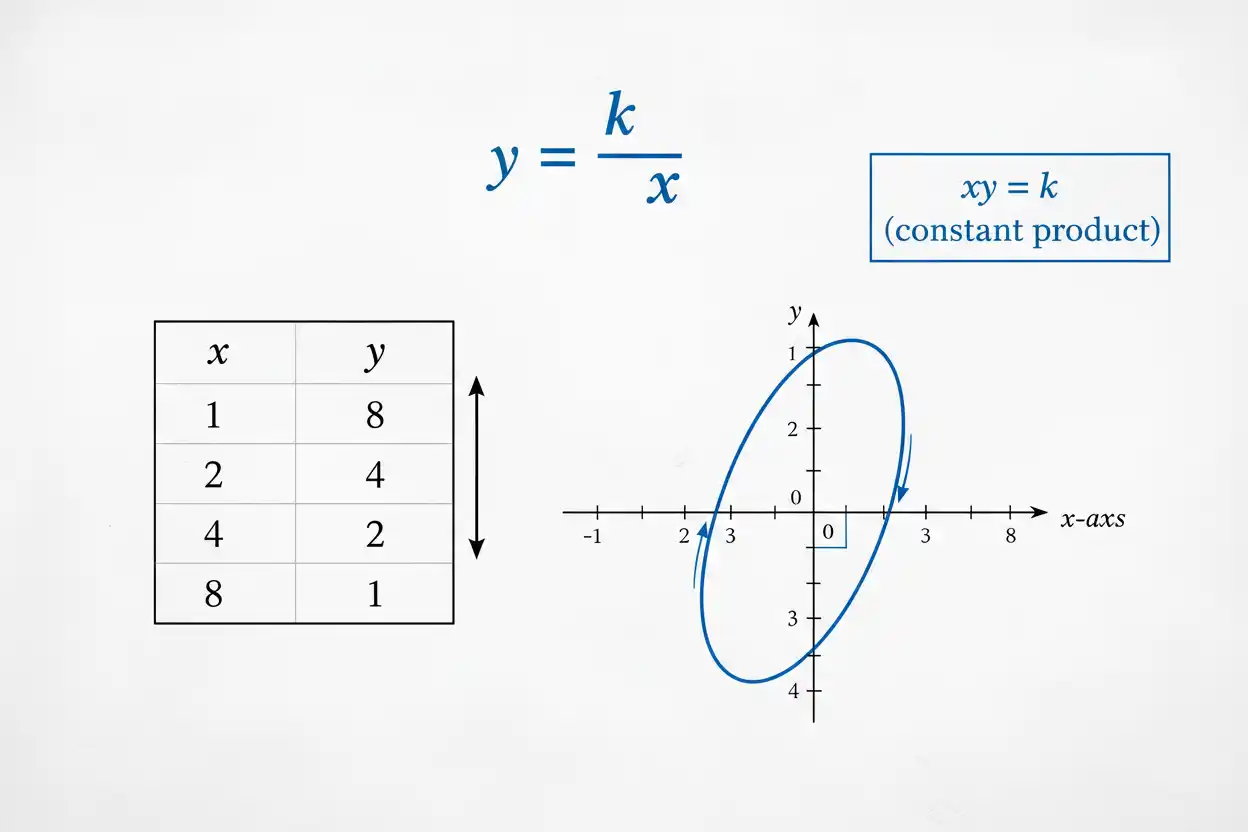
Inverse variation describes a relationship in which one variable changes in reciprocal proportion to another. When y varies inversely as x, their relationship is:
y = k / x
where k is a nonzero constant called the constant of variation.
The formula can also be written:
xy = k
This means the product of x and y remains constant.
For example, if:
y = 24 / x
then:
x = 2 ⇒ y = 12
and:
x = 4 ⇒ y = 6
Doubling x from 2 to 4 halves y from 12 to 6.
Inverse variation is therefore characterized by a constant product, rather than by a constant difference or a constant ratio between consecutive values.
What Is Inverse Variation?
Two variables x and y have an inverse variation relationship when y is proportional to the reciprocal of x.
Symbolically:
y ∝ 1/x
Introducing a constant of proportionality k gives the standard formula:
y = k / x
Multiplying both sides by x produces:
xy = k
Both equations describe the same relationship.
If k is fixed, increasing the magnitude of one variable causes the magnitude of the other to decrease in a corresponding reciprocal way.
Inverse variation is one of several variable relationships studied in algebra. It should not be confused with an inverse function, even though both use the word “inverse.”
Inverse Variation Formula
The main inverse variation formulas are:
y = k / x
xy = k
and, when x and y are known:
k = xy
where:
- x = first variable
- y = dependent variable
- k = constant of variation
Because division by zero is undefined:
x ≠ 0
If k is nonzero, y also cannot equal zero.
How to Find the Constant of Variation
If one pair of corresponding values is known, multiply them:
k = xy
Suppose y varies inversely as x and:
x = 6
y = 8
Then:
k = 6 × 8
k = 48
The inverse variation equation is therefore:
y = 48 / x
The same value k should result from every valid x-y pair belonging to that inverse variation.
Example 1: Find the Inverse Variation Equation
Suppose y varies inversely as x and:
y = 5 when x = 12
Start with:
y = k / x
Substitute the known values:
5 = k / 12
Multiply by 12:
k = 60
Therefore the equation is:
y = 60 / x
A useful check is the product:
xy = 12 × 5 = 60
which matches k.
Example 2: Find y From x
Suppose:
y = 72 / x
Find y when:
x = 9
Substitute:
y = 72 / 9
y = 8
So:
x = 9 ⇒ y = 8
Check the constant product:
9 × 8 = 72
Example 3: Find x From y**
Suppose:
y = 45 / x
and:
y = 5
Substitute:
5 = 45 / x
Multiply by x:
5x = 45
Divide by 5:
x = 9
The same problem could also be viewed as the linear equation 5x = 45 after the denominator has been cleared.
Constant Product Rule
The defining numerical property of inverse variation is:
xy = k
Suppose one inverse-variation pair is:
x₁ = 3, y₁ = 20
Then:
k = 3 × 20 = 60
Any other pair in the same relationship must satisfy:
x₂y₂ = 60
Therefore:
x₁y₁ = x₂y₂
This gives the useful proportion-like rule:
x₁y₁ = x₂y₂
For example, if:
x₁ = 3
y₁ = 20
x₂ = 12
then:
3(20) = 12y₂
60 = 12y₂
y₂ = 5
Increasing x by a factor of 4 decreased y by the same factor.
How Changes in x Affect y
For:
y = k / x
multiplying x by a positive factor c divides y by that same factor.
If x doubles:
x → 2x
then:
y → y/2
If x triples:
x → 3x
then:
y → y/3
If x is divided by 5:
x → x/5
then:
y → 5y
This reciprocal behavior is what gives inverse variation its name.
Example: Doubling and Tripling
Suppose:
xy = 100
At:
x = 10
we have:
y = 10
If x doubles to 20:
y = 100 / 20 = 5
So y is halved.
If x becomes 50:
y = 100 / 50 = 2
The product remains:
xy = 100
throughout.
How to Recognize Inverse Variation From a Table
Consider:
| x | y | xy |
|---|---|---|
| 2 | 30 | 60 |
| 3 | 20 | 60 |
| 5 | 12 | 60 |
| 10 | 6 | 60 |
The product xy is always 60.
Therefore:
k = 60
and:
y = 60 / x
The constant-product test is usually the fastest way to determine whether tabulated data represent inverse variation.
Example That Is Not Inverse Variation
Consider:
| x | y | xy |
|---|---|---|
| 2 | 12 | 24 |
| 3 | 8 | 24 |
| 4 | 7 | 28 |
The first two pairs produce a product of 24, but the third produces 28.
Because xy is not constant across the table, these values do not describe one exact inverse variation relationship.
Graph of an Inverse Variation
The basic inverse variation:
y = k / x
produces a reciprocal curve called a rectangular hyperbola.
When:
k > 0
x and y have the same sign. The graph has branches where both coordinates are positive and where both are negative.
When:
k < 0
x and y have opposite signs.
The graph approaches the coordinate axes but does not cross them when k ≠ 0.
In particular:
x = 0
is excluded because division by zero is undefined.
Also:
y = 0
cannot occur for a nonzero k because no finite nonzero x can make k/x equal zero.
Domain of a Basic Inverse Variation
For:
y = k / x
with k ≠ 0, the basic real-number restriction is:
x ≠ 0
In interval notation, that domain can be represented as:
(-∞, 0) ∪ (0, ∞)
The notation rules behind excluded points and disconnected intervals are explained more fully under inequalities.
In practical applications, additional restrictions may apply. Time, distance, speed, number of workers, or physical dimensions may be required to remain positive.
Inverse Variation With Positive Quantities
Many applications use only:
x > 0
and:
y > 0
For example, suppose the time t required to complete a fixed task varies inversely with the number n of equally productive workers:
t = k / n
If 4 workers require 15 hours:
k = 4 × 15
k = 60
With 6 workers:
t = 60 / 6
t = 10
Under the idealized model, increasing the number of workers reduces the required time.
The positive condition on n is an inequality constraint imposed by the application, rather than part of the generic inverse-variation formula itself.
Word Problem: Speed and Travel Time
For a fixed distance, travel time varies inversely with speed.
Suppose a journey takes 6 hours at 80 km/h.
Let:
t = k / v
where t is time and v is speed.
Find k:
k = tv
k = 6 × 80
k = 480
So:
t = 480 / v
At 120 km/h:
t = 480 / 120
t = 4
Under the constant-distance model, increasing speed from 80 km/h to 120 km/h reduces the travel time from 6 hours to 4 hours.
Word Problem: Number of Workers
Suppose the number of days d required for a fixed idealized job varies inversely with the number of workers w.
If 8 workers require 15 days:
d = k / w
Find k:
k = 8 × 15
k = 120
Therefore:
d = 120 / w
If 12 workers perform the same job at the same rate:
d = 120 / 12
d = 10
The inverse model assumes worker productivity remains constant and that the work can be divided efficiently.
Inverse Variation vs Direct Variation
Inverse variation has the form:
y = k / x
Direct variation has the form:
y = kx
In direct variation, the ratio y/x is constant.
In inverse variation, the product xy is constant.
For example, with direct variation, doubling x doubles y.
With inverse variation, doubling x halves y, assuming the same nonzero variation constant.
Recognizing whether a problem describes a constant ratio or a constant product prevents the wrong formula from being used.
Inverse Variation vs Inverse Function
An inverse function reverses a function’s input-output mapping.
For example, if:
f(x) = 2x + 3
then:
f⁻¹(x) = (x – 3) / 2
Inverse variation, by contrast, describes a reciprocal proportional relationship:
y = k / x
An inverse-variation equation may itself define a function, but the phrase inverse variation does not mean “the inverse of a function.”
Inverse Variation vs Joint Variation
A joint variation relationship involves a quantity varying directly with the product of two or more variables.
A basic joint variation might be:
z = kxy
Inverse variation instead places a variable in the denominator:
y = k / x
Some advanced variation models combine direct, joint, and inverse relationships, but a basic inverse-variation problem should remain focused on its reciprocal relationship.
Solving Inverse Variation With Two Data Pairs
Because:
x₁y₁ = x₂y₂
you can often solve a second pair without explicitly writing k as a separate step.
Suppose y = 18 when x = 4. Find y when x = 12.
Write:
4(18) = 12y
72 = 12y
y = 6
The same result follows from first finding:
k = 72
and then calculating:
y = 72 / 12 = 6
Both approaches are valid.
Inverse Variation With Negative Values
Inverse variation is not restricted to positive numbers unless the context imposes that condition.
Suppose:
y = -20 / x
If:
x = 4
then:
y = -5
If:
x = -10
then:
y = 2
In both cases:
xy = -20
The sign of k determines whether x and y have the same or opposite signs.
Can k Equal Zero?
In the standard definition of inverse variation, k is normally taken to be nonzero.
If:
k = 0
then:
y = 0 / x = 0
for every allowed x.
That produces the constant function y = 0 rather than the usual reciprocal behavior associated with inverse variation.
Therefore, for a genuine inverse variation:
k ≠ 0
Inverse Variation and Proportional Reasoning
The statement:
y ∝ 1/x
means y is directly proportional to the reciprocal of x.
This leads to:
y = k(1/x)
which simplifies to:
y = k/x
Understanding this proportional structure is useful because not every situation in which one quantity decreases while another increases is inverse variation. The relationship must satisfy a constant product.
Common Inverse Variation Mistakes
Using y = kx
That is the formula for direct variation, not inverse variation.
For inverse variation:
y = k/x
Adding x and y to Find k
The constant is found from the product:
k = xy
not from x + y.
Assuming Any Opposite Movement Is Inverse Variation
If x increases while y decreases, the relationship is not automatically inverse. The product xy must remain constant.
Forgetting That x Cannot Be Zero
The expression:
k/x
is undefined at x = 0.
Confusing Inverse Variation With an Inverse Function
The two terms describe different ideas. One is a reciprocal proportional relationship; the other reverses the mapping of a one-to-one function.
Forgetting Units in Applications
The units of k depend on the variables. If time is measured in hours and speed in kilometers per hour, their product has the corresponding compound units required by the model.
Worked Example
Suppose y varies inversely as x. When:
x = 15
y = 8
Find y when x = 24.
Start with:
y = k/x
Find k:
k = xy
k = 15 × 8
k = 120
Therefore:
y = 120/x
Now substitute x = 24:
y = 120/24
y = 5
Check:
15 × 8 = 120
and:
24 × 5 = 120
The constant product confirms the answer.
Frequently Asked Questions
What is inverse variation?
Inverse variation is a relationship in which one variable is proportional to the reciprocal of another.
Its standard form is:
y = k/x
What is the inverse variation formula?
The main formulas are:
y = k/x
and:
xy = k
where k is the constant of variation.
How do you find k in inverse variation?
Multiply corresponding values of x and y:
k = xy
If x = 5 and y = 12:
k = 5 × 12 = 60
How do you know whether a table shows inverse variation?
Calculate xy for each pair. If the product remains the same nonzero constant throughout, the data represent inverse variation.
What happens to y if x doubles?
For a basic inverse variation with the same k, doubling x halves y.
What happens to y if x is tripled?
Tripling x divides y by 3.
Can x equal zero in inverse variation?
No. The formula y = k/x involves division by x, so x = 0 is undefined.
Can inverse variation have negative values?
Yes. Unless the application restricts the variables to positive values, x, y, or k may be negative. The constant-product relationship must still hold.
Is inverse variation the same as an inverse function?
No. Inverse variation has a reciprocal form such as y = k/x. An inverse function reverses the input-output mapping of another function.
What is the difference between direct and inverse variation?
Direct variation uses:
y = kx
and has a constant ratio y/x.
Inverse variation uses:
y = k/x
and has a constant product xy.
What is the graph of inverse variation?
The graph of y = k/x is a rectangular hyperbola. For nonzero k, it approaches but does not cross the x-axis or y-axis.
What is the two-pair formula for inverse variation?
If two pairs belong to the same inverse variation:
x₁y₁ = x₂y₂
because both products equal the same constant k.