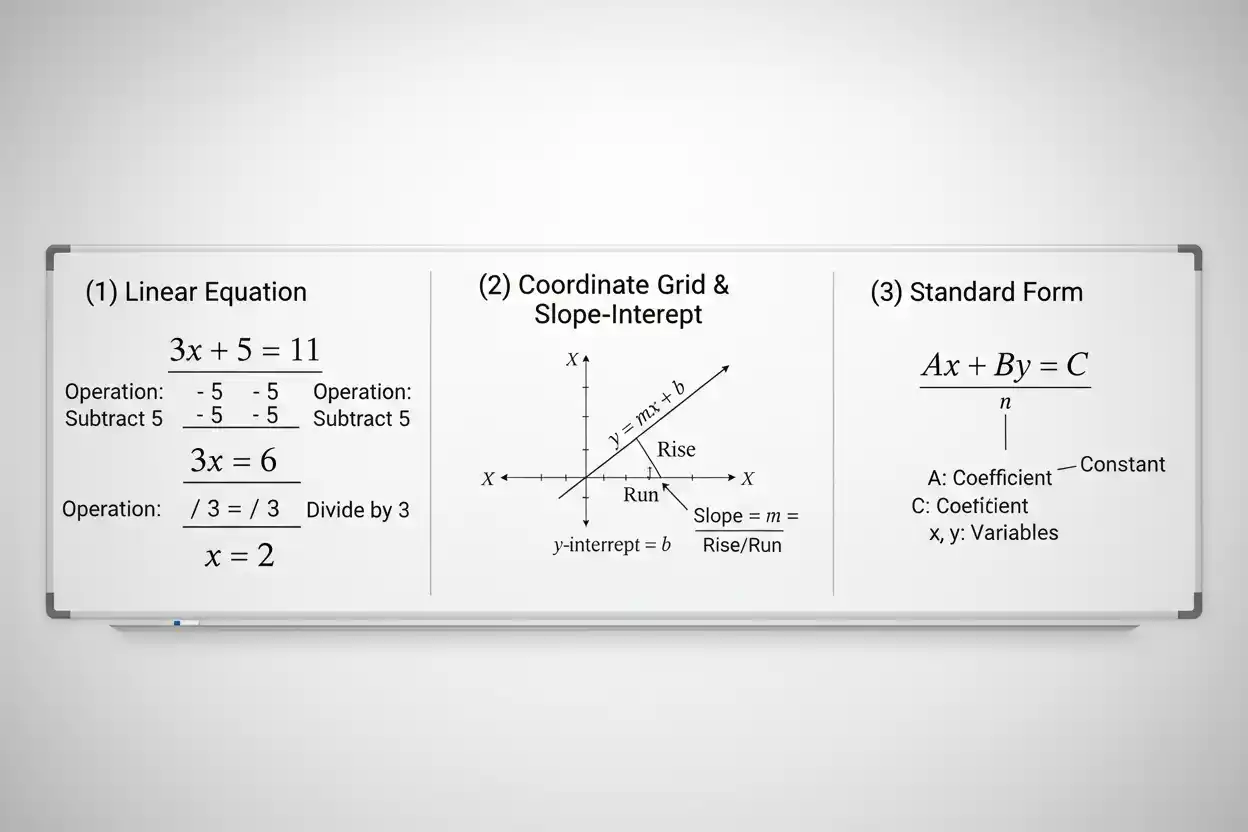
A linear equation is an equation in which the variable has a highest power of 1. In one variable, a common form is:
ax + b = c
where a, b, and c are constants and:
a ≠ 0
For example:
3x + 5 = 20
is a linear equation.
Subtract 5:
3x = 15
Divide by 3:
x = 5
A linear equation can also involve two variables. Common forms include:
y = mx + b
and:
Ax + By = C
When graphed in two variables, a linear equation represents a straight line.
What Is a Linear Equation?
A linear equation states that two linear expressions are equal.
Examples include:
2x + 7 = 19
5x – 4 = 3x + 10
y = 4x – 3
2x + 5y = 20
Each variable appears only to the first power.
Expressions such as:
x² + 3 = 7
or:
1/x = 5
are not linear equations in x because they involve a power other than 1 or place the variable in a denominator.
Linear equations are foundational in algebra because many more specialized problems eventually reduce to isolating an unknown through the same balancing operations.
Linear Equation Formula
A one-variable linear equation can be represented as:
ax + b = c
Solving for x gives:
x = (c – b) / a
provided:
a ≠ 0
For example:
4x + 7 = 31
Using the rearranged formula:
x = (31 – 7) / 4
x = 24 / 4
x = 6
This formula summarizes the algebra, but solving step by step is often clearer when an equation contains parentheses, fractions, or variables on both sides.
Standard Form of a Linear Equation in One Variable
Another common form is:
ax + b = 0
Solving gives:
x = -b/a
For example:
5x – 20 = 0
Then:
x = -(-20)/5
x = 20/5
x = 4
This form is especially convenient when all terms have already been moved to one side of the equation.
Rules for Solving Linear Equations
The central principle is to preserve equality.
If:
a = b
then adding the same quantity c to both sides gives:
a + c = b + c
Subtracting the same quantity also preserves equality:
a – c = b – c
Multiplying both sides by the same quantity preserves equality:
ac = bc
and dividing both sides by the same nonzero quantity gives:
a/c = b/c
These operations allow the variable to be isolated without changing the solution set.
Unlike an inequality, an equation does not reverse a comparison sign when multiplied or divided by a negative number because there is no order relation to reverse. Equality remains equality.
How to Solve a Linear Equation
For a basic equation:
ax + b = c
the usual process is:
First remove the constant term from the variable side:
ax = c – b
Then divide by the coefficient a:
x = (c – b) / a
For example:
7x + 9 = 44
Subtract 9:
7x = 35
Divide by 7:
x = 5
Check:
7(5) + 9 = 44
35 + 9 = 44
44 = 44
The solution is correct.
Example 1: Linear Equation With Addition
Solve:
x + 8 = 15
Subtract 8 from both sides:
x = 7
Check:
7 + 8 = 15
Example 2: Linear Equation With Subtraction
Solve:
x – 11 = 6
Add 11:
x = 17
Check:
17 – 11 = 6
Example 3: Linear Equation With Multiplication
Solve:
6x = 54
Divide by 6:
x = 9
Example 4: Linear Equation With Division
Solve:
x / 5 = 8
Multiply both sides by 5:
x = 40
Example 5: Two-Step Linear Equation
Solve:
4x – 7 = 21
Add 7:
4x = 28
Divide by 4:
x = 7
The order matters because the goal is to undo the operations surrounding x.
Variables on Both Sides
A linear equation may contain the variable on both sides.
For example:
5x + 3 = 2x + 18
Subtract 2x:
3x + 3 = 18
Subtract 3:
3x = 15
Divide by 3:
x = 5
Check:
Left side:
5(5) + 3 = 28
Right side:
2(5) + 18 = 28
Both sides agree.
Which Side Should the Variable Be On?
Either side is mathematically valid. A convenient strategy is to move the smaller variable term toward the larger one when doing so avoids a negative coefficient.
For:
8x + 2 = 3x + 22
subtracting 3x gives:
5x + 2 = 22
which is immediately convenient.
You could instead subtract 8x:
2 = -5x + 22
and still reach the same answer.
The choice affects convenience, not correctness.
Linear Equations With Parentheses
Consider:
3(x + 4) = 27
One approach is to divide by 3 first:
x + 4 = 9
Subtract 4:
x = 5
You could also distribute:
3x + 12 = 27
3x = 15
x = 5
Both methods are valid.
Distributive Property in a Linear Equation
Solve:
4(2x – 3) + 5 = 25
Distribute 4:
8x – 12 + 5 = 25
Combine constants:
8x – 7 = 25
Add 7:
8x = 32
Divide by 8:
x = 4
Substitution confirms:
4(2(4) – 3) + 5
= 4(8 – 3) + 5
= 20 + 5
= 25
Combining Like Terms
Some equations should be simplified before the variable is isolated.
Solve:
3x + 5 + 2x – 9 = 16
Combine x terms:
5x – 4 = 16
Add 4:
5x = 20
Divide by 5:
x = 4
Combining like terms early usually makes the equation easier to read and reduces arithmetic errors.
Linear Equations With Fractions
Consider:
x/3 + 2 = 7
Subtract 2:
x/3 = 5
Multiply by 3:
x = 15
For more complicated fractional equations, multiplying every term by the least common denominator can remove the fractions.
Suppose:
x/4 + x/2 = 9
Multiply every term by 4:
x + 2x = 36
3x = 36
x = 12
Check:
12/4 + 12/2 = 3 + 6 = 9
Linear Equations With Decimals
Solve:
0.4x + 1.2 = 5.2
Subtract 1.2:
0.4x = 4
Divide by 0.4:
x = 10
You may also multiply the entire original equation by 10:
4x + 12 = 52
which gives the same solution.
Removing decimals can make hand calculations easier.
Equations With One Solution
Most ordinary linear equations have exactly one solution.
For example:
3x + 4 = 19
leads to:
x = 5
This occurs when simplification produces a nonzero coefficient multiplying x.
In the form:
ax + b = c
with a ≠ 0, there is exactly one solution:
x = (c – b)/a
Linear Equations With No Solution
Some equations simplify to a contradiction.
Consider:
4x + 3 = 4x + 9
Subtract 4x:
3 = 9
This is false.
Therefore the equation has:
No solution
Geometrically, a comparable two-variable situation can occur when two distinct parallel lines never intersect.
Linear Equations With Infinitely Many Solutions
An equation may simplify to a statement that is always true.
Consider:
5(x + 2) = 5x + 10
Expand:
5x + 10 = 5x + 10
Subtract 5x:
10 = 10
This identity is true for every real x.
Therefore the equation has:
Infinitely many solutions
The variable disappears because both sides represent the same expression.
How to Identify One, None, or Infinitely Many Solutions
After simplifying a linear equation:
If you get:
x = number
there is one solution.
If you get a false numerical statement such as:
4 = 9
there is no solution.
If you get a true statement such as:
7 = 7
there are infinitely many solutions.
This classification is especially useful for equations with variables on both sides.
Linear Equation in Two Variables
A linear equation may contain two variables.
A common form is:
Ax + By = C
where A and B are not both zero.
For example:
2x + 3y = 12
Each ordered pair (x, y) satisfying the equation is a solution.
If x = 0:
3y = 12
y = 4
giving:
(0, 4)
If y = 0:
2x = 12
x = 6
giving:
(6, 0)
The complete solution set forms a straight line.
Slope-Intercept Form
A two-variable linear equation is often written:
y = mx + b
where:
- m = slope
- b = y-intercept
For example:
y = 2x + 3
has slope:
m = 2
and y-intercept:
b = 3
For every increase of 1 in x, y increases by 2.
This form describes the geometry of a straight line rather than the step-by-step process of solving a one-variable linear equation.
Standard Form in Two Variables
Another common representation is:
Ax + By = C
For example:
3x + 2y = 12
To rewrite it in slope-intercept form:
2y = -3x + 12
Divide by 2:
y = -(3/2)x + 6
Therefore:
m = -3/2
and:
b = 6
Different forms can represent the same line.
Checking a Linear Equation Solution
For a one-variable equation, substitute the proposed value into the original equation.
Suppose:
6x – 5 = 31
The calculated solution is:
x = 6
Check:
6(6) – 5 = 31
36 – 5 = 31
31 = 31
For a two-variable equation, substitute both coordinates.
Suppose:
2x + y = 9
Test:
(3, 3)
Then:
2(3) + 3 = 9
9 = 9
So (3, 3) is a solution.
Linear Equation vs Inequality
A linear equation uses equality:
2x + 3 = 11
Its solution is:
x = 4
A corresponding inequality might be:
2x + 3 > 11
whose solution is:
x > 4
The equation identifies the boundary value. The inequality identifies a range of values on one or both sides of a boundary.
Linear Equation vs Joint Variation
A joint variation relationship commonly has a multiplicative form such as:
z = kxy
This is not generally a linear equation in all of its variables considered simultaneously because it contains a product xy.
However, if every quantity except one is known, substituting those constants can reduce the problem to a simple linear equation in the remaining unknown.
For example:
60 = 3(5)y
becomes:
60 = 15y
which is linear in y.
Linear Equation vs Inverse Variation
An inverse variation equation commonly has the form:
y = k/x
Because x appears in the denominator, this is not a linear equation in x and y.
After particular values are substituted and denominators are cleared, however, an individual calculation may reduce to a linear equation.
The underlying relationship remains inverse variation.
Linear Equations and Inverse Functions
Finding an inverse function often requires solving a linear equation for y.
For example, starting from:
x = 3y + 6
subtract 6:
x – 6 = 3y
divide by 3:
y = (x – 6)/3
The equation-solving steps are ordinary linear algebra even though the broader task is finding an inverse.
Linear vs Logarithmic Equations
A linear equation contains its variable to the first power in a linear expression.
For example:
4x – 7 = 13
A logarithmic equation places the unknown inside a logarithm, such as:
log(x) = 2
The latter requires logarithmic or exponential properties rather than only linear-equation rules.
A logarithmic problem can still produce a linear equation after the logarithmic structure has been simplified, but the two equation types have different core intents.
Linear Equations and Partial Fractions
Partial fractions concern decomposing certain rational expressions into simpler fractions.
That process is different from solving a linear equation. However, the constants in a partial-fraction decomposition are often determined by comparing coefficients and solving resulting linear equations.
The linear equation remains the elementary equation-solving component inside the broader rational-expression method.
Common Linear Equation Mistakes
Performing an Operation on Only One Side
From:
x + 5 = 12
subtracting 5 must affect both sides:
x + 5 – 5 = 12 – 5
so:
x = 7
Changing only one side destroys the equality.
Incorrectly Distributing a Negative Sign
For:
-2(x – 4)
the correct expansion is:
-2x + 8
not:
-2x – 8
Combining Unlike Terms
Terms such as:
3x
and:
5
cannot be combined into 8x.
Only like terms may be combined.
Dividing Only One Term
If:
4x + 8 = 20
you cannot divide only 4x by 4 while leaving 8 unchanged unless you first isolate the variable term.
Either subtract 8 first or divide every term by 4.
Losing a Fraction Sign
For:
3x = 10
the solution is:
x = 10/3
There is no requirement that a linear equation have an integer solution.
Failing to Check for No Solution or Infinite Solutions
If the variable disappears, inspect the resulting numerical statement instead of assuming an error occurred.
Worked Linear Equation Example
Solve:
4(2x – 3) – 5 = 3x + 18
Distribute:
8x – 12 – 5 = 3x + 18
Combine constants:
8x – 17 = 3x + 18
Subtract 3x:
5x – 17 = 18
Add 17:
5x = 35
Divide by 5:
x = 7
Check the original equation.
Left side:
4(2(7) – 3) – 5
= 4(14 – 3) – 5
= 44 – 5
= 39
Right side:
3(7) + 18
= 21 + 18
= 39
Both sides equal 39, so:
x = 7
is correct.
Frequently Asked Questions
What is a linear equation?
A linear equation is an equation in which each variable appears only to the first power and is not multiplied by another variable in a way that makes the equation nonlinear.
What is the basic linear equation formula?
A common one-variable form is:
ax + b = c
with a ≠ 0.
Its solution is:
x = (c – b)/a
What is the standard form of a linear equation in one variable?
It can be written:
ax + b = 0
which gives:
x = -b/a
when a ≠ 0.
What is the standard form in two variables?
A common standard form is:
Ax + By = C
where A and B are not both zero.
What is slope-intercept form?
Slope-intercept form is:
y = mx + b
where m is the slope and b is the y-intercept.
How do you solve a linear equation?
Simplify both sides, collect variable terms as needed, move constants, and divide by the variable’s coefficient. Perform equivalent operations on both sides throughout.
Can a linear equation have no solution?
Yes. If simplification leads to a false statement such as:
3 = 8
the original equation has no solution.
Can a linear equation have infinitely many solutions?
Yes. If both sides simplify to the same expression and produce a true identity such as:
5 = 5
every permitted value of the variable is a solution.
Can a linear equation have a fractional answer?
Yes. For example:
3x = 8
has:
x = 8/3
A solution does not have to be an integer.
How do you check a linear equation answer?
Substitute the proposed value into the original equation. If both sides evaluate to the same number, the value satisfies the equation.
Is y = 1/x a linear equation?
No. The variable x appears in a denominator, so y = 1/x is not linear.
Is x² + 2x = 5 a linear equation?
No. The x² term makes it a quadratic equation rather than a linear equation.