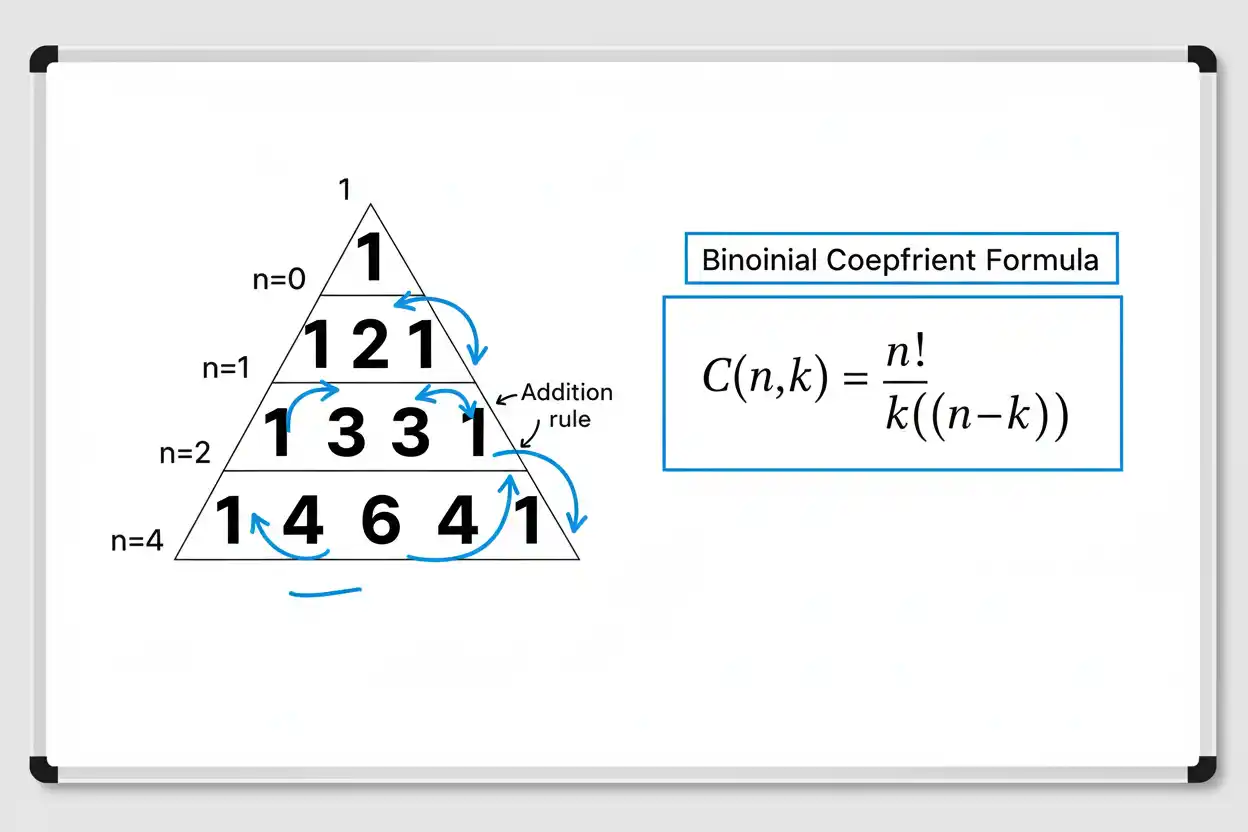

Pascal triangle is a triangular arrangement of numbers in which each interior number equals the sum of the two numbers directly above it. The triangle begins with 1 at the top, and every row starts and ends with 1.
The first several rows are:
1
1 1
1 2 1
1 3 3 1
1 4 6 4 1
1 5 10 10 5 1
1 6 15 20 15 6 1
If the top row is called row 0, the value in row n and position k can be calculated with:
C(n,k) = n! / [k!(n – k)!]
where:
- n = row number
- k = position within the row, beginning with 0
- ! = factorial
Pascal triangle appears throughout algebra, particularly when working with binomial coefficients and polynomial expansions.
What Is Pascal Triangle?
Pascal triangle is an infinite numerical pattern built from a simple addition rule.
Start with:
1
The next row has 1 at both ends:
1 1
Every later row also begins and ends with 1. Each number between those endpoints is found by adding the two adjacent values above it.
For example, row 4 is:
1 4 6 4 1
The 6 in the middle comes from:
3 + 3 = 6
using the two values directly above it in row 3.
Despite the simple construction rule, Pascal triangle contains many useful patterns involving combinations, powers of 2, polynomial coefficients, symmetry, and number sequences.
How to Build Pascal Triangle
Begin with row 0:
1
For row 1, place 1 at both ends:
1 1
To create row 2, keep 1 at each edge and add the two numbers above the interior position:
1 2 1
because:
1 + 1 = 2
For row 3:
1 3 3 1
The interior values come from:
1 + 2 = 3
and:
2 + 1 = 3
For row 4:
1 4 6 4 1
because:
1 + 3 = 4
3 + 3 = 6
3 + 1 = 4
This same rule can continue indefinitely.
Pascal Triangle Addition Rule
The fundamental construction rule is:
Current entry = above-left entry + above-right entry
Using indexed notation:
C(n,k) = C(n – 1,k – 1) + C(n – 1,k)
for interior entries.
The edge values are always:
C(n,0) = 1
and:
C(n,n) = 1
For example:
C(5,2) = C(4,1) + C(4,2)
From row 4:
C(4,1) = 4
C(4,2) = 6
Therefore:
C(5,2) = 4 + 6 = 10
which matches row 5:
1 5 10 10 5 1
Pascal Triangle Formula
You do not have to construct every preceding row to find a particular entry.
The direct formula is:
C(n,k) = n! / [k!(n – k)!]
This is the combinations formula for the binomial coefficient in position k of row n.
For example, find the third entry of row 6.
Because positions begin with k = 0, the third entry corresponds to:
n = 6
k = 2
Then:
C(6,2) = 6! / [2!(6 – 2)!]
C(6,2) = 6! / (2!4!)
Expand only what is necessary:
C(6,2) = (6 × 5) / (2 × 1)
C(6,2) = 30 / 2
C(6,2) = 15
Row 6 confirms the result:
1 6 15 20 15 6 1
What Does Factorial Mean?
The symbol:
n!
means the product of all positive integers from n down to 1.
For example:
5! = 5 × 4 × 3 × 2 × 1 = 120
and:
3! = 3 × 2 × 1 = 6
By definition:
0! = 1
That definition makes the Pascal triangle formula work correctly at the edges.
For example:
C(5,0) = 5! / [0!5!]
C(5,0) = 1
and:
C(5,5) = 5! / [5!0!]
C(5,5) = 1
This explains algebraically why every row begins and ends with 1.
Row Numbering in Pascal Triangle
Two row-numbering conventions are common.
In mathematics, the top row is usually called row 0:
| Row | Values |
|---|---|
| 0 | 1 |
| 1 | 1 1 |
| 2 | 1 2 1 |
| 3 | 1 3 3 1 |
| 4 | 1 4 6 4 1 |
| 5 | 1 5 10 10 5 1 |
Some elementary explanations call the top line row 1 instead.
This difference can create apparent disagreements. When using:
C(n,k) = n! / [k!(n – k)!]
the standard convention is to treat the top as row 0.
How Many Entries Are in Each Row?
Row n contains:
n + 1 entries
For example:
- Row 0 contains 1 entry.
- Row 1 contains 2 entries.
- Row 4 contains 5 entries.
- Row 10 contains 11 entries.
This follows directly from the positions:
k = 0, 1, 2, …, n
Example 1: Find an Entry Using the Triangle
Find the middle entry of row 4.
Row 4 is:
1 4 6 4 1
Therefore the middle entry is:
6
You can also calculate it as:
C(4,2) = 4! / [2!2!]
C(4,2) = 24 / (2 × 2)
C(4,2) = 6
Both methods agree.
Example 2: Find an Entry Without Building the Triangle
Find C(8,3).
Use:
C(8,3) = 8! / [3!5!]
Cancel 5!:
C(8,3) = (8 × 7 × 6) / (3 × 2 × 1)
C(8,3) = 336 / 6
C(8,3) = 56
So the fourth entry in row 8 is:
56
Symmetry Rule
Every row of Pascal triangle is symmetric.
For example:
1 6 15 20 15 6 1
reads the same from left to right and right to left.
Algebraically:
C(n,k) = C(n,n – k)
For example:
C(8,2) = C(8,6)
Calculate either side:
C(8,2) = (8 × 7) / 2 = 28
Therefore:
C(8,6) = 28
This symmetry can reduce the amount of calculation needed for entries near the right side of a row.
Sum of a Pascal Triangle Row
The sum of the entries in row n is:
2^n
For example, row 4 is:
1 + 4 + 6 + 4 + 1
The sum is:
16
and:
2^4 = 16
For row 5:
1 + 5 + 10 + 10 + 5 + 1 = 32
and:
2^5 = 32
Therefore:
Sum of row n = 2^n
This provides a useful check when constructing a row manually.
Example: Check a Row With the Sum Rule
Consider row 6:
1 6 15 20 15 6 1
Add the entries:
1 + 6 + 15 + 20 + 15 + 6 + 1 = 64
Since:
2^6 = 64
the row sum is consistent.
Pascal Triangle and the Binomial Theorem
One of the most important uses of Pascal triangle is generating the coefficients in binomial expansions.
The coefficients in row n correspond to the expansion of:
(a + b)^n
For example, row 4 is:
1 4 6 4 1
so those values become the coefficients of the terms in the expansion of (a + b)^4.
The underlying expansion formula and exponent pattern are covered in the binomial theorem. Pascal triangle provides a quick way to obtain its coefficients for relatively small nonnegative integer powers.
The distinction matters: Pascal triangle is the numerical coefficient structure, while the binomial theorem describes how those coefficients combine with powers of the two terms.
Example: Coefficients of a Binomial Expansion
Suppose you need the coefficients associated with:
(x + y)^5
Use row 5:
1 5 10 10 5 1
The coefficients are therefore:
1, 5, 10, 10, 5, 1
Pascal triangle supplies the coefficients immediately without calculating each combination independently.
Diagonal Patterns
Pascal triangle also contains recognizable patterns along its diagonals.
The outermost diagonal contains:
1, 1, 1, 1, 1, …
The next diagonal contains the counting numbers:
1, 2, 3, 4, 5, 6, …
The next diagonal contains:
1, 3, 6, 10, 15, 21, …
These are triangular numbers.
These patterns follow naturally from the way neighboring entries are repeatedly added.
Powers of 11 and Early Rows
The first few rows visually resemble powers of 11:
11^0 = 1
11^1 = 11
11^2 = 121
11^3 = 1331
The digits correspond to rows 0 through 3.
For row 4, the entries are:
1 4 6 4 1
and:
11^4 = 14641
so the pattern still appears directly.
For larger rows, entries become greater than 9 and carrying is required. Therefore, reading each entry as a single decimal digit is only a convenient early-row pattern, not the general definition of Pascal triangle.
Odd and Even Number Pattern
If odd entries are marked one way and even entries another, Pascal triangle develops a repeating triangular pattern.
For example:
1
1 1
1 2 1
1 3 3 1
1 4 6 4 1
The odd-even structure becomes increasingly intricate as additional rows are constructed.
This pattern follows from properties of binomial coefficients rather than from a separate construction rule.
Pascal Triangle and Polynomial Coefficients
Pascal triangle is strongly connected with polynomial coefficients, but it is not itself a method for solving a polynomial equation.
For example, a polynomial expression may contain coefficients generated by a binomial expansion. Pascal triangle can identify those coefficients, while solving a polynomial equation asks for the values of a variable that make the polynomial equal to zero or another specified value.
Keeping these roles separate prevents a coefficient tool from being confused with an equation-solving method.
Why the Entries Are Integers
Although the formula:
C(n,k) = n! / [k!(n – k)!]
contains division, every Pascal triangle entry is an integer.
That occurs because C(n,k) counts the number of ways to choose k objects from n objects without regard to order.
For example:
C(5,2) = 10
means there are 10 ways to choose 2 objects from a set of 5.
This counting interpretation is also why the entries are called binomial coefficients or combination numbers.
Finding a Missing Entry
Suppose part of the triangle is:
1 5 10 10 5 1
and the next row begins:
1 6 ?
The missing value is obtained from the two entries above:
5 + 10 = 15
So:
? = 15
No factorial calculation is needed when the preceding row is already available.
Example: Construct the Next Row
Given:
1 4 6 4 1
construct the next row.
Start and end with 1.
Then add neighboring pairs:
1 + 4 = 5
4 + 6 = 10
6 + 4 = 10
4 + 1 = 5
Therefore the next row is:
1 5 10 10 5 1
Common Pascal Triangle Mistakes
Starting a Row With the Wrong Value
Every row starts and ends with:
1
These edge values do not come from adding two visible entries above them.
Adding the Wrong Pair
Each interior number uses the two entries diagonally above it, not two entries from the same row.
Mixing Row-Numbering Conventions
If the formula uses n = 5, confirm whether you mean row 5 under the standard row-0 convention.
Using k Outside the Row
For row n:
0 ≤ k ≤ n
A position outside this range is not an ordinary entry in that row.
Forgetting Factorials in the Formula
The correct formula is:
C(n,k) = n! / [k!(n – k)!]
not:
n / [k(n – k)]
Assuming Pascal Triangle Solves a Polynomial
It supplies useful coefficients but does not by itself find the roots of a polynomial equation.
Worked Pascal Triangle Example
Find the fifth entry in row 9.
Using positions beginning with k = 0, the fifth entry has:
n = 9
k = 4
Apply the formula:
C(9,4) = 9! / [4!5!]
Cancel 5!:
C(9,4) = (9 × 8 × 7 × 6) / (4 × 3 × 2 × 1)
Calculate the numerator:
9 × 8 × 7 × 6 = 3024
Calculate the denominator:
4 × 3 × 2 × 1 = 24
Then:
C(9,4) = 3024 / 24
C(9,4) = 126
So the fifth entry of row 9 is:
126
By symmetry:
C(9,5) = 126
as well.
Frequently Asked Questions
What is Pascal triangle?
Pascal triangle is a triangular arrangement of numbers in which each interior entry is the sum of the two entries directly above it. Every row begins and ends with 1.
What is the Pascal triangle formula?
Using row 0 at the top:
C(n,k) = n! / [k!(n – k)!]
This calculates the entry in row n at position k.
How do you make the next row of Pascal triangle?
Place 1 at both ends, then add each neighboring pair from the preceding row to generate the interior entries.
What is row 5 of Pascal triangle?
Using the standard row-0 convention:
1 5 10 10 5 1
Why does every Pascal triangle row start and end with 1?
The edge entries are C(n,0) and C(n,n). Both equal 1 under the binomial coefficient formula.
Why is Pascal triangle symmetric?
The entries satisfy:
C(n,k) = C(n,n – k)
so corresponding values an equal distance from opposite ends of a row are identical.
What is the sum of row n?
The entries in row n sum to:
2^n
For example, row 6 sums to 64 because 2^6 = 64.
How is Pascal triangle related to binomial coefficients?
Every entry C(n,k) is a binomial coefficient. Row n supplies the coefficients associated with the nth power of a binomial.
How many numbers are in row n?
Row n contains:
n + 1
entries when the top of the triangle is row 0.
What is C(6,2)?
C(6,2) = 6! / [2!4!] = 15
The value 15 appears as the third entry of row 6.
Is Pascal triangle infinite?
Yes. The addition rule can be continued indefinitely, producing another row beneath every existing row.