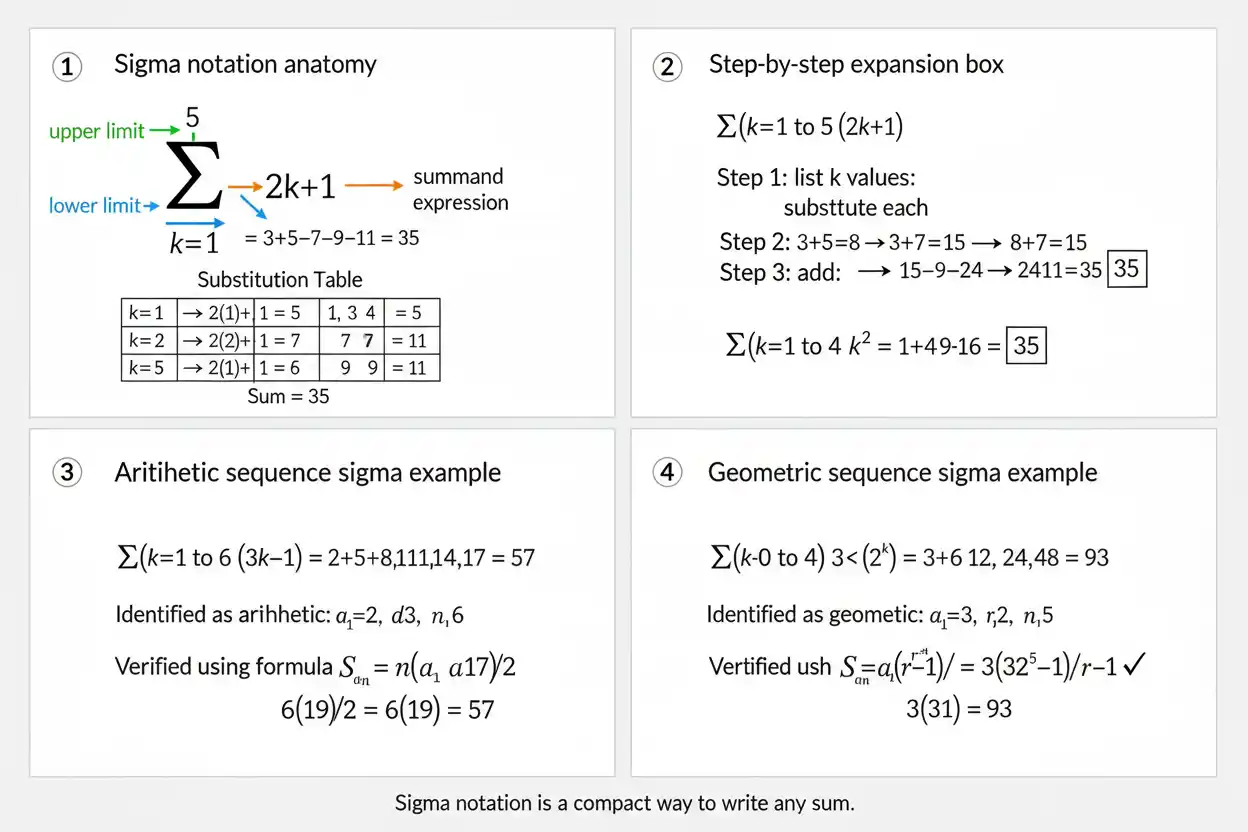

Summation notation uses the Greek capital letter sigma:
Σ
to represent the addition of a sequence of terms compactly.
For example:
Σ k, from k = 1 to 5
means:
1 + 2 + 3 + 4 + 5
so:
Σ k, from k = 1 to 5 = 15
A summation normally specifies four pieces of information: the sigma symbol, an index variable, a starting value, an ending value, and an expression that generates each term.
In general:
Σ f(k), from k = m to n
means:
f(m) + f(m+1) + f(m+2) + … + f(n)
Understanding how to read those parts is the foundation for expanding, simplifying, and evaluating sigma expressions correctly.
What Is Summation Notation?
Summation notation is a compact way to write repeated addition.
Instead of writing:
2 + 4 + 6 + 8 + 10
you can write:
Σ 2k, from k = 1 to 5
because substituting:
k = 1, 2, 3, 4, 5
produces:
2, 4, 6, 8, 10
The value of the summation is:
30
Therefore:
Σ 2k, k=1 to 5 = 30
The notation is especially useful when a sum has many terms or follows a clear algebraic pattern.
Parts of Sigma Notation
Consider:
Σ (3k+1), from k=2 to 6
The symbol:
Σ
means:
add the generated terms.
The index:
k
is the variable that changes.
The lower limit:
2
tells us where k starts.
The upper limit:
6
tells us where k stops.
The expression:
3k+1
tells us how to calculate each term.
How to Read a Sigma Expression
The expression:
Σ (2k+3), from k=1 to 4
can be read as:
“the sum of 2k plus 3 as k runs from 1 through 4.”
Substitute each allowed value.
For:
k = 1
term:
2(1)+3 = 5
For:
k = 2
term:
7
For:
k = 3
term:
9
For:
k = 4
term:
11
Therefore:
5 + 7 + 9 + 11
= 32
So:
Σ (2k+3), k=1 to 4 = 32
Number of Terms in a Summation
For integer index values from:
k = m
through:
k = n
inclusive, the number of terms is:
n – m + 1
For example:
k = 4 to 10
contains:
10 – 4 + 1
= 7
terms.
Those values are:
4,5,6,7,8,9,10
This count is useful when summing constants or checking expansions.
Sum of a Constant
Consider:
Σ 6, from k=1 to 5
The expression does not depend on k.
Therefore it means:
6 + 6 + 6 + 6 + 6
There are five terms.
So:
Σ 6, k=1 to 5 = 5×6 = 30
More generally:
Σ c, from k=m to n = c(n-m+1)
Example Starting at Zero
Evaluate:
Σ k², from k=0 to 4
Substitute:
0² + 1² + 2² + 3² + 4²
Calculate:
0 + 1 + 4 + 9 + 16
= 30
Therefore:
Σ k², k=0 to 4 = 30
Starting at zero matters because it determines which terms belong in the sum.
Example With a Negative Starting Index
Evaluate:
Σ k, from k=-2 to 2
Expand:
-2 + (-1) + 0 + 1 + 2
Positive and negative terms cancel.
Therefore:
Σ k, k=-2 to 2 = 0
Sigma notation is not limited to positive starting indexes.
Expanding Summation Notation
To expand:
Σ f(k), from k=m to n
write:
f(m)
then:
f(m+1)
continue through:
f(n)
For example:
Σ (k²+1), k=1 to 3
becomes:
(1²+1) + (2²+1) + (3²+1)
= 2 + 5 + 10
= 17
Therefore:
Σ (k²+1), k=1 to 3 = 17
A structured step-by-step math solving approach is useful whenever substitution, simplification, and final addition are all required.
Writing a Sum in Sigma Notation
The process can also be reversed.
Suppose the sum is:
3 + 6 + 9 + 12 + 15
Each term is:
3k
for:
k = 1,2,3,4,5
Therefore:
3 + 6 + 9 + 12 + 15 = Σ 3k, from k=1 to 5
There may be more than one correct sigma representation of the same finite sum.
Same Sum With a Different Index
Consider:
3 + 6 + 9 + 12 + 15
One form is:
Σ 3k, k=1 to 5
Another valid representation is:
Σ (3j+3), from j=0 to 4
Substitute:
j=0 → 3
j=1 → 6
j=2 → 9
j=3 → 12
j=4 → 15
The index letter itself is arbitrary as long as the expression and limits are consistent.
Dummy Index Variables
In a definite finite summation:
Σ k², k=1 to 5
the index k is local to the summation.
Changing it to another symbol does not change the value:
Σ k², k=1 to 5 = Σ j², j=1 to 5
Both mean:
1² + 2² + 3² + 4² + 5²
The index is sometimes called a dummy variable because its name does not affect the resulting sum.
Basic Linearity Rule
Summation distributes over addition:
Σ[aₖ + bₖ] = Σaₖ + Σbₖ
For example:
Σ(2k+1), k=1 to 4
can be separated:
Σ2k + Σ1
Then:
2Σk + Σ1
This is often faster than expanding every term.
Constant Multiple Rule
A constant factor can move outside the summation:
Σ(caₖ) = cΣaₖ
For example:
Σ5k, k=1 to 10
becomes:
5Σk, k=1 to 10
Using:
Σk = 10×11/2
= 55
we get:
5×55
= 275
Therefore:
Σ5k, k=1 to 10 = 275
Sum of Two Components
Evaluate:
Σ(3k+4), k=1 to 5
Use linearity:
3Σk + 4Σ1
First:
Σk, k=1 to 5 = 15
There are:
5
constant terms.
Therefore:
3(15) + 4(5)
= 45 + 20
= 65
So:
Σ(3k+4), k=1 to 5 = 65
Sum of the First n Positive Integers
One of the most important summation formulas is:
Σ k, from k=1 to n = n(n+1)/2
For:
n = 100
we get:
100×101/2
= 5,050
Therefore:
Σ k, k=1 to 100 = 5,050
The resulting values:
1, 3, 6, 10, 15, 21, …
are triangular numbers.
Triangular Numbers in Sigma Notation
The nth triangular number is:
Tₙ = Σ k, from k=1 to n
Therefore:
Tₙ = n(n+1)/2
For:
n = 8
we get:
T₈ = 8×9/2
= 36
Thus:
1+2+3+4+5+6+7+8 = 36
Sigma notation provides a compact definition of the entire triangular-number sequence.
Sum of the First n Squares
Another standard identity is:
Σ k², from k=1 to n = n(n+1)(2n+1)/6
For:
n = 5
calculate:
5×6×11/6
= 55
Therefore:
1²+2²+3²+4²+5² = 55
Sum of the First n Cubes
The standard cube-sum identity is:
Σ k³, from k=1 to n = [n(n+1)/2]²
For:
n = 4
we get:
[4×5/2]²
= 10²
= 100
Check:
1 + 8 + 27 + 64 = 100
Therefore:
Σk³, k=1 to 4 = 100
Arithmetic Sequences in Sigma Notation
An arithmetic sequence has general term:
aₖ = a₁ + (k-1)d
Its first n terms can be written:
Σ[a₁+(k-1)d], from k=1 to n
For example:
5,8,11,14,17
can be written:
Σ[5+3(k-1)], k=1 to 5
Expanding reproduces the five terms.
The resulting total can then be evaluated term by term or with an arithmetic-series formula.
Geometric Sequences in Sigma Notation
A geometric sequence has:
aₖ = a₁r^(k-1)
The first n terms can be represented:
Σa₁r^(k-1), from k=1 to n
For example:
3+6+12+24+48
is:
Σ3×2^(k-1), k=1 to 5
This compact notation preserves both the first term and common ratio.
Finite Geometric Sum
For:
r ≠ 1
the finite geometric sum is:
Σa₁r^(k-1), k=1 to n = a₁(1-rⁿ)/(1-r)
For:
a₁ = 3
r = 2
n = 5
we get:
3(1-32)/(1-2)
= 93
Therefore:
Σ3×2^(k-1), k=1 to 5 = 93
Summation Notation and Sequence Sums
The broader concept of finite addition is developed through sequence sums, but sigma notation is the compact symbolic language used to express those sums.
For example:
Sₙ = a₁+a₂+…+aₙ
can be written:
Sₙ = Σaₖ, from k=1 to n
The two forms communicate the same total.
Sigma notation becomes particularly valuable when the terms are generated by a formula rather than individually listed.
Changing the Starting Index
Suppose:
Σ k, from k=5 to 20
You can evaluate it by subtracting two sums that start at 1:
Σk, k=1 to 20 – Σk, k=1 to 4
Using:
n(n+1)/2
we get:
20×21/2 – 4×5/2
= 210 – 10
= 200
Therefore:
Σ k, k=5 to 20 = 200
Reindexing a Summation
A summation can often be rewritten using a shifted index.
Consider:
Σ k², from k=3 to 7
Let:
j = k-2
Then:
k = j+2
When:
k = 3
we have:
j = 1
When:
k = 7
we have:
j = 5
So the same sum becomes:
Σ(j+2)², from j=1 to 5
Both expressions represent identical terms.
Why Reindex a Sum?
Reindexing can:
align multiple sums,
convert a sum to a standard starting index,
simplify recurrence expressions,
or:
make cancellation more visible.
The value of the sum must remain unchanged.
Only the index description changes.
Splitting a Summation
A finite sum can be divided at an intermediate index.
For:
m ≤ p < n
we have:
Σaₖ, k=m to n = Σaₖ, k=m to p + Σaₖ, k=p+1 to n
For example:
Σk, k=1 to 10
can be written:
Σk, k=1 to 4 + Σk, k=5 to 10
The first total is:
10
The second:
45
Together:
55
which matches:
10×11/2 = 55
Combining Sums With the Same Limits
If two summations have identical index limits:
Σaₖ + Σbₖ
they can be combined:
Σ(aₖ+bₖ)
For example:
Σk + Σ2k
from:
k=1 to 5
becomes:
Σ3k
The value is:
3(15)
= 45
You Cannot Always Combine Different Limits Directly
Suppose one sum runs:
k=1 to 5
and another:
k=1 to 10
You cannot simply place their expressions under one sigma without accounting for the unmatched terms.
The limits are part of the mathematical definition.
Always align or split ranges before combining.
Nested Summations
Summation notation can be nested.
For example:
Σ Σ (i+j)
with separate ranges for i and j.
A small example is:
outer i = 1 to 2
inner j = 1 to 3
Then evaluate all combinations:
For:
i=1
inner terms:
2,3,4
sum:
9
For:
i=2
inner terms:
3,4,5
sum:
12
Overall:
9+12 = 21
Nested sigma notation is common in matrix, probability, and combinatorial calculations.
Summing Square Roots
The expression:
Σ√k, from k=1 to 4
expands to:
√1 + √2 + √3 + √4
Simplify perfect roots:
1 + √2 + √3 + 2
Therefore:
Σ√k, k=1 to 4 = 3 + √2 + √3
The mapped square roots topic determines how each radical term simplifies.
Summing Surds
Terms containing surds can sometimes combine after simplification.
Consider:
Σ√(8k²), from k=1 to 3
For positive k:
√(8k²) = k√8
= 2k√2
Therefore:
Σ2k√2, k=1 to 3
Factor out:
2√2 Σk
Then:
Σk = 1+2+3 = 6
So:
Sum = 12√2
The irrational radical remains exact while the integer coefficients are summed.
Summation With Alternating Signs
Alternating terms can be generated by:
(-1)ᵏ
or:
(-1)^(k-1)
For example:
Σ(-1)^(k-1), k=1 to 6
generates:
1 – 1 + 1 – 1 + 1 – 1
Therefore:
Sum = 0
Changing the exponent from k-1 to k reverses the first sign.
Alternating Weighted Sum
Evaluate:
Σ(-1)^(k-1)k, k=1 to 5
Expand:
1 – 2 + 3 – 4 + 5
Calculate:
1-2 = -1
-1+3 = 2
2-4 = -2
-2+5 = 3
Therefore:
Sum = 3
Summation of Travel Segments
Sigma notation can organize repeated applied quantities.
Suppose a trip consists of distances:
d₁,d₂,…,dₙ
Then total distance is:
D = Σdₖ, from k=1 to n
Likewise, if segment times are:
t₁,t₂,…,tₙ
then:
T = Σtₖ
The speed distance time relationship for an entire multi-stage trip can then use:
Average Speed = Total Distance / Total Time
or:
Average Speed = (Σdₖ)/(Σtₖ)
This is a natural application of sigma notation to repeated measurements.
Example: Sum Travel Distances
Suppose four stages are:
25 km
40 km
55 km
30 km
Write:
Σdₖ, k=1 to 4
with:
d₁=25
d₂=40
d₃=55
d₄=30
Total:
25+40+55+30
= 150 km
Therefore:
Total distance = 150 km
Sigma Notation With Fractions
Evaluate:
Σ 1/k, from k=1 to 4
Expand:
1 + 1/2 + 1/3 + 1/4
Use denominator:
12
Then:
12/12 + 6/12 + 4/12 + 3/12
= 25/12
Therefore:
Σ1/k, k=1 to 4 = 25/12
Not every summation reduces to a simple polynomial formula.
Summation With Powers of Ten
Evaluate:
Σ10ᵏ, from k=0 to 3
Expand:
10⁰ + 10¹ + 10² + 10³
= 1 + 10 + 100 + 1000
= 1111
Therefore:
Σ10ᵏ, k=0 to 3 = 1111
This is a finite geometric series with ratio 10.
Summation and Factorials
Sigma expressions can contain factorials.
For example:
Σk!, from k=1 to 4
means:
1! + 2! + 3! + 4!
Calculate:
1 + 2 + 6 + 24
= 33
Therefore:
Σk!, k=1 to 4 = 33
Such sums do not necessarily have a simple elementary closed form, but the notation still describes them precisely.
Summation and Remainders
A term-generating formula can also include remainder operations.
For example:
Σ(k mod 2), k=1 to 6
produces:
1 + 0 + 1 + 0 + 1 + 0
Therefore:
Sum = 3
This effectively counts how many odd integers occur in the range.
Finite vs. Infinite Sigma Notation
Finite:
Σaₖ, k=1 to n
has a definite final index.
Infinite:
Σaₖ, k=1 to ∞
continues indefinitely.
A finite sum can always be evaluated in principle if every term is defined.
An infinite sum requires a convergence analysis before it can be assigned a finite total.
The infinity symbol is not simply an extremely large upper integer.
Infinite Geometric Example
Consider:
Σ(1/2)ᵏ, from k=0 to ∞
The terms are:
1 + 1/2 + 1/4 + 1/8 + …
Because the geometric ratio has magnitude:
1/2 < 1
the series converges to:
1/(1-1/2)
= 2
Therefore:
Σ(1/2)ᵏ, k=0 to ∞ = 2
The finite and infinite uses of sigma notation share the same symbolic structure but require different evaluation ideas.
Common Mistake: Forgetting the Endpoints Are Included
If:
k=2 to 6
the values are:
2,3,4,5,6
There are:
5
terms, not 4.
Use:
n-m+1
when counting integer index values inclusively.
Common Mistake: Treating Σ Like Multiplication
The sigma symbol means:
add
It does not mean multiply the listed terms.
For:
Σk, k=1 to 3
correct:
1+2+3 = 6
not:
1×2×3
Common Mistake: Forgetting to Substitute the Index Everywhere
For:
Σ(k²+2k), k=1 to 3
when:
k=2
the term is:
2²+2(2)
= 4+4
= 8
Every occurrence of the index must receive the same substituted value.
Common Mistake: Changing the Index Without Changing the Limits
When reindexing, the expression and limits must be transformed consistently.
Changing:
k
to:
j+2
while leaving the old bounds unchanged can produce different terms.
Always map the old lower and upper index values into the new variable.
Common Mistake: Using a Closed Formula Without Matching the Pattern
The formula:
Σk = n(n+1)/2
applies to:
1+2+…+n
It does not directly evaluate:
2+4+6+…+2n
without accounting for the factor 2.
Correct:
Σ2k = 2Σk
= n(n+1)
Common Mistake: Ignoring Parentheses
Consider:
Σ(k+1)²
This means square the entire:
k+1
expression.
It is not:
Σ(k+1²)
because:
(k+1)² = k²+2k+1
Clear grouping is essential.
How to Check a Summation
For a small number of terms, expand it manually.
Suppose a formula gives:
Σ(3k-1), k=1 to 4 = 26
Direct expansion:
2 + 5 + 8 + 11
= 26
The direct calculation verifies the result.
For large sums, test the formula on a smaller index range before relying on it.
Frequently Asked Questions
What does sigma mean in math?
The capital Greek letter Σ means to add a collection of terms.
What is summation notation?
It is a compact notation for repeated addition using Σ, an index, limits, and a term-generating expression.
What does the lower number under sigma mean?
It gives the starting value of the index.
What does the upper number mean?
It gives the final index value for a finite sum.
What does Σk from k=1 to 5 equal?
1+2+3+4+5 = 15
How many terms are in Σ from k=m to n?
For consecutive integer indexes:
n-m+1
Can a sigma start at zero?
Yes.
Can a sigma start at a negative number?
Yes, if the expression is defined for those index values.
What is Σk from 1 to n?
n(n+1)/2
What is Σk² from 1 to n?
n(n+1)(2n+1)/6
What is Σk³ from 1 to n?
[n(n+1)/2]²
Can constants move outside sigma?
Yes:
Σ(caₖ) = cΣaₖ
when c does not depend on the summation index.
Can summations contain roots?
Yes.
Can summations be infinite?
Yes, but an infinite series requires convergence analysis to determine whether it has a finite ordinary sum.
Final Example
Evaluate:
Σ(4k-3), from k=1 to 10
Use linearity:
Σ(4k-3)
= 4Σk – 3Σ1
There are:
10
terms.
Calculate:
Σk, k=1 to 10
= 10×11/2
= 55
Therefore:
4(55) – 3(10)
= 220 – 30
= 190
So:
Σ(4k-3), k=1 to 10 = 190
Check the generated sequence:
1,5,9,13,17,21,25,29,33,37
This is arithmetic.
Its sum is:
10(1+37)/2
= 5×38
= 190
Both methods agree.
The central summation notation is:
Σf(k), from k=m to n = f(m)+f(m+1)+…+f(n)
Once the index, limits, and term formula are identified correctly, sigma notation turns long repetitive sums into concise mathematical expressions while preserving exactly which terms must be added.