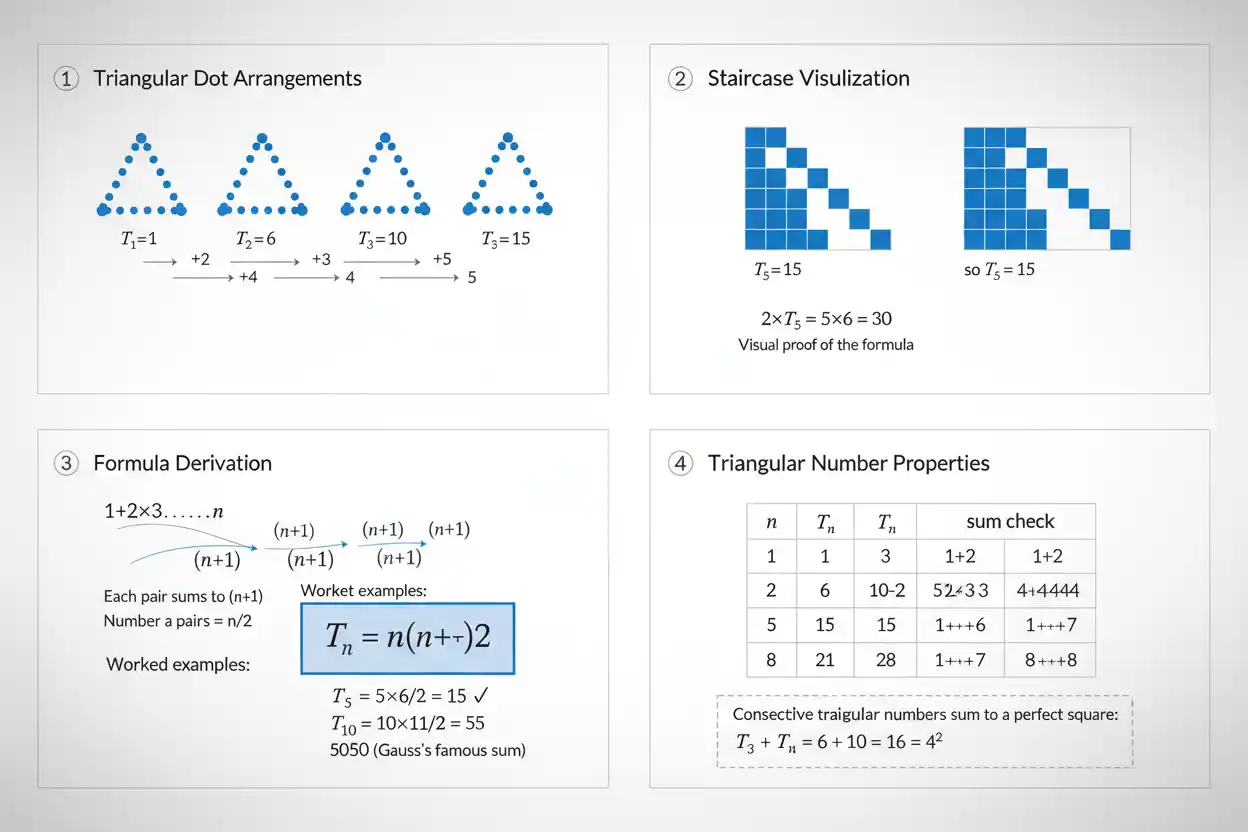

Triangular numbers are numbers that can be represented by arranging equally spaced objects into an equilateral triangular pattern.
The sequence begins:
1, 3, 6, 10, 15, 21, 28, 36, 45, 55, …
The nth triangular number is:
Tₙ = n(n+1)/2
Equivalently:
Tₙ = 1 + 2 + 3 + … + n
For example, the sixth triangular number is:
T₆ = 6(7)/2
= 21
Therefore:
T₆ = 21
The formula connects triangular numbers directly with consecutive-integer sums, arithmetic sequences, combinations, and geometric counting patterns.
What Is a Triangular Number?
A triangular number counts objects arranged in rows containing:
1 object,
then 2,
then 3,
continuing through
n.
For four rows:
1 + 2 + 3 + 4
= 10
Therefore:
10 is the fourth triangular number
The first few are:
| n | Tₙ |
|---|---|
| 1 | 1 |
| 2 | 3 |
| 3 | 6 |
| 4 | 10 |
| 5 | 15 |
| 6 | 21 |
| 7 | 28 |
| 8 | 36 |
| 9 | 45 |
| 10 | 55 |
Each value is obtained by adding the next positive integer to the previous triangular number.
Triangular Number Formula
The main formula is:
Tₙ = n(n+1)/2
where:
n = position in the triangular-number sequenceTₙ = nth triangular number
For:
n = 12
we get:
T₁₂ = 12(13)/2
= 6×13
= 78
Therefore:
The 12th triangular number is 78
Triangular Numbers as a Sum
Triangular numbers are cumulative sums of positive integers:
Tₙ = 1+2+3+…+n
Using summation notation:
Tₙ = Σk, from k=1 to n
The standard sum formula:
Σk = n(n+1)/2
therefore gives the triangular-number formula immediately.
Why the Formula Works
Start with:
S = 1+2+3+…+(n-1)+n
Write the same sum backward:
S = n+(n-1)+(n-2)+…+2+1
Add corresponding terms.
Each pair equals:
n+1
and there are:
n
pairs across the two copies.
So:
2S = n(n+1)
Divide by 2:
S = n(n+1)/2
Since this sum is Tₙ:
Tₙ = n(n+1)/2
Geometric Interpretation
Imagine a triangular arrangement with:
1 dot in row 1,
2 dots in row 2,
3 dots in row 3,
and so on.
Two identical triangular arrangements can be fitted together to form a rectangle containing:
n rows
and:
n+1 columns.
The rectangle therefore contains:
n(n+1)
objects.
One triangle contains half:
n(n+1)/2
This geometric argument explains the factor of:
1/2
in the formula.
Recursive Formula
Each triangular number is the previous triangular number plus the next positive integer:
Tₙ = Tₙ₋₁ + n
with:
T₁ = 1
For example:
T₅ = 15
Then:
T₆ = T₅ + 6
= 15+6
= 21
This recurrence makes the pattern easy to generate sequentially.
Differences Between Triangular Numbers
Consider:
1, 3, 6, 10, 15, 21, …
First differences are:
2, 3, 4, 5, 6, …
The differences increase by:
1
each time.
So triangular numbers do not form an ordinary arithmetic sequence, but their first differences do.
Their constant second difference is:
1
which reflects the quadratic formula:
Tₙ = (n²+n)/2
Example: Find T₂₀
Use:
Tₙ = n(n+1)/2
Then:
T₂₀ = 20×21/2
= 10×21
= 210
Therefore:
T₂₀ = 210
This also means:
1+2+3+…+20 = 210
Example: Find T₅₀
Calculate:
T₅₀ = 50×51/2
= 25×51
= 1,275
Therefore:
T₅₀ = 1,275
Directly adding 50 integers is unnecessary.
Example: Sum 1 Through 100
Because:
1+2+…+100 = T₁₀₀
use:
T₁₀₀ = 100×101/2
= 5,050
Therefore:
1+2+…+100 = 5,050
This is one of the most common applications of triangular numbers.
Testing Whether a Number Is Triangular
Suppose a positive integer T is given.
Start from:
T = n(n+1)/2
Multiply by 2:
2T = n²+n
Rearrange:
n²+n-2T = 0
Solve for n:
n = [−1 + √(8T+1)]/2
The negative quadratic root is irrelevant for a positive sequence index.
Therefore a positive integer T is triangular when:
8T+1
is an odd perfect square that gives an integer n.
Example: Is 45 a Triangular Number?
Calculate:
8(45)+1
= 360+1
= 361
Now:
√361 = 19
Then:
n = (19−1)/2
= 9
Therefore:
45 = T₉
So 45 is triangular.
Example: Is 50 Triangular?
Calculate:
8(50)+1
= 401
The number:
401
is not a perfect square.
Therefore the expression:
(√401−1)/2
does not produce an integer index.
So:
50 is not a triangular number
The appearance of the surds expression is useful diagnostically: a non-integer inverse value means the given integer does not occupy a triangular-number position.
Example: Is 210 Triangular?
Calculate:
8(210)+1
= 1,681
And:
√1681 = 41
Therefore:
n = (41−1)/2
= 20
So:
210 = T₂₀
Perfect-Square Test
The triangular-number test can be summarized:
T is triangular ⇔ 8T+1 is an odd perfect square
For example:
T = 36
gives:
8(36)+1 = 289
and:
289 = 17²
Therefore 36 is triangular.
Indeed:
T₈ = 8×9/2
= 36
This creates a useful bridge between triangular numbers and perfect squares.
Every Triangular Number Times 8 Plus 1 Is a Square
Starting from:
Tₙ = n(n+1)/2
multiply by 8:
8Tₙ = 4n(n+1)
Add 1:
8Tₙ+1 = 4n²+4n+1
Factor:
8Tₙ+1 = (2n+1)²
Therefore the result is always an odd square.
For:
T₆ = 21
we get:
8×21+1
= 169
= 13²
and:
13 = 2(6)+1
Triangular Numbers and Combinations
The number of ways to choose two objects from:
n+1
objects is:
(n+1)C2
Using the combinations formula:
(n+1)C2 = (n+1)n/2
Therefore:
Tₙ = (n+1)C2
For example:
T₅ = 15
and:
6C2 = 15
This gives triangular numbers a combinatorial interpretation: Tₙ counts unordered pairs chosen from n+1 objects.
Pair-Counting Example
Suppose:
8 people
each pair shakes hands exactly once.
The number of handshakes is:
8C2
= 8×7/2
= 28
But:
28 = T₇
Therefore:
The number of unordered pairs among 8 objects is the seventh triangular number
Consecutive Triangular Numbers
The difference between consecutive triangular numbers is:
Tₙ − Tₙ₋₁ = n
For example:
T₈ − T₇
= 36−28
= 8
This follows directly from adding one new row containing n objects.
Sum of Two Consecutive Triangular Numbers
A useful identity is:
Tₙ + Tₙ₋₁ = n²
Proof:
Tₙ = n(n+1)/2
and:
Tₙ₋₁ = n(n−1)/2
Add:
[n(n+1)+n(n−1)]/2
= [2n²]/2
= n²
Therefore:
Tₙ + Tₙ₋₁ = n²
Example of the Square Identity
Take:
T₆ = 21
and:
T₅ = 15
Then:
21+15
= 36
and:
6² = 36
Therefore:
T₆ + T₅ = 6²
This gives a geometric way to build a square from two consecutive triangular arrays.
A Square as Two Triangles
Because:
n² = Tₙ + Tₙ₋₁
a square array of:
n×n
objects can be partitioned into two triangular arrangements.
For:
n = 5
we have:
25 = 15+10
where:
15 = T₅
and:
10 = T₄
This relationship links triangular and square-number geometry.
Sum of the First n Triangular Numbers
Another identity is:
T₁ + T₂ + … + Tₙ = n(n+1)(n+2)/6
For:
n = 4
left side:
1+3+6+10
= 20
Formula:
4×5×6/6
= 20
The resulting sequence:
1,4,10,20,35,…
is associated with three-dimensional triangular stacking.
Sigma Form of the Sum of Triangular Numbers
Using summation notation:
ΣTₖ, from k=1 to n = n(n+1)(n+2)/6
This also equals:
C(n+2,3)
which gives another combinatorial interpretation.
For:
n = 5
we get:
5×6×7/6
= 35
Therefore:
1+3+6+10+15 = 35
Triangular Numbers and Sequence Sums
Sequence sums provide the broader framework:
Sₙ = a₁+a₂+…+aₙ
Triangular numbers are the special case where:
aₖ = k
Therefore:
Tₙ = Σk
This makes triangular numbers one of the simplest and most important examples of a closed-form finite sum.
Triangular Numbers and Number Sequences
Within the broader topic of number sequences, triangular numbers form a quadratic sequence:
1,3,6,10,15,…
First differences:
2,3,4,5,…
Second differences:
1,1,1,…
A constant second difference identifies the quadratic nature of the sequence.
Formula in Expanded Polynomial Form
Starting from:
Tₙ = n(n+1)/2
expand:
Tₙ = (n²+n)/2
This makes the quadratic structure explicit.
For large n, the dominant term is:
n²/2
so triangular numbers grow approximately quadratically.
Approximate Growth
For large n:
Tₙ ≈ n²/2
For example:
T₁₀₀ = 5,050
while:
100²/2 = 5,000
The approximation is close because the smaller correction term:
n/2
becomes relatively less important as n grows.
Finding the Index From a Large Triangular Number
Suppose:
T = 5,050
Use:
n = [√(8T+1)−1]/2
Calculate:
8×5050+1
= 40,401
Then:
√40,401 = 201
Therefore:
n = (201−1)/2
= 100
So:
5,050 is the 100th triangular number
Triangular Numbers and Unit Rates
A unit rate can describe average growth per step across a selected interval of triangular numbers, although triangular numbers themselves do not have a constant unit increase.
For example, from:
T₅ = 15
to:
T₁₀ = 55
the total increase is:
40
across:
5 index steps
The average increase per index step is:
40/5
= 8
But the actual individual increases are:
6,7,8,9,10
so the sequence’s step-by-step rate is not constant.
This distinction helps separate an average rate over an interval from the sequence’s actual changing differences.
Weighted Averages of Triangular Values
The mapped weighted averages concept can be used when triangular-number observations do not contribute equally.
If values:
T₂, T₃, T₄
carry weights:
w₁,w₂,w₃
the weighted mean is:
(w₁T₂ + w₂T₃ + w₃T₄)/(w₁+w₂+w₃)
This does not generate a new triangular number in general. It is simply a way to combine triangular-number values according to unequal importance.
The triangular-number formula still determines each individual Tₙ.
Structured Solution Example
Use a step-by-step math solving process to find the 30th triangular number.
Identify the target:
T₃₀
Choose the formula:
Tₙ = n(n+1)/2
Substitute:
T₃₀ = 30×31/2
Simplify:
30/2 = 15
15×31 = 465
Therefore:
T₃₀ = 465
Check:
8×465+1 = 3,721
and:
61² = 3,721
Since:
61 = 2(30)+1
the result passes the triangular-number square test.
Finding Missing n From Tₙ
Suppose:
Tₙ = 120
Use:
n(n+1)/2 = 120
Multiply:
n(n+1) = 240
So:
n²+n−240 = 0
Factor:
(n+16)(n−15) = 0
Possible roots:
n = -16
or:
n = 15
A sequence index must be positive.
Therefore:
n = 15
Check:
15×16/2 = 120
Consecutive Integer Interpretation
Triangular numbers are exactly the totals obtained from consecutive positive integers starting at 1.
For example:
T₇ = 1+2+3+4+5+6+7
= 28
If a sum starts at another integer, such as:
4+5+6+7
it is not itself the standard definition of one triangular number, but it can be written as a difference:
T₇−T₃
= 28−6
= 22
Sum From m Through n
For positive integers:
m ≤ n
we have:
m+(m+1)+…+n = Tₙ−Tₘ₋₁
For example:
11+12+…+20
equals:
T₂₀−T₁₀
= 210−55
= 155
This is often faster than adding ten terms individually.
Even and Odd Triangular Numbers
Triangular numbers show a repeating parity pattern.
First values:
1 odd
3 odd
6 even
10 even
15 odd
21 odd
28 even
36 even
So the pattern is:
odd, odd, even, even, …
This repeats every four indices.
Why the Parity Pattern Repeats
Use:
Tₙ = n(n+1)/2
Among consecutive integers:
n and n+1
one is even.
Whether dividing that even factor by 2 leaves an odd or even product depends on n mod 4.
This produces the repeating parity structure.
Zero as a Triangular Number
If the sequence is extended to index:
n = 0
then:
T₀ = 0(1)/2
= 0
So some conventions include:
0
as the zeroth triangular number.
When a sequence is defined beginning at:
n = 1
its first listed triangular number is:
1
Both conventions are consistent when the index is stated.
Common Mistake: Using n² Instead of n(n+1)/2
The formula:
n²
produces square numbers:
1,4,9,16,…
not triangular numbers.
Correct:
Tₙ = n(n+1)/2
For:
n = 5
triangular:
15
square:
25
These are different figurate-number patterns.
Common Mistake: Forgetting the Division by 2
For:
n = 10
incorrect:
10×11 = 110
Correct:
10×11/2
= 55
The factor 1/2 arises because the triangular arrangement is half of an n × (n+1) rectangle.
Common Mistake: Confusing n With Tₙ
If:
T₁₀ = 55
then:
10
is the index.
55
is the triangular-number value.
The formula maps:
n → Tₙ
The inverse test maps a candidate value back to its possible index.
Common Mistake: Assuming Every Cumulative Sum Is Triangular
Only:
1+2+…+n
is the standard nth triangular number.
A sum such as:
2+4+6+8
is an arithmetic-sequence sum but not a triangular number by that definition.
Its value may coincidentally equal a triangular number, but that is a separate question.
How to Check a Triangular Number
For claimed index n, calculate:
n(n+1)/2
For claimed triangular value T, check:
8T+1
If it is:
(2n+1)²
the values are consistent.
For example:
T = 153
Then:
8×153+1 = 1,225
√1225 = 35
Then:
n = (35−1)/2
= 17
So:
153 = T₁₇
Frequently Asked Questions
What are triangular numbers?
Triangular numbers count objects arranged in triangular rows of 1, 2, 3, …, n objects.
What is the triangular number formula?
Tₙ = n(n+1)/2
What are the first ten triangular numbers?
1, 3, 6, 10, 15, 21, 28, 36, 45, 55
What is the 20th triangular number?
210
What is the 100th triangular number?
5,050
Why are they called triangular numbers?
Because each can be represented by an array of equally spaced points arranged in a triangular pattern.
How do you test whether a number is triangular?
For positive integer T, check whether:
8T+1
is an odd perfect square.
Is 36 triangular?
Yes.
36 = T₈
Is 50 triangular?
No.
What is the relationship between triangular numbers and consecutive integers?
Tₙ = 1+2+…+n
What is the relationship between triangular numbers and combinations?
Tₙ = C(n+1,2)
What is Tₙ + Tₙ₋₁?
n²
Is 0 a triangular number?
It can be included as T₀ = 0 when indexing begins at zero.
Final Example
Determine whether:
1,275
is triangular and, if so, find its position.
Use the inverse test:
8T+1
Substitute:
8×1,275+1
= 10,200+1
= 10,201
Take the square root:
√10,201 = 101
Therefore:
n = (101−1)/2
= 100/2
= 50
So:
1,275 = T₅₀
Check directly:
T₅₀ = 50×51/2
= 25×51
= 1,275
The central triangular-number relationships are:
Tₙ = n(n+1)/2
Tₙ = 1+2+…+n
Tₙ = C(n+1,2)
8Tₙ+1 = (2n+1)²
These formulas connect the geometric triangular pattern with finite sums, quadratic sequences, perfect squares, and combinatorial counting.