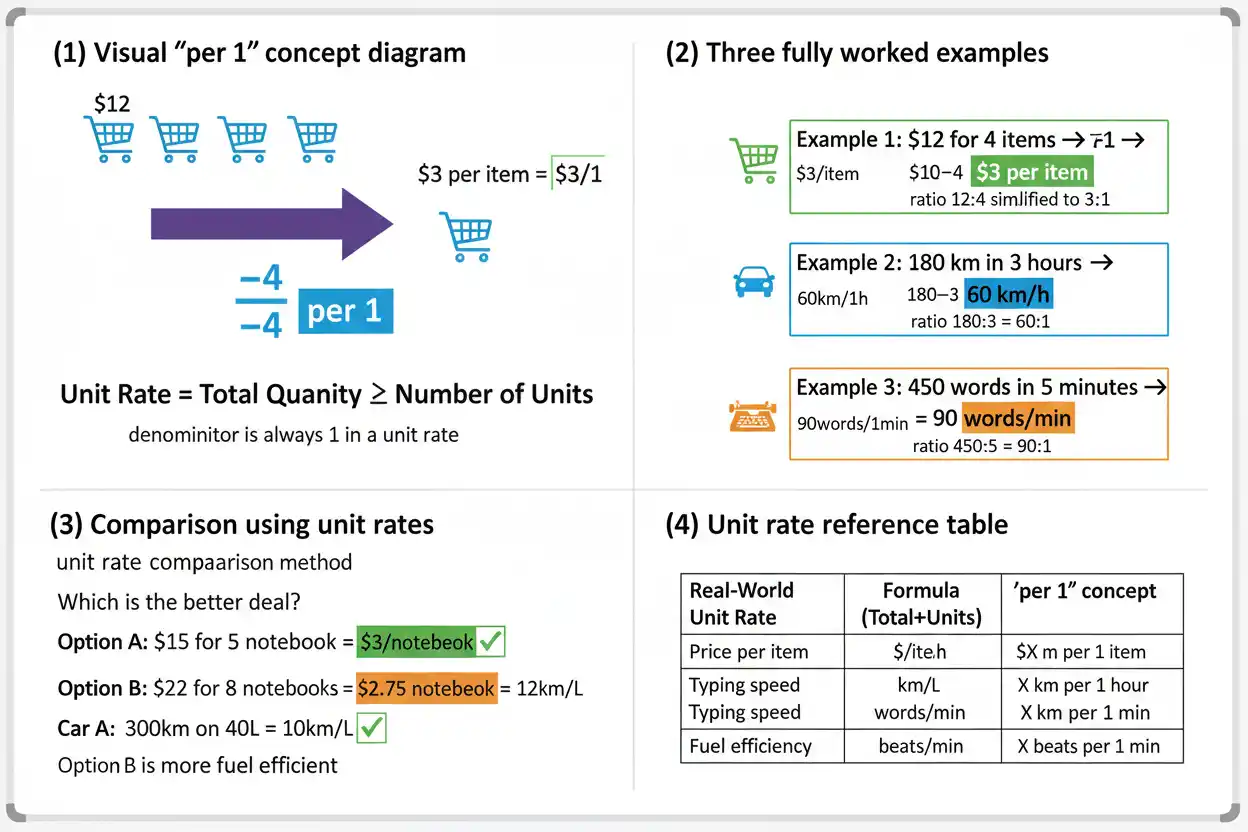

A unit rate compares one quantity with exactly one unit of another quantity.
The basic formula is:
Unit Rate = Quantity A / Quantity B
where Quantity B is reduced to:
1 unit
For example, if:
4 notebooks cost $12
then the cost per notebook is:
$12/4
= $3
Therefore:
Unit rate = $3 per notebook
Likewise, if a vehicle travels:
180 km in 3 hours
its unit rate is:
180/3
= 60 km per hour
So:
Unit rate = 60 km/h
Unit rates make ratios easier to interpret and allow quantities with different totals to be compared on a common “per one” basis.
What Is a Unit Rate?
A rate compares two quantities, usually with different units.
Examples include:
dollars per kilogram,
kilometers per hour,
words per minute,
liters per person,
items per box.
A unit rate converts the second quantity to:
1
For example:
24 pages in 3 minutes
becomes:
8 pages in 1 minute
or:
8 pages/minute
The denominator of the rate has been reduced to one unit.
Unit Rate Formula
If quantity A corresponds to quantity B, then:
Unit Rate = A/B
For example:
35 dollars for 7 kilograms
gives:
35/7
= 5
Therefore:
Unit rate = $5/kg
The units remain essential because the number 5 alone does not explain what is being measured.
Unit Rate as a Ratio
A ratio such as:
18:6
can be simplified:
3:1
Therefore the unit rate is:
3 per 1
If the original quantities were:
18 kilometers in 6 minutes
then the meaningful unit rate is:
3 km/min
The same numerical ratio can represent different rates depending on its units.
Rate vs. Unit Rate
Consider:
120 km in 2 hours
This is a rate:
120 km / 2 h
Divide both quantities by 2:
60 km / 1 h
Therefore:
60 km/h
is the unit rate.
Every unit rate is a rate, but a general rate does not necessarily have a denominator equal to one.
Example: Unit Price
A package of:
8 items
costs:
$20
Unit price:
20/8
= 2.50
Therefore:
Unit rate = $2.50 per item
Unit price allows packages with different quantities to be compared fairly.
Example: Price per Kilogram
A:
6 kg
bag costs:
$27
Calculate:
27/6
= 4.5
Therefore:
Unit rate = $4.50/kg
If another bag costs:
$20 for 5 kg
its unit price is:
20/5
= $4/kg
So the second option has the lower price per kilogram.
Comparing Unit Prices
Suppose:
Option A
12 units for $30
Unit price:
30/12
= $2.50
Option B
18 units for $41.40
Unit price:
41.40/18
= $2.30
Therefore:
Option B has the lower unit price
even though its total purchase price is higher.
This is why total price alone can be misleading when package sizes differ.
Unit Rate and Ratios
The broader ratios framework allows a comparison such as:
15:5
to be reduced:
3:1
A unit rate is essentially a ratio expressed relative to one unit of the reference quantity.
For example:
15 pages : 5 minutes
simplifies:
3 pages : 1 minute
Therefore:
3 pages/minute
Unit Rate and Proportion
Once a unit rate is known, a proportion can scale the relationship.
Suppose:
6 items cost $15
Unit price:
15/6
= $2.50/item
For 14 items:
Cost = 14×2.50
= $35
Equivalently:
6/15 = 14/x
Cross multiplication also gives:
x = 35
Unit-rate and proportion methods describe the same constant multiplicative relationship from different perspectives.
Constant Rate and Proportions
If the unit rate remains fixed, the corresponding quantities are directly proportional.
For example:
$4 per kilogram
produces:
1 kg → $4
2 kg → $8
5 kg → $20
10 kg → $40
The cost-to-mass relationship has constant rate:
Cost/Mass = 4
This is a direct proportional relationship of the type covered under proportions.
Speed as a Unit Rate
Speed is a classic unit rate:
Speed = Distance / Time
If:
240 km
are traveled in:
4 hours
then:
240/4
= 60
Therefore:
Speed = 60 km/h
The specialized speed distance time relationship then uses:
Distance = Speed × Time
and:
Time = Distance / Speed
for motion problems.
Example: Miles per Hour
A vehicle travels:
150 miles
in:
2.5 hours.
Unit rate:
150/2.5
= 60
Therefore:
60 miles per hour
The denominator has been reduced from 2.5 hours to exactly 1 hour.
Example: Meters per Second
A runner covers:
400 meters
in:
50 seconds.
Calculate:
400/50
= 8
Therefore:
Unit rate = 8 m/s
Work Rate
Suppose:
420 components
are produced in:
7 hours.
Production unit rate:
420/7
= 60
Therefore:
60 components per hour
At that unchanged rate, a 10-hour period would produce:
60×10
= 600 components
Reading Rate
A reader completes:
135 pages
in:
3 hours.
Rate:
135/3
= 45
Therefore:
45 pages/hour
If the reading rate remains constant, a 4.5-hour reading period would cover:
45×4.5
= 202.5 pages
Mathematically the rate calculation permits the fractional result, even if a practical count of completed whole pages needs separate interpretation.
Typing Rate
Suppose someone types:
2,250 words
in:
25 minutes.
Unit rate:
2250/25
= 90
Therefore:
90 words/minute
If the rate remains constant for:
40 minutes
the projected word count is:
90×40
= 3,600 words
Fuel Consumption Rate
Suppose a vehicle uses:
24 liters
over:
300 km.
Fuel consumed per kilometer:
24/300
= 0.08 L/km
A more readable rate may be:
8 L per 100 km
because:
0.08×100 = 8
Both rates describe the same consumption relationship but use different reference units.
Distance per Unit of Fuel
The reciprocal comparison is:
Distance/Fuel
Using the same example:
300/24
= 12.5 km/L
Therefore:
12.5 km per liter
Notice that:
L/km
and:
km/L
are reciprocal rates, not interchangeable units.
Wage Rate
Suppose:
$720
is earned for:
24 hours
of work.
Hourly rate:
720/24
= 30
Therefore:
$30/hour
If the pay structure remains proportional, 35 hours would correspond to:
35×30
= $1,050
before considering any separate overtime rules or fixed payments.
Cost per Person
A total cost of:
$450
is shared equally among:
18 people.
Calculate:
450/18
= 25
Therefore:
Unit rate = $25 per person
Equal sharing is one of the simplest unit-rate applications.
Items per Container
Suppose:
336 items
are packed equally into:
14 containers.
Calculate:
336/14
= 24
Therefore:
24 items per container
If item counts must be whole numbers, divisibility matters in addition to the numerical rate.
Unit Rate With Decimals
Suppose:
7.5 kilograms
cost:
$24
Calculate:
24/7.5
= 3.2
Therefore:
$3.20/kg
Ordinary decimal operations apply; the presence of decimal quantities does not change the unit-rate formula.
Unit Rate With Fractions
Suppose:
3/4 kilogram
costs:
$6
Unit price:
6 ÷ 3/4
Invert and multiply:
6×4/3
= 8
Therefore:
$8/kg
The fraction operations are part of the arithmetic, while the conceptual rate remains quantity per one unit.
Another Fractional Example
A machine produces:
15 units
in:
3/4 hour.
Rate:
15 ÷ 3/4
= 15×4/3
= 20
Therefore:
20 units/hour
Complex Unit Conversion
Suppose a speed is:
90 km/h
Convert to meters per second.
Use:
1 km = 1000 m
1 h = 3600 s
Then:
90 km/h × 1000 m/1 km × 1 h/3600 s
Cancel:
km
and:
h
leaving:
m/s
Numerically:
90×1000/3600
= 25
Therefore:
90 km/h = 25 m/s
Units can be treated algebraically during conversion.
Dimensional Consistency
A unit rate should report:
numerator unit / denominator unit
If:
120 km
are traveled in:
2 h
then:
120 km / 2 h
produces:
km/h
An answer in:
km·h
would signal that multiplication was used when division was required.
Checking units can therefore detect structural mistakes.
Converting a Rate to “Per 1”
Suppose:
54 dollars / 12 kg
To make the denominator one:
divide numerator and denominator by 12.
Then:
54/12 dollars / 1 kg
= 4.5 dollars/kg
Therefore:
$4.50 per kilogram
This is equivalent to simplifying a numerical ratio until its denominator is 1.
Unit Rate Table
Suppose a service costs:
$7 per hour.
Then:
| Hours | Cost |
|---|---|
| 1 | $7 |
| 2 | $14 |
| 3 | $21 |
| 5 | $35 |
| 10 | $70 |
For every nonzero row:
Cost/Hours = 7
Therefore the constant unit rate is:
$7/hour
Finding a Missing Quantity From a Unit Rate
Suppose the rate is:
8 liters/minute
and the process runs:
12.5 minutes.
Then:
Quantity = Rate × Time
= 8×12.5
= 100 liters
Therefore:
100 liters
The unit rate converts directly from one unit of time to any requested number of time units.
Finding the Number of Units
Suppose an item costs:
$4.50 each
and the total cost is:
$36.
Number of items:
36/4.5
= 8
Therefore:
8 items
This reverses the rate relationship.
Comparing Rates With Different Units
Before comparing rates, make their units identical.
Suppose:
Rate A = 60 km/h
and:
Rate B = 20 m/s
Convert B:
20×3.6
= 72 km/h
Therefore:
Rate B is faster
Comparing the raw numbers:
60 and 20
without considering units would give the wrong conclusion.
Comparing Price per 100 g and Price per kg
Suppose:
Product A
$2.40 per 100 g
Convert to 1 kg:
1 kg = 10×100 g
Therefore:
$2.40×10
= $24/kg
Product B
$21/kg
Therefore:
Product B has the lower unit price
Matching the comparison unit is essential.
Rate Per 100 vs. Unit Rate
A statement such as:
8 liters per 100 km
is a standardized rate but not literally a denominator of one kilometer.
The corresponding per-one-kilometer unit rate is:
8/100
= 0.08 L/km
Rates “per 100,” “per 1,000,” or “per million” are often more readable, but the mathematical unit rate can always be reduced to a denominator of 1.
Percentages as Rates per 100
A percentage is a rate per:
100
For example:
35%
means:
35/100
A literal unit rate per one is:
0.35/1
Thus:
35% = 0.35 per 1
The percentage representation is often more intuitive for proportions of a whole.
Unit Rate From a Graph
For a direct proportional relationship:
y = kx
the unit rate is:
k = y/x
It is also the slope of the graph through the origin.
Suppose a graph contains:
(4,20)
Then:
k = 20/4
= 5
Therefore:
y = 5x
and the unit rate is:
5 units of
yper unit ofx.
Unit Rate and Slope
For a straight proportional graph passing through:
(0,0)
and:
(x,y)
the slope is:
y/x
which equals the unit rate.
For example:
(0,0)
and:
(6,42)
give:
42/6
= 7
Therefore the graph’s proportional unit rate is:
7
A straight line with a nonzero intercept can have a slope but is not a direct proportion from the origin.
Unit Rate and Weighted Averages
A simple average of several unit rates is not always the correct combined rate.
Suppose:
2 hours at 40 km/h
and:
6 hours at 60 km/h.
Because the time exposures differ, the combined speed is a time-weighted average:
(2×40 + 6×60)/(2+6)
= (80+360)/8
= 55 km/h
Equivalently:
Total Distance / Total Time
= 440/8
= 55 km/h
Unequal weights matter.
When a Simple Average Works
Suppose a machine produces at:
40 units/hour
for one hour
and:
60 units/hour
for one hour.
Equal time weights give:
(40+60)/2
= 50 units/hour
The simple average works because the durations are equal.
With unequal durations, use the relevant weights or total quantity divided by total exposure.
Unit Rate and Triangular Numbers
The mapped triangular numbers sequence has changing increments:
1,3,6,10,15,…
From one term to the next, increases are:
2,3,4,5,…
So there is no constant unit rate between triangular number and index.
For example:
T₅/T index = 15/5 = 3
while:
T₁₀/10 = 55/10 = 5.5
The formula:
Tₙ = n(n+1)/2
is quadratic rather than directly proportional.
This is a useful counterexample to assuming every relationship can be summarized by one constant unit rate.
Unit Rates Containing Surds
A unit rate can be exact even when it contains surds.
Suppose a distance of:
6√2 meters
is covered in:
3 seconds.
Rate:
6√2/3
= 2√2
Therefore:
Unit rate = 2√2 m/s
Decimal approximation:
2√2 ≈ 2.828 m/s
The exact surd can be retained until an approximate decimal is required.
Unit Rates in Summation Problems
Summation notation can represent totals accumulated across many units.
If unit k contributes quantity:
qₖ
then total quantity is:
Q = Σqₖ
If there are n equally weighted units, the mean quantity per unit is:
Q/n = (Σqₖ)/n
For example, if five machines produce:
8,10,9,11,12
items during the same interval, total production is:
50
and average production per machine is:
50/5
= 10
The summation finds the total; dividing by the number of equal units converts that total to a per-unit average.
Step-by-Step Unit Rate Example
Use a step-by-step math solving structure.
Problem:
14 liters of paint cover 98 square meters. Find the coverage per liter.
Given:
Area = 98 m²
Paint = 14 L
Find:
square meters per liter
Formula:
Unit Rate = Area/Paint
Substitute:
98/14
Calculate:
= 7
Therefore:
Coverage = 7 m²/L
Check:
7 m²/L × 14 L
= 98 m²
The original total is recovered.
Reciprocal Unit Rates
A rate can often be inverted.
Suppose:
60 km/h
The reciprocal is:
1/60 h/km
This means one kilometer takes:
1/60 hour
at that constant speed.
Convert to minutes:
1/60×60
= 1 minute
So:
60 km/h corresponds to 1 minute per kilometer
The reciprocal rate can be more useful depending on the question.
Pace as a Unit Rate
Runners often express movement as:
time per distance
rather than:
distance per time.
Suppose a runner covers:
10 km
in:
50 minutes.
Speed-style rate:
10/50
= 0.2 km/min
Pace:
50/10
= 5 min/km
Therefore:
Pace = 5 minutes per kilometer
Speed and pace are reciprocal rate concepts when units are handled consistently.
Productivity Per Worker
Suppose:
8 workers
produce:
480 units
during the same period.
Output per worker:
480/8
= 60
Therefore:
60 units per worker
This calculation assumes the question is asking for an equal-share average. It does not prove that every worker individually produced exactly 60 units.
Population Density
A region has:
250,000 people
over:
500 km².
Population per square kilometer:
250,000/500
= 500
Therefore:
Population density = 500 people/km²
Density is another common form of unit rate.
Cost per Area
Suppose flooring costs:
$1,350
for:
90 m².
Unit cost:
1350/90
= 15
Therefore:
$15/m²
For:
120 m²
at the same unit price:
120×15
= $1,800
Scaling From a Unit Rate
Once a unit rate r is known:
Total = r × Number of Units
For:
r = $3.20/kg
and:
7.5 kg
total cost:
3.20×7.5
= 24
Therefore:
Total = $24
This is the reverse of the original unit-rate division.
Unit Rate From Total and Number of Units
Conversely:
r = Total/Units
For:
Total = 540
Units = 18
we get:
r = 30
Therefore:
Unit rate = 30 per unit
These two forms create a simple inverse pair:
r = Total/Units
Total = r×Units
Common Mistake: Dividing in the Wrong Direction
If:
$18
buys:
6 kg
and the question asks:
dollars per kilogram
calculate:
18/6
= $3/kg
Do not calculate:
6/18
because that gives:
kg per dollar
which is a different reciprocal rate.
Always match the numerator and denominator order to the requested units.
Common Mistake: Ignoring Units
The number:
5
could mean:
$5/kg
5 km/h
5 items/minute
or many other things.
A unit-rate answer without units can be incomplete or ambiguous.
Common Mistake: Comparing Different Denominators
Suppose one product is:
$4 per 200 g
and another is:
$18/kg
The raw numbers:
4 and 18
cannot be compared directly.
Convert the first:
$4 per 200 g
Five groups of 200 g equal:
1 kg
So:
$4×5 = $20/kg
Now compare:
$20/kg vs. $18/kg
The second product is cheaper per kilogram.
Common Mistake: Averaging Rates Without Weights
Rates such as:
30 km/h
and:
90 km/h
do not automatically combine to:
60 km/h
The correct average depends on the amount of time, distance, output, or other exposure associated with each rate.
Use total quantity divided by total reference units, or an appropriate weighted average.
Common Mistake: Assuming Every Relationship Has a Constant Unit Rate
A direct proportion such as:
y = 5x
has constant unit rate:
5
But:
y = x²
does not.
For:
x = 2
we get:
y/x = 2
For:
x = 4
we get:
y/x = 4
The rate changes.
A constant unit rate is a property of direct proportional relationships, not every mathematical function.
Common Mistake: Rounding Before Comparing
Suppose two unit prices are:
$2.344/item
and:
$2.346/item
Rounding both prematurely to:
$2.35
would hide the difference.
Compare using sufficient precision first, then round the reported values if needed.
How to Check a Unit Rate
Multiply the unit rate by the original number of units.
Suppose:
28 liters
are used over:
7 hours.
Rate:
28/7
= 4 L/h
Check:
4 L/h × 7 h
= 28 L
The original total is recovered.
Also verify that the denominator unit in the final answer is the unit requested by the problem.
Frequently Asked Questions
What is a unit rate?
A unit rate compares a quantity with exactly one unit of another quantity.
What is the unit rate formula?
Unit Rate = Quantity A / Quantity B
with the result interpreted per one unit of Quantity B.
What is an example of a unit rate?
$15 for 5 items
gives:
$3 per item
Is speed a unit rate?
Yes. Speed such as 60 km/h measures distance per one unit of time.
What is unit price?
Unit price is cost per one item, kilogram, liter, or other selected unit.
How do you find a unit rate from a ratio?
Divide both quantities by the second quantity so its value becomes 1.
What is the difference between rate and unit rate?
A rate compares two quantities. A unit rate expresses the comparison per exactly one unit of the reference quantity.
Can a unit rate be a decimal?
Yes.
For example:
$9/4 items = $2.25 per item
Can a unit rate contain a fraction?
Yes.
Can a unit rate contain an irrational number?
Yes. An exact rate can contain a surd such as 2√2 m/s.
How do you compare two rates?
Convert them to the same numerator and denominator units, preferably a common unit rate, then compare their numerical values.
Is a percentage a unit rate?
A percentage is conventionally a rate per 100. It can be converted to a per-one decimal rate by dividing by 100.
Is a unit rate always constant?
Only when the underlying relationship is proportional or otherwise explicitly modeled with a constant rate.
Final Example
Two internet plans report data usage costs differently.
Plan A:
$42 for 12 GB
Plan B:
$54 for 18 GB
Find each unit price.
Plan A:
42/12
= 3.50
So:
Plan A = $3.50/GB
Plan B:
54/18
= 3.00
So:
Plan B = $3.00/GB
Compare:
$3.00 < $3.50
Therefore:
Plan B has the lower cost per GB
The difference in unit price is:
3.50−3.00
= $0.50/GB
For:
18 GB
that difference corresponds to:
18×0.50
= $9
Indeed, 18 GB at Plan A’s unit rate would cost:
18×3.50
= $63
while Plan B costs:
$54
The central unit-rate relationships are:
Unit Rate = Total Quantity / Number of Reference Units
Total Quantity = Unit Rate × Number of Reference Units
A unit rate turns unequal totals into comparable “per one” values. Correct numerator order, consistent units, and appropriate weighting are essential whenever rates are compared or combined.