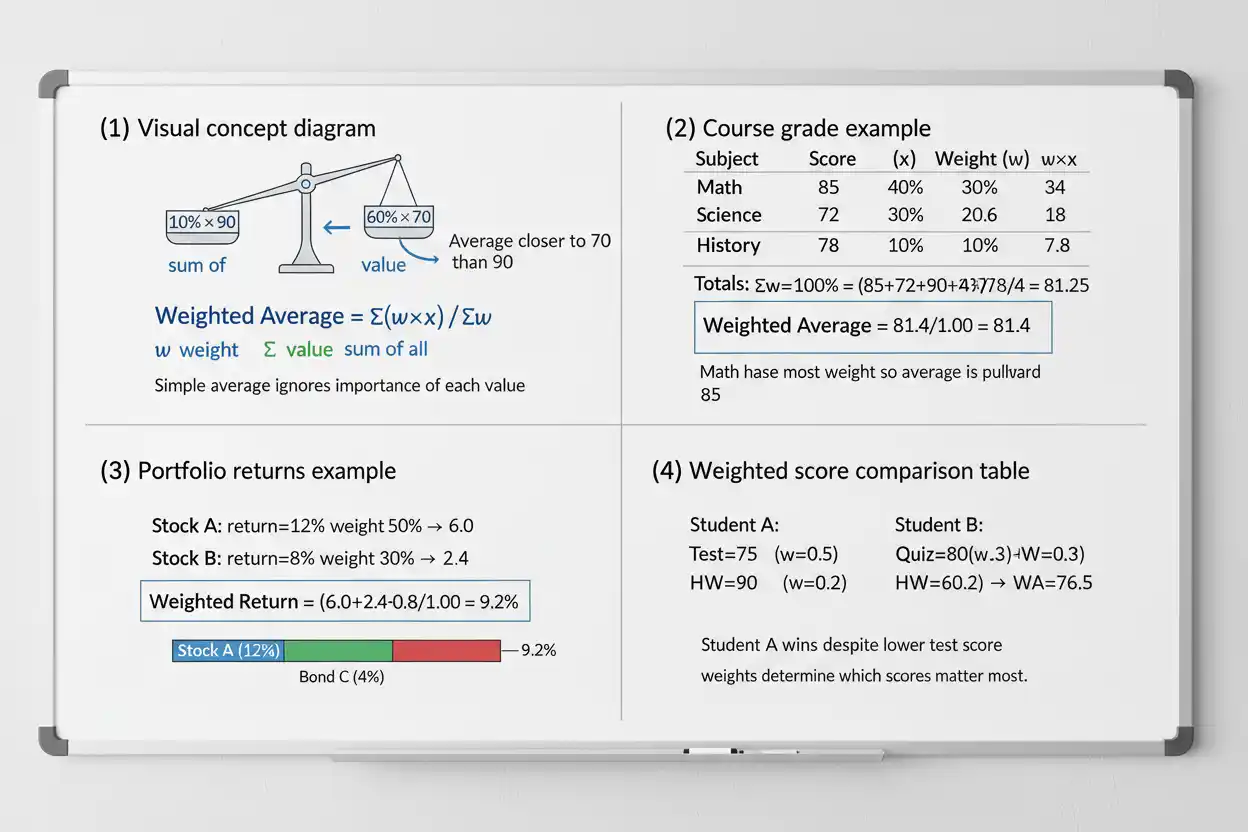

Weighted averages combine values while allowing some observations to contribute more strongly than others.
The general weighted-average formula is:
Weighted Average = Σ(wᵢxᵢ) / Σwᵢ
where:
xᵢ = each valuewᵢ = the weight assigned to that value
For example, suppose three scores are:
80, 90, 70
with weights:
20%, 50%, 30%
The weighted average is:
80(0.20) + 90(0.50) + 70(0.30)
= 16 + 45 + 21
= 82
Therefore:
Weighted Average = 82
A simple average would give every score the same importance. A weighted average instead reflects the actual contribution of each value.
What Is a Weighted Average?
A weighted average is an average in which observations do not necessarily count equally.
A simple arithmetic mean of:
x₁, x₂, …, xₙ
is:
Mean = (x₁+x₂+…+xₙ)/n
Every observation receives the same effective weight:
1/n
A weighted average replaces those equal contributions with explicitly chosen weights.
For three values:
x₁, x₂, x₃
with weights:
w₁, w₂, w₃
the weighted average is:
(w₁x₁ + w₂x₂ + w₃x₃)/(w₁+w₂+w₃)
This allows one observation to matter twice, five times, or any other specified amount relative to another.
Weighted Average Formula
The general formula is:
x̄w = Σ(wᵢxᵢ) / Σwᵢ
Written without sigma notation:
x̄w = (w₁x₁ + w₂x₂ + … + wₙxₙ)/(w₁+w₂+…+wₙ)
The compact version uses summation notation:
x̄w = [Σwᵢxᵢ]/[Σwᵢ]
The numerator is the total weighted contribution.
The denominator is the total weight.
When Weights Sum to 1
If:
w₁+w₂+…+wₙ = 1
then the denominator is already 1.
The formula simplifies to:
x̄w = Σwᵢxᵢ
This often occurs when weights are written as decimals corresponding to percentages.
For example:
25% = 0.25
35% = 0.35
40% = 0.40
and:
0.25+0.35+0.40 = 1
So the weighted average can be calculated directly from the weighted products.
Percentage Weights
When weights are given as percentages, they should total:
100%
for a complete allocation.
For example:
20% + 30% + 50% = 100%
Convert to decimals:
0.20 + 0.30 + 0.50 = 1
The ordinary percentage conversion is:
Decimal Weight = Percentage Weight / 100
Therefore:
35% → 0.35
Using decimal weights makes the multiplication straightforward.
Example: Weighted Course Grade
Suppose a course grade consists of:
Homework: 85, worth 25%
Midterm: 78, worth 30%
Final exam: 92, worth 45%
Calculate each contribution.
Homework:
85×0.25 = 21.25
Midterm:
78×0.30 = 23.40
Final:
92×0.45 = 41.40
Add:
21.25+23.40+41.40
= 86.05
Therefore:
Weighted course grade = 86.05
A simple mean would be:
(85+78+92)/3
= 85
but that would ignore the unequal grading weights.
Example With Integer Weights
Suppose values are:
10, 15, 25
with weights:
1, 2, 3
Use:
Weighted Average = [10(1)+15(2)+25(3)]/(1+2+3)
Numerator:
10+30+75
= 115
Denominator:
6
Therefore:
115/6
≈ 19.1667
So:
Weighted Average ≈ 19.17
The weights do not need to be percentages.
Only their relative sizes matter.
Scaling All Weights Does Not Change the Answer
Consider weights:
1,2,3
Multiplying every weight by 10 gives:
10,20,30
Original:
[10(1)+15(2)+25(3)]/6
Scaled:
[10(10)+15(20)+25(30)]/60
Both produce:
115/6
Therefore:
Multiplying all weights by the same positive constant does not change the weighted average
because the scale factor appears in both numerator and denominator and cancels.
Normalizing Weights
Weights can be converted so they sum to 1.
Suppose:
w = 2,3,5
Total:
2+3+5 = 10
Normalized weights:
2/10 = 0.2
3/10 = 0.3
5/10 = 0.5
Then:
0.2+0.3+0.5 = 1
The original and normalized weights produce the same weighted average.
Weighted Average vs. Simple Average
Consider values:
50, 70, 100
Simple mean:
(50+70+100)/3
= 220/3
≈ 73.33
Now assign weights:
10%, 20%, 70%
Weighted average:
50(0.10)+70(0.20)+100(0.70)
= 5+14+70
= 89
Therefore:
Simple Average ≈ 73.33
Weighted Average = 89
The heavily weighted value 100 pulls the weighted average upward.
Weighted Average as Repeated Observations
Integer weights can be interpreted as frequency counts.
Suppose:
x₁ = 4 with weight 2
x₂ = 9 with weight 3
This is equivalent to the data:
4,4,9,9,9
Simple mean:
(4+4+9+9+9)/5
= 35/5
= 7
Weighted formula:
[4(2)+9(3)]/(2+3)
= (8+27)/5
= 7
Therefore:
Frequency-weighted averaging is equivalent to repeating each value according to its frequency
Frequency Table Example
Suppose survey ratings are:
| Rating | Frequency |
|---|---|
| 1 | 2 |
| 2 | 3 |
| 3 | 5 |
| 4 | 7 |
| 5 | 3 |
Total frequency:
2+3+5+7+3 = 20
Weighted sum:
1(2)+2(3)+3(5)+4(7)+5(3)
= 2+6+15+28+15
= 66
Therefore:
Weighted Average = 66/20
= 3.3
So:
Average rating = 3.3
Why the Denominator Is Total Weight
Suppose a value with weight:
4
represents four times as much contribution as a value with weight:
1
The weighted numerator counts that larger contribution.
But the total must also be divided by the total amount of represented weight.
This keeps the answer on the same scale as the original values.
For nonnegative weights, a properly computed weighted average generally lies between the smallest and largest included values.
Range Check
Suppose values are:
20, 40, 80
with positive weights.
Any ordinary weighted average must satisfy:
20 ≤ Weighted Average ≤ 80
If a calculation gives:
105
something is wrong unless the problem uses unusual negative weights or another nonstandard structure.
This minimum-to-maximum check is a useful verification step.
Weighted Average of Two Values
For two values:
x₁ and x₂
with weights:
w₁ and w₂
the formula is:
x̄w = (w₁x₁+w₂x₂)/(w₁+w₂)
For example:
x₁ = 60
x₂ = 90
w₁ = 2
w₂ = 3
Then:
x̄w = [2(60)+3(90)]/5
= (120+270)/5
= 390/5
= 78
Therefore:
Weighted Average = 78
Finding an Unknown Value From a Weighted Average
Suppose two test scores have weights:
40% and 60%
The first score is:
75
and the overall weighted average must be:
84
Let the second score be:
x
Write:
75(0.40)+x(0.60) = 84
Calculate:
30+0.60x = 84
Subtract:
0.60x = 54
Divide:
x = 90
Therefore:
The second score must be 90
Finding an Unknown Weight
Suppose values:
70 and 90
are combined to give weighted average:
82
Let the weight on 70 be:
w
and the weight on 90 be:
1-w
Then:
70w + 90(1-w) = 82
Expand:
70w+90-90w = 82
-20w = -8
w = 0.4
Therefore the weights are:
40% for 70
and:
60% for 90
Weighted Average of Unit Rates
A unit rate can sometimes be combined using a weighted average, but the correct weights depend on what the rate measures.
Suppose a machine operates at:
40 units/hour for 2 hours
and:
70 units/hour for 3 hours
The time-weighted production rate is:
[40(2)+70(3)]/(2+3)
= (80+210)/5
= 58 units/hour
Therefore:
Combined rate = 58 units/hour
Check through totals:
Total output = 290 units
Total time = 5 hours
290/5 = 58 units/hour
The two methods agree.
Weighted Average Speed
When speeds apply for different durations, time serves naturally as the weight.
Suppose:
50 km/h for 2 h
and:
80 km/h for 3 h
Distance traveled:
50(2)+80(3)
= 100+240
= 340 km
Total time:
5 h
Average speed:
340/5
= 68 km/h
Equivalently:
[50(2)+80(3)]/(2+3)
= 68
This time-weighted structure is consistent with the definition on average speed.
Equal Distances Require Different Weights
Suppose the same distance is traveled at:
40 km/h
and:
60 km/h
You cannot simply weight the speeds equally by distance using an arithmetic weighted average of the two speeds.
The amount of time spent at each speed differs.
For equal distances, average speed becomes:
2s₁s₂/(s₁+s₂)
For:
40 and 60
this gives:
2×40×60/100
= 48 km/h
So:
Average speed = 48 km/h
This illustrates why weights must represent the quantity that actually determines contribution to the total.
Portfolio Weighted Return
Suppose investments are allocated:
20% to Asset A returning 5%
30% to Asset B returning 8%
50% to Asset C returning 12%
Portfolio return:
0.20(5%) + 0.30(8%) + 0.50(12%)
= 1% + 2.4% + 6%
= 9.4%
Therefore:
Portfolio weighted return = 9.4%
This differs from an unweighted average return when the invested amounts are unequal.
Weighted Average Cost of Capital
Finance provides a major weighted-average application through weighted average cost of capital.
At a high level, financing sources contribute according to their shares in the capital structure.
A simplified structure is:
WACC = w₁r₁ + w₂r₂ + …
where each financing cost rᵢ is multiplied by its relevant capital weight wᵢ, with tax treatment applied where the specific formula requires it.
The general mathematical mechanism is the same weighted-average principle, though WACC has its own financial definitions and assumptions.
Average Atomic Mass
Chemical isotope calculations use weighted averages because isotopes occur with different natural abundances.
The specialist average atomic mass calculation follows:
Average Atomic Mass = Σ(Isotope Mass × Fractional Abundance)
Suppose:
Isotope A: mass 10, abundance 20%
Isotope B: mass 11, abundance 80%
Then:
10(0.20)+11(0.80)
= 2+8.8
= 10.8
Therefore:
Average atomic mass = 10.8
Grade Point Average
A grade point average often uses course credits as weights.
Suppose:
Course A: grade points 4.0, 3 credits
Course B: grade points 3.0, 4 credits
Course C: grade points 3.7, 2 credits
Weighted quality points:
4.0(3)+3.0(4)+3.7(2)
= 12+12+7.4
= 31.4
Total credits:
3+4+2
= 9
GPA:
31.4/9
≈ 3.489
Therefore:
Weighted GPA ≈ 3.49
Weighted Average With Ratios
Weights may be expressed as a ratio.
Suppose weights are:
2:3:5
Total parts:
2+3+5 = 10
Normalized weights:
0.2, 0.3, 0.5
If corresponding values are:
50, 60, 90
then:
Weighted Average = 50(0.2)+60(0.3)+90(0.5)
= 10+18+45
= 73
Therefore:
Weighted Average = 73
You can also calculate directly:
[50(2)+60(3)+90(5)]/10
= 730/10
= 73
Triangular Numbers as Weight Totals
The mapped triangular numbers topic provides a useful shortcut when weights are:
1,2,3,…,n
Their total is:
1+2+…+n = n(n+1)/2
Suppose five values receive weights:
1,2,3,4,5
Then total weight is:
T₅ = 5×6/2
= 15
So a weighted average with these weights has denominator:
15
without needing to add the weights individually.
Example With Increasing Weights
Suppose values:
10,20,30,40
receive weights:
1,2,3,4
Total weight:
1+2+3+4
= 10
Weighted numerator:
10(1)+20(2)+30(3)+40(4)
= 10+40+90+160
= 300
Weighted average:
300/10
= 30
Therefore:
Weighted Average = 30
Later values contribute more strongly because their weights are larger.
Weighted Average With Surds
Weighted averages can retain exact irrational values.
Suppose:
x₁ = √2
x₂ = 3√2
with weights:
1 and 2
Then:
x̄w = [1(√2)+2(3√2)]/(1+2)
= [√2+6√2]/3
= 7√2/3
Therefore:
Weighted Average = 7√2/3
The surds form keeps the answer exact.
Numerically:
7√2/3 ≈ 3.300
if an approximation is required.
Negative Weights
In the ordinary interpretation of a weighted average, weights are generally:
nonnegative
with at least one positive weight.
This guarantees that the result behaves like an average and remains between the minimum and maximum input values.
Some specialized mathematical and financial constructions permit negative weights, but then the result may fall outside the range of the observations.
For example, with values:
10 and 20
and weights:
2 and -1
we get:
[10(2)+20(-1)]/(2-1)
= 0
which lies below both values.
Therefore negative-weight calculations require context and should not automatically be interpreted as ordinary averages.
Zero Weights
A value with weight zero contributes nothing.
Suppose:
values = 20, 50, 100
weights = 2, 0, 3
Then:
Weighted Average = [20(2)+50(0)+100(3)]/(2+0+3)
= 340/5
= 68
The value:
50
has no effect because its weight is zero.
Total Weight Cannot Be Zero
The formula:
Σ(wᵢxᵢ)/Σwᵢ
requires:
Σwᵢ ≠ 0
If total weight equals zero, division is undefined.
With ordinary nonnegative weights, this is avoided by requiring at least one positive weight.
Weighted Average With Missing Categories
Suppose a grading plan originally has:
Homework 20%
Midterm 30%
Final 50%
but only homework and midterm have occurred.
If you want the current average using only completed components, do not automatically treat the missing final as zero unless that is explicitly the intended rule.
Instead normalize the completed weights.
Completed total:
20%+30%
= 50%
Suppose scores are:
80 and 90
Current weighted average:
[80(20)+90(30)]/(20+30)
= (1600+2700)/50
= 86
Therefore:
Current completed-component average = 86
This differs from assigning a zero to the future final exam.
Weighted Average With Scores and Credits
Suppose scores are:
75, 82, 91
and course credits are:
2, 4, 3
Weighted sum:
75(2)+82(4)+91(3)
= 150+328+273
= 751
Total credits:
9
Weighted average:
751/9
≈ 83.444
Therefore:
Weighted Average ≈ 83.44
Weighted Average From Percent Contributions
Suppose a project has:
Quality: 90, weight 40%
Cost: 75, weight 25%
Schedule: 80, weight 20%
Risk: 70, weight 15%
Check weights:
40+25+20+15 = 100%
Calculate:
90(0.40)+75(0.25)+80(0.20)+70(0.15)
= 36+18.75+16+10.5
= 81.25
Therefore:
Weighted score = 81.25
Why Weight Definitions Matter
A weighted average is only as meaningful as its weights.
Weights may represent:
frequency,
time,
money invested,
credits,
probabilities,
market shares,
quantities,
or:
importance scores.
Different weighting definitions can produce different answers from the same underlying values.
Therefore the first conceptual question is:
What does each weight represent?
Weighted Average as Expected Value
If possible outcomes:
x₁,x₂,…,xₙ
have probabilities:
p₁,p₂,…,pₙ
where:
Σpᵢ = 1
then:
Expected Value = Σpᵢxᵢ
This is mathematically a weighted average with probabilities as weights.
For example, suppose:
Outcome 0 with probability 0.25
Outcome 10 with probability 0.75
Expected value:
0(0.25)+10(0.75)
= 7.5
The expected value need not itself be one of the possible outcomes.
Weighted Average of Group Means
Suppose Group A has:
20 observations with mean 70
and Group B has:
80 observations with mean 90
The combined mean is not:
(70+90)/2 = 80
unless the groups have equal sizes.
Weight each group mean by group size:
[70(20)+90(80)]/(20+80)
= (1400+7200)/100
= 86
Therefore:
Combined mean = 86
This is an important use of weighted averages.
Why Averaging Averages Can Fail
Suppose:
Class A average = 60 from 10 students
Class B average = 90 from 90 students
Simple average of averages:
(60+90)/2
= 75
But combined average:
[60(10)+90(90)]/100
= (600+8100)/100
= 87
Therefore:
Combined average = 87
The group sizes must be used as weights.
Weighted Average With Unequal Sample Sizes
The same principle applies whenever summary averages represent different quantities of underlying data.
If:
mean₁ represents n₁ observations
and:
mean₂ represents n₂ observations
then combined mean:
(n₁mean₁+n₂mean₂)/(n₁+n₂)
This extends naturally to any number of groups.
Weighted Average in Sigma Form
For values:
x₁,x₂,…,xₙ
and weights:
w₁,w₂,…,wₙ
the most compact expression is:
x̄w = [Σ wᵢxᵢ]/[Σ wᵢ]
If weights are normalized:
Σwᵢ = 1
then:
x̄w = Σwᵢxᵢ
This notation becomes especially convenient when dozens or hundreds of observations are involved.
Step-by-Step Weighted Average Method
A reliable step-by-step math solving approach is:
First identify every value and its corresponding weight.
Check that each value is paired with the correct weight.
Convert percentage weights to decimals if convenient.
Multiply:
value × weight
for every pair.
Add all weighted contributions.
Add all weights.
Divide the weighted total by total weight unless the weights already sum to 1.
Finally, check whether the answer is reasonable relative to the input values.
Worked Example
Values:
65, 80, 92
Weights:
2, 3, 5
Weighted products:
65×2 = 130
80×3 = 240
92×5 = 460
Numerator:
130+240+460
= 830
Total weight:
2+3+5
= 10
Weighted average:
830/10
= 83
Therefore:
Weighted Average = 83
Check:
65 ≤ 83 ≤ 92
so the result lies within the expected range.
Common Mistake: Dividing by the Number of Values
Suppose three observations have weights:
1,2,7
The denominator is:
1+2+7 = 10
not:
3
The correct formula is:
Σwx / Σw
not:
Σwx / number of observations
unless every weight is exactly equal.
Common Mistake: Forgetting to Convert Percentages
If a value:
80
has weight:
25%
its weighted contribution is:
80×0.25
= 20
not:
80×25
unless the final calculation also divides by the total percentage weight in matching units.
Both approaches can work if used consistently, but mixing percentage and decimal forms creates errors.
Common Mistake: Weights Do Not Cover the Same Basis
Suppose some weights represent:
hours
while others represent:
percentages.
They cannot be combined directly without translating them to a consistent interpretation.
Weights must represent comparable contributions to the same weighted calculation.
Common Mistake: Averaging Rates With the Wrong Weights
For changing speeds, the correct weights depend on time or distance.
A simple arithmetic mean of speeds is not universally valid.
The weighting basis must reflect how the underlying total quantity is accumulated.
Common Mistake: Ignoring Zero or Missing Weights
A zero weight removes a value from the result.
A missing weight, however, is not automatically zero.
Determine whether the observation is excluded, unknown, or intended to receive some other weight.
Common Mistake: Rounding Weighted Products Too Early
Suppose several weighted contributions contain long decimals.
Rounding each one aggressively before summing can alter the final result.
Retain additional precision during intermediate calculations and round the final weighted average according to the required precision.
How to Check a Weighted Average
For ordinary nonnegative weights:
First verify:
total weight > 0
Then check that the result lies between:
minimum value
and:
maximum value.
Also check whether larger weights pull the result toward their associated values.
For example, if the largest weight belongs to the largest score, a weighted average substantially below the unweighted mean may deserve another look.
Frequently Asked Questions
What is a weighted average?
A weighted average is an average in which observations contribute according to assigned weights rather than all counting equally.
What is the weighted average formula?
Weighted Average = Σ(wᵢxᵢ)/Σwᵢ
What if the weights total 1?
Then:
Weighted Average = Σwᵢxᵢ
What if the weights total 100%?
Convert them to decimals or divide the weighted percentage total by 100.
Is a weighted average the same as a mean?
It is a type of mean. The ordinary arithmetic mean is the special case where all observations have equal weights.
Do weights have to be percentages?
No. They may be frequencies, credits, hours, quantities, probabilities, or any consistent relative weighting system.
Do weights have to sum to 100?
Not in their original form. The formula divides by total weight. Percentage weights for a complete allocation normally sum to 100%.
Can a weight be zero?
Yes. A zero-weight value does not affect the result.
Can weights be negative?
Specialized models can use negative weights, but an ordinary weighted average generally uses nonnegative weights.
How do I combine averages from groups of different sizes?
Use each group’s number of observations as its weight.
Why is a weighted average different from averaging the group averages?
Group averages represent unequal amounts of underlying data when group sizes differ.
Can weighted averages be used for grades?
Yes. Assignment categories can be weighted according to their percentage contribution to the final grade.
Can weighted averages be used for investments?
Yes. Portfolio returns can be weighted by the share invested in each asset.
Final Example
A performance score contains four components:
Component A = 72, weight 10%
Component B = 85, weight 20%
Component C = 91, weight 30%
Component D = 88, weight 40%
Check:
10%+20%+30%+40%
= 100%
Convert to decimal weights and multiply:
72×0.10 = 7.2
85×0.20 = 17
91×0.30 = 27.3
88×0.40 = 35.2
Add:
7.2+17+27.3+35.2
= 86.7
Therefore:
Weighted Average = 86.7
Compare with the simple mean:
(72+85+91+88)/4
= 84
The weighted result is higher because the larger scores receive greater weights.
The central weighted-average formula is:
x̄w = Σ(wᵢxᵢ)/Σwᵢ
A reliable calculation pairs every value with the correct weight, uses a consistent weighting basis, preserves enough intermediate precision, and interprets the result in light of what the weights actually represent.