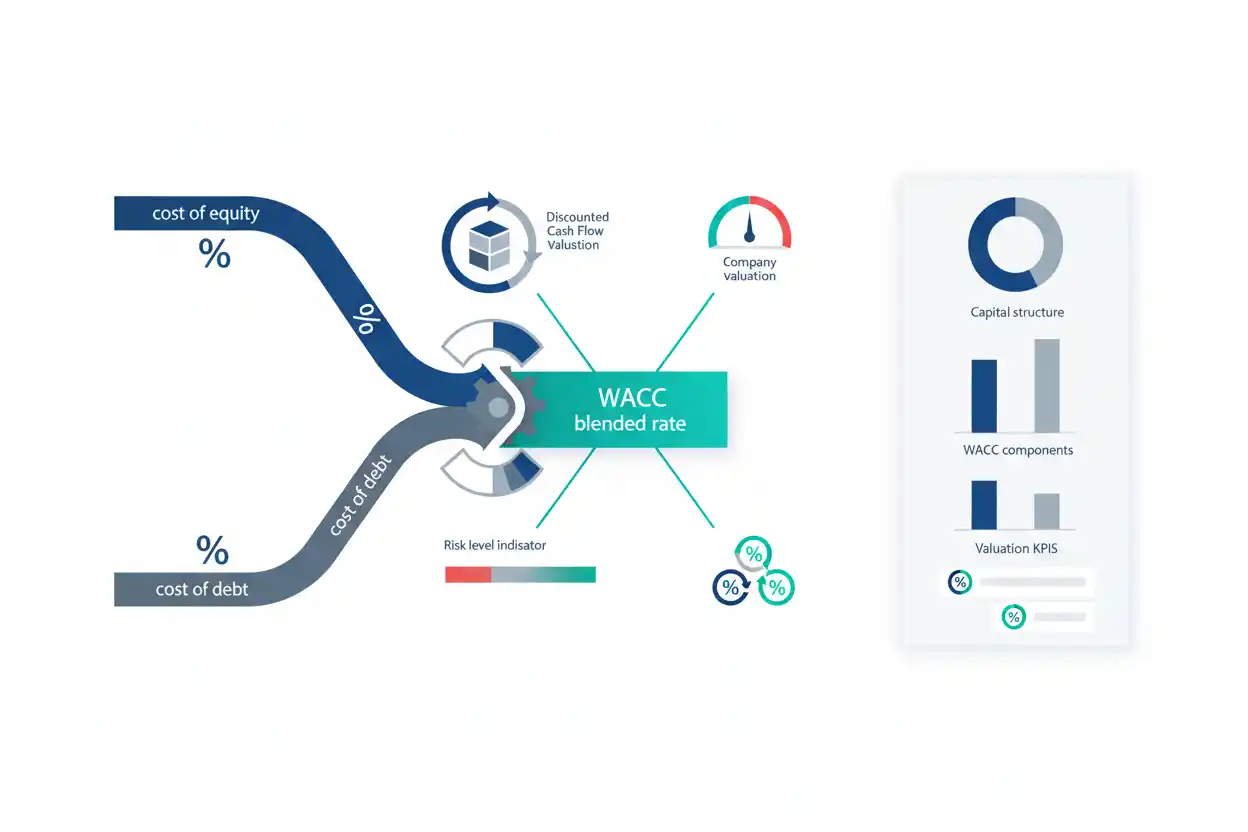

Weighted average cost of capital, usually abbreviated as WACC, estimates the blended return a company’s capital providers require for supplying debt and equity financing.
In practical corporate finance, WACC is especially important because it can serve as the discount rate for cash flows available to all capital providers when the risk of those cash flows is consistent with the company’s operating risk. It also provides a useful benchmark for comparing the expected return generated by invested capital with the cost of financing that capital.
A company does not normally finance itself entirely with one source of capital. Shareholders expect a return on equity, lenders require interest or yield on debt, and some businesses may also use preferred stock. Weighted average cost of capital combines those financing costs according to their economic weights.
Understanding WACC therefore connects several areas of business finance, including valuation, capital structure, investment analysis, risk, and financing decisions. It is one of the core concepts within the broader Finance framework.
What Is Weighted Average Cost of Capital?
Weighted average cost of capital is the weighted average required return on the financing used to support a company’s operating assets.
For a company financed with common equity and interest-bearing debt, the standard formula is:
WACC = (E ÷ V × Re) + (D ÷ V × Rd × (1 − T))
Where:
E = market value of equity
D = market value of interest-bearing debt
V = total invested financing, normally E + D
Re = cost of equity
Rd = pretax cost of debt
T = applicable corporate tax rate
The formula weights the required return on equity and debt according to their proportions of total capital. The debt component is commonly adjusted for the tax benefit associated with deductible interest, although actual deductibility depends on the applicable tax system and may be subject to limitations.
For example, a company financed 60% with equity and 40% with debt does not simply average an 11% cost of equity and a 7% cost of debt. Each financing source must receive the correct weight, and the debt cost must be adjusted appropriately for taxes.
Why Is WACC Important?
WACC helps answer a fundamental financial question:
What return must the company generate to compensate the providers of the capital it uses?
Suppose investors and lenders collectively require an average return of approximately 9% for financing a company’s operations. An investment expected to earn substantially less than that may fail to compensate capital providers adequately for the risk they assume.
Conversely, an investment earning more than the relevant cost of capital may create economic value, provided the forecasts and risk assumptions are reasonable.
This is why WACC appears frequently in corporate valuation, capital budgeting, acquisition analysis, strategic finance, and performance measurement.
It is also why WACC should not be viewed as merely an accounting percentage. It represents an economic opportunity cost of financing.
Weighted Average Cost of Capital Formula
For debt and common equity, the core formula is:
WACC = (E ÷ V × Re) + (D ÷ V × Rd × (1 − T))
The financing weights are:
Equity Weight = E ÷ (D + E)
Debt Weight = D ÷ (D + E)
If preferred stock is a material part of the capital structure, the formula can be extended:
WACC = (E ÷ V × Re) + (D ÷ V × Rd × (1 − T)) + (P ÷ V × Rp)
Where P represents the market value of preferred stock and Rp represents its required return.
In that case:
V = E + D + P
For many ordinary operating companies, however, a debt-and-equity version is sufficient.
How to Calculate WACC Step by Step
A reliable WACC calculation requires more than inserting percentages into a formula. Each component must be estimated consistently.
Step 1: Determine the Market Value of Equity
For a publicly traded company, market capitalization provides a common starting point.
Market Value of Equity = Share Price × Diluted Shares Outstanding
Suppose a company has 6 million relevant shares and a market price of $10.
Market Value of Equity = 6 million × $10 = $60 million
Equity therefore contributes $60 million to the financing base.
Market values are generally more economically relevant than historical book equity because WACC is intended to reflect current required returns and financing values.
Step 2: Estimate the Market Value of Debt
Assume the company has approximately $40 million of interest-bearing debt.
The financing base is therefore:
Total Capital = $60 million Equity + $40 million Debt = $100 million
That produces the following weights:
Equity Weight = $60 million ÷ $100 million = 60%
Debt Weight = $40 million ÷ $100 million = 40%
Metrics such as the debt-to-equity ratio, debt ratio, and overall financial leverage help explain the company’s financing profile, although WACC requires its own capital-weight calculation.
Step 3: Estimate the Cost of Equity
The cost of equity represents the return shareholders require for bearing equity risk.
A frequently used framework is the Capital Asset Pricing Model:
Cost of Equity = Risk-Free Rate + Beta × Equity Risk Premium
For example, assume:
Risk-free rate = 4.0%
Beta = 1.0
Equity risk premium = 7.0%
Then:
Cost of Equity = 4.0% + (1.0 × 7.0%) = 11.0%
The company’s beta affects this estimate because beta measures the sensitivity of equity returns to broader market movements within the CAPM framework.
Cost-of-equity estimation can become more complex for private businesses, companies operating across multiple countries, highly leveraged companies, and businesses with unusual risk profiles.
Step 4: Estimate the Pretax Cost of Debt
The cost of debt should generally reflect the rate the company would face on its debt financing under current conditions rather than blindly using the coupon rate on an old loan or bond.
Suppose the estimated pretax cost of debt is 7%.
Pretax Cost of Debt = 7%
A business with weak credit quality will generally face a higher borrowing cost than an otherwise comparable business with stronger credit metrics. Measures such as interest coverage can therefore help explain why borrowing costs differ across companies.
Market-based approaches to WACC commonly estimate debt cost using borrowing rates or yields appropriate to the company’s credit risk, while cost of equity may be estimated through CAPM.
Step 5: Calculate the After-Tax Cost of Debt
Assume a 25% applicable tax rate for this example.
After-Tax Cost of Debt = Rd × (1 − T)
So:
After-Tax Cost of Debt = 7% × (1 − 25%)
After-Tax Cost of Debt = 7% × 75% = 5.25%
The after-tax adjustment reflects the potential tax benefit of deductible interest. However, companies should not automatically assume that every dollar of interest creates an immediate tax shield. Tax laws can restrict the amount or timing of deductible business interest.
Step 6: Calculate the Equity Contribution
The equity portion of WACC is:
Equity Contribution = Equity Weight × Cost of Equity
Using our assumptions:
Equity Contribution = 60% × 11% = 6.60%
Step 7: Calculate the Debt Contribution
The debt portion is:
Debt Contribution = Debt Weight × After-Tax Cost of Debt
Therefore:
Debt Contribution = 40% × 5.25% = 2.10%
Step 8: Add the Components
Finally:
WACC = 6.60% + 2.10% = 8.70%
The company’s estimated weighted average cost of capital is therefore 8.7%.
WACC Example at a Glance
| Component | Assumption |
|---|---|
| Market value of equity | $60 million |
| Market value of debt | $40 million |
| Total capital | $100 million |
| Equity weight | 60% |
| Debt weight | 40% |
| Cost of equity | 11.0% |
| Pretax cost of debt | 7.0% |
| Tax rate | 25% |
| After-tax cost of debt | 5.25% |
| WACC | 8.70% |
This 8.7% does not mean the company earns 8.7%, pays 8.7% interest, or guarantees investors an 8.7% return.
It represents the estimated blended required return associated with the company’s financing and operating risk under the assumptions used.
What Does an 8.7% WACC Mean?
An 8.7% WACC means that, based on the model’s assumptions, the company’s debt and equity capital providers collectively require an estimated weighted return of approximately 8.7%.
One practical interpretation is that an operating investment with risk comparable to the company’s existing operations should generally be expected to produce returns sufficient to compensate for approximately that cost of capital.
That interpretation needs an important qualification: WACC is not automatically the correct hurdle rate for every project.
A low-risk project may justify a lower discount rate. A highly speculative expansion may require a higher rate. Using the company-wide WACC indiscriminately can make risky projects appear more attractive and safer projects appear less attractive than they really are.
WACC and Discounted Cash Flow Valuation
One of the most common applications of weighted average cost of capital is discounted cash flow valuation.
When analysts forecast unlevered cash flows available to both debt and equity capital providers, WACC can be used to discount those cash flows to present value.
Present Value = Future Cash Flow ÷ (1 + WACC)^n
This is closely connected with free cash flow analysis and the mechanics of net present value.
In valuation practice, WACC is commonly paired with debt-free or unlevered cash flows because both relate to all providers of capital rather than equity holders alone.
Suppose an unlevered cash flow of $100 million is expected five years from now and the appropriate WACC is 8.7%.
Present Value = $100 million ÷ (1.087)^5
Present Value ≈ $65.9 million
If the appropriate WACC were higher, the present value would generally be lower because future cash flows would be discounted more heavily. SEC-filed valuation disclosures likewise describe higher WACC assumptions as producing lower estimated fair values, all else equal.
WACC is therefore a major assumption in a business valuation, but it is only one part of the process. Cash-flow forecasts, growth assumptions, terminal value, taxes, reinvestment requirements, and operating risk can be equally important.
WACC vs Cost of Equity
WACC and cost of equity are related but not interchangeable.
Cost of equity measures the required return of equity investors.
WACC combines the required returns of multiple financing sources.
If a company is financed with both debt and equity, its cost of equity may be significantly higher than its WACC because shareholders generally bear greater residual risk than senior lenders.
Equity cash flows should therefore not automatically be discounted using WACC. The discount rate must match the cash flows being valued.
WACC vs Cost of Debt
Cost of debt measures the company’s borrowing cost.
WACC includes debt cost but also incorporates equity financing and the relative weights of each financing source.
In the example above:
Cost of debt = 7% pretax
Cost of equity = 11%
WACC = 8.7%
None of those three percentages means the same thing.
WACC vs IRR
The internal rate of return is a return implied by an investment’s projected cash flows.
WACC, by contrast, is a required-return benchmark based on financing costs and risk.
A simplified capital-budgeting comparison might be:
- IRR above the appropriate required return can indicate an economically attractive project.
- IRR below the required return can indicate an unattractive project.
However, project scale, cash-flow timing, reinvestment assumptions, and differences in risk can make IRR comparisons more complicated.
WACC vs NPV
WACC can be an input into an NPV calculation, while NPV is the resulting value measure.
If projected operating cash flows are discounted at an appropriate WACC:
NPV = Present Value of Expected Cash Flows − Initial Investment
The profitability index uses a related present-value framework when comparing the value of expected inflows with the required investment.
These metrics serve different purposes, so WACC should not be treated as a substitute for NPV or other investment-evaluation measures.
WACC vs ROIC
The return on invested capital measures operating returns generated from invested capital, while WACC estimates the cost of that capital.
This creates a useful conceptual comparison:
ROIC greater than WACC can indicate that the company is generating operating returns above its estimated capital cost.
ROIC below WACC can indicate that operating returns are insufficient to cover the estimated opportunity cost of capital.
The spread should not be interpreted mechanically, because measurement periods, accounting adjustments, cyclicality, and risk matter. Nevertheless, it is central to the logic behind economic value added.
What Makes WACC Increase?
Several changes can raise a company’s weighted average cost of capital.
Higher Equity Risk
If investors perceive greater business or financial risk, the required return on equity can increase.
For example, suppose the cost of equity in our example rises from 11% to 13% while all other assumptions remain unchanged.
WACC = (60% × 13%) + (40% × 7% × 75%)
WACC = 7.80% + 2.10% = 9.90%
That is a substantial increase from 8.7%.
Higher Borrowing Costs
Rising market yields, weaker credit quality, refinancing risk, or greater leverage can raise the company’s marginal cost of debt.
The effect is especially important for businesses that depend heavily on borrowed capital.
Greater Business Risk
Volatile revenues, uncertain margins, competitive disruption, cyclical demand, concentration risk, or weak operating predictability can increase the returns investors require.
Changes in Capital Structure
Changing the debt-equity mix changes the WACC weights and can also change the costs themselves.
Adding relatively inexpensive debt does not guarantee that WACC will continue falling indefinitely. As leverage becomes excessive, lenders may demand higher interest rates and shareholders may require higher returns because financial risk has increased.
What Can Make WACC Decrease?
WACC may decline when financing becomes cheaper or perceived business risk decreases.
Possible drivers include stronger credit quality, lower required equity returns, lower market interest rates, more stable operating performance, or a more efficient capital structure.
Still, a low WACC should not automatically be interpreted as evidence of a superior company.
A low-risk utility and a high-growth technology company may reasonably have very different capital costs. The correct comparison depends on risk, industry, capital structure, geography, and market conditions.
Market Value vs Book Value in WACC
One of the most common WACC mistakes is using historical balance-sheet values simply because they are easy to obtain.
WACC is forward-looking. As a result, the financing weights should generally reflect economic values rather than historical accounting amounts whenever reasonable market-value estimates are available.
For public equity, market capitalization is often observable.
Debt can be more difficult. Public bonds may have observable market prices, while private loans may require estimation. If the market value of debt is reasonably close to carrying value, analysts sometimes use book debt as an approximation, but that is an assumption rather than a universal rule.
Which Debt Should Be Included?
WACC normally focuses on interest-bearing financing obligations used to fund the business.
Examples can include:
- bonds,
- bank loans,
- notes payable,
- revolving credit borrowings,
- other material interest-bearing financing.
Not every liability on the balance sheet should automatically be classified as WACC debt.
Ordinary operating liabilities such as trade payables are typically part of operating working capital rather than a financing source treated identically to bonds or bank loans.
This distinction matters when analyzing working capital and financing separately.
Should Cash Reduce Debt in WACC?
Analysts sometimes use net debt when examining capital structure, but excessive cash creates an important valuation issue.
Automatically subtracting every dollar of cash from debt can produce strange results, including negative debt for cash-rich companies.
A cleaner approach in many enterprise valuations is to value the operating business using an appropriate operating capital structure and then treat excess cash or non-operating assets separately when moving from enterprise value to equity value.
The appropriate treatment depends on the purpose of the valuation and the economic role of the cash.
WACC Does Not Replace Cash-Flow Forecasting
A technically precise discount rate cannot rescue an unrealistic forecast.
WACC affects how projected cash flows are valued. It does not determine the cash flows themselves.
For example, variable costs affect operating profitability and cash-generation assumptions. Changes in inventory, receivables, and payables affect reinvestment through working capital. Operating cash flow reflects the cash generated by ongoing operations.
Similarly, unit economics can affect the plausibility of growth forecasts, while target pricing deals with pricing and margin economics rather than the required return on financing.
Keeping those concepts separate prevents a common modeling error: trying to compensate for optimistic operating assumptions by arbitrarily increasing the discount rate.
WACC for Startups and Private Companies
Estimating weighted average cost of capital becomes considerably harder when a company has no publicly traded shares or bonds.
A startup valuation may require estimates based on comparable public companies, industry capital structures, normalized leverage, observed financing terms, and adjustments for risks that are not directly observable in market prices.
Private companies also create challenges because:
- equity value is not continuously quoted,
- beta is not directly observable,
- debt may be privately negotiated,
- capital structures can change rapidly,
- future profitability may be uncertain,
- conventional tax shields may have limited immediate value when the business has losses.
For very early-stage businesses, a single mechanically precise WACC percentage can create false confidence. Scenario analysis and explicit risk modeling may be more informative than reporting a discount rate to multiple decimal places.
Common WACC Mistakes
Using Historical Interest Expense as the Cost of Debt
Dividing last year’s interest expense by debt can provide information about historical financing costs, but it may not represent the company’s current marginal borrowing rate.
WACC is generally intended to be forward-looking.
Assuming All Interest Is Fully Tax Deductible
The familiar after-tax debt formula assumes a usable tax benefit.
Real-world tax rules may limit deductions, delay them, or make the tax shield less valuable when a company has insufficient taxable income. In the United States, for example, business interest deductions can be subject to Section 163(j) limitations.
Using the Same WACC for Every Project
Company-wide WACC reflects an average risk profile.
A project substantially riskier or safer than the existing business may require a different discount rate.
Mixing Equity Cash Flow with WACC
The discount rate and cash-flow definition must be consistent.
Using WACC to discount cash flows available only to equity holders can mix financing perspectives and distort valuation.
Mixing Nominal and Real Assumptions
Nominal cash flows should normally be paired with a nominal discount rate. Real cash flows require a consistently constructed real discount rate.
Inflation assumptions cannot be ignored.
Mixing Currencies
A dollar-denominated WACC should not be inserted mechanically into cash flows projected in another currency with different inflation and risk characteristics.
Treating WACC as a Fixed Company Trait
WACC changes.
Market interest rates move. Share prices change. credit spreads change. Capital structures evolve. Risk perceptions shift. Tax circumstances can change.
A WACC calculated several years ago may no longer represent current financing conditions.
WACC and Capital Structure Decisions
Because debt often appears cheaper than equity, management may be tempted to conclude that increasing debt always lowers WACC.
That conclusion is incomplete.
Initially, moderate debt financing can sometimes reduce the blended capital cost. But as leverage rises, default risk and financial distress risk also increase. Lenders may demand higher yields, and equity holders may demand higher returns.
The relationship is therefore not simply:
More debt = lower WACC.
Capital structure must be considered together with operating stability, financing flexibility, debt maturity, interest coverage, credit quality, and business risk.
Can WACC Be Negative?
A conventional operating-company WACC will ordinarily be positive because both lenders and shareholders generally require positive expected returns.
Unusual market conditions can create negative yields on specific securities, but a negative company-wide WACC would require careful scrutiny of the assumptions and is not a normal result.
If a model produces a negative WACC because the company holds more cash than debt and the analyst has created a negative debt weight, that is a strong signal to reconsider how excess cash and operating capital structure are being modeled.
What Is a Good WACC?
There is no universal good WACC.
A 7% WACC might be low for one industry and high for another. Comparing WACC across unrelated companies without considering risk, geography, leverage, maturity, and market conditions can be misleading.
The more useful question is:
Does the WACC reasonably represent the current required return for the risk and financing of the cash flows being analyzed?
That question focuses on economic consistency rather than an arbitrary benchmark.
WACC Limitations
Weighted average cost of capital is useful, but it is still an estimate.
Cost of equity cannot be directly observed. Beta estimates can change depending on the measurement period and comparable companies selected. Equity risk premiums are estimated. Market values fluctuate. Credit spreads move. Tax assumptions may not reflect the company’s actual ability to use interest deductions.
WACC can also become unreliable when capital structure is expected to change substantially over the forecast period.
As a result, sophisticated valuation work commonly evaluates a range of discount rates instead of relying on one precise point estimate.
Sensitivity analysis can show how much a valuation depends on WACC assumptions and help distinguish genuine economic conclusions from model precision.
Frequently Asked Questions
What does WACC stand for?
WACC stands for weighted average cost of capital. It combines the required returns on a company’s financing sources according to their relative weights.
What is the basic WACC formula?
For a company financed with debt and common equity:
WACC = (E ÷ V × Re) + (D ÷ V × Rd × (1 − T))
The formula weights the cost of equity and after-tax cost of debt according to their share of total financing.
Why is debt adjusted for taxes in WACC?
Interest expense can provide a tax benefit when it is deductible, reducing the effective cost of debt. The simplified adjustment is:
After-Tax Cost of Debt = Pretax Cost of Debt × (1 − Tax Rate)
Actual tax benefits may differ because deductibility depends on jurisdiction, taxable income, and applicable limitations.
Should WACC use market value or book value?
Market-value weights are generally preferred when reliable market values are available because WACC is intended to reflect current economic financing costs. Book values may sometimes be used as approximations when market values cannot be estimated reliably.
Is WACC the same as a discount rate?
WACC can be used as a discount rate when the cash flows being valued are available to all capital providers and have risk consistent with the WACC assumptions. Not every valuation or project should automatically use company-wide WACC.
Is a lower WACC always better?
No. A lower WACC can indicate cheaper financing or lower perceived risk, but it does not automatically mean the business is better. Different companies naturally have different capital costs because their risks and financing structures differ.
Why is the cost of equity usually higher than the cost of debt?
Equity investors are residual claimants and generally bear more downside risk than senior lenders. Lenders typically have contractual payment claims and may have priority over shareholders if a company fails.
Does increasing debt lower WACC?
Not indefinitely. Moderate debt can sometimes lower the blended financing cost, but excessive leverage raises financial risk. Eventually lenders and shareholders may both demand higher returns.
Can WACC be used for every investment project?
No. Company-wide WACC represents average operating risk. Projects with materially different risk profiles should be evaluated using discount rates consistent with their own risks.
How often should WACC be recalculated?
WACC should be reconsidered whenever material inputs change, including market interest rates, credit spreads, equity value, leverage, business risk, tax circumstances, or the target capital structure.
What is the difference between WACC and required rate of return?
Required rate of return is a broad concept describing the return investors demand for taking risk. WACC is a specific blended required return calculated across a company’s debt and equity financing sources.
Final Takeaway
Weighted average cost of capital measures the blended required return associated with the debt and equity financing supporting a business.
Its core formula is:
WACC = (E ÷ V × Re) + (D ÷ V × Rd × (1 − T))
In the worked example, a company financed with 60% equity and 40% debt, with an 11% cost of equity, 7% pretax cost of debt, and 25% tax rate, produces a WACC of 8.7%.
That percentage becomes useful only when its components are estimated consistently. Market-value financing weights, a forward-looking cost of debt, a defensible cost of equity, realistic tax assumptions, and properly matched cash flows all matter.
Used carefully, WACC provides a disciplined link between financing risk, investment returns, and valuation. Used mechanically, it can create a false impression of precision.