
Business valuation is the process of estimating the economic value of a business or ownership interest at a particular date under a defined set of assumptions.
There is rarely one universally correct value. A business can produce different defensible valuation conclusions depending on the purpose of the valuation, the interest being valued, the financial information available, expected future performance, risk, market evidence, and the valuation method used.
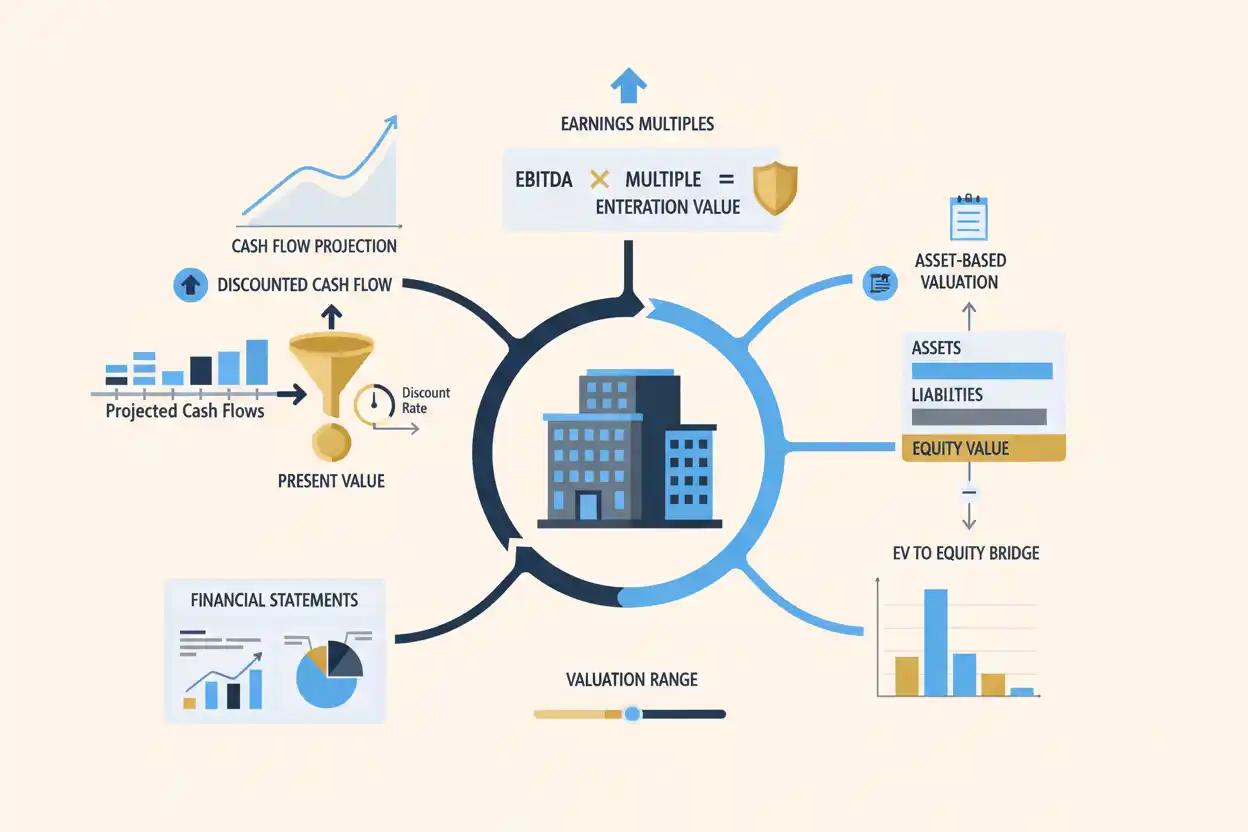
Three broad approaches dominate business valuation: income-based methods, which value expected economic benefits; market-based methods, which compare the business with relevant transactions or companies; and asset-based methods, which focus on the value of assets less liabilities.
For owners, investors, buyers, lenders, and managers, the important question is therefore not simply “What multiple should I use?” It is which method fits this business, which financial measure should be valued, and which assumptions genuinely drive the result.
Business valuation belongs within the wider framework of business finance, because value ultimately depends on the economics behind revenue, margins, cash generation, assets, liabilities, growth, and risk.
What Is Business Valuation?
Business valuation estimates what an entire company or a specific ownership interest may be worth under a particular standard and purpose.
A valuation may be needed for a sale, acquisition, investment, succession plan, financing transaction, shareholder matter, tax-related purpose, estate planning, litigation, employee ownership transaction, or internal strategic decision.
Those situations do not necessarily require identical assumptions.
For example, estimating what a strategic buyer might pay for an entire company is not automatically the same exercise as valuing a minority ownership interest for another purpose.
The valuation must therefore begin by defining what is being valued and why.
Only after that should the analyst choose formulas, multiples, discount rates, or comparable companies.
Business Valuation Is More Than a Multiple
Many informal valuations begin with a statement such as:
“Businesses in this industry sell for five times EBITDA.”
That may provide a useful starting point, but it is not a complete valuation.
A multiple only becomes meaningful when the analyst understands what financial metric it applies to, how that metric has been normalized, whether the multiple represents enterprise value or equity value, how similar the comparable companies are, and whether the subject company’s growth and risk justify the selected multiple.
A useful valuation therefore connects the multiple with the economics of the company rather than treating it as a fixed industry rule.
The Three Main Business Valuation Approaches
Most business valuation methods can be organized into three broad approaches.
The income approach estimates value from expected future economic benefits, commonly using discounted cash flow or capitalization methods.
The market approach uses pricing evidence from comparable companies, transactions, or market multiples.
The asset approach considers the value of the company’s underlying assets and liabilities.
A valuation may use more than one approach when reliable information is available. Different methods can provide useful cross-checks, but averaging unrelated results mechanically does not necessarily improve accuracy.
The method should fit the business and the valuation purpose.
Income Approach to Business Valuation
The income approach values a company according to the economic benefits investors expect to receive.
For an operating business, that often means future cash flow.
The most familiar income method is discounted cash flow, or DCF.
A simplified DCF concept is:
Business Value = Present Value of Expected Future Cash Flows + Present Value of Terminal Value
Each future cash flow is discounted because receiving money later is not economically equivalent to receiving the same amount today.
The relationship is based on the present value concept:
Present Value = Future Cash Flow ÷ (1 + Discount Rate)^n
where n represents the number of periods into the future.
The discount rate reflects the return required for the risk and timing associated with those expected cash flows.
Discounted Cash Flow Example
Assume a simplified company is expected to generate $400,000 of free cash flow next year.
If the appropriate discount rate for this example is 12%, the present value of that one future cash flow is:
Present Value = $400,000 ÷ (1 + 0.12)^1
Present Value ≈ $357,143
A complete DCF would repeat the process across multiple forecast periods and include a terminal value for economic benefits expected beyond the explicit forecast.
The value is therefore sensitive to the assumptions used for revenue growth, margins, reinvestment, cash conversion, long-term growth, and the discount rate.
This is one reason a detailed cash flow forecast can be more important to valuation quality than making the spreadsheet itself more complicated.
Free Cash Flow in Business Valuation
A DCF must define which cash flow is being valued.
Free cash flow broadly represents cash generated after specified operating and investment requirements, but different valuation models may use cash flow available to all capital providers or cash flow available specifically to equity holders.
That choice affects the corresponding discount rate and the type of value calculated.
A simplified operating relationship might begin with:
Free Cash Flow = Operating Cash Flow − Capital Expenditures
However, a professional valuation model may require more detailed adjustments for taxes, working capital, debt, and other items.
The important principle is consistency: the cash flow being discounted and the discount rate applied to it must belong to the same valuation framework.
Why Forecast Quality Matters
A DCF can produce a precise-looking number from weak assumptions.
Suppose a forecast assumes revenue grows 25% every year while gross margin simultaneously improves, customer acquisition costs decline, capital expenditure remains low, and working capital needs barely change.
The resulting value may look attractive, but the assumptions need economic support.
A strong valuation forecast should connect projected growth with operational requirements.
For example, higher sales may require more inventory, receivables, staff, equipment, or marketing. Those requirements can affect working capital, cash conversion cycle, and free cash flow.
The valuation should reflect those relationships rather than forecasting revenue independently from the resources needed to create it.
Terminal Value
A DCF commonly includes a terminal value because most operating businesses are expected to continue beyond a short explicit forecast period.
One widely used conceptual form is a constant-growth model:
Terminal Value = Next-Period Cash Flow ÷ (Discount Rate − Long-Term Growth Rate)
If normalized cash flow after the explicit forecast is expected to be $750,000, the discount rate is 12%, and the long-term growth assumption is 3%:
Terminal Value = $750,000 ÷ (0.12 − 0.03)
Terminal Value ≈ $8,333,333
That figure is calculated at the end of the forecast period and then must itself be discounted back to the valuation date.
Small changes in the long-term growth rate or discount rate can materially change terminal value. This sensitivity is why terminal assumptions require particular care.
Capitalization of Earnings or Cash Flow
Not every valuation requires a detailed multi-year DCF.
A mature business with relatively stable, normalized economic performance may sometimes be analyzed using a capitalization method.
The simplified relationship is:
Value = Normalized Economic Benefit ÷ Capitalization Rate
Suppose normalized annual cash flow is $500,000 and the selected capitalization rate is 20%.
Value = $500,000 ÷ 0.20
Value = $2,500,000
The capitalization rate reflects both expected long-term growth and risk under the chosen framework.
This method becomes less suitable when cash flows are highly volatile, the company is changing rapidly, or near-term performance differs materially from a sustainable long-term level.
Market Approach to Business Valuation
The market approach estimates business value by comparing the company with relevant market transactions or publicly traded companies.
The underlying idea is straightforward: if investors have paid certain prices for economically similar companies, those transactions may provide evidence about the subject company’s value.
A common expression is:
Estimated Value = Selected Financial Metric × Valuation Multiple
Possible financial metrics include revenue, EBIT, EBITDA, net income, or another industry-relevant measure.
The difficult part is not multiplication.
It is selecting genuinely relevant comparables and determining whether their pricing can reasonably be applied to the subject business.
EBITDA Multiple Example
Suppose a company has normalized EBITDA of $1.2 million and analysis of appropriate market evidence supports an enterprise-value-to-EBITDA multiple of 5.5×.
Estimated Enterprise Value = $1,200,000 × 5.5
Estimated Enterprise Value = $6,600,000
The result is an estimated enterprise value, not automatically the value belonging to shareholders.
If the business has $1.5 million of relevant debt and $400,000 of excess cash, a simplified bridge might be:
Equity Value = Enterprise Value − Debt + Excess Cash
Equity Value = $6,600,000 − $1,500,000 + $400,000
Equity Value = $5,500,000
Actual transaction adjustments can be more complicated, particularly when debt-like items, working-capital targets, non-operating assets, or other negotiated adjustments exist.
Enterprise Value vs Equity Value
Confusing enterprise value with equity value is one of the most consequential business valuation mistakes.
Enterprise value broadly represents the value of the operating business attributable to capital providers under the selected framework.
Equity value represents the value attributable to owners after relevant financing and other adjustments.
The simplified relationship often appears as:
Equity Value = Enterprise Value − Debt + Cash
But the exact bridge depends on what the valuation includes.
A company with a $10 million enterprise value and substantial debt does not automatically have $10 million of owner equity.
Understanding debt ratio and debt-to-equity ratio can provide additional capital-structure context, although those ratios do not replace the valuation bridge itself.
Revenue Multiples
Some businesses are valued with revenue multiples when earnings or cash flow are not yet representative.
A simplified formula is:
Estimated Value = Revenue × Selected Revenue Multiple
Suppose annual revenue is $4 million and the relevant evidence supports a 1.5× revenue multiple.
Estimated Value = $4,000,000 × 1.5
Estimated Value = $6,000,000
The apparent simplicity creates risk.
Two businesses with identical revenue can deserve very different values if their gross margins, customer retention, growth, capital requirements, profitability, or risk differ.
For that reason, gross margin often provides essential context when evaluating revenue-based valuation multiples.
Why the Same Revenue Can Produce Different Values
Consider Company A and Company B, each generating $5 million in annual revenue.
Company A has strong margins, recurring customers, low customer concentration, modest capital requirements, and positive free cash flow.
Company B has thin margins, one customer representing most sales, heavy capital requirements, and recurring cash shortages.
Applying the same revenue multiple to both businesses simply because their sales are equal ignores their different economics.
Business valuation therefore asks not only how much revenue a company generates but how durable, profitable, scalable, and cash-generative that revenue is.
Measures such as customer acquisition cost and customer lifetime value can also matter in business models where customer economics materially affect future performance.
Normalized EBITDA
Private-company valuation often requires adjusting historical financial statements to estimate sustainable economic performance.
Reported EBITDA may include unusual, nonrecurring, discretionary, or owner-specific items that a buyer or valuation analyst needs to examine.
Suppose reported EBITDA is $800,000. The company incurred a genuinely nonrecurring $100,000 legal expense and also recorded $50,000 of another adjustment that the valuation analysis concludes should be normalized.
A simplified illustration would be:
Normalized EBITDA = Reported EBITDA + Valid Normalizing Adjustments
Normalized EBITDA = $800,000 + $100,000 + $50,000
Normalized EBITDA = $950,000
The key word is valid.
An adjustment should reflect the economic circumstances expected under the valuation premise. Labeling every undesirable expense “nonrecurring” can materially overstate value.
Owner Compensation Adjustments
Closely held businesses can require particular attention to owner compensation.
An owner may receive compensation above or below a market-equivalent amount, or personal and business expenses may be mixed in ways that require careful review.
If the purpose of the valuation is to estimate sustainable earnings under a specified ownership assumption, compensation may need to be normalized.
That does not mean simply adding all owner compensation back to earnings.
The analyst should determine what level of compensation would reasonably be required for the work performed under the valuation premise.
This distinction can materially affect normalized profitability.
EBITDA Is Not Cash Flow
An EBITDA multiple does not eliminate the importance of cash flow.
EBITDA excludes depreciation and amortization and is calculated before interest and taxes, but a business may still require substantial capital expenditures, working capital, taxes, and other cash commitments.
Two companies with identical EBITDA can therefore generate very different amounts of free cash flow.
A capital-intensive company may continually reinvest heavily in equipment. An asset-light company may require much less reinvestment.
For business valuation, EBITDA is a useful market metric in many contexts, not a universal substitute for economic cash flow.
Asset Approach to Business Valuation
An asset approach considers the economic value of a company’s assets less its liabilities.
The simplest conceptual relationship is:
Net Asset Value = Fair Value of Assets − Fair Value of Liabilities
This can be particularly relevant for asset-holding businesses, investment entities, certain real-estate-oriented companies, businesses with limited earnings but valuable assets, or situations involving liquidation.
The approach should not automatically use accounting book value.
Assets recorded at historical cost can have current economic values that differ substantially from their balance-sheet carrying amounts.
Likewise, some economically important assets or obligations may require separate analysis.
Book Value vs Business Value
Book value comes from accounting records.
A simplified equity relationship is:
Book Equity = Recorded Assets − Recorded Liabilities
Business value is an economic conclusion.
The two can differ significantly.
A profitable service company may have relatively few tangible assets but valuable customer relationships, systems, brand recognition, intellectual property, or workforce capabilities.
Conversely, a company can report a large accounting asset base while earning weak returns from those assets.
This is one reason asset turnover can provide useful operating context: owning substantial assets does not necessarily mean those assets produce proportionate revenue or value.
Liquidation Value vs Going-Concern Value
Valuation also depends on the assumed premise.
A functioning company expected to continue operating can have value because its assets work together to produce future economic benefits.
A liquidation scenario asks a different question: what could be realized if assets were sold and obligations settled under the specified conditions?
Those conclusions may differ substantially.
Equipment that is productive as part of an integrated business may sell for less when removed and sold separately.
Likewise, customer relationships, assembled workforce, processes, and other operating advantages can lose value when the business is dismantled.
The valuation premise therefore needs to be defined before selecting the method.
Comparable Company Multiples
Public-company comparisons can provide useful market evidence when sufficiently similar companies exist.
Common ratios can include:
Enterprise Value ÷ Revenue
Enterprise Value ÷ EBITDA
Price ÷ Earnings
The analyst then compares the subject business with the reference companies across factors such as growth, size, margins, business model, customer concentration, geography, leverage, risk, and expected performance.
A smaller private company may not deserve the same multiple as a large, diversified public company merely because both operate in the same broad industry.
The multiple must be interpreted, not copied.
Transaction Multiples
Completed acquisitions can provide another source of market evidence.
Suppose similar businesses have sold within a range of EBITDA multiples.
That range can help frame value, but transaction data need context.
A strategic buyer may have expected synergies. The transaction may include unusual financing. Market conditions may have changed. The acquired company may have been larger, faster-growing, or less risky.
Moreover, headline transaction values may not always disclose every adjustment needed for a precise comparison.
Comparable transactions are evidence, not automatic answers.
How Growth Affects Business Valuation
Expected growth can increase value when the growth is economically attractive and sufficiently credible.
Higher revenue alone is not enough.
Growth that requires substantial capital while producing weak incremental margins may contribute less value than slower growth with strong free cash flow.
Similarly, rapid expansion funded by persistent cash consumption can create financing risk.
The company’s burn rate and cash runway may therefore become relevant when valuing an early-stage or cash-consuming company.
Value depends on what the company is expected to produce from its growth, not simply the growth percentage itself.
How Profitability Affects Value
Profitable businesses often have stronger valuation foundations than otherwise similar companies that continually lose money, but profit quality matters.
One company may show strong net profit while underinvesting in assets it will soon need to replace.
Another may report lower accounting earnings because depreciation is substantial even though cash generation remains strong.
Financial statements should therefore be examined together.
Margin, working capital, capital expenditure, leverage, and free cash flow can explain whether reported profitability converts into durable owner economics.
Working Capital and Transaction Value
Working capital can become particularly important in business acquisitions.
A buyer generally expects an operating company to have enough normal working capital to continue running after closing under the agreed transaction structure.
If receivables, inventory, payables, or other working-capital accounts differ significantly from normal levels, purchase-price adjustments may arise depending on the transaction agreement.
Understanding current ratio can help assess short-term balance-sheet structure, while days-based measures such as days sales outstanding and days inventory outstanding can expose unusual operating balances.
A headline valuation multiple alone does not capture these transaction mechanics.
Customer Concentration
A business earning 60% of its revenue from one customer generally carries a different risk profile from an otherwise similar company with a diversified customer base.
If the dominant customer leaves, revenue and cash flow could fall sharply.
That risk may affect forecasts, discount rates, market multiples, deal structures, or the amount buyers are willing to pay.
The same principle applies to supplier concentration, dependence on one employee, geographic concentration, or reliance on one product.
Business valuation needs to examine the durability of expected economic benefits, not merely historical totals.
Recurring vs Nonrecurring Revenue
Predictability can influence valuation.
Contracted recurring revenue may give an analyst more confidence in near-term forecasts than one-off project revenue, although contract quality, churn, customer concentration, renewal terms, and margin still matter.
A business should not receive a high valuation merely because management labels revenue “recurring.”
The economic question is whether the cash flows are likely to persist and at what cost.
Where customer acquisition is central to the model, customer lifetime value and acquisition economics can provide additional evidence about the durability and profitability of growth.
Debt and Business Valuation
Debt affects the transition from enterprise value to equity value and can also affect business risk.
A highly leveraged company faces fixed financing obligations that may reduce financial flexibility.
Financial leverage can magnify outcomes for owners, while debt-to-equity ratio describes one aspect of the capital structure.
However, valuation should not simply subtract every balance-sheet liability from an EBITDA multiple without understanding what the multiple represents and which items are considered debt-like.
The enterprise-to-equity bridge needs to match the valuation framework and transaction terms.
Value Is Date-Specific
A business valuation applies as of a particular date.
Economic conditions, interest rates, customer contracts, company performance, financing markets, competitive conditions, and forecasts can change afterward.
A valuation prepared using information available at one point may therefore differ materially from a valuation performed later.
This is not necessarily evidence that the earlier analysis was wrong.
Value changes when the facts and expectations that market participants would consider change.
Business Valuation Example Using an EBITDA Multiple
Consider a fictional business with reported EBITDA of $1,050,000.
After reviewing its financial statements, assume the valuation analysis supports $150,000 of net normalizing adjustments.
Normalized EBITDA = $1,050,000 + $150,000
Normalized EBITDA = $1,200,000
Assume relevant market evidence supports a 5× enterprise-value multiple.
Enterprise Value = $1,200,000 × 5
Enterprise Value = $6,000,000
The company has $1.3 million of relevant debt and $300,000 of excess cash.
Estimated Equity Value = $6,000,000 − $1,300,000 + $300,000
Estimated Equity Value = $5,000,000
This is an illustration, not a rule that similar companies deserve a 5× multiple.
A real valuation would need evidence supporting the normalized earnings, selected multiple, debt and cash adjustments, and the interest being valued.
Business Valuation Example Using Cash Flow
Assume another business is expected to generate $600,000 of sustainable annual cash flow and a capitalization approach is considered appropriate.
If the supported capitalization rate is 15%:
Indicated Value = $600,000 ÷ 0.15
Indicated Value = $4,000,000
If the capitalization rate were 20%:
Indicated Value = $600,000 ÷ 0.20
Indicated Value = $3,000,000
The $1 million difference shows how sensitive valuation can be to risk and growth assumptions embedded in capitalization rates.
The formula cannot determine the correct rate by itself.
Why Valuation Methods Produce Different Results
Different methods can produce different values because they view the company from different economic perspectives.
An asset approach focuses on underlying resources.
A market approach asks what investors have paid for comparable economic benefits.
An income approach converts expected future benefits into present value.
If the results differ substantially, the analyst should understand why rather than averaging them automatically.
Perhaps the company owns valuable assets that do not generate strong earnings. Maybe its growth forecast is materially stronger than historical results. Perhaps comparable transactions include strategic premiums.
Differences between methods often contain information.
Sensitivity Analysis
Because business valuation depends on assumptions, a single output can create false precision.
Sensitivity analysis shows how value changes when major assumptions change.
A DCF might test different discount rates and long-term growth rates.
A market approach could examine several defensible multiples.
A forecast can model lower revenue growth, weaker margins, slower collections, or greater capital expenditure.
The purpose is not to choose whichever scenario creates the desired value.
It is to identify which assumptions matter most and understand the plausible valuation range.
Business Valuation vs Startup Valuation
Established business valuation and startup valuation overlap, but the information available can be very different.
A mature company may have several years of revenue, margins, cash flow, assets, and market history.
An early-stage startup may have limited revenue, negative cash flow, rapidly changing economics, and substantial uncertainty.
Traditional cash-flow and earnings methods can therefore be harder to apply to very early businesses without highly assumption-sensitive forecasts.
The startup valuation page should own those specialized early-stage methods and financing considerations rather than duplicating them here.
Business Valuation vs ROI
Business valuation estimates the value of a company or ownership interest.
ROI measures return relative to an investment under a selected calculation.
Suppose an investor pays $4 million for a business later worth $5 million. The acquisition price and subsequent value are inputs to return analysis, but valuation and ROI are not the same calculation.
Likewise, IRR evaluates the discount rate associated with a stream of cash flows rather than directly determining the company’s market value.
These tools answer related but distinct financial questions.
Business Valuation vs Book Value
Book value comes from accounting balances.
Business valuation estimates economic value.
A business purchased or developed years ago may have assets carried at values substantially different from current economic values. At the same time, internally developed customer relationships, reputation, processes, or other economic advantages may not appear on the balance sheet at an amount representing their full business value.
Book value can therefore be relevant without serving as a universal valuation conclusion.
Common Business Valuation Mistakes
One common mistake is applying an industry multiple to unadjusted financial statements.
Another is confusing enterprise value with owner equity.
DCF models can fail because forecasts are too optimistic, discount rates are unsupported, or terminal values dominate the result.
Market approaches become weak when supposedly comparable businesses are materially different from the subject company.
Asset values can be misleading when accounting carrying amounts are mistaken for current economic values.
Perhaps the broadest mistake is beginning with the desired valuation and selecting assumptions that produce it.
A credible business valuation works in the opposite direction: define the valuation question, analyze the evidence, select appropriate methods, and allow the supported assumptions to determine the conclusion.
How to Prepare Financial Information for a Business Valuation
Reliable valuation begins with reliable financial information.
Historical income statements, balance sheets, and cash-flow information should be reconciled and understood.
Material nonrecurring items need documentation rather than unsupported add-backs. Owner compensation and related-party transactions may require review. Debt, cash, working capital, and capital expenditures should be identifiable.
Forecasts should connect with operational assumptions rather than existing only as top-line growth percentages.
The better the underlying financial information, the easier it becomes to distinguish real business economics from accounting noise.
Frequently Asked Questions
What is business valuation?
Business valuation is the process of estimating the economic value of a business or ownership interest as of a specified date and under a defined valuation framework.
What are the main business valuation methods?
The principal approaches are the income approach, market approach, and asset approach. Individual methods such as discounted cash flow, capitalization, comparable-company multiples, transaction multiples, and adjusted net assets fall within those broader approaches.
How do you value a business using EBITDA?
A simplified market approach is:
Enterprise Value = Normalized EBITDA × Selected EBITDA Multiple
The multiple requires support from relevant market evidence and must match the financial metric being valued.
Is EBITDA the value of a business?
No. EBITDA is a financial performance measure. A valuation multiple may be applied to normalized EBITDA, but the resulting value also depends on the multiple, capital structure, risks, growth, and other adjustments.
How do you calculate equity value from enterprise value?
A simplified version is:
Equity Value = Enterprise Value − Debt + Excess Cash
Real transactions may require additional debt-like, working-capital, or non-operating adjustments.
Can revenue be used to value a business?
Yes, revenue multiples can be useful in some industries or situations, but companies with identical revenue can have very different margins, growth, risk, and cash-flow economics.
What is discounted cash flow?
Discounted cash flow estimates value by forecasting future cash flows and converting them into present value using a discount rate that reflects timing and risk.
Why is normalized EBITDA used?
Normalized EBITDA attempts to remove supported unusual, nonrecurring, or owner-specific effects so the valuation can better reflect sustainable operating performance under the defined assumptions.
Is book value the same as business value?
No. Book value is based on accounting balances. Business valuation estimates economic value and can differ substantially from recorded net assets.
What increases business value?
Factors can include stronger sustainable cash flow, profitable growth, good margins, diversified customers, lower risk, efficient working capital, limited dependence on individuals, defensible competitive advantages, and reliable financial information. Their effects depend on the business and valuation method.
Does debt reduce business value?
Debt commonly reduces equity value when converting from an enterprise-value conclusion, although the precise treatment depends on the valuation method and what liabilities or debt-like items are included.
Can two valuers calculate different values for the same business?
Yes. Different supported assumptions, valuation dates, purposes, forecasts, market evidence, discount rates, normalizing adjustments, or valuation premises can produce different conclusions.
Final Perspective
Business valuation is not a search for a universal multiple.
A credible valuation connects the company’s financial performance with the economic benefits an owner or investor expects to receive.
The market approach can be summarized as:
Value = Financial Metric × Supported Multiple
An income approach can be summarized as:
Value = Present Value of Expected Future Economic Benefits
An asset approach begins with:
Net Asset Value = Fair Value of Assets − Fair Value of Liabilities
The formulas are the easy part.
The difficult work is determining sustainable earnings, credible future cash flows, appropriate comparables, economic asset values, risk, capital requirements, debt adjustments, and the correct valuation premise.
That is why a useful business valuation does more than produce a number. It explains what creates the value, which assumptions support it, and which risks could materially change it.