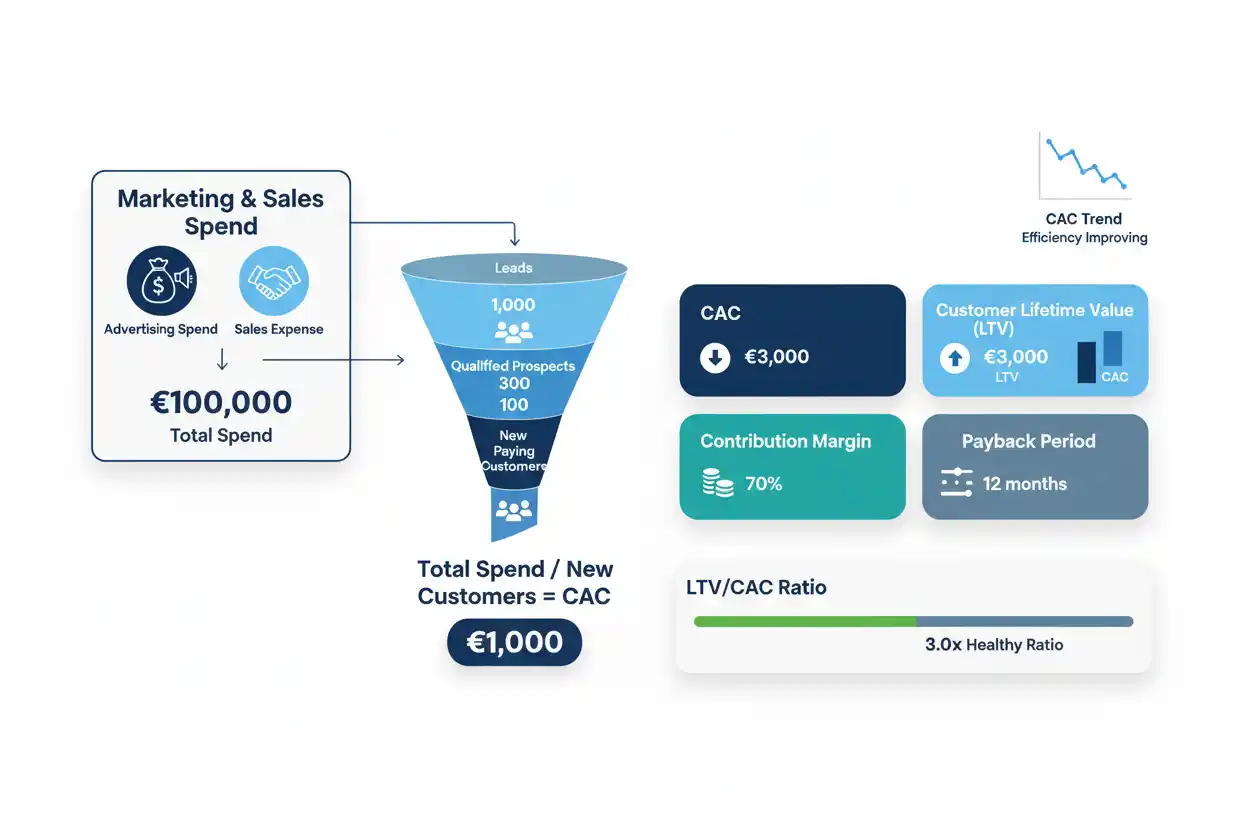

Customer acquisition cost, commonly abbreviated CAC, measures how much a business spends to acquire a new customer during a defined period under the cost definition it chooses.
A basic customer acquisition cost formula is:
Customer Acquisition Cost = Customer Acquisition Costs ÷ New Customers Acquired
If a company spends $120,000 on qualifying sales and marketing activity and acquires 600 new customers:
CAC = $120,000 ÷ 600
CAC = $200 per new customer
The arithmetic is easy. The harder question is deciding which expenses belong in acquisition cost, which customers count as genuinely new, how long the measurement period should be, and whether the resulting CAC is economically sustainable.
A $200 customer acquisition cost may be excellent for a customer expected to generate thousands of dollars of contribution. It can be disastrous when the customer’s total economic contribution is only $80.
For that reason, CAC should be interpreted alongside customer lifetime value, contribution margin, cash flow, retention, and the wider business finance model.
What Is Customer Acquisition Cost?
Customer acquisition cost estimates the average acquisition spending associated with obtaining a new customer.
The metric connects two parts of the growth process:
How much did the business spend acquiring customers?
and
How many new customers resulted during the applicable measurement period?
At a high level:
CAC = Acquisition Spending ÷ New Customers
This sounds standardized, but real businesses define acquisition spending differently.
One company may include only direct advertising.
Another may include advertising, sales salaries, commissions, marketing software, agencies, creative production, and allocated management costs.
SEC-filed companies also use materially different CAC definitions. That makes internal consistency essential and cross-company comparison difficult unless both definitions are understood.
Customer Acquisition Cost Formula
A practical broad formula is:
Customer Acquisition Cost = Total Qualifying Sales and Marketing Costs ÷ Number of New Customers Acquired
Suppose a company spends:
Advertising: $80,000
Sales compensation attributable to acquisition: $55,000
Marketing tools and agencies: $15,000
Total qualifying acquisition cost:
Acquisition Cost = $80,000 + $55,000 + $15,000
Acquisition Cost = $150,000
If 750 new customers are acquired:
CAC = $150,000 ÷ 750
CAC = $200
The company spent an average of $200 per acquired customer under that definition.
Changing the numerator changes CAC even when customer volume remains identical.
Simple CAC vs Fully Loaded CAC
A simple CAC may use only directly attributable marketing expenditure.
A fully loaded CAC can include a broader share of sales and marketing expenses involved in acquiring customers.
Suppose a company spends $100,000 on advertising and acquires 1,000 customers.
Advertising-only CAC is:
Advertising CAC = $100,000 ÷ 1,000
Advertising CAC = $100
Now include another $60,000 of acquisition-focused sales compensation and $20,000 of marketing technology.
Fully Loaded Acquisition Cost = $100,000 + $60,000 + $20,000
Fully Loaded CAC = $180,000 ÷ 1,000
Fully Loaded CAC = $180
Both calculations can be useful.
The mistake is calling both numbers “CAC” without documenting what each includes.
Customer Acquisition Cost Example
Consider an online business during one quarter.
It reports:
Paid advertising: $180,000
Affiliate commissions: $40,000
Acquisition-focused sales payroll: $60,000
Marketing software and agency costs: $20,000
New customers acquired: 1,200
Total acquisition cost:
Total Acquisition Cost = $180,000 + $40,000 + $60,000 + $20,000
Total Acquisition Cost = $300,000
CAC becomes:
Customer Acquisition Cost = $300,000 ÷ 1,200
Customer Acquisition Cost = $250
The business spends an average of $250 to acquire each new customer under this defined cost base.
Whether $250 is attractive cannot be determined from CAC alone.
The company needs to understand what those customers produce after acquisition.
What Should Be Included in CAC?
The cost base should reflect the purpose of the analysis.
For internal management, companies may include costs such as paid media, affiliate commissions, sales commissions, acquisition-oriented salaries, agency fees, campaign production, marketing software, event expenditure, and other resources directly or indirectly used to acquire new customers.
The correct answer is not “include everything” or “include advertising only.”
The definition should answer the business question consistently.
If management wants to evaluate the efficiency of paid advertisements, advertising-only CAC can be useful.
If executives want to understand the full organizational cost of acquiring customers, a broader numerator is more informative.
Maintaining both measures can provide more insight than forcing every decision into one version.
Which Customers Count as Acquired?
The denominator needs a clear definition too.
A website visitor is not necessarily a customer.
A lead is not necessarily a customer.
A free trial can be different from a paying customer.
A returning customer is not a newly acquired customer.
The business needs to define the conversion event that qualifies someone as newly acquired.
For an e-commerce store, it may be the first completed purchase.
For a subscription company, it may be the start of a paid subscription.
For a B2B company, it could be a signed paying account.
The denominator should match the acquisition process being measured.
Match Costs and Customers to the Same Period
CAC can become distorted when costs and customers are measured over incompatible periods.
Suppose a company spends $500,000 on a major campaign in December, but much of the campaign’s customer conversion occurs in January and February.
Calculating December marketing expenditure against only December customers can exaggerate CAC.
The opposite distortion occurs if later customers are counted without including the spending that generated them.
Businesses with short acquisition cycles can often use monthly or quarterly periods reasonably well.
Long B2B sales cycles may require more careful cohort or lag analysis.
Blended Customer Acquisition Cost
Blended CAC combines acquisition activity across channels into one company-level average.
Suppose a company spends:
Search advertising: $80,000
Social advertising: $50,000
Affiliate marketing: $30,000
Sales and supporting acquisition costs: $40,000
Total acquisition spending is:
Total Acquisition Spending = $200,000
The company acquires 1,000 customers.
Blended CAC = $200,000 ÷ 1,000
Blended CAC = $200
Blended CAC helps management understand overall acquisition economics.
However, it can hide meaningful differences between channels.
Channel CAC
Channel CAC estimates acquisition cost within a specific marketing or sales channel.
Suppose paid search costs $60,000 and produces 300 acquired customers.
Paid Search CAC = $60,000 ÷ 300
Paid Search CAC = $200
Paid social costs $40,000 and acquires 100 customers:
Paid Social CAC = $40,000 ÷ 100
Paid Social CAC = $400
At first glance, paid search looks much more efficient.
But channel decisions should not stop there.
The customers from paid social might make larger purchases, remain customers longer, or generate stronger customer lifetime value.
CAC measures the acquisition cost. It does not measure the quality of the resulting customer.
CAC by Customer Segment
A blended average can also hide major differences between customer types.
Suppose a software business sells to small businesses and large enterprises.
Small-business CAC = $500
Enterprise CAC = $15,000
The enterprise CAC appears dramatically higher.
However, an enterprise customer might generate $100,000 of annual recurring revenue while a small account produces only $1,200.
Comparing CAC without customer economics would lead to the wrong conclusion.
Segment-level analysis becomes particularly valuable when sales cycles, retention, pricing, or gross margins differ substantially.
Organic Customers Are Not Necessarily Free
A company may acquire customers through unpaid search, referrals, brand awareness, or direct traffic.
That does not mean those customers necessarily cost zero to acquire.
SEO can require writers, developers, research, and tools.
Referral programs can have incentives.
Brand awareness can result from previous advertising.
Content production has costs.
For some channel analyses, management may reasonably treat direct media spend as zero. For fully loaded economics, however, the resources supporting organic acquisition may still matter.
Definitions should match the decision being made.
Customer Acquisition Cost vs Cost per Lead
Cost per lead measures spending relative to generated leads.
Cost per Lead = Marketing Spend ÷ Leads Generated
CAC measures spending relative to acquired customers.
Suppose advertising costs $20,000 and produces 1,000 leads.
Cost per Lead = $20,000 ÷ 1,000 = $20
Only 100 leads become new customers.
If $20,000 is the relevant acquisition cost:
CAC = $20,000 ÷ 100 = $200
The campaign therefore produces $20 leads but $200 customers.
Confusing leads with customers can understate acquisition economics significantly.
Customer Acquisition Cost vs Cost per Acquisition
“Cost per acquisition” can mean different things depending on the advertising platform or business.
An acquisition event might be a purchase, registration, application, subscription, or another conversion.
CAC specifically focuses on acquiring a new customer under the company’s definition.
When reporting metrics internally, precise labels prevent teams from comparing fundamentally different conversion events.
CAC and Conversion Rate
Acquisition cost is strongly influenced by conversion efficiency.
Suppose a business spends $50,000 to attract 10,000 qualified prospects.
If 500 become customers:
CAC = $50,000 ÷ 500 = $100
If conversion improvements increase acquired customers to 750 without increasing the same defined spending:
CAC = $50,000 ÷ 750
CAC ≈ $66.67
CAC falls by approximately one-third.
Improving acquisition efficiency therefore does not always require cheaper advertising. Better targeting, sales execution, landing pages, qualification, offers, or checkout completion can improve the denominator.
CAC and Customer Lifetime Value
CAC becomes much more meaningful when compared with customer lifetime value, or CLV/LTV.
CAC asks:
What did acquiring the customer cost?
Customer lifetime value asks:
What economic value is expected from the customer relationship under the chosen model?
A simplified LTV-to-CAC relationship is:
LTV:CAC = Customer Lifetime Value ÷ Customer Acquisition Cost
If estimated customer lifetime value is $900 and CAC is $300:
LTV:CAC = $900 ÷ $300
LTV:CAC = 3.0×
The customer value estimate is three times acquisition cost under the assumptions used.
That does not make 3× a universal target. Definitions, timing, gross margins, retention, overhead, and capital requirements vary widely.
Why Revenue LTV Can Mislead CAC Analysis
Suppose a customer generates $1,000 of lifetime revenue and costs $300 to acquire.
At first glance:
Revenue LTV ÷ CAC = $1,000 ÷ $300 ≈ 3.33×
But suppose delivering that revenue requires $700 of variable costs.
Lifetime contribution before acquisition cost is only:
Lifetime Contribution = $1,000 − $700
Lifetime Contribution = $300
The customer’s $300 acquisition cost consumes the entire $300 contribution.
Revenue-based lifetime value can therefore make acquisition economics look stronger than contribution-based value.
This is why contribution margin matters when interpreting CAC.
Customer Acquisition Cost and Gross Margin
Gross margin also affects how much customer revenue remains to recover acquisition spending.
Consider two companies that each acquire customers for $100.
Company A has an 80% gross margin.
Company B has a 20% gross margin.
If both customers produce $200 of revenue, the amount remaining after cost of sales differs dramatically.
Using revenue alone would make their CAC economics appear identical.
Margin context reveals that they are not.
CAC Payback Period
The CAC payback period estimates how long customer contribution takes to recover acquisition cost.
A simplified version is:
CAC Payback Period = Customer Acquisition Cost ÷ Monthly Contribution per Customer
Suppose CAC is $600 and monthly customer contribution is $100.
CAC Payback Period = $600 ÷ $100
CAC Payback Period = 6 months
Under the simplified model, six months of contribution are needed to recover the acquisition cost.
If the customer cancels after four months, the company may never recover the acquisition investment.
Payback therefore adds timing to LTV:CAC analysis.
CAC and Customer Retention
Strong retention can make a higher acquisition cost economically viable because the customer relationship has more time to generate revenue and contribution.
Weak retention has the opposite effect.
Suppose two businesses both have $300 CAC.
Company A’s customers remain for three years.
Company B’s customers typically leave after three months.
The same acquisition cost has very different implications.
Retention therefore influences the amount a company can rationally spend to acquire a customer.
The acquisition team and retention team cannot be evaluated entirely independently.
CAC and Churn
Churn reduces the duration of customer relationships and can weaken the economic value created by acquisition spending.
A company may improve headline CAC by aggressively acquiring cheaper customers, only to discover that those customers cancel quickly.
That produces apparently efficient acquisition but poor unit economics.
For subscription businesses, CAC should therefore be considered with customer retention, churn, contribution, and lifetime value.
Reducing acquisition cost at the expense of customer quality can destroy value.
CAC and Pricing
Pricing changes can alter customer acquisition economics in several ways.
A higher price may increase contribution per customer but reduce conversion rate.
A lower price can improve conversion while reducing the amount available to recover CAC.
Cost-plus pricing can help establish a cost-based price, while target pricing addresses price decisions from a different direction.
CAC introduces another question:
Does the resulting customer economics support what it costs to generate the sale?
A price that covers production cost can still be inadequate after acquisition cost.
CAC and Discounts
Discounts can increase conversion, but they can also reduce the contribution available to recover CAC.
Suppose a customer costs $150 to acquire.
At the regular price, the first purchase contributes $80.
After a promotion, first-purchase contribution falls to $40.
CAC did not change, but the amount recovered from the initial sale fell by half.
If retention is strong, the promotion may still be worthwhile.
If most customers purchase only once, acquisition economics may deteriorate sharply.
CAC and Break-Even Analysis
Customer acquisition cost can become part of a broader break-even analysis.
Suppose a business has $200,000 of fixed operating costs and spends acquisition cost only when a customer is acquired.
If CAC behaves as a variable cost for the particular model, it can reduce the contribution produced by each new customer.
Ignoring acquisition cost can therefore understate the sales volume needed to support the business.
The exact treatment depends on how sales and marketing expenses behave, so cost classification should reflect the actual decision being modeled.
CAC and Cash Flow
A customer can be economically valuable yet create near-term cash pressure.
Suppose acquisition costs $1,000 today, while the customer pays $100 per month over several years.
The long-run economics may be attractive, but acquisition spending occurs before much of the cash arrives.
A detailed cash flow forecast can show whether the business has enough liquidity to finance that gap.
Strong unit economics do not automatically eliminate working-capital or financing requirements.
CAC and Burn Rate
Fast-growing companies can increase burn rate by acquiring customers aggressively.
Suppose each new customer costs $500 to acquire.
Increasing monthly acquisitions from 1,000 to 3,000 can require another $1 million of acquisition spending before considering other costs.
If customer cash arrives gradually, rapid growth can increase immediate burn even when expected lifetime economics are attractive.
Management therefore needs to balance growth rate with available capital.
CAC and Cash Runway
Higher acquisition spending can shorten cash runway if customer cash does not arrive quickly enough to offset the expenditure.
Suppose a company has $2 million of available cash and currently burns $100,000 per month.
An aggressive customer-growth program raises net burn to $250,000.
Original runway:
Runway = $2,000,000 ÷ $100,000 = 20 months
After acceleration:
Runway = $2,000,000 ÷ $250,000 = 8 months
Acquisition growth reduced modeled runway by 12 months.
That strategy may still be rational if it creates strong customer economics and reaches an important milestone, but the financing consequence must be understood.
CAC and Working Capital
Customer acquisition cost is not normally considered a working-capital ratio, but acquisition growth can interact with working capital.
A company selling physical goods may acquire many new customers and then need additional inventory.
A B2B company may acquire customers who purchase on credit, causing receivables to grow.
The acquisition campaign therefore creates not only marketing expenditure but also downstream operating cash requirements.
The cash conversion cycle can help explain those additional timing effects.
Customer Acquisition Cost and DSO
Days sales outstanding becomes relevant when customers are acquired through credit sales.
Suppose CAC is $500 and the company expects attractive customer value, but customers take 90 days to pay initial invoices.
The business needs enough liquidity to finance both the acquisition cost and the collection period.
A lower CAC does not eliminate the financial impact of slow receivables.
Acquisition efficiency and collection efficiency are therefore separate dimensions of customer economics.
CAC and Business Valuation
Business valuation can be influenced by the quality and scalability of customer acquisition economics.
A company that can repeatedly acquire valuable customers at attractive costs may have stronger growth economics than one dependent on increasingly expensive acquisition.
However, CAC alone does not determine business value.
Retention, margins, growth, cash generation, customer concentration, competitive advantages, capital requirements, and risk all matter.
CAC is evidence about the efficiency of one part of the growth engine.
CAC and Startup Valuation
Startup valuation often involves companies whose current profits do not yet capture expected future economics.
In that context, investors may examine acquisition efficiency and customer lifetime economics to understand whether growth can become sustainable.
A startup with rapid customer growth but deteriorating CAC may be spending progressively more to generate each incremental customer.
Another with stable CAC and improving retention can demonstrate a more attractive growth pattern.
Neither metric guarantees future performance, but both can inform the economics behind growth assumptions.
Why CAC Often Rises as a Business Scales
Companies sometimes assume CAC should continually decline.
That is not guaranteed.
A young company may initially reach customers who already know the founders, have strong product interest, or come through inexpensive referrals.
As the company expands, it may need to reach less familiar audiences through more expensive channels.
Competition for advertisements can rise.
Sales teams may enter harder markets.
Channel saturation can increase marginal acquisition costs.
The relevant question is therefore not whether CAC is always falling, but whether incremental customers continue creating sufficient economic value.
Marginal CAC vs Average CAC
Average CAC describes the average acquisition cost across a defined population.
Marginal CAC asks what acquiring the next group of customers costs.
Suppose the first 10,000 customers were acquired at an average $100 CAC.
The next 1,000 cost $250 each.
Historical average CAC may still look attractive, but the economics of future growth have changed.
For growth planning, marginal acquisition efficiency can matter more than the historical average.
Cohort CAC
Cohort analysis groups customers by acquisition period or another shared characteristic.
This lets management compare the acquisition economics of customers acquired in January with those acquired in February, for example.
A cohort can then be tracked for retention, revenue, contribution, and lifetime economics.
This approach helps avoid mixing old high-value customers with newly acquired customers whose quality is not yet known.
CAC becomes more informative when the numerator and customer cohort correspond logically.
Customer Acquisition Cost by Geography
CAC can vary substantially by market.
Advertising costs, competition, consumer awareness, sales salaries, local purchasing behavior, and regulatory requirements may differ by geography.
A company expanding internationally should therefore not assume its domestic CAC applies everywhere.
Market-specific CAC can reveal where customer growth is efficient and where acquisition assumptions need revision.
The same principle applies to product lines and customer segments.
Should Brand Advertising Count in CAC?
There is no universally correct answer for every internal use.
Brand advertising can influence future acquisition without producing immediately attributable customers.
Including all brand spending in direct-response channel CAC may distort the channel comparison.
Excluding brand expenditure from every company-level acquisition measure can understate the resources supporting customer growth.
A practical system may therefore maintain more than one metric: a directly attributable CAC for campaign optimization and a broader fully loaded CAC for company-level economics.
Consistency and disclosure matter more than pretending the definition is universal.
Should Sales Salaries Count in CAC?
If the sales team exists primarily to acquire new customers, excluding its compensation can materially understate fully loaded acquisition cost.
However, some sales teams also manage renewals, account growth, or existing customer relationships.
In that situation, allocating 100% of compensation to new-customer acquisition may overstate CAC.
The business should use an allocation that reflects how the resources are actually used and keep the methodology consistent.
Should Marketing Software Count in CAC?
Software used specifically for customer acquisition can reasonably belong in a broad acquisition-cost analysis.
A platform used across brand, retention, support, analytics, and customer acquisition may require allocation.
Again, the correct treatment depends on the analytical objective.
The strongest CAC reporting defines what is included rather than relying on the abbreviation alone.
What Is a Good Customer Acquisition Cost?
There is no universal good CAC.
A $20 CAC can be terrible if a customer generates only $10 of economic contribution.
A $10,000 CAC can be excellent if the acquired customer reliably produces hundreds of thousands of dollars of contribution.
The better question is:
How does customer acquisition cost compare with the economic value, timing, retention, and risk of the customers being acquired?
This is why standalone CAC benchmarks should be treated cautiously.
Industry averages can conceal enormous differences in price, margin, retention, sales cycle, and customer value.
Is a Lower CAC Always Better?
No.
Lowering acquisition cost is valuable when customer quality remains comparable.
A company could cut CAC by targeting customers who convert easily but generate little revenue or cancel quickly.
Another campaign might have higher CAC but acquire customers with substantially higher retention and contribution.
The financially relevant objective is not minimum CAC.
It is efficient acquisition of economically valuable customers.
How to Reduce Customer Acquisition Cost
CAC can improve by reducing qualifying acquisition spending, acquiring more customers from the same spending, or both.
Better audience targeting can reduce wasted media expenditure.
Stronger landing pages or sales processes can increase conversion.
Referral programs, organic search, partnerships, and customer advocacy can add acquisition channels with different economics.
Reducing sales-cycle friction can also help.
However, every reduction should be checked against customer quality.
A cheaper customer who produces substantially less lifetime contribution is not necessarily an improvement.
How to Improve CAC Without Cutting Marketing
Suppose marketing spending stays at $100,000.
At 400 new customers:
CAC = $100,000 ÷ 400 = $250
Improve conversion and acquire 500 customers:
CAC = $100,000 ÷ 500 = $200
CAC falls 20% without reducing the budget.
This is why conversion rate, sales execution, website performance, offer clarity, and qualification can matter as much as media price.
When Rising CAC Is Acceptable
Rising CAC can be rational if customer lifetime economics improve even more.
Suppose CAC rises from $200 to $300.
At the same time, customer contribution value rises from $600 to $1,200 because the company attracts larger, more loyal customers.
Old relationship:
LTV:CAC = $600 ÷ $200 = 3×
New relationship:
LTV:CAC = $1,200 ÷ $300 = 4×
Acquisition became more expensive, but modeled economics improved.
CAC should therefore be evaluated as part of a system rather than optimized independently.
Common Customer Acquisition Cost Mistakes
The first mistake is failing to define the numerator.
Another is counting leads, trials, or transactions instead of genuinely new customers.
Mixing acquisition expenditure from one period with customers acquired in another can distort the result.
Using revenue rather than contribution when assessing lifetime economics can make acquisition appear more attractive than it really is.
Businesses also risk relying too heavily on blended CAC when individual channels or segments behave very differently.
Finally, minimizing CAC at the expense of customer quality can improve the headline metric while damaging the business.
How to Analyze CAC Properly
Start with a clearly documented definition.
Calculate total and per-channel CAC using consistent periods.
Segment the result where meaningful.
Then connect acquisition cost with customer contribution, retention, lifetime value, and payback period.
Review the cash timing required to finance acquisition.
Track the metric over time and by cohort.
Finally, examine incremental CAC as acquisition volume increases.
That sequence answers the important question: Is customer growth becoming more or less economically efficient?
Frequently Asked Questions
What is customer acquisition cost?
Customer acquisition cost is the average qualifying cost a business incurs to acquire a new customer during a defined measurement period.
What is the CAC formula?
Customer Acquisition Cost = Acquisition Costs ÷ New Customers Acquired
What does CAC stand for?
CAC stands for customer acquisition cost.
What should be included in CAC?
Depending on the analytical definition, CAC may include advertising, sales compensation, commissions, agencies, marketing technology, creative costs, and other resources used to acquire customers. The definition should be stated and applied consistently.
Is CAC the same as marketing cost?
No. Marketing expense can include brand, retention, research, communications, and other activities. CAC focuses specifically on resources associated with acquiring new customers under the selected definition.
What is blended CAC?
Blended CAC combines acquisition spending and acquired customers across multiple channels into one average company-level measure.
What is channel CAC?
Channel CAC divides the acquisition costs associated with a specific channel by the new customers attributed to that channel.
What is LTV:CAC?
LTV:CAC = Customer Lifetime Value ÷ Customer Acquisition Cost
It compares modeled customer value with acquisition cost.
What is CAC payback period?
CAC payback estimates how long customer contribution takes to recover acquisition cost.
CAC Payback = CAC ÷ Monthly Contribution per Customer
What is a good CAC?
There is no universal good CAC. It should be evaluated relative to customer value, margins, retention, payback, cash requirements, and business economics.
Is lower CAC always better?
No. A lower CAC can be less attractive if the acquired customers spend less, churn faster, or produce weaker contribution.
Can CAC include sales salaries?
Yes, in a fully loaded calculation when those sales resources are used to acquire new customers. Allocation may be necessary when employees also serve existing customers.
Final Perspective
Customer acquisition cost answers a deceptively simple question:
What does it cost us to acquire a new customer?
The core formula is:
CAC = Acquisition Costs ÷ New Customers Acquired
But that number has little meaning until its definition and customer economics are understood.
Advertising-only CAC differs from fully loaded CAC.
Blended CAC can hide channel differences.
A low CAC can still create poor economics when customers produce weak contribution or leave quickly.
A high CAC can be justified when acquired customers generate durable, high-margin value.
The strongest analysis therefore connects customer acquisition cost with contribution margin, lifetime value, retention, payback, cash flow, and incremental acquisition economics.
CAC is not a contest to acquire customers as cheaply as possible.
It is a measure of whether the business can repeatedly spend money to acquire customers whose economic value justifies that investment.