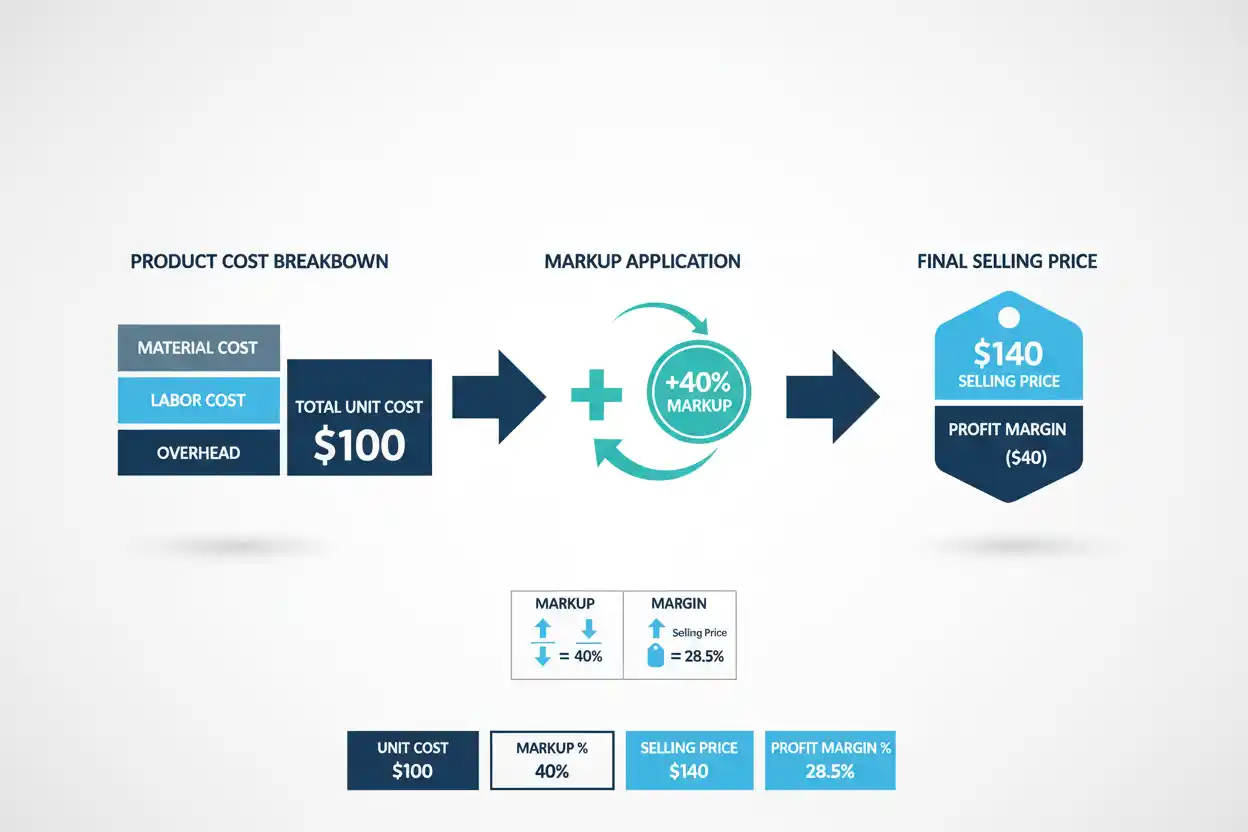

Cost-plus pricing is a pricing method that starts with a defined cost and adds a markup to determine the selling price.
The basic formula is:
Selling Price = Cost + Markup
When markup is expressed as a percentage of cost:
Selling Price = Cost × (1 + Markup Rate)
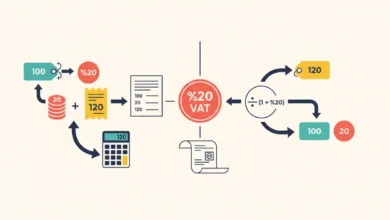
If a product costs $80 and the business applies a 25% markup:
Selling Price = $80 × (1 + 0.25)
Selling Price = $100
Cost-plus pricing is easy to calculate, easy to explain internally, and useful when a company needs a consistent relationship between cost and price. Its limitation is equally important: cost alone does not determine what customers are willing to pay or what competitors will charge.
A sound pricing decision therefore connects costs with contribution margin, demand, competitive positioning, required profit, capacity, and broader business finance.
What Is Cost-Plus Pricing?
Cost-plus pricing calculates a selling price by taking an identified cost base and adding a predetermined markup.
The method can be used for products, manufacturing jobs, contracts, services, projects, and other transactions where costs can be estimated with sufficient reliability.
Conceptually:
Cost + Desired Markup = Selling Price
The word cost is important because companies can define it differently.
One business may use only direct manufacturing cost.
Another may calculate a fully allocated unit cost that includes production overhead.
A service company may combine labor, software, travel, subcontractors, and allocated overhead.
As a result, two businesses applying the same markup percentage can reach very different prices if their cost bases are defined differently.
Cost-Plus Pricing Formula
The standard percentage-markup formula is:
Selling Price = Unit Cost × (1 + Markup Percentage)
Suppose unit cost is $50 and markup is 40%.
Selling Price = $50 × 1.40
Selling Price = $70
The markup amount itself is:
Markup Amount = Unit Cost × Markup Percentage
Markup Amount = $50 × 0.40
Markup Amount = $20
Therefore:
Selling Price = $50 + $20 = $70
The calculation is simple. Choosing an appropriate cost base and markup requires much more judgment.
Cost-Plus Pricing Example
Suppose a manufacturer calculates the following cost per unit:
Materials: $24
Direct labor: $16
Allocated manufacturing overhead: $10
Total unit cost is:
Unit Cost = $24 + $16 + $10
Unit Cost = $50
Management applies a 30% markup on cost.
Markup = $50 × 30%
Markup = $15
Selling price becomes:
Selling Price = $50 + $15
Selling Price = $65
The company therefore prices the product at $65 using its defined $50 unit cost and a 30% cost-based markup.
That does not mean the company earns a 30% profit margin on sales.
Markup percentage and margin percentage use different denominators.
Cost-Plus Pricing vs Markup
Markup measures the amount added to cost.
If cost is $80 and the selling price is $100:
Markup Amount = $100 − $80 = $20
Markup percentage on cost is:
Markup % = Markup ÷ Cost × 100
Markup % = $20 ÷ $80 × 100
Markup % = 25%
Cost-plus pricing uses this markup relationship to determine the selling price.
The method can therefore be thought of as cost plus a cost-based markup.
Cost-Plus Pricing vs Profit Margin
A 25% markup does not produce a 25% margin.
Using the same example:
Cost = $80
Selling price = $100
Profit before other costs under the simple example = $20
The margin measured against selling price is:
Margin % = Profit ÷ Selling Price × 100
Margin % = $20 ÷ $100 × 100
Margin = 20%
Therefore:
25% markup on cost = 20% margin on selling price
This distinction is fundamental in pricing.
The margin vs markup guide covers the conversion in detail, but cost-plus users need to understand it before choosing a markup.
Markup Needed for a Target Margin
If management wants a specific gross or contribution margin, simply adding the same percentage as markup will not produce that margin.
The price needed for a target margin can be calculated as:
Selling Price = Cost ÷ (1 − Target Margin)
Suppose cost is $80 and management wants a 30% margin on selling price.
Selling Price = $80 ÷ (1 − 0.30)
Selling Price = $80 ÷ 0.70
Selling Price ≈ $114.29
The implied markup is:
Markup = $114.29 − $80 = $34.29
Markup % = $34.29 ÷ $80 × 100 ≈ 42.86%
A 30% target margin therefore requires approximately a 42.86% markup on cost in this example.
This denominator difference is why pricing teams should specify whether a percentage means markup or margin.
What Costs Should Cost-Plus Pricing Include?
There is no single cost base suitable for every business.
The calculation might begin with direct costs, variable costs, manufacturing cost, or a fully allocated cost depending on the purpose.
For a manufacturer, relevant cost categories can include raw materials, direct labor, manufacturing overhead, packaging, and other production costs.
The IRS distinguishes purchases and manufacturing inputs when documenting business costs and cost of goods sold, illustrating why businesses need reliable records of what goes into producing or acquiring goods.
However, tax or financial-reporting cost classifications are not automatically the correct management cost base for every pricing decision.
Pricing requires understanding the economic costs that the proposed price must support.
Direct-Cost Cost-Plus Pricing
A simple calculation may apply markup only to direct cost.
Suppose:
Materials = $30
Direct labor = $20
Direct cost:
Direct Cost = $30 + $20 = $50
With a 50% markup:
Selling Price = $50 × 1.50
Selling Price = $75
This looks straightforward, but suppose the business also incurs substantial fixed production overhead, selling expenses, administration, and customer support.
A $75 price may not generate enough total contribution to support those costs.
Direct-cost pricing therefore requires separate analysis of the expenses excluded from the cost base.
Full-Cost Pricing
A full-cost approach attempts to include both direct costs and an allocation of indirect or overhead costs.
Suppose per-unit economics are estimated as:
Materials = $30
Direct labor = $20
Allocated production overhead = $15
Allocated administrative overhead = $5
Total allocated cost becomes:
Full Unit Cost = $30 + $20 + $15 + $5
Full Unit Cost = $70
A 25% markup produces:
Selling Price = $70 × 1.25
Selling Price = $87.50
The advantage is that the price attempts to recover a broader share of company costs.
The limitation is that overhead allocations can be subjective.
Changing the allocation method can change the calculated unit cost even if the actual economics of producing one additional unit do not change.
Variable-Cost-Plus Pricing
For some short-term decisions, management may focus first on variable cost.
Suppose variable cost per unit is $45.
A 60% markup on variable cost gives:
Selling Price = $45 × 1.60
Selling Price = $72
The resulting contribution per unit is:
Contribution Margin = $72 − $45
Contribution Margin = $27
That $27 must cover fixed costs and then profit.
This approach can be useful for incremental or special-order analysis, but a business cannot ignore fixed costs indefinitely.
If normal prices never generate enough total contribution to cover the fixed-cost structure, the company will not become sustainably profitable merely because every sale exceeds variable cost.
Cost-Plus Pricing for Services
Service businesses can also use cost-plus pricing.
Suppose a consulting project is expected to require:
Professional labor: $4,000
Contractor support: $1,000
Travel and direct project expenses: $500
Total direct project cost:
Project Cost = $4,000 + $1,000 + $500
Project Cost = $5,500
With a 40% markup:
Quoted Price = $5,500 × 1.40
Quoted Price = $7,700
Whether $7,700 is an appropriate price depends on more than cost.
The company’s expertise, scarcity, client value, market rates, risk, unused capacity, project complexity, and required profit can all influence what it should charge.
Cost-Plus Pricing for Hourly Work
Suppose an employee’s direct labor cost to the business is $30 per hour.
The company estimates another $20 per hour for benefits, operating overhead, administration, and other allocated costs.
Total hourly cost is:
Hourly Cost = $30 + $20 = $50
Applying a 60% markup:
Billing Rate = $50 × 1.60
Billing Rate = $80 per hour
The $80 rate should then be tested against billable utilization.
If employees are paid for 2,080 hours annually but only 1,300 hours are realistically billable, using cost allocations based on every paid hour can understate the rate needed to support the business.
Cost-Plus Pricing and Contribution Margin
Cost-plus pricing tells management how a proposed price was derived.
Contribution margin shows how much of that price remains after variable costs.
Suppose full allocated cost is $70, including $50 of variable cost and $20 of allocated fixed cost.
A 25% markup produces:
Price = $70 × 1.25 = $87.50
Contribution margin is based on the variable $50 cost:
Contribution Margin = $87.50 − $50
Contribution Margin = $37.50
Contribution margin ratio:
Contribution Margin Ratio = $37.50 ÷ $87.50 × 100
Contribution Margin Ratio ≈ 42.86%
These are different analytical views of the same price.
Cost-plus explains the build-up. Contribution margin explains how the sale supports fixed costs and profit.
Cost-Plus Pricing and Break-Even Point
A cost-plus price should be tested against the break-even point.
Suppose variable cost is $60, the cost-plus selling price is $100, and fixed costs are $200,000.
Contribution per unit:
Contribution Margin = $100 − $60 = $40
Break-even volume:
Break-Even Units = $200,000 ÷ $40
Break-Even Units = 5,000 units
If realistic annual demand is only 3,000 units, the selected price and cost structure do not reach break-even under those assumptions.
Management would need to reconsider price, costs, fixed expenses, expected volume, or the business model.
Cost-plus pricing should therefore never stop at the markup calculation.
Cost-Plus Pricing and Target Profit
A business can incorporate a target profit into its pricing analysis.
Suppose fixed costs are $300,000, target operating profit is $150,000, expected volume is 15,000 units, and variable cost is $40 per unit.
The required contribution per unit is:
Required Contribution per Unit = (Fixed Costs + Target Profit) ÷ Expected Units
Required Contribution per Unit = ($300,000 + $150,000) ÷ 15,000
Required Contribution per Unit = $30
Required selling price becomes:
Required Price = Variable Cost + Required Contribution
Required Price = $40 + $30
Required Price = $70
This approach starts from the economics required to produce a target result rather than selecting an arbitrary markup.
The dedicated target pricing page owns that broader target-profit intent.
Why Cost-Plus Pricing Is Popular
The method has several practical advantages.
Cost information may be easier for a company to estimate than customer willingness to pay.
The pricing logic is transparent.
Teams can apply consistent markup rules across similar products.
Prices automatically move when the measured cost base changes if markup stays constant.
For contracts or projects where costs are uncertain, a cost-plus structure can also reduce the risk that unexpected qualifying costs eliminate the supplier’s economics, depending on the agreement.
These practical benefits explain why cost-based pricing remains useful despite its limitations.
The Main Problem With Cost-Plus Pricing
Cost-plus pricing begins internally.
Customers make buying decisions externally.
A customer does not necessarily care that the seller’s cost rose from $80 to $100.
If competing products offer similar value for $95, adding a 30% markup and charging $130 may not be commercially viable.
The opposite problem can also occur.
A product may cost only $10 to produce but solve a problem worth hundreds of dollars to the customer. A simple 30% markup would produce a $13 price and potentially leave significant economic value uncaptured.
Cost provides an important pricing floor and profitability input. It does not automatically determine market value.
The SBA currently emphasizes that pricing decisions should consider costs, profit margins, market position, and business goals rather than costs alone.
Cost-Plus Pricing vs Value-Based Pricing
Cost-plus pricing begins with the seller’s costs.
Value-based pricing begins with the economic or perceived value of the offering to the customer.
Suppose software costs relatively little to provide to one additional user but saves a client $100,000 annually.
A purely cost-based price might be far below what the client is economically willing to pay.
Conversely, a commodity product with high production cost may have little room for a cost-plus price if market competitors sell at lower levels.
Value-based pricing therefore adds customer economics to the decision.
That does not make cost irrelevant. A price that customers love but that cannot support the company’s economics is still a problem.
Cost-Plus Pricing vs Competitor-Based Pricing
Competitor-based pricing uses market prices as a major reference point.
Cost-plus pricing uses internal cost.
Consider a market where comparable products sell for $90 to $110.
If a company’s cost-plus formula produces $150, management should investigate why its cost structure or desired markup is so different.
If the formula produces $60, the company may have a cost advantage—or it may be leaving money on the table.
Market comparison is therefore a useful external check on a cost-based calculation.
Cost-Plus Pricing vs Target Pricing
Target pricing reverses much of the cost-plus logic.
Traditional cost-plus reasoning is:
Cost + Markup = Price
A target-cost perspective can begin with a market-supported price and required profit, then determine the cost the business can afford.
Conceptually:
Allowable Cost = Target Selling Price − Required Profit
Suppose the market supports approximately $100 and the company requires $25 of contribution or profit under its chosen framework.
Allowable Cost = $100 − $25 = $75
If the current cost is $90, simply marking it up may produce an uncompetitive price.
Management instead has a cost-reduction problem.
Cost-Plus Pricing and Gross Profit
The SEC describes gross profit as net revenue minus cost of sales.
That relationship is useful when evaluating what happens after a cost-plus price is implemented.
Suppose a product sells for $130 and reported cost of sales is $80.
Gross Profit = $130 − $80 = $50
Gross margin:
Gross Margin = $50 ÷ $130 × 100
Gross Margin ≈ 38.46%
If the selling price was created by applying a 62.5% markup to the $80 cost:
Markup = $50 ÷ $80 × 100
Markup = 62.5%
Again, a 62.5% markup corresponds to only a 38.46% gross margin in this simplified example.
Cost-Plus Pricing and Gross Margin
Gross margin measures gross profit relative to revenue.
Gross Margin = Gross Profit ÷ Revenue × 100
Cost-plus markup is usually measured relative to cost.
Because the denominators differ, pricing teams should not use the words margin and markup interchangeably.
A company that wants a 40% gross margin cannot simply add a 40% markup to its cost.
For $60 cost:
40% markup gives:
Price = $60 × 1.40 = $84
Gross margin:
Gross Margin = ($84 − $60) ÷ $84
Gross Margin ≈ 28.57%
To achieve a 40% margin:
Required Price = $60 ÷ (1 − 0.40)
Required Price = $100
Cost Changes and Cost-Plus Pricing
One attraction of cost-plus pricing is that price can adjust systematically as costs change.
Suppose cost rises from $80 to $92 and markup remains 25%.
Original price:
$80 × 1.25 = $100
New price:
$92 × 1.25 = $115
The price rises 15%.
This protects the percentage markup mathematically.
However, the customer may not accept the higher price.
Management should therefore examine whether to pass through the entire cost increase, accept lower margin, reduce other costs, redesign the offering, or adjust the pricing model.
Cost Reductions and Pricing
If cost falls, a fixed cost-plus formula lowers the selling price automatically.
Suppose unit cost falls from $80 to $64 with a 25% markup.
Old price:
$80 × 1.25 = $100
New cost-plus price:
$64 × 1.25 = $80
Yet a business does not necessarily need to reduce its market price simply because production became more efficient.
If customers still value the product at $100 and competitors remain near $100, keeping the selling price can increase margin.
This is another example of why cost-plus pricing should inform pricing rather than mechanically dictate every decision.
Cost-Plus Pricing and Discounts
A price created with a cost-plus markup can lose much of its intended economics when discounted.
Suppose cost is $60 and the normal price is $100.
Markup amount:
$100 − $60 = $40
Now offer a 20% discount:
Discounted Price = $100 × 0.80 = $80
Remaining amount above cost:
$80 − $60 = $20
The price fell 20%, but the amount above cost fell from $40 to $20—a 50% reduction.
The discounts and contribution-margin analyses should therefore be considered before approving broad promotional reductions.
Cost-Plus Pricing and Sales Volume
A markup may look attractive per unit but produce insufficient total profit if demand is low.
Suppose a business earns $25 of contribution per unit and has $250,000 of annual fixed costs.
Selling 5,000 units produces:
Total Contribution = 5,000 × $25 = $125,000
That does not cover fixed costs.
Selling 15,000 units produces:
Total Contribution = 15,000 × $25 = $375,000
After $250,000 of fixed costs:
Operating Profit = $125,000
The appropriate price therefore cannot be evaluated independently of expected sales volume.
Cost-Plus Pricing and Capacity
Capacity can also change the economics.
A company may calculate a low unit cost by assuming 100,000 units of production.
If realistic production is only 50,000 units, fixed overhead allocated per unit may be substantially higher.
Conversely, operating near full capacity may justify prioritizing higher-contribution sales rather than simply accepting every order that meets a standard markup.
This is where operating leverage and contribution-per-constrained-resource analysis can become relevant.
Cost-Plus Pricing for Custom Projects
Custom jobs often involve uncertain labor, materials, subcontractors, or project duration.
A cost-plus approach can help account for those differences.
Suppose estimated project cost is $150,000 and the agreed pricing approach adds 20%.
Price = $150,000 × 1.20
Price = $180,000
If actual qualifying cost becomes $170,000 and the agreement permits the same 20% addition:
Adjusted Price = $170,000 × 1.20
Adjusted Price = $204,000
Contract terms determine which costs qualify, how markup is applied, which approvals are required, and whether price caps exist. Those legal and contractual questions go beyond the simple pricing formula.
Cost-Plus Contracts Are Not the Same as Cost-Plus Retail Pricing
The phrase cost-plus can describe both a pricing method and certain contractual reimbursement structures.
In ordinary pricing, the seller generally calculates cost and uses a markup to set a selling price.
Under a cost-reimbursement contract, allowable or agreed costs may be reimbursed according to contract terms, potentially with an additional fee.
These arrangements involve different legal, accounting, and procurement rules.
A general cost-plus pricing guide should not assume that a simple retail markup formula determines the amount payable under a contract.
How to Choose a Markup Percentage
There is no universal markup percentage that works for every business.
A useful starting analysis considers the company’s variable costs, fixed-cost burden, expected sales volume, required return, competitors, customer value, capacity, risk, and channel economics.
Suppose two companies each buy a product for $50.
One has minimal overhead and sells thousands of units every month.
The other sells only a small number and provides extensive technical support.
Using the same markup simply because acquisition cost is identical may produce poor economics for one of them.
The markup should emerge from the business model rather than an arbitrary industry myth.
What Is a Good Cost-Plus Markup?
There is no universally good percentage.
A 20% markup may be more than sufficient for a high-volume, low-overhead operation and completely inadequate for a low-volume business with substantial fixed costs.
Similarly, a 100% markup can produce excellent economics in one market and an uncompetitive price in another.
Instead of asking whether the markup itself is good, test the resulting selling price against contribution margin, break-even volume, customer willingness to pay, competing alternatives, and required profit.
When Cost-Plus Pricing Works Well
Cost-plus pricing is most useful when costs are measurable and relatively stable, the market tolerates cost-based pricing, and the business wants a clear pricing discipline.
It can also provide a practical starting point when products are similar, procurement costs dominate economics, or a contract explicitly permits cost-based reimbursement.
The method becomes stronger when it is used as a pricing floor or internal reference and then checked against market and customer information.
When Cost-Plus Pricing Works Poorly
The approach becomes weaker when customer value is disconnected from production cost.
Digital products, intellectual property, premium services, highly differentiated offerings, scarce capacity, and rapidly changing markets can all create large gaps between cost and market value.
Cost allocations can also create misleading prices in businesses with substantial shared overhead.
If the company simply takes whatever accounting cost appears in a system and adds 20%, the resulting price may have little connection with incremental economics or market reality.
Common Cost-Plus Pricing Mistakes
The most common mistake is confusing markup with margin.
Another is using an incomplete cost base while assuming the markup will cover all company expenses.
The opposite problem occurs when arbitrary overhead allocations inflate unit cost and produce uncompetitive prices.
Companies may also keep the same markup across products with very different demand, risk, support burden, or inventory requirements.
A further mistake is ignoring sales volume.
A seemingly healthy markup can still produce losses if total contribution never covers fixed costs.
Finally, automatic price increases following every cost increase can weaken demand if customers do not perceive equivalent value.
How to Evaluate a Cost-Plus Price
Begin with the cost base and document what it contains.
Apply the proposed markup.
Then calculate contribution margin and the resulting margin percentage.
Estimate break-even volume.
Compare required volume with realistic demand and capacity.
Review the market price of meaningful alternatives.
Consider whether customers receive substantially more or less value than the proposed price implies.
Finally, test downside cases such as higher costs, lower volume, or promotional discounts.
This process turns cost-plus from a mechanical formula into a usable pricing framework.
Frequently Asked Questions
What is cost-plus pricing?
Cost-plus pricing is a method that determines selling price by adding a markup to a defined cost base.
What is the cost-plus pricing formula?
Selling Price = Cost × (1 + Markup Rate)
How do you calculate a 20% cost-plus price?
If cost is $100:
Selling Price = $100 × 1.20 = $120
Is a 20% markup the same as a 20% margin?
No. A $100 cost marked up 20% produces a $120 price and $20 gross amount above cost.
Margin = $20 ÷ $120 ≈ 16.67%
How do I price for a target margin?
Selling Price = Cost ÷ (1 − Target Margin)
For an $80 cost and 30% target margin:
Selling Price = $80 ÷ 0.70 ≈ $114.29
What costs should be included in cost-plus pricing?
The appropriate cost base depends on the pricing purpose. It may include direct cost, variable cost, manufacturing cost, or allocated full cost. The definition should be explicit.
Is cost-plus pricing profitable?
It can be, but adding a markup does not guarantee that total contribution will cover fixed costs or that customers will purchase enough units at the resulting price.
What is the difference between cost-plus pricing and markup?
Markup is the amount or percentage added to cost. Cost-plus pricing is the pricing method that uses that markup to establish a selling price.
What is the difference between cost-plus pricing and value-based pricing?
Cost-plus begins with seller cost. Value-based pricing begins primarily with customer-perceived or economic value.
What is the difference between cost-plus pricing and target pricing?
Cost-plus starts with cost and builds toward price. Target pricing can begin with a market-supported selling price and work backward to an allowable cost.
What is a good markup percentage?
There is no universal good markup. The appropriate percentage depends on costs, volume, fixed expenses, market conditions, customer value, competitive alternatives, and required profitability.
What is the biggest disadvantage of cost-plus pricing?
Its central weakness is that the calculated price can ignore what customers are willing to pay and what competing alternatives cost.
Final Perspective
Cost-plus pricing begins with a simple relationship:
Selling Price = Cost × (1 + Markup Rate)
That simplicity is useful.
A company can establish consistent prices, understand how changes in cost affect the selling price, and ensure that each transaction includes an amount above the defined cost base.
But cost-plus pricing becomes dangerous when the formula is mistaken for a complete pricing strategy.
Costs tell the business what an offering requires economically.
They do not tell the business what customers value, how much demand exists, what competitors charge, or whether the resulting contribution will cover fixed costs at realistic sales volume.
The stronger approach is therefore:
Know the true cost. Calculate the markup correctly. Convert markup to margin accurately. Test contribution and break-even. Then compare the resulting price with market reality and customer value.
That keeps cost-plus pricing useful without allowing the simplicity of the formula to replace the harder work of pricing.