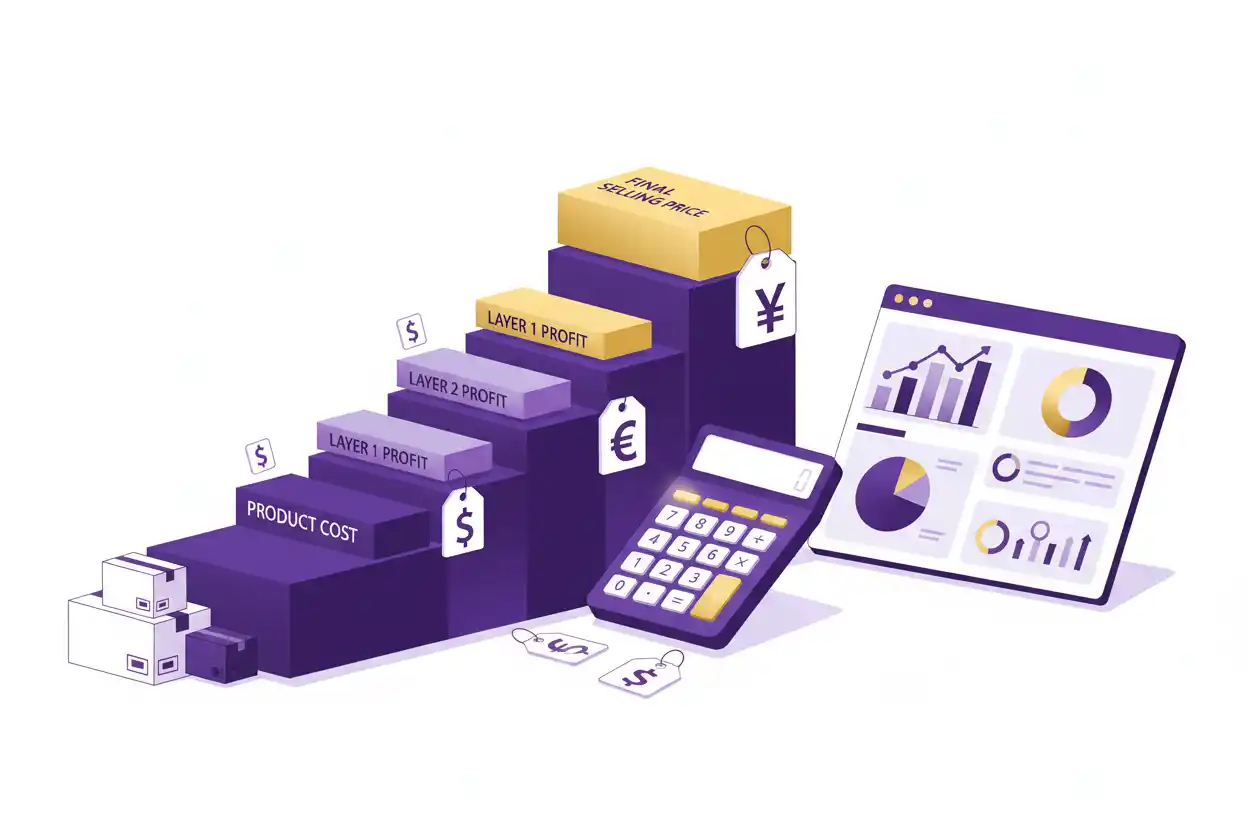

Markup is the amount added to a product or service cost to establish its selling price. When expressed as a percentage, markup measures that added amount relative to cost, not relative to the final selling price.
If a product costs $80 and sells for $120, the business has added $40 above cost. The markup is therefore 50% because $40 represents 50% of the original $80 cost.
Markup is widely used in retail, wholesale, distribution, contracting, manufacturing, and service pricing because it provides a direct way to move from a known cost to a proposed selling price. However, markup is not the same as margin, final profit, or investment return.
Within business finance, understanding markup is particularly useful when connecting product cost, pricing decisions, gross profit, and overall profitability.
What Is Markup?
Markup is the difference between selling price and cost, expressed either as a dollar amount or as a percentage of cost.
The dollar markup is:
Dollar Markup = Selling Price − Cost
The percentage markup is:
Markup % = (Selling Price − Cost) ÷ Cost × 100
Suppose a business buys an item for $40 and sells it for $60.
Dollar markup:
$60 − $40 = $20
Percentage markup:
$20 ÷ $40 × 100 = 50%
The business therefore applies a $20 markup, equal to 50% of cost.
The important denominator is cost. If the same $20 were divided by the $60 selling price instead, the calculation would produce a margin rather than markup.
Markup Formula
The standard markup formula is:
Markup % = Profit Above Cost ÷ Cost × 100
Because profit above cost in a simple transaction is selling price minus cost:
Markup % = (Selling Price − Cost) ÷ Cost × 100
For example:
Cost = $75
Selling price = $105
First calculate the dollar markup:
$105 − $75 = $30
Then divide by cost:
Markup % = $30 ÷ $75 × 100
Markup = 40%
The $105 selling price therefore represents a 40% markup on the $75 cost.
How to Calculate Markup Step by Step
Consider a retailer purchasing a product for $120 and selling it for $180.
First identify cost:
Cost = $120
Then identify selling price:
Selling Price = $180
Calculate the dollar difference:
Markup Amount = $180 − $120
Markup Amount = $60
Now divide that $60 by the original $120 cost:
Markup % = $60 ÷ $120 × 100
Markup = 50%
The product carries a 50% markup.
A common error would be dividing $60 by $180. That calculation gives 33.33%, but it represents margin rather than markup.
The dedicated margin vs markup comparison explains that distinction in greater depth.
How to Calculate Selling Price From Markup
Markup becomes especially practical when cost is already known and the business wants to establish a price.
The formula is:
Selling Price = Cost × (1 + Markup Rate)
Markup should be written as a decimal in the calculation.
Suppose:
Cost = $50
Markup = 60%
Convert 60% to 0.60:
Selling Price = $50 × (1 + 0.60)
Selling Price = $50 × 1.60
Selling Price = $80
A 60% markup on $50 produces an $80 selling price.
The dollar markup is:
$80 − $50 = $30
And:
$30 ÷ $50 = 60%
How to Calculate Cost From Selling Price and Markup
The formula can also be rearranged when selling price and markup are known:
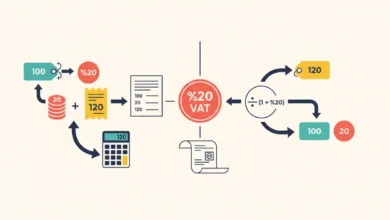
Cost = Selling Price ÷ (1 + Markup Rate)
Suppose a product sells for $150 and carries a 50% markup.
Cost = $150 ÷ 1.50
Cost = $100
Check:
Markup Amount = $150 − $100 = $50
$50 ÷ $100 = 50%
This form can be useful when reviewing existing prices and trying to determine the cost implied by a stated markup.
How to Calculate Markup Amount
If cost and markup percentage are known:
Markup Amount = Cost × Markup Rate
Suppose cost is $200 and markup is 35%.
Markup Amount = $200 × 0.35
Markup Amount = $70
Then:
Selling Price = $200 + $70 = $270
This breaks the price into two components:
Cost = $200
Markup = $70
Selling Price = $270
25% Markup Example
Suppose cost is $80.
A 25% markup equals:
Markup Amount = $80 × 0.25 = $20
Selling price is:
$80 + $20 = $100
Therefore:
$80 Cost + 25% Markup = $100 Selling Price
The resulting margin is not 25%. That separate percentage uses selling price rather than cost as the denominator.
50% Markup Example
Suppose an item costs $100.
A 50% markup is:
$100 × 0.50 = $50
Selling price:
$100 + $50 = $150
Markup check:
($150 − $100) ÷ $100 = 50%
This price produces a margin of 33.33%, demonstrating why markup and margin percentages should not be used interchangeably.
100% Markup Example
A 100% markup means the amount added equals the original cost.
If cost is $40:
Markup Amount = $40 × 100% = $40
Selling price:
$40 + $40 = $80
Therefore:
100% Markup = Selling Price Equal to Twice Cost
A 100% markup does not mean a 100% margin.
The profit amount of $40 represents half of the $80 selling price, so the corresponding margin is 50%.
Markup vs Margin
Markup measures profit above cost relative to cost.
Margin measures profit relative to selling price or revenue.
Using a $60 cost and $100 selling price:
Markup:
($100 − $60) ÷ $60 × 100 = 66.67%
Margin:
($100 − $60) ÷ $100 × 100 = 40%
Both percentages describe the same $40 difference.
They simply use different denominators.
For product pricing, markup can be convenient because businesses often know cost first. For financial reporting and profitability analysis, gross margin is often more useful because it expresses gross profit relative to sales.
Markup vs Gross Profit
Gross profit is generally expressed as a dollar amount.
At the financial-statement level:
Gross Profit = Revenue − Cost of Goods Sold
Markup instead expresses a price increase relative to cost.
Suppose a retailer purchases products for a total cost of $300,000 and sells them for $450,000.
Gross profit is:
$450,000 − $300,000 = $150,000
Markup on cost is:
$150,000 ÷ $300,000 × 100 = 50%
The business therefore generates $150,000 of gross profit from a sales level equivalent to a 50% markup on the stated cost base.
However, the broader accounting cost base should be verified before using a simple purchase-price markup as a substitute for reported financial-statement profitability.
Why Cost Definition Matters
Markup is only as meaningful as the cost figure used in the calculation.
Suppose a business purchases a product for $60 and sells it for $100.
If only the purchase price is considered:
Markup = ($100 − $60) ÷ $60 = 66.67%
Now suppose another $10 of directly relevant costs must be included, producing a more complete cost of $70.
Then:
Markup = ($100 − $70) ÷ $70
Markup ≈ 42.86%
The selling price has not changed.
The markup percentage changes because the cost base changed.
This is particularly important when cost of goods sold includes manufacturing, purchasing, freight, labor, or other costs beyond a product’s invoice price.
Markup and Revenue
Markup is established relative to cost, but the resulting selling price ultimately contributes to revenue.
Suppose a business sells 1,000 products with:
Cost per unit = $40
Selling price = $60
Per-unit markup:
($60 − $40) ÷ $40 = 50%
Total revenue:
1,000 × $60 = $60,000
Total product cost:
1,000 × $40 = $40,000
Difference:
$60,000 − $40,000 = $20,000
The same 50% markup therefore produces $20,000 above the stated product cost across 1,000 units.
Sales volume determines how much total dollar profit a given per-unit markup can potentially generate.
Markup and Profit
Markup should not be interpreted as the company’s final profit.
Suppose a product costs $50 and sells for $100.
The markup is 100%.
However, the company may still need to pay for advertising, employee salaries, rent, insurance, software, interest, taxes, customer service, returns, payment processing, and other expenses.
Therefore:
High Markup ≠ High Final Profit Automatically
Markup describes the relationship between a stated cost and selling price.
Final profitability depends on the wider cost structure.
Markup and Net Profit
The difference becomes clearer when comparing markup with net profit.
A business could apply a 75% markup to merchandise while still producing little net profit if operating costs are high.
For example:
Sales revenue = $1,000,000
Product cost = $600,000
Gross difference = $400,000
Other expenses = $370,000
The merchandise may have been priced attractively relative to product cost, yet only $30,000 remains after the additional expenses in this simplified example.
Markup therefore belongs near the pricing decision. Net profit belongs at the broader company-profitability level.
Markup and Net Profit Margin
Net profit margin measures final profit relative to revenue rather than how much was added to product cost.
A business could have high markups but a low net profit margin when overhead is substantial.
Conversely, an efficient operation may achieve respectable net profitability with comparatively modest markups.
This distinction matters when management sets pricing policies. A markup target is not automatically a net-margin target.
Markup and Operating Margin
Operating margin measures operating profit relative to revenue after operating expenses are incorporated.
Markup does not include those expenses unless they have deliberately been built into the cost base used for pricing.
For example, adding 50% to a raw material or wholesale purchase cost may look attractive at the transaction level. Yet if selling and administrative expenses consume most of the difference, operating profitability can remain weak.
Pricing therefore needs to support the complete economics of the business, not merely create a positive markup.
Markup in Cost-Plus Pricing
Markup is central to cost-plus pricing.
The basic approach starts with cost and adds a predetermined amount or percentage.
For example:
Cost = $200
Markup = 30%
Selling Price = $200 × 1.30
Selling Price = $260
Cost-plus pricing is straightforward because the business can apply a consistent markup to a known cost base.
However, cost-plus pricing does not automatically account for customer willingness to pay, competitor prices, perceived value, or changes in demand.
The mathematical markup can establish a price, but the market determines whether customers will accept it.
Markup and Target Pricing
Target pricing approaches the problem from another direction.
Instead of beginning only with cost and adding markup, a company may begin with the price the market is likely to support and then determine what cost structure is economically acceptable.
Suppose the market price is $100 and the company’s target product economics imply a maximum cost of $65.
The dollar difference is:
$100 − $65 = $35
Markup on cost is:
$35 ÷ $65 ≈ 53.85%
Markup can therefore still be calculated, but it may be an output of the target-pricing process rather than the input used to establish price.
Markup and Contribution Margin
Contribution margin focuses on revenue remaining after variable costs.
That makes it particularly useful for assessing how sales contribute toward fixed costs and eventual profit.
Suppose:
Selling price = $100
Product purchase cost = $50
Other variable costs = $15
Markup on the $50 purchase cost is:
($100 − $50) ÷ $50 = 100%
However, contribution after all $65 of variable costs is:
$100 − $65 = $35
The apparently large markup therefore does not mean $50 is available to cover fixed expenses and profit.
The economically relevant cost base depends on the decision being analyzed.
Markup and Variable Costs
Variable costs can include expenses that increase as sales increase.
Examples may include transaction processing, packaging, sales commissions, certain fulfillment expenses, and usage-based service costs.
If these costs are ignored when a business sets markup, the price may produce less economic contribution than expected.
A company can therefore use a simple markup for day-to-day pricing while separately testing whether the resulting price supports all relevant variable costs.
Markup and Fixed Costs
Fixed costs generally do not change directly with each additional sale over a relevant activity range, but they still need to be covered by the business’s aggregate profit.
Suppose a retailer adds healthy markups to every item yet generates only a small sales volume.
The resulting gross profit may still be insufficient to cover rent, salaries, systems, insurance, and other fixed expenses.
Markup answers:
How much was added to cost?
It does not answer:
Have total sales generated enough contribution to cover the entire business?
Markup and Break-Even Analysis
Break-even analysis connects selling price, variable cost, fixed cost, and required sales volume.
Suppose a business increases markup and therefore raises its selling price.
Contribution per unit may increase, reducing the number of units required to cover fixed costs—assuming sales demand remains sufficient.
However, if the higher price causes a large reduction in volume, the expected benefit may disappear.
This is why pricing decisions should evaluate both markup per unit and sales volume.
Markup and Unit Economics
Unit economics provides a broader view of what one customer, order, product, or transaction contributes economically.
Consider an ecommerce product:
Purchase cost = $30
Selling price = $75
Basic markup:
($75 − $30) ÷ $30 = 150%
That looks substantial.
Now add:
Fulfillment = $10
Payment fee = $3
Variable support = $4
Expected return cost = $5
Relevant variable costs become $52.
The remaining contribution is only:
$75 − $52 = $23
The basic 150% markup is mathematically correct relative to purchase cost, but the wider unit economics tell a more complete story.
Markup and Customer Acquisition Cost
Businesses that spend heavily on advertising or sales should also consider customer acquisition cost.
Suppose a first purchase generates $30 above product and variable fulfillment costs, while acquiring that customer costs $40.
The transaction may show a positive markup but produce negative economics on the first order.
That outcome could still be rational if repeat purchases generate sufficient future value, but markup alone cannot establish that.
Pricing decisions often need to connect product economics with customer economics.
Markup and Inventory Turnover
Markup and inventory turnover can create important tradeoffs.
A high-markup product that sits unsold for a year may be less economically attractive than a lower-markup item that sells repeatedly.
Consider:
Product A: 100% markup, one inventory turn.
Product B: 30% markup, ten inventory turns.
The higher markup on Product A does not automatically mean it generates the better return on inventory capital.
Product demand, margin dollars, carrying costs, markdown risk, and turnover all matter.
Markup and Inventory Carrying Cost
Slow-moving products can generate inventory carrying cost while they remain unsold.
Storage, insurance, shrinkage, deterioration, financing, obsolescence, and opportunity cost can reduce the economic value of a large nominal markup.
Suppose a specialty item has a 150% markup but remains in stock for three years.
If carrying costs and markdowns consume a meaningful portion of the eventual profit, the headline markup may overstate the product’s economic attractiveness.
Markup should therefore be considered alongside how long inventory capital remains tied up.
Markup and Discounts
Discounts reduce both selling price and dollar markup when cost remains unchanged.
Suppose:
Cost = $60
Original price = $100
Original markup:
($100 − $60) ÷ $60 = 66.67%
Now discount the product by 10%, reducing price to $90.
New markup:
($90 − $60) ÷ $60 = 50%
The customer-facing discount is 10%, but markup falls from 66.67% to 50%.
The dollar difference above cost falls from $40 to $30, a 25% reduction.
This is why seemingly modest discounts can have a disproportionately large effect on profit dollars.
What Price Maintains Markup After a Cost Increase?
Suppose cost rises but the business wants to preserve its existing markup percentage.
Original cost = $80
Original markup = 50%
Original selling price:
$80 × 1.50 = $120
Now cost rises to $90.
To preserve the same 50% markup:
New Selling Price = $90 × 1.50
New Selling Price = $135
The company would need to raise price from $120 to $135 to maintain the same markup.
Whether customers will accept that price is a separate commercial question.
Markup and Inflation
When supplier or production costs rise, a business that keeps its selling prices unchanged experiences lower dollar markup and a lower markup percentage.
Suppose:
Original cost = $50
Selling price = $80
Original markup:
($80 − $50) ÷ $50 = 60%
If cost increases to $60 while price stays $80:
($80 − $60) ÷ $60 = 33.33%
The markup falls sharply.
Businesses facing sustained input-cost increases therefore need to decide whether to raise prices, reduce costs, accept lower profitability, alter product mix, or make some combination of those changes.
Weighted Average Markup
A business selling several products may want to understand markup across the entire sales mix.
Simply averaging product-level markup percentages can be misleading because products may have very different costs and sales volumes.
Suppose:
Product A cost = $10,000
Markup amount = $10,000
Product B cost = $100,000
Markup amount = $20,000
Product A markup:
$10,000 ÷ $10,000 = 100%
Product B markup:
$20,000 ÷ $100,000 = 20%
A simple average is 60%.
But aggregate markup on the combined cost is:
Total Markup Amount = $30,000
Total Cost = $110,000
Aggregate Markup = $30,000 ÷ $110,000
Aggregate Markup ≈ 27.27%
For company-level analysis, weighting by the underlying dollars generally provides a more meaningful result than simply averaging percentages.
Initial Markup vs Realized Markup
The markup set when a price is established may differ from the markup ultimately realized.
A retailer might initially price a $50 product at $100:
Initial Markup = 100%
If the product later sells for $75 after markdowns:
Realized Markup = ($75 − $50) ÷ $50
Realized Markup = 50%
Returns, discounts, promotional pricing, damage, and clearance activity can all cause realized economics to differ from the original ticket-price markup.
For this reason, planned markup and actual selling results should be analyzed separately.
Markup vs Markdown
Markup and markdown describe opposite pricing movements but use terminology that can cause confusion.
A markup raises price above a cost or another reference amount.
A markdown reduces a previously established selling price.
Suppose an item costs $50 and is priced at $100.
The $50 increase from cost to initial price is markup.
If the $100 price is later reduced to $80, the $20 price reduction is a markdown from the prior selling price.
The denominators used for markup percentages and markdown percentages may differ, so the percentages should always be defined explicitly rather than assumed to be directly reversible.
Markup in Retail
Retail businesses frequently use markup because purchase cost is often known before the selling price is established.
A retailer buying an item for $25 may apply an 80% markup:
Selling Price = $25 × 1.80
Selling Price = $45
The simplicity makes markup practical for large product catalogs.
However, a uniform markup across every product may not maximize profitability. Demand elasticity, competitive prices, inventory velocity, product differentiation, shrinkage, seasonality, and promotional strategy can justify different markups across categories.
Markup in Wholesale and Distribution
Wholesalers and distributors may operate with lower percentage markups than specialty retailers but process larger sales volumes.
Suppose a distributor buys a component for $900 and sells it for $990.
Markup = ($990 − $900) ÷ $900
Markup = 10%
A 10% markup may appear modest, but substantial volume and rapid inventory movement can still produce attractive economics.
This reinforces an important point: a high markup percentage is not automatically better than a lower one.
The complete business model matters.
Markup in Services
Service businesses can also use markup, particularly when outside costs are incurred on behalf of clients.
Suppose an agency purchases a third-party service for $2,000 and bills the client $2,600.
Markup = ($2,600 − $2,000) ÷ $2,000
Markup = 30%
However, if internal employee time, project management, administrative overhead, and risk are not included in the underlying cost, the 30% markup may not represent the project’s actual profitability.
Defining cost accurately is therefore especially important in service businesses.
Markup in Manufacturing
Manufacturers may calculate markup over manufacturing cost, standard cost, full cost, or another defined cost base.
Those definitions can produce different results.
Suppose:
Direct manufacturing cost = $70
Allocated full cost = $90
Selling price = $120
Markup on direct manufacturing cost:
($120 − $70) ÷ $70 ≈ 71.43%
Markup on full cost:
($120 − $90) ÷ $90 ≈ 33.33%
Both calculations can be mathematically valid, but they answer different management questions.
The cost definition should always accompany the markup percentage when ambiguity is possible.
Markup and Liquidity
A high markup does not guarantee strong liquidity ratios.
A company can price products well yet have cash tied up in excess inventory or unpaid customer invoices.
Conversely, a business with modest markups may maintain strong liquidity if customers pay rapidly and inventory turns efficiently.
Markup is a pricing metric.
Liquidity describes the company’s short-term financial capacity.
The two should not be treated as substitutes.
Markup and Investment Return
Markup also differs from investment metrics such as IRR and net present value.
Suppose a company marks inventory up by 100%.
That does not mean investors earn a 100% annual return.
The company may require substantial investment in property, equipment, inventory, technology, employees, and working capital. Sales may also take months or years to occur.
Markup describes price relative to cost.
Investment return considers cash flows, timing, and capital committed.
Common Markup Mistakes
The most common mistake is confusing markup with margin. A 50% markup does not produce a 50% margin.
Another mistake is using an incomplete cost base. If freight, labor, commissions, fulfillment, or other relevant costs are ignored, the apparent markup may look stronger than the true economics.
Businesses can also select a markup mechanically without considering what customers are willing to pay.
A third problem is assuming that a high markup guarantees high profit. Low sales volume, expensive customer acquisition, high fixed costs, returns, discounts, inventory carrying costs, and overhead can consume the difference between cost and selling price.
Finally, markup percentages should always identify their cost base. “A 40% markup” is incomplete if different teams use different definitions of cost.
How to Set a Markup
A useful markup decision begins with a clearly defined cost.
Next, identify the profit contribution the product needs to make toward variable expenses, fixed costs, and overall business objectives.
Then evaluate market pricing. A mathematically attractive markup has little value if the resulting selling price is uncompetitive or exceeds the value customers perceive.
Volume also matters. A business may accept a lower markup on fast-moving items while requiring a larger markup on slow, risky, specialized, or expensive-to-stock products.
Finally, test the resulting selling price against broader business economics rather than evaluating the markup in isolation.
Markup is a pricing input, not a complete pricing strategy.
Why Markup Matters
Markup provides one of the simplest ways to move from cost to selling price.
Its core calculation is:
Markup % = (Selling Price − Cost) ÷ Cost × 100
When a target markup is already known:
Selling Price = Cost × (1 + Markup Rate)
These formulas make markup useful for everyday pricing, estimating, product management, retail, wholesale, contracting, and service businesses.
However, markup should always be interpreted within its proper scope.
It measures how much was added to cost.
It does not measure final net profitability, liquidity, investment return, or how much of revenue becomes profit.
Once that distinction is clear, markup becomes a practical pricing tool rather than a source of pricing errors.
Frequently Asked Questions
What is markup in simple terms?
Markup is the amount added to cost to create a selling price. If an item costs $50 and sells for $75, the $25 difference is the dollar markup.
What is the markup formula?
The standard formula is:
Markup % = (Selling Price − Cost) ÷ Cost × 100
Markup is calculated as a percentage of cost.
How do you calculate a 20% markup?
Multiply cost by 1.20.
If cost is $100:
Selling Price = $100 × 1.20 = $120
The markup amount is $20.
How do you calculate a 50% markup?
Multiply cost by 1.50.
If cost is $80:
Selling Price = $80 × 1.50 = $120
The $40 difference represents a 50% markup on $80.
What does 100% markup mean?
A 100% markup means the amount added equals the original cost. A $50 product with a 100% markup sells for $100.
Is markup the same as margin?
No. Markup divides profit by cost, while margin divides profit by selling price or revenue. A 50% markup corresponds to a 33.33% margin.
How do I calculate selling price from markup?
Use:
Selling Price = Cost × (1 + Markup Rate)
For a $60 cost and 25% markup:
$60 × 1.25 = $75
How do I calculate cost when I know markup and price?
Use:
Cost = Selling Price ÷ (1 + Markup Rate)
If price is $150 and markup is 50%:
$150 ÷ 1.50 = $100
Is a higher markup always better?
No. A higher markup can increase profit per unit, but it can also make a product less competitive and reduce sales volume. Inventory turnover, demand, costs, customer value, and competition also matter.
Does markup include overhead?
Only if overhead is included in the cost base used for the calculation. A markup based only on purchase cost will not automatically account for rent, salaries, marketing, software, or other overhead.
Can markup be negative?
Yes. If selling price falls below the defined cost, the formula produces a negative markup. For example, selling a $100-cost item for $80 gives:
($80 − $100) ÷ $100 = −20%
This indicates the item is being sold below the stated cost base.
What is a good markup percentage?
There is no universal good markup percentage. Appropriate markup depends on the product or service, complete cost structure, customer demand, competitive pricing, sales volume, inventory risk, overhead, and the profitability required by the business.