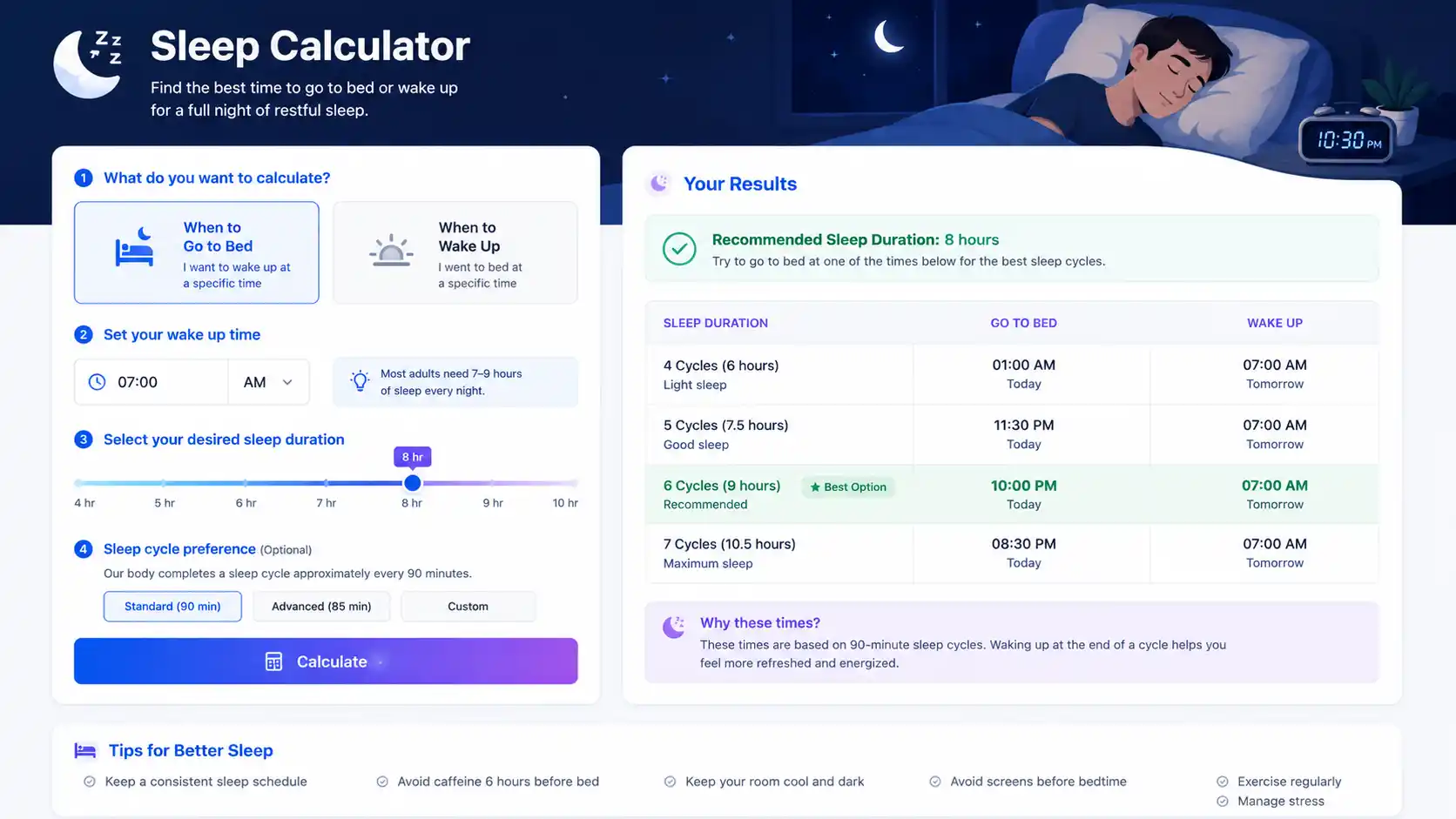
What Is a Sleep Calculator?
A sleep calculator is a tool that determines the optimal time to go to sleep or wake up based on your sleep cycles. Rather than simply counting hours in bed, a sleep calculator works backward — or forward — from a target wake time or bedtime to identify the moments when waking will feel most natural and least disruptive.
The difference between waking at the end of a sleep cycle versus in the middle of one is the difference between feeling alert and refreshed versus groggy, disoriented, and exhausted — even if the total hours slept are identical. This phenomenon, known as sleep inertia, is why an alarm interrupting deep sleep can leave you feeling worse than if you had slept two hours less but woken at a lighter stage.
Sleep calculators are used by millions of people worldwide who want to optimize their rest, manage shift work schedules, plan travel across time zones, reduce morning grogginess, or simply understand why they sometimes feel terrible after eight hours of sleep. The tool is straightforward; the science behind it is worth understanding deeply.
The Science of Sleep Cycles
To understand how a sleep calculator works, you first need to understand what happens during sleep. Human sleep is not a uniform, static state. It is an active, cyclical process composed of distinct stages that repeat throughout the night in predictable patterns.
The Four Stages of Sleep
Sleep is divided into two broad categories: Non-REM (NREM) sleep and REM (Rapid Eye Movement) sleep. A complete sleep cycle moves through four stages:
Stage 1 — NREM Light Sleep: The transition from wakefulness to sleep. Lasts 1–7 minutes. Muscles relax, heart rate slows, brain activity shifts from waking patterns to slower theta waves. Easy to wake from; if woken, many people feel they were not actually asleep.
Stage 2 — NREM Light Sleep: A deeper version of light sleep characterized by sleep spindles (bursts of brain activity) and K-complexes. Body temperature drops, eye movement stops, heart rate continues to slow. This stage accounts for roughly 45–55% of total sleep time in adults.
Stage 3 — NREM Deep Sleep (Slow-Wave Sleep): The most restorative stage. Brain activity slows to delta waves. This is when the body repairs tissue, builds muscle, strengthens the immune system, and consolidates memories. Growth hormone is primarily released during this stage. It is hardest to wake from — if roused, most people experience significant sleep inertia.
Stage 4 — REM Sleep: Brain activity surges to near-waking levels. Eyes move rapidly under closed eyelids. Most vivid dreaming occurs here. REM sleep is critical for emotional processing, creativity, learning consolidation, and cognitive performance. REM stages lengthen with each successive cycle throughout the night.
The Sleep Cycle Duration
One complete pass through all four stages — from Stage 1 NREM through Stage 2, Stage 3, and REM — constitutes one sleep cycle, lasting approximately 90 minutes on average, though individual cycles range from 80 to 110 minutes.
Most adults complete 4 to 6 sleep cycles per night. The composition of each cycle shifts across the night: early cycles contain more deep slow-wave sleep (Stage 3); later cycles contain more REM sleep. This is why cutting sleep short by even one cycle disproportionately reduces REM sleep — the stage most people cannot afford to lose for cognitive function and emotional regulation.
The Sleep Calculator Formula
The core formula behind every sleep calculator is built on the 90-minute cycle and a standard sleep onset latency — the time it typically takes a person to fall asleep after lying down.
Standard Sleep Onset Latency
Most sleep calculators use 14–15 minutes as the average time to fall asleep. This figure comes from clinical sleep research and represents the median sleep onset latency for adults without significant sleep disorders. Some calculators use 15 minutes for simplicity; others allow users to input their own latency.
Formula 1: What Time Should I Wake Up?
If you know when you want to go to bed:
Wake-Up Times = Bedtime + Sleep Onset Latency + (N × 90 minutes)
Where N = number of complete sleep cycles (recommended: 4, 5, or 6).
Example — Bedtime: 10:30 PM
Sleep onset: 10:30 PM + 15 min = 10:45 PM (asleep)

After 4 cycles: 10:45 PM + (4 × 90 min) = 10:45 PM + 360 min = 4:45 AM
After 5 cycles: 10:45 PM + (5 × 90 min) = 10:45 PM + 450 min = 6:15 AM
After 6 cycles: 10:45 PM + (6 × 90 min) = 10:45 PM + 540 min = 7:45 AM
Recommended wake times: 4:45 AM, 6:15 AM, or 7:45 AM
Formula 2: What Time Should I Go to Bed?
If you know when you must wake up:
Bedtimes = Wake-Up Time − Sleep Onset Latency − (N × 90 minutes)
Example — Must wake at 6:30 AM
After 6 cycles: 6:30 AM − 15 min − 540 min = 6:30 AM − 9 hr 15 min = 9:15 PM
After 5 cycles: 6:30 AM − 15 min − 450 min = 6:30 AM − 7 hr 45 min = 10:45 PM
After 4 cycles: 6:30 AM − 15 min − 360 min = 6:30 AM − 6 hr 15 min = 12:15 AM
Recommended bedtimes: 9:15 PM, 10:45 PM, or 12:15 AM
Sleep Calculator by Wake-Up Time: Reference Table
Using the standard 15-minute sleep onset latency and 90-minute cycles, here are optimal bedtimes for common morning wake-up targets:
| Wake-Up Time | 6 Cycles (9 hrs 15 min) | 5 Cycles (7 hrs 45 min) | 4 Cycles (6 hrs 15 min) |
|---|---|---|---|
| 5:00 AM | 7:45 PM | 9:15 PM | 10:45 PM |
| 5:30 AM | 8:15 PM | 9:45 PM | 11:15 PM |
| 6:00 AM | 8:45 PM | 10:15 PM | 11:45 PM |
| 6:30 AM | 9:15 PM | 10:45 PM | 12:15 AM |
| 7:00 AM | 9:45 PM | 11:15 PM | 12:45 AM |
| 7:30 AM | 10:15 PM | 11:45 PM | 1:15 AM |
| 8:00 AM | 10:45 PM | 12:15 AM | 1:45 AM |
| 8:30 AM | 11:15 PM | 12:45 AM | 2:15 AM |
| 9:00 AM | 11:45 PM | 1:15 AM | 2:45 AM |
Tip: 5 complete cycles (7 hours 45 minutes of actual sleep time) is the most commonly recommended target — it falls within the National Sleep Foundation’s 7–9 hour guideline for adults and aligns with the natural sleep architecture of most people.
How Many Hours of Sleep Do You Actually Need?
The “8 hours” rule is one of the most persistent and oversimplified pieces of health advice in circulation. Sleep needs are real, they vary by individual and age, and they are more nuanced than a single number suggests.
Sleep Recommendations by Age Group
| Age Group | Recommended Sleep | Notes |
|---|---|---|
| Newborns (0–3 months) | 14–17 hours | Multiple sleep periods |
| Infants (4–11 months) | 12–15 hours | Includes naps |
| Toddlers (1–2 years) | 11–14 hours | Includes naps |
| Preschoolers (3–5 years) | 10–13 hours | May include nap |
| School-age (6–13 years) | 9–11 hours | |
| Teenagers (14–17 years) | 8–10 hours | Circadian shift → later bedtimes |
| Young adults (18–25 years) | 7–9 hours | |
| Adults (26–64 years) | 7–9 hours | |
| Older adults (65+) | 7–8 hours | Sleep architecture changes with age |
Source: National Sleep Foundation 2015 consensus panel, updated with subsequent research.
Why Individual Sleep Needs Vary
Genetics plays a significant role in sleep need. Research from the University of California, San Francisco identified a rare mutation in the DEC2 gene that allows certain individuals to function optimally on 6 hours of sleep — but this affects fewer than 3% of the population. For the vast majority, chronic short sleep accumulates as sleep debt — a measurable cognitive and physiological deficit that cannot be fully repaid by a single long sleep.
Other factors that influence sleep need include physical activity level (athletes require more sleep for muscle repair), illness and recovery, mental health status, stress load, and age-related changes in sleep architecture.
Sleep Inertia: Why Waking at the Wrong Time Feels Terrible
Sleep inertia is the grogginess, disorientation, and cognitive impairment experienced immediately after waking. It is caused by waking during deep slow-wave sleep (Stage 3) when the brain is at its least alert and most difficult to rouse.
Sleep inertia typically lasts 15–60 minutes after an abrupt awakening from deep sleep, but research has documented impairment lasting up to 2–4 hours in some individuals — particularly those who are sleep-deprived. During this window, cognitive performance, reaction time, and decision-making ability can be worse than the equivalent of a 0.08% blood alcohol concentration.
This is why sleep calculators designed around cycle timing are more useful than simple “sleep 8 hours” advice. Waking at the end of a REM stage — when sleep is lightest — dramatically reduces sleep inertia, even if total sleep time is slightly shorter.
How to Minimize Sleep Inertia
- Use a sleep calculator to time your wake-up to the end of a cycle.
- Use a gradual light alarm or smart alarm that monitors movement and wakes you during a light sleep phase within a target window.
- Avoid napping longer than 20–30 minutes (a “power nap”) or longer than 90 minutes (a full cycle) — naps between 30–80 minutes are most likely to wake you from deep sleep.
- Get morning light exposure within 30 minutes of waking — it suppresses melatonin and accelerates the transition to full alertness.
Nap Calculator: How to Time a Nap Using Sleep Cycles
Sleep calculators are not only for nighttime sleep. Strategic napping — used by military personnel, elite athletes, NASA pilots, and productivity researchers — follows the same cycle logic.
Types of Naps by Duration
Power Nap (10–20 minutes): Stays in Stage 1 and Stage 2 NREM only. No deep sleep entered, so no sleep inertia. Provides immediate alertness boost and cognitive reset. Ideal for the post-lunch energy dip (1:00–3:00 PM).
Full Cycle Nap (90 minutes): Completes one full sleep cycle including REM. Provides memory consolidation, creativity boost, and emotional regulation benefits. Minimal sleep inertia if timed correctly. Best for shift workers, recovery from sleep deprivation, or creative work sessions.
The Nap to Avoid (30–80 minutes): Long enough to enter deep slow-wave sleep but too short to complete the cycle. Waking from Stage 3 produces significant sleep inertia. Unless you need deep sleep specifically (physical recovery, illness), this range is the most counterproductive nap length.
The Coffee Nap
A well-researched technique that combines caffeine with a 20-minute nap:
1. Drink a cup of coffee (≈100 mg caffeine).
2. Immediately lie down and nap for exactly 20 minutes.
3. Wake when the nap ends — caffeine's peak effect arrives just as the nap concludes.
Caffeine takes approximately 20–30 minutes to peak in the bloodstream after consumption. By timing the nap to match, you wake from light sleep precisely as the caffeine is reaching maximum effect — producing alertness greater than either caffeine or the nap alone. Studies published in journals including Psychophysiology and Sleep have validated the coffee nap’s effectiveness over either intervention independently.
Circadian Rhythm and Sleep Timing
A sleep calculator works best when its outputs are aligned with your natural circadian rhythm — the body’s internal 24-hour biological clock that governs sleep-wake cycles, body temperature, hormone release, and metabolism.
The circadian rhythm is primarily set by light exposure, particularly morning sunlight. The suprachiasmatic nucleus (SCN) in the hypothalamus receives light signals from the retina and synchronizes the body clock accordingly, triggering melatonin suppression in the morning and melatonin release in the evening.
Chronotypes: Not Everyone Is the Same
Chronotype refers to an individual’s natural preference for sleep and wake times. Research by sleep scientist Dr. Matthew Walker and chronobiologist Dr. Till Roenneberg identifies a spectrum of chronotypes:
- Morning types (“larks”): Naturally sleep and wake earlier. Peak cognitive performance in the morning. Approximately 25–30% of the population.
- Evening types (“owls”): Naturally sleep and wake later. Peak cognitive performance in the late afternoon and evening. Approximately 25–30% of the population.
- Intermediate types: The majority of people (40–50%) fall between the two extremes.
A sleep calculator that ignores chronotype may recommend a 10:00 PM bedtime to a confirmed evening type whose circadian rhythm is not ready for sleep until midnight — producing extended sleep onset latency, lighter sleep, and an inaccurate cycle calculation.
The most accurate sleep calculators allow users to input their chronotype or natural sleep window, adjusting recommendations accordingly.
Sleep Calculator for Shift Workers
Shift workers — nurses, police officers, factory workers, pilots, emergency responders — face unique challenges that standard sleep calculators don’t fully address. Rotating shifts continuously disrupt circadian alignment, making it one of the most well-documented occupational health hazards.
For shift workers, the sleep calculator logic remains valid — 90-minute cycles, 15-minute sleep onset latency — but the application differs:
Day shift (6:00 AM – 2:00 PM): Target sleep window approximately 9:30 PM – 5:45 AM (ideally 5 cycles). Sleep onset latency may be shorter due to natural circadian alignment.
Evening shift (2:00 PM – 10:00 PM): Target sleep window approximately 12:00 AM – 8:15 AM. Consider blackout curtains to prevent morning light from disrupting later-cycle REM sleep.
Night shift (10:00 PM – 6:00 AM): Target daytime sleep window approximately 7:30 AM – 3:45 PM. Wear blue-light blocking glasses after the shift ends to prevent morning light from suppressing melatonin. Use blackout curtains and white noise. This is the most physiologically disruptive shift and requires the most disciplined sleep hygiene to manage.
Common Sleep Calculator Mistakes and Misconceptions
Mistake 1: Treating 90 minutes as a fixed rule. Sleep cycles average 90 minutes but range from 80–110 minutes across individuals and across the night. If you consistently wake groggy despite cycle-aligned timing, try adjusting your assumed cycle length to 85 or 95 minutes and observe the difference over several days.
Mistake 2: Ignoring sleep onset latency. A calculator that simply adds 90-minute multiples to your bedtime, without accounting for the 14–15 minutes it takes to fall asleep, will produce wake times 15 minutes too early. Across five cycles, this puts you in the wrong sleep stage.
Mistake 3: Assuming more cycles are always better. Six cycles (approximately 9 hours) is appropriate during recovery from illness, intense physical training, or significant sleep debt. For most healthy adults on a regular schedule, five cycles (approximately 7 hours 45 minutes) is both sufficient and easier to maintain consistently.
Mistake 4: Using a sleep calculator without consistent sleep timing. Sleep calculators optimize within a given night, but the deeper gains come from regularity. Going to bed and waking at consistent times strengthens circadian alignment, reduces sleep onset latency, and improves sleep architecture over time — making cycle timing more predictable and accurate.
Mistake 5: Confusing time in bed with time asleep. A sleep calculator calculates time asleep — from sleep onset to final wake. If you spend 30 minutes on your phone in bed before attempting sleep, the calculator’s recommended bedtime shifts 30 minutes earlier.
Frequently Asked Questions
How does a sleep calculator work?
A sleep calculator determines optimal sleep or wake times by accounting for the average 90-minute sleep cycle and a 15-minute sleep onset latency. It identifies the times at which waking will coincide with the end of a REM cycle — when sleep is lightest — minimizing grogginess.
How many sleep cycles do I need per night?
Most adults need 4–6 complete sleep cycles (6–9 hours of sleep). Five cycles — approximately 7 hours and 45 minutes — is the most commonly recommended target, aligning with the National Sleep Foundation’s 7–9 hour guideline.
What time should I go to sleep to wake up at 6:00 AM?
To wake at 6:00 AM after 5 complete cycles, you should be asleep by 10:15 PM — meaning you should lie down by 10:00 PM to account for the 15-minute sleep onset period.
Why do I feel more tired after 8 hours than 7.5 hours?
You likely woke during a deep sleep stage (Stage 3) rather than at the end of a REM cycle. 7.5 hours corresponds to exactly 5 complete 90-minute cycles from sleep onset — a natural cycle boundary — while 8 hours may fall mid-cycle.
What is a good sleep cycle length to use in a calculator?
The standard is 90 minutes, which is accurate for most adults. If you consistently feel cycle-aligned wake times are off for you, experiment with 85 or 95 minutes over a week to find your individual cycle length.
Does the sleep calculator account for REM sleep?
Indirectly — yes. The 90-minute cycle includes all sleep stages, with REM occurring at the end of each cycle. Waking at the end of a cycle means waking after REM, which is the lightest sleep stage and the ideal waking point.
Is 6 hours of sleep enough?
For the vast majority of adults, 6 hours is insufficient for optimal health and cognitive performance. Research from the University of Pennsylvania found that sustained 6-hour sleep (4 cycles) produces cognitive deficits equivalent to 2 full nights of sleep deprivation — with subjects unaware of their own impairment.
Can a sleep calculator help with jet lag?
Partially. A sleep calculator helps you align sleep timing with your destination time zone, but jet lag also involves circadian desynchrony that takes 1 day per time zone hour to fully resolve. Light exposure management, strategic melatonin use, and gradual pre-travel schedule shifting are the most effective jet lag interventions.
Conclusion
A sleep calculator takes what seems like a simple question — “when should I sleep?” — and answers it with the precision the biology of sleep actually demands. By aligning wake times with natural cycle boundaries, accounting for the time it takes to fall asleep, and adapting recommendations to individual chronotype and life circumstances, a good sleep calculator transforms sleep from a passive activity into a deliberately optimized one.
The formula is consistent: add 15 minutes for sleep onset, then count forward or backward in 90-minute increments. The application, however, is deeply personal — shaped by your chronotype, age, health, schedule, and the cumulative weight of the sleep debt you carry or have repaid. Use the numbers as a starting point, observe how you feel over several days of consistent timing, and refine from there.
Sleep is the single most powerful performance-enhancing and health-protective behavior available to human beings. A sleep calculator is simply the tool that helps you take it seriously.